Air compressor lines for stationary air compressor.

   / Air compressor lines for stationary air compressor. #21  
To help cool the hot vapors from the tank into larger and cooler droplets that the water filter can remove, I coiled a 25' long, half inch I.D. hose on the cool concrete floor between the tank outlet and the regulator/filter inlet. That works for me, but I don't paint. My regulator/filter is a RapidAir with a ¾" inlet and a 5 micron filter.

I also have an auto-drain on the 60 gallon tank that I have set to blow the condensate out for 3 seconds every 6 hours.

When I mow the yard on the most humid days in August, I get dry air from the hose while blowing all the grass chaff off of me.

Before this setup, I could get enough moisture out of the blowgun to make my shirt feel wet after blowing off the grass.
 
Last edited:
   / Air compressor lines for stationary air compressor. #22  
Hydraulic lines are prety cheap with Npt fittings. I have had a 3/4in hyd hose running off my air compressor for at least a decade.
 
   / Air compressor lines for stationary air compressor. #23  
However, water vapor can travel through any water trap, or water filter.
...
You have two options: A refrigerated drier. Or, a desiccant drier.
"Dry" is a relative term. How dry one really needs is dictated by usage, the guy just running impact wrenches or even spraying the occasional alkyd-based enamel doesn't need nearly the same level of "dry" as one spraying linear polyurethane or epoxy paints with isocyanate-based hardeners.

I have done both, and would argue that a refrigerated dryer or desiccant dryer are total overkill for the majority of the people reading this forum. These are the tools used by the amateur body shop guy, who really does need to spray some very moisture-senstive paints (again, isocyanate), not those running typical air tools for fixing tractors or even 1-part enamels.

Hydraulic lines are prety cheap with Npt fittings. I have had a 3/4in hyd hose running off my air compressor for at least a decade.
Same. I don't understand the aversion to rubber hose, if it's rated accordingly. In fact, I always use a rubber hose to connect every compressor I've ever owned to the hard-plumbed system. I see at least a few good reasons to do this.
 
   / Air compressor lines for stationary air compressor. #24  
"Dry" is a relative term.
Air is either clean, and dry, and you don't have to think about it.

Or, you can fool around, and find out later if it was.

I realize that some people are not concerned about it. That's up to them.
 
   / Air compressor lines for stationary air compressor. #25  
Air is either clean, and dry, and you don't have to think about it.

Or, you can fool around, and find out later if it was.

I realize that some people are not concerned about it. That's up to them.
"Better" is the mortal enemy of "good enough".
 
   / Air compressor lines for stationary air compressor. #26  
Air is either clean, and dry, and you don't have to think about it.

Or, you can fool around, and find out later if it was.

I realize that some people are not concerned about it. That's up to them.
When you don't understand requirements, exceeding them is always a safe bet, but also always a waste of money and effort.

You don't need an ISO 8573 Class I air dryer on a system used solely for driving power tools, but if you have time and money to waste, it won't hurt.
 
   / Air compressor lines for stationary air compressor. #27  
When you don't understand requirements, exceeding them is always a safe bet, but also always a waste of money and effort.

You don't need an ISO 8573 Class I air dryer on a system used solely for driving power tools, but if you have time and money to waste, it won't hurt.

What he does should only be based on his intentions, his budget, the environment he is working in, and the humidity there.

I did not only suggest a drier. But, one may be necessary.
 
   / Air compressor lines for stationary air compressor.
  • Thread Starter
#28  
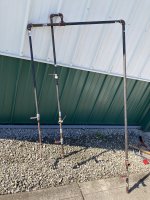
I'm the OP on this and here is what I just took down in my barn because I'm having it insulated. It's iron pipe, I put it in 20 years ago and have no idea where I got the plans. It's worked fine for me.

IMG_5834.jpeg

The hose off the connector went into the long pipe on the right that was also a drain. The down pipe on the left is also a drain pipe. The center pipe had a filter and moisture remover and my output hose connected there. This worked well for me. I drained my tank and filter every day when I used it and no problems.

My plan was to ditch this and replace with something new and easy to install but now I'm wondering if I should just put this back up with a new filter and moisture remover and call it good.


These days I just use the compressor to pump up tires and blow off equipment. I paint a few pieces of ag equipment a year and use OEM acrylic enamel paint. I only paint on dry summer days when the temps are right. It's low humidity here and I rarely use the compressor in the winter.

After all the comments, do you think I should leave well enough alone?
 
   / Air compressor lines for stationary air compressor. #29  
Install the auto drain I linked above, and you'll never have that problem, again.
I’ve been running a Dayton auto drain since 1995 and every 5 years the state comes out to inspect without issue…
 
   / Air compressor lines for stationary air compressor. #30  
I'm the OP on this and here is what I just took down in my barn because I'm having it insulated. It's iron pipe, I put it in 20 years ago and have no idea where I got the plans. It's worked fine for me.

View attachment 3281188

The hose off the connector went into the long pipe on the right that was also a drain. The down pipe on the left is also a drain pipe. The center pipe had a filter and moisture remover and my output hose connected there. This worked well for me. I drained my tank and filter every day when I used it and no problems.

My plan was to ditch this and replace with something new and easy to install but now I'm wondering if I should just put this back up with a new filter and moisture remover and call it good.


These days I just use the compressor to pump up tires and blow off equipment. I paint a few pieces of ag equipment a year and use OEM acrylic enamel paint. I only paint on dry summer days when the temps are right. It's low humidity here and I rarely use the compressor in the winter.

After all the comments, do you think I should leave well enough alone?
@sixdogs Yes, I think you should leave well enough alone. That's a fine design. If the inside of the pipes look ok, I would reuse it if it were me. If I were feeling full of beans and wanted a project, I might redo it in copper not to have rust in the compressed air, but since that hasn't been a problem for you, I probably would not even do that.

Small soap box for others:
A few folks with safe experiences notwithstanding, PVC compressed air lines are known to be unsafe due to rapid and catastrophic failure modes. PVC manufacturers do not support it, neither does ASME, nor OSHA. The OSHA ban dates from 1988. This should not be news. If you have a business with PVC/CPVC compressed air lines, that is an OSHA violation, and if an accident happens, I would expect an insurer not to cover the damages.

PVC can be weakened by impact, solvent exposure, age, temperature, and strain, and when it shatters, the shards can be razor sharp. At 110F, the pressure rating is half that at room temperature, and at 140F, it is one fifth of the room temperature rating. Temperature and Pressure Ratings of PVC

If you have PVC/CPVC pipe for your compressed air system, please do yourself and those around you a favor and replace it.


ASME does permit polyethylene pipe under less than 100psi for underground gas service, and never above ground unless enclosed in a cover that could absorb the explosion.

End of soapbox.

Stay safe out there folks.

All the best,

Peter
 
   / Air compressor lines for stationary air compressor. #31  
I'm the OP on this and here is what I just took down in my barn because I'm having it insulated. It's iron pipe, I put it in 20 years ago and have no idea where I got the plans. It's worked fine for me.

View attachment 3281188

The hose off the connector went into the long pipe on the right that was also a drain. The down pipe on the left is also a drain pipe. The center pipe had a filter and moisture remover and my output hose connected there. This worked well for me. I drained my tank and filter every day when I used it and no problems.

My plan was to ditch this and replace with something new and easy to install but now I'm wondering if I should just put this back up with a new filter and moisture remover and call it good.


These days I just use the compressor to pump up tires and blow off equipment. I paint a few pieces of ag equipment a year and use OEM acrylic enamel paint. I only paint on dry summer days when the temps are right. It's low humidity here and I rarely use the compressor in the winter.

After all the comments, do you think I should leave well enough alone?
Looks like a perfectly useable setup, to me. Why fix what ain’t broken?
 
   / Air compressor lines for stationary air compressor. #32  
Just a comment regarding rubber hose.

I like to put a short whip on all my air powered hand tools, and I have a bunch from my aviation days.

Automotive fuel injection hose is by far the BEST when it comes to flexibility, durability and longevity. I even have a 20 foot length that is nearly always on the main hose. I NEVER have to fight that hose to maneuver the tool in my hand. (Spendy though $$)
The only draw back is the inside diameter. There are applications where there is just not enough air passes through.
Like trying to seat a bead on a new tire installation.
 
   / Air compressor lines for stationary air compressor. #33  
I put a 30" whip on the business end of my primary air hose. It takes a beating and gets replaced every year or three, protecting the main hose from all that "at the tool" wear and tear.

Most of my tools have the fitting right on the handle, but I do use a flexible hose whip on air hammers and jack hammers, as putting the fitting right on the tool tends to cause fitting failures due to constant vibration. It might actually be a good idea to do the same with needle scalers, although I've honestly never bothered.
 
   / Air compressor lines for stationary air compressor.
  • Thread Starter
#34  
Good point on connections. Where do you buy quality connections?
 
   / Air compressor lines for stationary air compressor. #35  
Good point on connections. Where do you buy quality connections?
As in quick couplers? I usually just pick up extras at Tractor Supply or McMaster-Carr, whenever I'm passing thru or ordering something. Keep at least one spare in each size and type you use.

I tend to use the the M-type in 1/4" and Automotive type in 3/8", as they're the easiest to find and replace, in a pinch.

As to "quality", I just buy the all-brass variants in whatever brand is at hand. These things tend to last many years, and their ultimate failure is usually more related to usage than build quality, so this is not an area where I'd waste much time finding the "best quality" alternative. I like the brass ones because they feel better in my hand and are less abusive to my epoxy-coated floor. Also, if you don't have a good separator/dryer upstream of your quick-disconnects, the steel ones will tend to rust a bit from the inside, after a few years.
 
   / Air compressor lines for stationary air compressor. #36  
I used hydraulic hose to connect my compressor to my black pipe lines, T traps and regulator/oilers at each drop.

My neighbour works on classic cars. He used 3/4" copper pipe to plumb his shop. He says it helps keeps the moisture down as it condenses on the copper tubing and his air filter/cleaner takes out the rest for painting.
 
   / Air compressor lines for stationary air compressor. #37  
I used a 2-foot length of 300 psi air hose, in the 3/4" size, to connect my compressor to my all-copper hard-plumbed system:

 
   / Air compressor lines for stationary air compressor. #38  
My plan was to ditch this and replace with something new and easy to install but now I'm wondering if I should just put this back up with a new filter and moisture remover and call it good.

These days I just use the compressor to pump up tires and blow off equipment. I paint a few pieces of ag equipment a year and use OEM acrylic enamel paint. I only paint on dry summer days when the temps are right. It's low humidity here and I rarely use the compressor in the winter.

After all the comments, do you think I should leave well enough alone?
I'd just put it back up, modified as needed and with an updated filter/moisture trap. Save the extra $.
 
   / Air compressor lines for stationary air compressor.
  • Thread Starter
#39  
I used a 2-foot length of 300 psi air hose, in the 3/4" size, to connect my compressor to my all-copper hard-plumbed system:


Fo my connector hose I think I used a 3 ft piece of tractor hydraulic hose. 3,000 or 5,000 psi. Plan to get a new one like that. OK?
 
   / Air compressor lines for stationary air compressor. #40  
So long as you isolate the compressor(s) from your hard lines, all is good. In my case I use a braided stainless flex hose between the compressors and the hard lines and between the hard lines and the receivers.

I looked at the cheapo Chinese timed moisture drains as well, but I prefer domestic made if at all possible so I went with the Suburban Manufacturing timed drain from Compressors Direct. It cost more but it's also made here in America and being patriotic whenever possible, I bought the American made unit. Looks like the Chinses / Amazon unit but made here. I bet the Chinese bought one and copied it.
 

Marketplace Items

2016 Yanmar VIO25 (A60462)
2016 Yanmar VIO25...
Neckover GL24-2-7K Gooseneck Trailer  24ft Deck, Dual 7K Axles, 14K GVWR (A61307)
Neckover GL24-2-7K...
2010 Honda Accord Sedan (A59231)
2010 Honda Accord...
Case 1083 20ft Corn Head (A61307)
Case 1083 20ft...
2018 JOHN DEERE 844K-III AG HANDLER WHEEL LOADER (A60429)
2018 JOHN DEERE...
2023 Chevrolet Tahoe SUV (A59231)
2023 Chevrolet...
 
Top