Advice regarding my flail mower

   / Advice regarding my flail mower #1  

dochockin

Member
Joined
Nov 20, 2013
Messages
29
Location
Merville, BC
Tractor
Kubota B2920
I've just started using my flail mower to mow my pasture and it's not working how I anticipated it would. Perhaps you can help me improve my results or at least help me realize I was expecting too much...

I have 3.5 acres of pasture, PNW climate. It grows fast from April to July: grasses, yarrow, buttercup, daisies, plantain, thistle. It rains here until mid June to early July, so the pasture is wet and lush until late July. Parts of the ground are too muddy for to drive across until early June, though every year is different, of course.

I have a 29 HP Kubota, and a 48" Chinese flail mower (Value Leader) with 20 'hammer' mulching blades. The flail mower rotates opposite the direction of the Tractor tires. I've been cutting at a pretty slow speed... far slower than a walking pace.

When I installed the mulching blades, I pointed the 'scooped' side in the direction of the rotation of the flail mower. I assume this is correct? The rear roller on the flail mower is in the middle of three possible settings (it could be set with either a wider or narrower opening.

My pasture's growth is about just under 3' high on average at this point. I tried a couple of test strips last week, and it worked great! However, it left behind a carpet of fairly large pieces of mulched vegetation. These have essentially blanketed the remaining grasses and seem to be creating a 'sheet mulch' effect as they dry, killing off the plants underneath.

I expected a finer particulate of mulch that would settle to the soil more, leaving the remaining plants exposed to the sun. I'm worried that the grasses under the 'mulch blanket' will die off as if they were 'solarized' under plastic sheeting.

What can I do to improve my results? Should I harrow the mulch? Should I alter the roller/housing gap? Should I go slower? Are the blades backwards? Should I cut the grasses earlier?

Any advice or tips would be 'mulch' appreciated!

 
   / Advice regarding my flail mower #2  
3' tall?
How many passes, or were you hoping for perfection in a single pass?
Shoot us some pics, please.

David Sent from my iPad Air using TractorByNet
 
   / Advice regarding my flail mower #3  
If cutting 3' tall grass you will need to bale and remove it to allow the grass beneath a fighting chance. The blanket is normal when cutting thick grass that tall. The alternative to bailing would be to keep cutting it short until you (in time) have a healthy stand of grass.
 
   / Advice regarding my flail mower #4  
If you have a bad blanket of grass mow over it 3+ times to mulch it up. A more economical way would be to mow more often preventing the grass from getting so tall, this would prevent the grass blanket.
 
   / Advice regarding my flail mower #5  
I have the 68" wide Value Leader flail mower. I replace the two-piece blades with Vrismo scoop blades oriented as yours are. I've never tried to mow 3 ft tall pasture grass--about 18" tall is my limit. I noticed a similar effect with the cuttings.

This spring I sharpened the blades on my 6 ft wide brush hog rather than continuing to mess around with the flail. The edge radius now is similar to what's on my riding mower. The hog with those sharpened blades gives me the cut I want--2-3" height, minimal problem with mulch.

Good luck
 
   / Advice regarding my flail mower #6  
A properly designed, operated, and maintained flail should not leave behind the "blanket" such as you describe. The residue should be pretty much shredded and scattered. The fault is either with the mower or the operator.
1. when looking at the mower from the front - you should see the cutting edges of the knives.
2. PTO horsepower must be adequate for both the swath and the material being flailed.
3. you must operate the tractor PTO at the specified 540 rpm.
4. the mower must be operated with the rear shroud in place for full shredding to occur before the residue departs the mower housing.
5. ground speed must adjusted relative to the material being flailed.
If these minimum essentials are satisfied, then there's an apparent underlying fault with the Value Leader design.

Don't know the horsepower of the 2nd tractor, but 29hp geared tractors generally have no more than 25 hp at the PTO. 29hp hydrostats generally have even less. I suspect the OP may simply not have enough horsepower to keep the PTO steady at 540 rpm when attempting to flail 36" material

//greg//
 
   / Advice regarding my flail mower #7  
I have the 68" wide Value Leader flail mower. I replace the two-piece blades with Vrismo scoop blades oriented as yours are. I've never tried to mow 3 ft tall pasture grass--about 18" tall is my limit. I noticed a similar effect with the cuttings. This spring I sharpened the blades on my 6 ft wide brush hog rather than continuing to mess around with the flail. The edge radius now is similar to what's on my riding mower. The hog with those sharpened blades gives me the cut I want--2-3" height, minimal problem with mulch. Good luck

I'm told by Vrisimo that the scoop knives are designed for maintained grass and will out perform side slicers when used in that application. In seldom cut taller grass the side slicer knives have the cut quality advantage. I'm also using a Vrisimo unit with scoop knives and the cut is equal to a finish mower. It provides a smooth and even cut with no blanket.
 
   / Advice regarding my flail mower #8  
A bit off topic, but I'd like some info on using the scoop knives on the Value Leader, part number, where to buy, etc.

As for topic at hand. I think it's important when comparing a flail to rotary to compare in same situation. I used a rotary for years before getting my flail and it surely didn't leave a clean job on a tall growth or even first cut. Shoot, even our scag ZTR leaves behind a mess if the grass is too tall.

David Sent from my iPad Air using TractorByNet
 
   / Advice regarding my flail mower #9  
A bit off topic, but I'd like some info on using the scoop knives on the Value Leader, part number, where to buy, etc.

As for topic at hand. I think it's important when comparing a flail to rotary to compare in same situation. I used a rotary for years before getting my flail and it surely didn't leave a clean job on a tall growth or even first cut. Shoot, even our scag ZTR leaves behind a mess if the grass is too tall.


David Sent from my iPad Air using TractorByNet

Flailmaster.com. Part #V-CD2110. $1.87 each. Set up for 7/16" bolt. You need to grind the corners of the knife a small amount to remove the interferences with the drum, so the knife swings freely.
 
   / Advice regarding my flail mower
  • Thread Starter
#10  
I appreciate the responses. I'm not worried about the cleanliness of the cut, it's pasture so a rough cut is fine. My perfect cut would be keeping the pasture healthy, fairly short, no invading shrubs...

My research and reading led me to believe that a flail mower would (even on a smaller tractor, given low speeds) reduce pasture grass and weeds to a fine shredded mulch... and so far that's not the case. I'm hoping to mimic the effects of 'mob browsing', for soil building, as per the joel salatin/alan savoury concept. Keeping big grass eating animals is not really an option.

I'm using 3' as a rough estimate, not all the grass is quite that high, but it's close enough (~31") to not matter much. I'm hoping for some advice on how to rectify and ameliorate the situation as is... Buying a whole new tractor/implement is not feasible.

Next year I'll try and get out cutting earlier in the season, but that doesn't help right now, so...

What adjustments to mower set up or cutting height might help? Would it be wise to make a pass with the mower raised up off the ground, or would that stress the 3 PH too much? Would a higher blade height help (by lowering the rear roller)? Would using the drag harrow afterwards help (how soon? less or more aggressive harrow orientation?)? I have the shroud in place, but it is adjustable; would a smaller or larger opening be better?

Any suggestions would be awesome. I can experiment on my own, but if someone has tips or ideas I'd rather streamline my experimentation (and not wreck my equipment).
 
   / Advice regarding my flail mower #11  
The only way and I mean the only way you are going to solve this is simply take half cuts with the flail mower on the ground NOT elevated. You can mow when the grass is dormantdead for winter before the snow flies too and that would help a lot
 
   / Advice regarding my flail mower #12  
If you want the flail mower to shread the grass more, then lower the rear of the flail to about 1 inch higher than the front. If you just want to snip it off and not shread it, the raise the rear of the mower and it will spit out all the grass before it grinds it up. It takes a LOT more HP to run the rear lower, because you are recutting all that grass a few times before it gets spit out.
 
   / Advice regarding my flail mower #13  
Just for comparison.
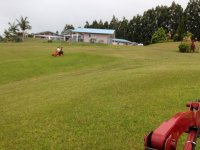
Wife and I mowed today. As you can see in 1st pic this pasture is only about 6 inches tall, not really very thick. I'm not going to say which areas were mowed by my value Leader flail with Y knives and which areas were with the scag ZTR. You can see the uncut areas.


image-2668762449.jpg

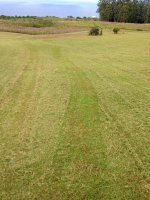
2nd is where we met up - done

image-805170691.jpg

Soooo, discernable difference?

David Sent from my iPad Air using TractorByNet
 
   / Advice regarding my flail mower #14  
Flailmaster.com. Part #V-CD2110. $1.87 each. Set up for 7/16" bolt. You need to grind the corners of the knife a small amount to remove the interferences with the drum, so the knife swings freely.

Thanks

David Sent from my iPad Air using TractorByNet
 
   / Advice regarding my flail mower #15  
My pasture's growth is about just under 3' high on average at this point. I tried a couple of test strips last week, and it worked great! However, it left behind a carpet of fairly large pieces of mulched vegetation. These have essentially blanketed the remaining grasses and seem to be creating a 'sheet mulch' effect as they dry, killing off the plants underneath.

I fought this same problem on similar sized pasture I bought 9 years ago. Today it looks likes parkland instead of a pasture. I realize the problems of trying to mow over wet ground, but grasses that are allowed to grow too tall present problems if the cuttings aren't removed or further ground up with subsequent cuttings immediately following the initial cut. I initially went with multi-cutting in the beginning but have since discarded that method in favor of more frequent and earlier cuts.

One of the benefits of early cutting, at least for my land, is when I do the first cutting at around 10" I'm able to keep more of the grasses at the 'leaf' stage as opposed to leaving just stalks after the cut. I also eliminate the over-burden of hay that kills the grasses below. And my field over time is now growing the kinds of grasses I prefer instead of the weeds and weed grasses that made up a good portion of the field before.

Additionally, cutting the field at a height where the grasses are still leaf at the cutting level instead of stalk keeps the field healthier in my view. And overall, I actually save time, fuel, and wear on the tractor when I cut it every 18 to 20 days instead of the 30 day cycle I used for a few years.

If you are leaving the field tall at the end of the season you will have to deal with the mass of the grass (e.g. volume and weight) at the beginning of the new season in the spring. If that is the case I would try cutting the field short at the end of the season so you eliminate some of the potential problems with too much hay after the first cut in the spring. But all-in-all, if you're not baling the hay I would suggest you try keep the field in 'blades' vs 'stalks' and that way the grasses have a much better chance of staying healthy and not dying due to lack of leaf for sunlight absorption, as well as the crushing/blanketing effects of hay over-burden.
 
   / Advice regarding my flail mower #16  
I just rotated the cuttershaft on my MOTT88 to rotate opposite of the tire rotation in an attempt to get a finer cut, that was a mistake, it works ok with short grass but will not cut grass that has any height to it, problem is, it piles the cut grass back in front of the cutter and overwhelms the blades. It didn't matter how slow I was going. Before I use it again I will go through all the trouble again and swap it back. Tough lesson learned,LOL
 
   / Advice regarding my flail mower #17  
I've just started using my flail mower to mow my pasture and it's not working how I anticipated it would. Perhaps you can help me improve my results or at least help me realize I was expecting too much...

I have 3.5 acres of pasture, PNW climate. It grows fast from April to July: grasses, yarrow, buttercup, daisies, plantain, thistle. It rains here until mid June to early July, so the pasture is wet and lush until late July. Parts of the ground are too muddy for to drive across until early June, though every year is different, of course.

I have a 29 HP Kubota, and a 48" Chinese flail mower (Value Leader) with 20 'hammer' mulching blades. The flail mower rotates opposite the direction of the Tractor tires. I've been cutting at a pretty slow speed... far slower than a walking pace.

When I installed the mulching blades, I pointed the 'scooped' side in the direction of the rotation of the flail mower. I assume this is correct? The rear roller on the flail mower is in the middle of three possible settings (it could be set with either a wider or narrower opening.

My pasture's growth is about just under 3' high on average at this point. I tried a couple of test strips last week, and it worked great! However, it left behind a carpet of fairly large pieces of mulched vegetation. These have essentially blanketed the remaining grasses and seem to be creating a 'sheet mulch' effect as they dry, killing off the plants underneath.

I expected a finer particulate of mulch that would settle to the soil more, leaving the remaining plants exposed to the sun. I'm worried that the grasses under the 'mulch blanket' will die off as if they were 'solarized' under plastic sheeting.

What can I do to improve my results? Should I harrow the mulch? Should I alter the roller/housing gap? Should I go slower? Are the blades backwards? Should I cut the grasses earlier?

Any advice or tips would be 'mulch' appreciated!


You are going to have the carpet of cuttings with a flail with 3 foot tall grass. You will have ugly windrowed cuttings with a rotary cutter. Either will smother the grass underneath and 3 foot tall material is too tall to expect a nice clean finish. The solution to this problem is to mow one day, let it dry a day or two or three then mow again. The flail will shred the dry cuttings. Don't wait to long to cut the cuttings. Then you need to keep it mowed to a reasonable height after that as best you can with your weather conditions.

I cut a place that has johnson grass that gets about 30 inches between mowings along with some burmuda that gets about 12 to 18 inches. It doesn't look good after I mow it but the customer doesn't want to pay for more frequent mowings. However, the same customer has another place that I cut every 10 days or so. It is beautiful. I cut my lawn with my flail it cuts so well. There are pictures here somewhere of that.

Ok I found one of my picture showing a bit of what I mow. It's post #10

http://www.tractorbynet.com/forums/...ain-top-link-flail-mower.html?highlight=flail
 
Last edited:
 

Tractor & Equipment Auctions

2014 Freightliner Bucket Truck (A56438)
2014 Freightliner...
Electric Golf Cart (A56859)
Electric Golf Cart...
2019 Dodge Charger Sedan (A59231)
2019 Dodge Charger...
2025 MACK GRANITE GR64F DUMP TRUCK (A59823)
2025 MACK GRANITE...
2013 CATERPILLAR 950K WHEEL LOADER (A60429)
2013 CATERPILLAR...
gps trailers (A56859)
 
Top