A home made tool

   / A home made tool #21  
Good idea KC, the only way I could screw that up is if my QC were to bind somehow and the tool would continue to force it together.
Might mess up the retainer balls, what ya think ?
 
   / A home made tool
  • Thread Starter
#22  
John, I will see what I can do tomorrow. Ok?

Will, I don't think that you would mess up the retainer balls if a you use common since in putting the coupler together.
 
   / A home made tool #23  
John, I will see what I can do tomorrow. Ok?

Will, I don't think that you would mess up the retainer balls if a you use common since in putting the coupler together.
I think the tool you made will serve your purpose well.

That is some nice tools in your photobucket.

* I think everyone knows how to relieve the pressure on hoses, or should know having equipment around.*


Bird,

I'm new to hydraulic couplings and have struggled with mine. I think this tool is just what I need, but in reading your reply, I realized that I didn't know this,

Eddie

:confused::confused:
 
   / A home made tool #25  
KC the gas engine, did you use plans, how long to build it,
 
   / A home made tool
  • Thread Starter
#26  
laurencen, I am sorry I am not sure what you are referring to when you mention the gas engine. If it is that green and orange thing that is a two cylinder steam engine, the other one is john deer green and yellow and that is a model hit and miss engine that was serialized in the Home Shop Machinist back in the late 1980s.
 
   / A home made tool
  • Thread Starter
#27  
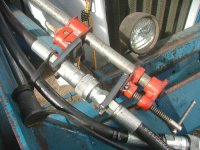
John, here is the tool in place. Man, with a arm like that you sure could use a tool that would help put those couplings together.

Sorry I forgot the pictures.
 
   / A home made tool
  • Thread Starter
#28  
Here they are. The second pic I have a little squeeze on the coupling.
 

Attachments

  • 2003_0107Image0001.JPG
    2003_0107Image0001.JPG
    79.7 KB · Views: 390
  • 2003_0107Image0003.JPG
    2003_0107Image0003.JPG
    70.5 KB · Views: 384
   / A home made tool #29  
Bird,

I'm new to hydraulic couplings and have struggled with mine. I think this tool is just what I need, but in reading your reply, I realized that I didn't know this, nor have I tried it. I usually cracked the hose connections to release the pressure.

With Spring here, I'll be putting my grapple on pretty soon and will try your method first. If that doesn't work, I'm gonna make me a tool with one of my pipe clamps.

Eddie

Eddie, the times I had to do it on my Kubota FEL, and my neighbor's hay equipment, it was always quick and easy and just almost no loss of fluid. I never loosened the hose connections, and I think I learned that little trick here on TBN, but can't remember who posted those instructions first.
 
   / A home made tool #31  
hi KC its the hit and miss engine, what scale and do you run it
 
   / A home made tool
  • Thread Starter
#32  
laurencen, I don't believe that there was a scale for the engine. It was machined from bar stock no casting at all. I had the thing fire a couple of time and it would never run any more. I never figured out why so now it sits on the shelf and gathers dust.

A friend is building one from a kit and when he gets his done maybe I will get with him and work on this one and get it running.
 
   / A home made tool #33  
KC:

Many thanks for the clamp idea. I am going to make one this weekend.

The "quick attach" (ha ha) backhoe on my JD 455 crawler has 1" quick disconnects that can be connected only after the backhoe is almost completely in position to be pinned to the crawler. So the disconnects are down in a hole and it is impossible to push on them very hard. I will need to make it a bit more compact than yours (I should not need the adjustable length) to get it in place, but I think it will work very well.

Thanks again for the idea.

That's beautiful work in your shop. The steam engine seems pretty powerful for the size boat it is in. How fast does it go?
 
   / A home made tool #34  
Bird,

I'm new to hydraulic couplings and have struggled with mine. I think this tool is just what I need, but in reading your reply, I realized that I didn't know this, nor have I tried it. I usually cracked the hose connections to release the pressure.

With Spring here, I'll be putting my grapple on pretty soon and will try your method first. If that doesn't work, I'm gonna make me a tool with one of my pipe clamps.

Eddie

With my grapple, the trick is to make sure that when I disconnect the grapple is fully closed ...otherwise, gravity trying to close it puts pressure on the connector.

If I have somehow forgotten, I have to find a way to relieve that pressure ...of course, cracking the line will do it but a fair amount of fluid will come out and the grapple will close, perhaps abruptly ...the alternative is a small bottle jack that pushes to open the grapple and fights gravity, removing the pressure in the line.
 
   / A home made tool #35  
Joe, that certainly makes sense. In my case, it was just my front end loader and what made the pressure increase in the lines was just increased temperature; i.e., hotter when I went to connect it than when I disconnected it.
 
   / A home made tool #36  
The Kubota female fittings on my tractor do not require your moving any sleeve. It is just push the fitting in and pull it out. If you were to forget to disconnect it will when you drive off. Costly fittings and when I damaged one did not know how much better than was until I used a standard one with sleeve to slide. I will toss that fitting one day and get the Kubota design.

I have a friend who runs skid steer and he told me the fittings on it can be hooked and unhooked with pressure on it with no loss of fluid. If that is correct it would seem we should toss other designs and use that design only. Does anyone here know?
Worked with many a quick coupler that made that claim. None I have seen fully live up to the hype. Yes, some QC will disconnect under pressure and auto seal the line by a check valve of some type. The issue is always reconnecting under pressure. It takes a lot of force to push the QC together while simultaneously opening the sealing check valve. Most of the time the pressure must be relieved somehow. Better than nothing, but...

The best QCs I have seen are the flush face units. The face left on the male end is nearly smooth and is easily cleaned. Disconnected QCs are a magnet for dirt and dust. They must be cleaned before reconnecting to avoid contamination of the oil. The smooth face make the clean up a lot easier. And it is preferable to put the male QCS on the tractor for that reason, IMHO.

YMMV.
 
   / A home made tool #37  
The flush face couplers used on skid steers are great, but they are very expensive compared to the rest (a crappy flush face is 2X the price of a good name brand Ag coupler), and they aren't always easy to reconnect under load.
 

Tractor & Equipment Auctions

2019 Harley Davidson FLHTP Electra Glide Motorcycle (A56859)
2019 Harley...
2008 TEXAS BRAGG 20 UTILITY TRAILER (A55745)
2008 TEXAS BRAGG...
2017 John Deere 6120E (A53317)
2017 John Deere...
2020 KENWORTH T680 TANDEM AXLE SLEEPER (A59905)
2020 KENWORTH T680...
SANY SY225C9C5KL EXCAVATOR (A59823)
SANY SY225C9C5KL...
2004 JOHN DEERE 650H LGP CRAWLER DOZER (A60429)
2004 JOHN DEERE...
 
Top