Ballast 2520 ballast

/ 2520 ballast #1  

tomd999

Platinum Member
Joined
Jul 22, 2007
Messages
656
Location
Viva Manchvegas!
Tractor
'10 3320 cab
Hiya,

I was out playing with my icebergs while we had some warmth come through.

While I was scooping and mounding them up higher while trying to push them back, I noticed when the loader would stall on the hard packed ice in the mounds it would lift up on 3 wheels. Yep, it was pulling the high side rear wheel off the ground on a slight slope. (Actually, there was compound angles involved, nose down slightly and on a side slope. however, more nose down than side slope.)

So, I'm figuring that a cement filled JD ballast box and 1 wheel weight on each side aren't enough for my hills.

Being the CYA kinda guy I became after years of working for local government, I checked the manual for the loader. It says, and I'm going from memory on this so don't shoot me if I'm wrong, that proper ballast for the 200cx is cement filled ballast box AND either a full set of weights OR filled rears.

So, what I'm asking is what are other people running?

Do you think a full set of weights, loaded tires AND a filled box would be too much? I'm figuring 750-800 for the box, 425-450ish for the filled tires and 300 or so for the iron. Given the loader weighs about 300 or so, bucket another 150ish and it lifts about 1000 they both add up to roughly the same range give or take a couple hundred.

What I have noticed is that going up slopes with the loader in float pushing snow, it already lifts the front wheels up about 6 inches so I'm a bit hesitant to add 700 more Lbs to the rear. (But I can always slap the tiller on the rear and back it into the burgs like a ice shaver to make it easier to bucket...)

Tom
 
/ 2520 ballast #2  
On my 4010, with gravel in its 53" bucket (probably a little more than 1/3 yard with FEL mounded some), it needs AT LEAST around 300# on the 3ph with my rear tires loaded. The 400# LX4 on back is great, but sticks out a bit far and requires a lot more care in backing up and maneuvering. Can take the trail wheel off it to give a couple more feet of leeway.

If you have a 60" or so bucket that some say they have, you'll likely need A LOT more weight on the rear if you load the bucket with gravel. Snow and ice are a bit less weight.

Work that bucket slowly and move slowly on sloped ground with a load in the FEL.

Ralph
 
/ 2520 ballast #3  
It's expensive but I like using my backhoe when I may be in need of variable ballast. Not only is it a good deal of weight by itself, but I can move the bucket close to the tractor to reduce the ballast with a light front or extend the bucket if I've got a full loader. You can even get tricky with angling it on slopes, but my land's mostly flat. You can also put stuff in the bucket or hang it from the teeth if you need a bit more. Plus you'll find all sorts of reasons to use it once you've got one! :cool:
 
/ 2520 ballast #4  
Being somewhat paranoid I run water filled tires and a full set of wheel weights. I normally have the Frontier box blade on the rear and am considering getting a couple of the 70# suitcase weights to put on that. I have very little flat property so I want as much weight low down as possible. Don't want to test my ROPS.
 
/ 2520 ballast #5  
Hi
I have filled rear tires and and cement filled ballast box on the back of my 2520 - does a great job keeping the rear end down during loader work. Also helps pushing into the pile. I don't use it pushing snow b/c I do think it makes it harder to steer in the float position etc as you stated.

Brad
 
/ 2520 ballast #6  
lincolnvt said:
Hi
I have filled rear tires and and cement filled ballast box on the back of my 2520 - does a great job keeping the rear end down during loader work. Also helps pushing into the pile. I don't use it pushing snow b/c I do think it makes it harder to steer in the float position etc as you stated.

Brad

Do you feel that this is plenty of ballast or have there been times where you've still felt you should have more? I am awaiting delivery of my 2520, I am having the tires filled and will be getting a ballast box with it, and I too plan to fill the box with cement.
 
/ 2520 ballast #7  
tomd999 said:
Hiya,

What I have noticed is that going up slopes with the loader in float pushing snow, it already lifts the front wheels up about 6 inches so I'm a bit hesitant to add 700 more Lbs to the rear. (But I can always slap the tiller on the rear and back it into the burgs like a ice shaver to make it easier to bucket...)

Tom

Tom,
Are you sure you are truly in the FLOAT position? Unless you are going up some insanely steep hills, the amount of ballast you describe should not be lifting your front tires off the ground.
It is more likely that you are not in FLOAT and your front end is rising as your bucket starts going up the hill.
 
/ 2520 ballast
  • Thread Starter
#8  
Hi All,

I ordered the 4 additional iron weights and made an appointment to get the tires filled. I figure I'll have about 700 Lbs without a ballast box and about 1500 with the cement box. I still have my empty box to "adjust" with paver bricks but after the weights and filled wheels, it may be redundant. ( I used it with light loading work over the grass, ie wood chips but with loaded tires and iron, I don't think I'll need it)

Ralph: It has plenty of ballast with just the cement filled box when scooping even stone dust, I believe because I was stalling the loader 3 or more feet above ground level, the loader had additional leverage over the chassis which is why combined with the compound angle, I was lifting one wheel.

Nate: I'm sure the loader is in float. I raise it about 2 feet up and push the control stick rapidly forward past the detent, release the control stick and the loader lowers in a controlled manner to ground level. My driveway has some sections that are by my rough measurements about a 22% grade. It's on these sections, while plowing snow, with the loader in float that the front end gets light and if I stay with it, the front wheels will leave the ground. What's happening is with the loader on float, the weight of plow, snow and the resistance to forward movement are being transfered through the loader arms to the upper pins of the loader masts. The load being placed at the top pin, the masts are acting as a long lever, making it easier to lever the front of the tractor up. While this is happening, the torque reaction of the rear wheels turning is trying to rotate the axle housings opposite to rotation, thus aiding the lifting of the front. In addition, the 700 or so pound box hanging off the 3pt also acts as a lever rotating the axle housings so as to lift the front. The combination of all three forces combined with the slope and the weight of the snow being pushed, lift the wheels.

At least that's what I think is going on.

Tom
 
/ 2520 ballast #9  
Tom,
Is it possible you are unknowingly forming a snow ramp due to the bucket bottom being slightly pitched upward at the front? Plowing snow with a bucket is tricky, the bucket having a base of 20" or so, makes it very sensitive to the curl lever setting. Snow is compressible up to a point...then it begins to take on the properties of what it is...water. As you move forward, more snow is forced into this space, compressing to the point that it will support the down force (weight) resulting in lifting of the front wheels.

Now the real tricky part....even in the "float" position, the above can still happen because the forward speed and rate of compressing snow is greater than what your hydraulic system will allow fluid to float (pass) through the control valve.
The next time you experience the front wheels lifting, stop your forward travel to see if they settle back down as the float fluid travel cathes back up.

As I stated earlier, plowing snow with a bucket is tricky as compared to a conventional plow. A plow only has ~1/4" of contact with the ground surface as compared to the 20" or so with the bucket.

Because of the frustration of trying to keep the bucket curl position at the critical position when plowing, I picked up a quick attach plow for my 2520. Switching back and forth between the two is quite effortless. The plow is for plowing (pushing) and the bucket is for bucketing (lifting/moving).

I am by no means a Hydraulic Engineer....but I did stay in a Holiday Inn Express last night....:)
 
/ 2520 ballast #10  
My 2520 does that in Float mode too. Its actually just rocking over center because there is no resistance to the hydraulics. If u stop, it drops right back down.

I have Lead in my ballast box, and it seems that 1,200lbs is just about perfect for mine. I only have the box 1/3 full, so I can add ALOT more if I ever needed to! :)
 
/ 2520 ballast
  • Thread Starter
#11  
Pauly,

The wheel lift happens with either the bucket or my Curtis plow. However much more often with the plow when pushing/plowing heavy amounts of snow up the hill.

It's progressive, as I start up the steep part of my drive first the steering goes away, (however my drive is straight at this point so it don't matter) then as the slope gets to the 22% part, the wheels will lift. if I can ride it out to the part above with less of a grade, the wheels will eventually return to the ground and I will regain steering but we are talking about 75-100 yards total from steering loss to where the wheels set down so unless I get lucky, I have to stop and set the wheels down again to correct the direction.

If I stop going forward and roll back slightly the wheels will regain contact however this is not from a buildup of snow as with the plow I bare blade on the driveway so at most there is only a trace of snow left. Also, my driveway is 2 years old without any cracks or holes so I know it's not getting stuck.

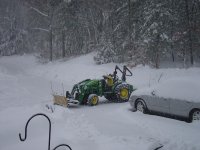
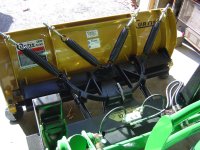
I also think that the length of the Curtis plow setup with the JD QC frame and angle cylinders are part of the reason the loader has so much leverage over the tractor. That plow setup weighs about 600 Lbs alone with the QC mount frame and it sticks out a whole lot more than the bucket.

Next time we get a significant, (at least a foot or so is when it happens the most often) I'll take my digi-cam and try to make a movie while plowing but Im not sure I have enough hands for that. (maybe I should graft another one something like that nut in France that had an ear grown on his forearm and rig it with sound so he can broadcast it on the Internet)

See the pics for my snow setup.

Thanks,

Tom
 

Attachments

  • DSC01171-50.JPG
    DSC01171-50.JPG
    179 KB · Views: 221
  • DSC01134-50.JPG
    DSC01134-50.JPG
    223 KB · Views: 199
/ 2520 ballast #12  
Birdmayon
That amount feels good to me - if you hook a root or something you can get the back end up but that would be true even if you had more weight. For gravel and topsoil bucket work it feels great. I don't think you want much more off the back IMHO.

Brad
 
/ 2520 ballast #13  
Thanks for the response Brad, I think this is the route I'm going. Tractor is being delivered tomorrow!
 
/ 2520 ballast #15  
Tom,
I didn't realize you were using a plow..for some reason I assumed you were bucketing snow...bad assumption on my part. The Curtiss blade looks like a nice setup....does the power angle have its own control valve/lines or does it use the bucket curl valve/lines?

Zooming in on your first picture...it looks like the bucket arm cylinder shaft is extended 3 or 4 inches with the blade resting on level ground. If that is indeed the case, then I can see your problem. In float mode, As you are pushing snow (especially uphill) the force required overtakes the force (weight) holding the front end down. Being in float mode, the reaction is the raising of the front end of the tractor untill the cylinder is fully retracted....at that point, the raising stops. If you still have control over the curl function, raise the blade using it....then lower the blade using the lift control.....the mission is to have the blade making contact with the ground with the lift cylinder near full retraction. The only catch here is that when you crest the top of your drive, the blade will leave the ground surface untill the back axle of the tractor is on the same plane as the blade (level ground). If you still do have control of the curl funtion, you can maintain blade contact by adjusting this during the crest.

My QA plow has a mechanical adjustment allowing the blade to be raised up/down on the QA backer plate...does the curtiss??

Adding lots of weight to the front end will help elininate what you are experiencing....but I think just some simple adjustments to the position of the blade at rest is all you really need.

FastPauly
 

Marketplace Items

skeleton / rock bucket (A56857)
skeleton / rock...
Yamaha Golf Cart (A57149)
Yamaha Golf Cart...
2019 ALLMAND MAXI-POWER 25 GENERATOR (A58214)
2019 ALLMAND...
HEAVYEQUIPMENT TIRES (A60736)
HEAVYEQUIPMENT...
2024 Bobcat T86 (A60462)
2024 Bobcat T86...
2015 Caterpillar 430F 4x4 Extendahoe Loader Backhoe (A60352)
2015 Caterpillar...
 
Top