understanding my front loader hydraulics

/ understanding my front loader hydraulics #1  

lapioche

New member
Joined
Mar 10, 2024
Messages
6
Tractor
Zetor 7245
I bought a front loader (used) for my Zetor 7245. I am trying to understand how it functions as the system is not straightforward. There are four valves, three of one type and a fourth that's different, that I would like to understand what they are for. I drew a (crude) schematics based on observation (the direction of the lines is my guess, and of course they reverse).

If someone can tell me what are the valves in the system and what they do, I'd greatly appreciate.
 

Attachments

  • front-loader-schematics-1.png
    front-loader-schematics-1.png
    59.1 KB · Views: 284
/ understanding my front loader hydraulics #2  
Not enough info. What tractor did the loader come from? Is the loader also off of an open center type of hydraulic system?

Does T mean "Tee"?

Where are the valves? I assume they are feeding the colored inputs? But that would only require two. How are the other valves connected?

Do you know what the Hydacs do? Do they have any markings? It's impossible for me to be sure what they are... could be relief valves, flow control or accumulators....or ? Do they have a pneumatic fitting?
 
/ understanding my front loader hydraulics
  • Thread Starter
#3  
1. I don't know what tractor it comes from but the tractor connection is designed for Zetor. So I assume it was a zetor, and by the size of it, something around 70-80hp.
2. T indeed means Tee. These are just fittings. I marked them so I have an easy time looking at the system with the diagram but functionally they aren't necessary.
3. all the valves are attached at different places on the inside of the loader, along the arms and the connecting bar.
4. I don't know what the HYDACs do. The port letters are marked and noted on the schematics. They have no pneumatic fittings but there's an unused small port marked M. They look like relief valves but I'm trying to understand the logic of how they are connected.
 
/ understanding my front loader hydraulics #4  
How about some photos of the actual parts in question.

You could have a third function control such as a grapple.

Are there any wires going to the hydraulic controls? Self leveling?
 
/ understanding my front loader hydraulics #5  
Post some photos of what you have. If anyone can make any sense of your description they're far smarter than I am.

Could be your best bet might be to just invest in a new loader valve and be done with it.
 
/ understanding my front loader hydraulics #6  
Maybe this well help.
 

Attachments

  • RD5000InstS.pdf
    222.9 KB · Views: 211
/ understanding my front loader hydraulics #7  
Can you share a picture of the loader? I suspect it has self leveling, either mechanical or hydraulic, therefore it will have at least one extra relief valve mounted in the loader.

It can also have valves for loader suspension. Then again, we need some pictures.
 
/ understanding my front loader hydraulics
  • Thread Starter
#8  
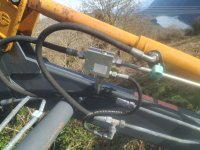
thanks for all of you responding. here's some photos. you can see the three HYDAC units with three connections as well as the single other valve with four connections.
 

Attachments

  • IMG_20240311_085940.jpg
    IMG_20240311_085940.jpg
    2.1 MB · Views: 264
  • IMG_20240311_085932.jpg
    IMG_20240311_085932.jpg
    2 MB · Views: 182
  • IMG_20240311_085920.jpg
    IMG_20240311_085920.jpg
    2.3 MB · Views: 169
  • IMG_20240311_085908.jpg
    IMG_20240311_085908.jpg
    2.4 MB · Views: 162
  • IMG_20240311_085858.jpg
    IMG_20240311_085858.jpg
    2.4 MB · Views: 419
Last edited:
/ understanding my front loader hydraulics #9  
In photos #2 and #3 I have seen similar looking valves on diggers. Thier job is to prevent the digger boom free falling if a hydraulic hose has a blowout. Possibly these do the same job. ?
Can any hydraulics people comment?
 
/ understanding my front loader hydraulics #10  
The two valves mounted on the curl cylinders look like regen valves to me, to prevent the floppy bucket when fully dumping a load.

1710151194035.jpeg


The other one may be the relief valve because of the self leveling linkage.
 
Last edited:
/ understanding my front loader hydraulics
  • Thread Starter
#11  
The two valves mounted on the curl cylinders look like regen valves to me, to prevent the floppy bucket when fully dumping a load.

View attachment 856753

The other one may be the relief valve because of the self leveling linkage.
Thank you, ptsg! the regen function makes sense to me, but why would there be a relief valve on a single cylinder? Could you explain what you mean by self-leveling?
 
/ understanding my front loader hydraulics #12  
Thank you, ptsg! the regen function makes sense to me, but why would there be a relief valve on a single cylinder? Could you explain what you mean by self-leveling?
Self leveling, in that loader in particular, is that parallel linkage on top of the main arms. As you lift the loader, it will maintain the bucket at the same position from the ground all the way to the top. Same as you lower.

It's called "self leveling" but the name is somewhat misleading. It doesn't actually keep the bucket level all the times, it just keeps the bucket in the same position along the range of motion of the loader. Let's say you have the bucket curled all the way, as you lift the loader, it will keep that bucket in the same position.

This is also a great safety feature as it won't let you dump the load on top of the hood of the tractor. Lots of people got killed or injured that way with logs and hay bales.

The self leveling feature also reduces the need to do two functions at the same time by a lot. Without this feature, some tractors are very hard to do two functions at the same time due to either the control valve used or just not enough flow from the pump.

The relief valve has to be there because there certain positions that something has to give in order to prevent something from break and bend. So the relief valve just relieves the fluid.

Let's say you have the loader 1 meter in the air and you have the bucket dumped all the way to the stops. If you tried to lift the loader, the parallel linkage would try to push the cylinder further forward but since the bucket is already hitting the stops, it can't move. So the loader couldn't lift or it would damage something.

With this relief valve, it relieves the fluid from the extension port of the dump cylinders, so the loader can go back up. This relieved fluid is often sent to the retract side of the lift cylinders and then dumped back to the tank.

EDIT: The pressure on this relief valve is set lower than system pressure, so it can actually work as designed.

Hopefully my explanation makes sense. If not, let me know and maybe I can find some better wording.

I did find some manuals from Faucheux but none have an hydraulic schematic.

 
Last edited:
/ understanding my front loader hydraulics
  • Thread Starter
#13  
Self leveling, in that loader in particular, is that parallel linkage on top of the main arms. As you lift the loader, it will maintain the bucket at the same position from the ground all the way to the top. Same as you lower.

It's called "self leveling" but the name is somewhat misleading. It doesn't actually keep the bucket level all the times, it just keeps the bucket in the same position along the range of motion of the loader. Let's say you have the bucket curled all the way, as you lift the loader, it will keep that bucket in the same position.

This is also a great safety feature as it won't let you dump the load on top of the hood of the tractor. Lots of people got killed or injured that way with logs and hay bales.

The self leveling feature also reduces the need to do two functions at the same time by a lot. Without this feature, some tractors are very hard to do two functions at the same time due to either the control valve used or just not enough flow from the pump.

The relief valve has to be there because there certain positions that something has to give in order to prevent something from break and bend. So the relief valve just relieves the fluid.

Let's say you have the loader 1 meter in the air and you have the bucket dumped all the way to the stops. If you tried to lift the loader, the parallel linkage would try to push the cylinder further forward but since the bucket is already hitting the stops, it can't move. So the loader couldn't lift or it would damage something.

With this relief valve, it relieves the fluid from the extension port of the dump cylinders, so the loader can go back up. This relieved fluid is often sent to the retract side of the lift cylinders and then dumped back to the tank.

EDIT: The pressure on this relief valve is set lower than system pressure, so it can actually work as designed.

Hopefully my explanation makes sense. If not, let me know and maybe I can find some better wording.

I did find some manuals from Faucheux but none have an hydraulic schematic.

Your explanation is great! I understand the linkage type, in France it's called parallelogram, I didn't know it's called "self-leveling". What I still do not understand is why there's a relief valve only on the left side.

EDIT: Correct me if I'm wrong. Since the two sides are set in parallel, when the relief is triggered on the left side it also drops the pressure on the right side?
 
/ understanding my front loader hydraulics
  • Thread Starter
#14  
for the benefits of posterity. I attach a revised schematics based on the thread
 

Attachments

  • front-loader-schematics-2.png
    front-loader-schematics-2.png
    61.7 KB · Views: 123
/ understanding my front loader hydraulics #15  
Your explanation is great! I understand the linkage type, in France it's called parallelogram, I didn't know it's called "self-leveling". What I still do not understand is why there's a relief valve only on the left side.

EDIT: Correct me if I'm wrong. Since the two sides are set in parallel, when the relief is triggered on the left side it also drops the pressure on the right side?
In Portuguese it's called parallelogram as well. I guess in the US is more known as self leveling.

Since the cylinder are connected in parallel, it only needs one relief valve. What I'm not following entirely is why they use what I assume two Regen valves.
 

Marketplace Items

2005 Chevrolet Impala Sedan (A56859)
2005 Chevrolet...
2012 SOUTHERN VAC 130 BBL STEEL VACUUM TRAILER (A60736)
2012 SOUTHERN VAC...
2016 FORD TRANSIT T250 CARGO VAN (A59575)
2016 FORD TRANSIT...
2012 International WorkStar 7300 AWD Altec DC47TR Insulated Digger Derrick Truck (A60352)
2012 International...
Classic 1969 Massey Ferguson 135, newly rebuilt engine, refurb front end, 3-pt blade.
Classic 1969...
CAT D8 (A58214)
CAT D8 (A58214)
 
Top