Cast iron repair

   / Cast iron repair #1  

WinterDeere

Super Star Member
Top Poster Of Month
Joined
Sep 6, 2011
Messages
12,810
Location
Philadelphia
Tractor
John Deere 3033R, 855 MFWD, 757 ZTrak; IH Cub Cadet 123
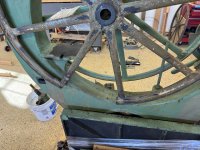
I have a 32" bandsaw ca.1920, with a chip in the rim of the upper wheel. I'm trying to figure out the best way to repair, before re-tiring the wheel.

Wheel is cast iron, with a machined rim and hub, and some spot removal on the spokes for balancing. Since getting it right and strong is much more important to me than saving a few dollars, I'm looking for the only "best" way to repair this, and how to find the right expert to do it. Spray welding to build it up? Cut and weld in a segment of steel? Brazing? Glass-reinforced epoxy?

How do I even go about weeding out all of the, "we could probably do something with that" guys, and find a real expert who is going to get this right the first time? I really do NOT want to do this twice, as it will mean a lot of repair and re-tiring work, plus more machine down-time.
 
   / Cast iron repair #2  
a few close up images would be useful. also if using heat for repair, i like to wrap wet towels close to the repair on each side to avoid heat radiating & possible warping the wheel. good luck
 
Last edited:
   / Cast iron repair #3  
I have a 32" bandsaw ca.1920, with a chip in the rim of the upper wheel. I'm trying to figure out the best way to repair, before re-tiring the wheel.

Wheel is cast iron, with a machined rim and hub, and some spot removal on the spokes for balancing. Since getting it right and strong is much more important to me than saving a few dollars, I'm looking for the only "best" way to repair this, and how to find the right expert to do it. Spray welding to build it up? Cut and weld in a segment of steel? Brazing? Glass-reinforced epoxy?

How do I even go about weeding out all of the, "we could probably do something with that" guys, and find a real expert who is going to get this right the first time? I really do NOT want to do this twice, as it will mean a lot of repair and re-tiring work, plus more machine down-time.
If it was mine, I would have it welded. There are special rods for cast iron, and procedures, that often make the repair as good as new. If you know of a trusted machine shop, they may be familiar with what is necessary to do the job the right way. There was a family run shop near me that did a lot of engine rebuilds and most blocks and heads were cast iron, so they had abilities to do serious repairs. I know this because I worked there part-time, after getting off my regular job.

In my humble opinion, if you want a repair to last, epoxy would be my last choice in this particular situation. Brazing would be my second choice.
 
   / Cast iron repair #5  
This worked for the 454 chev exhaust manifolds they would crack
and the cement for the cast iron woood stoves worked for the repair

willy
 
   / Cast iron repair #6  
TIG using silicon/bronze. After cleaning the area, warm the whole wheel up to take the chill off it, build it up using silicon bronze and grind to suit. Just remember, you're brazing not welding so you don't melt the base metal. Worst thing with a spoke wheel is the stresses that build up in places you wouldn't think, that's the reason for warming the whole thing up.
 
   / Cast iron repair #7  
Spray powder torch would work well too.
 
   / Cast iron repair
  • Thread Starter
#8  
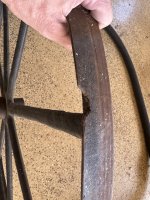
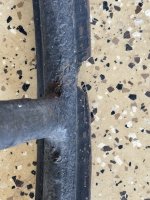
Hey guys, here are some close ups I grabbed this morning. I’ll try to remember to grab a photo of the whole wheel when I go back out to the shop after lunch. Click on either thumbnail for full size.

IMG_2284.jpeg IMG_2283.jpeg
 
   / Cast iron repair #9  
I'd go with the SB if it were me. One of two ways, after cleaning it up, either fill up fully with SB rod or (my preference) cut a small piece of formed steel and SB it in. I wouldn't think there'd be a lot of strain on it so I wouldn't be overly concerned about full penetration.
 
   / Cast iron repair #10  
Hey guys, here are some close ups I grabbed this morning. I’ll try to remember to grab a photo of the whole wheel when I go back out to the shop after lunch. Click on either thumbnail for full size.

View attachment 854210 View attachment 854211
After seeing the pic of the wheel, I am not so sure welding is the best idea. I had pictured in my mind a much thicker and heavier wheel. While its possible with a smaller diameter rod to weld cast that thin, Tig may be the better option if it's as thin as it looks in pic. I hope I haven't muddied the water. Good Luck
 
   / Cast iron repair #11  
Welding is a very bad idea on that. You are very likely to get cracking elsewhere as it cools. Blast it clean and then clean with acetone. Shape a piece of graphite with a file to fit closely to the underside of the rim, preheat and silicone braze the spot to be filled and immediately wrap with insulation and let cool. Very little file work with a smooth cut file would be needed to bring it back to the original shape.
 
   / Cast iron repair #12  
TIG using silicon/bronze. After cleaning the area, warm the whole wheel up to take the chill off it, build it up using silicon bronze and grind to suit. Just remember, you're brazing not welding so you don't melt the base metal. Worst thing with a spoke wheel is the stresses that build up in places you wouldn't think, that's the reason for warming the whole thing up.
I also would use silicon bronze rod with a TIG machine. Clean well first. Then I would heat the whole wheel with a weed burner, wrap with ceramic wool or similar, then with just the area to be brazed exposed fill with silicon bronze. Wrap completely. Let cool slowly and then grind to shape. Any decent weld shop would make the repair in a similar fashion.
Eric
 
   / Cast iron repair
  • Thread Starter
#13  
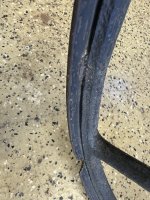
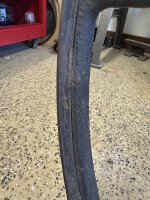
Game changer, guys. Realized when I got back out to the shop after lunch… that ain’t cast iron! Wheel appears to be a steel hoop welded to cast iron spoke and hub assembly. See photos

IMG_2291.jpeg IMG_2290.jpeg
 
   / Cast iron repair #14  
Game changer, guys. Realized when I got back out to the shop after lunch… that ain’t cast iron! Wheel appears to be a steel hoop welded to cast iron spoke and hub assembly. See photos

View attachment 854233 View attachment 854234
I highly doubt its welded. More than likely furnaced brazed if it is but I would even question that. Pictures are hard to tell exactly what that blob is. Take a small sharp caping chisel and see if its just old paint or hardened grease/metal chips.

You can grind on an inconspicuous spot and observe the spark pattern

Cast iron and steel have very different spark patterns.

spark-patterns.jpg
 
   / Cast iron repair
  • Thread Starter
#15  
This is a wood cutting bandsaw, so no way is it metal chips, etc. But I'll go at it tomorrow with something to expose metal, and see what it is. It could be a steel hoop that was heated to expand, and then cooled in place onto the cast iron wheel, then torch-welded or brazed in a few spots. Think 1920's tech. But either way, up-close inspection reveals the hoop is definitely a separate piece from the cast wheel, and I do believe the hoop is steel.

One more wrinkle, this chipped wheel is just a replacement wheel, which has a different hub configuration from the original upper wheel. So, if I use it, I still have some work to reconfigure and bush out the hub.

On the flip side, I also have the original, but a whole section has been broken out of it. I have those pieces, but had assumed skarfing them back in to make a repair was impractical:

IMG_2292_web.jpg

Third option is just have a whole new wheel made. Could have replica of original cast by Cattail Foundry, and then turned and balanced by a local machine shop. If doing that, I'd just scarf the original back together and let the guys at the foundry build it up, to use the original as a mold for a new wheel.

Fourth option is to keep shopping for another wheel. But on a 100+ year old machine of a less common size, they don't come up very often, and more often than not they're worse than what I already have.
 
Last edited:
   / Cast iron repair #16  
interesting thread. what size or swing? is the saw, 17" or greater? sounds worth restoring the vintage machine
 
   / Cast iron repair #17  
IF its steel. build it up with any weld process and grind to conform with rest of wheel diameter.... Personally I would use MIG or Braze, but that is what I have available to me....
 
   / Cast iron repair #18  
I'd work on the original wheel myself a break in a thicker section is easier than building up thin.

The process I would use would be similar to this repair.


No need to have to repair and then modify to fit, if you are using the original part.
 
   / Cast iron repair #19  
This is a wood cutting bandsaw, so no way is it metal chips, etc. But I'll go at it tomorrow with something to expose metal, and see what it is. It could be a steel hoop that was heated to expand, and then cooled in place onto the cast iron wheel, then torch-welded or brazed in a few spots. Think 1920's tech. But either way, up-close inspection reveals the hoop is definitely a separate piece from the cast wheel, and I do believe the hoop is steel.

One more wrinkle, this chipped wheel is just a replacement wheel, which has a different hub configuration from the original upper wheel. So, if I use it, I still have some work to reconfigure and bush out the hub.

On the flip side, I also have the original, but a whole section has been broken out of it. I have those pieces, but had assumed skarfing them back in to make a repair was impractical:

View attachment 854272

Third option is just have a whole new wheel made. Could have replica of original cast by Cattail Foundry, and then turned and balanced by a local machine shop. If doing that, I'd just scarf the original back together and let the guys at the foundry build it up, to use the original as a mold for a new wheel.

Fourth option is to keep shopping for another wheel. But on a 100+ year old machine of a less common size, they don't come up very often, and more often than not they're worse than what I already have.

Thank you for the explanation. I've done some foundary work, and went to bed after reading on your project and got to wondering how they could cast that wheel and keep the outer flange in one piece, much less keep it round. Banding a steel rim to affix to cast spokes does make a whole lot more sense.

In fact, as I look at your original wheel is it possible that the outer band was originally riveted to the spokes? Look at the lower rt hand corner of the photo...is that a riveted joint? And if so, are many of the other spoke attachents welded repairs?
If so, then the original was made in two pieces as well. Again that makes more sense than a cast wheel of those dimensions. I think it would almost have to be two pieces if it was cast.

And the same reason - thermal stresses - is why any welding/brazing process is going to be difficult. Brazing is the most likely way to fix it, but best way is to heat the whole piece up to near brazing temperature in a sand box in a furnace. Foundarys do that all the time. Then braze it, and then a 24 hour cool. And even so it might not work. That kind of temperature cycle can expose all sorts of age-related stresses.

Bottom line is if this is a project that matters, I would take both wheels down to your local Foundary and have a chat with them.

rScotty
 
   / Cast iron repair #20  
This is a wood cutting bandsaw, so no way is it metal chips, etc. But I'll go at it tomorrow with something to expose metal, and see what it is. It could be a steel hoop that was heated to expand, and then cooled in place onto the cast iron wheel, then torch-welded or brazed in a few spots. Think 1920's tech. But either way, up-close inspection reveals the hoop is definitely a separate piece from the cast wheel, and I do believe the hoop is steel.

One more wrinkle, this chipped wheel is just a replacement wheel, which has a different hub configuration from the original upper wheel. So, if I use it, I still have some work to reconfigure and bush out the hub.

On the flip side, I also have the original, but a whole section has been broken out of it. I have those pieces, but had assumed skarfing them back in to make a repair was impractical:

View attachment 854272

Third option is just have a whole new wheel made. Could have replica of original cast by Cattail Foundry, and then turned and balanced by a local machine shop. If doing that, I'd just scarf the original back together and let the guys at the foundry build it up, to use the original as a mold for a new wheel.

Fourth option is to keep shopping for another wheel. But on a 100+ year old machine of a less common size, they don't come up very often, and more often than not they're worse than what I already have.
I'd go with your third option have a blacksmith cast a new wheel and shrink a new wheel to it. Or most any machine shop could fabricate you a new wheel out of steel.
 

Tractor & Equipment Auctions

500 BBL FRAC TANK (A58214)
500 BBL FRAC TANK...
2019 DRAGON ESP 150BBL ALUMINUM (A58214)
2019 DRAGON ESP...
DEUTZ MARATHON 60KW GENERATOR (A58214)
DEUTZ MARATHON...
2018 Dodge Ram 3500 (A53317)
2018 Dodge Ram...
2016 Nissan Altima 2.5 Sedan (A59231)
2016 Nissan Altima...
7ft Pull-Behind Rake Tractor Attachment (A59228)
7ft Pull-Behind...
 
Top