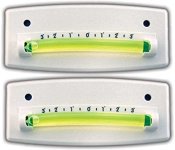
Terrified of tipping - how about an inclinometer?

/ Terrified of tipping - how about an inclinometer? #61  
Lots of replies related to the vital issue of rollover. When my first and only tractor was delivered (Massey GC-2300 TLB) on my steep road, as the guy backed it off the trailer, it tipped momentarily towards the rear. The driver looked shocked, but it tipped back onto all 4 wheels. My tires are not filled. He said "you have to be careful of rollovers - they will kill you." So I immediately looked online, and found a large database that gave pictures and details and anecdotal comments on fatal injuries. I spent maybe 4 hours reading as many as I could. Many were older operators - which is something to consider as you age. Some were young inexperienced operators, some in the middle.

I have a property that is entirely sloped, with a fair amount of 20%-25% grading. I tip my backhoe to the side as you described, often. Routinely keep the loader arms as low as possible. The dicyest situations I have gotten into in 600 hours of use have come from a moment of inattention, or brushing against a control inadvertently. I have had a wheel lift off the ground on more than one occasion, and it is very unsettling. So unsettling it reminds me to be careful, which I try always to be. One mistake is all it takes. You asked - if I were to make one change, I would have my tires filled. I mow these slopes with an old Simplicity garden tractor, and when I added wheel weights for winter plowing, I also found that mowing on the slopes was much easier.

Personally I would have little use for an inclinometer. It would give a false sense of security. While it may be somewhat useful in some situations, my guess is there are several where it would not give me warning because I wasn't looking at it or a tip precipitously occurs. I would hate to rely on it. Having that fear is a good thing, and knowing the limits of your equipment and experience. I would rather rely on my internal needle, not one on a gauge.
 
Last edited:
/ Terrified of tipping - how about an inclinometer? #62  
A1548CAC-70EF-4E28-9557-17E673E7ED5E.png
I was seriously thinking of installing one of the Level Guages I use for my sailboat.
They work great and I can usually be found at about 28 to 35 degrees if the wind is very stiff in my particular sailboat.
But… that’s where a gauge like this stops being a reality.

The only way to know at what point my sailing rig will roll is to roll it, or …at least get it to the point where you are hanging onto something more solidly connected to the boat than the person next to you 😮🤭!!

So yes I agree that the only way to know is to either get it close or get it to the point where you are uncomfortable going any further and then mark that on the guage, in the position the Gauge is in when you test it.

I was thinking about an actual test using a support like an automotive lift in a garage with something against the loader vertical support brackets to support the tractor at a point where it might begin to tilt over (using a floor Jack) but with the car lift to prevent full rolling of the equipment, or only a minimal amount of roll to not damage the equipment.

With the increased use of cabs today, that resistance to roll will decrease with the change in the center of gravity of the equipment (CG).

With all of this there are also “dry weight” considerations versus “live weight”.
Dry weight being with no additional gear in the tractor whatsoever compared to live weight being with chains, tools, add-ons to the cab or other material.

Don’t forget that with quick attach loaders being a major use option today, it’s very easy to change the CG of any piece of equipment either higher or lower very easily without the operator understanding the possible consequences. That’s just with the attachment change, but one can’t disregard the height of that attachment (either front or rear attachment). That one single variable will have more on the impact of the CG than anything else period.

So even given full disclosure of the CG for a given piece of equipment, from the factory, the roll over effects will still be challenging to calculate for any given tractor based on everything … including the weight and height of the occupant(s)

A daunting task for sure, but like me, if you’re inquisitive and have a desire to protect yourself from a general rollover sItuation, then an attempt to give yourself the maximum amount of angle you might want to visit is better than having no idea where the break point is until it happens!

I forgot to mention that CG also has a forward and aft component, with the tilt ot rollover subject to a variable of weight forward or aft of a horizontal line… not just vertical.

Add that to your equation and it gets very messy very quickly.

Let’s say you have a 1200 lbs mower of ballast on the 3 point, at 6” high. And you have little or no ballast or implements on the front.

If you get into a situation where the tractor could tilt (roll), then the rear end will have a lower center of gravity than the front end, causing the front to attempt to“roll” or lift the front end, and then depending on the distance away from the total CG of the tractor (in both directions) then the unit may only lift a front tire at that angle.

But if the mower were at transport height or say 2 ft, then there is less distance to the rear ballast due to the pivoting ballast closer to the center or CL of the tractor weight to the total tractor CG, and the entire unit could roll Vs just picking up a front tire…. Lots of variables !!!
 
Last edited:
/ Terrified of tipping - how about an inclinometer? #63  
I get your concern about comfort (in the absence of solid numbers for when she might tip). I installed an inclinometer like you linked to on my UTV, but wanted a bit more for my tractor so I went with one of these. It's not perfect, but I make note of the angle when I'm tipping (and uncomfortable) so I start to really understand what angles it's capable of versus my stomach. I should note, the one tip-over I had was on nearly level ground. Bucket high (to clear a fence) when the right front wheel decided to dig a hole (4wd) in soft sand. That angle, plus the high weight, put me right over. I've added fluid in my rear tires and routinely get to 10 to 15° slopes sideways without issues, but still pucker occasionally.

 
/ Terrified of tipping - how about an inclinometer? #64  
Alright, I admit it! I'm a crybaby when it comes to running any of my tractors on an incline. I'm terrified of tipping the machine on its side (or worse!). I know, fear is a good thing, but I get the heeby-jeebies whenever one of the rear wheels goes over a rock and the machine lifts up just a little on one side. On the 4600, if there's a little incline I'll often put down the stabilizers so if it does begin to tip, it will have something to rest on before it goes all the way over. Also, I'll turn the backoe over to the high side to add counter weight. Tires can be loaded, wheels weights added, and the wheels set for a wider track. All these things can, and should be done. But what about a way to measure how much the machine is leaning?

I find it odd that I have never seen any references to putting an inclinometer on the tractor dash. Has anybody done this? What about something like this? Amazon.com: Sun Company 201-F Lev-o-gage Inclinometer | USA-Made Level for Off-Road Vehicle, Jeep, Truck, RV, Camper, Trailer, or Boat: Industrial & Scientific

(I have no interest or involvement with promoting a product. I'm just asking.)


I bought that exact gauge for my Ventrac. I like it.


Like Dirty Harry said: "A man's got to know his limitations." :)
 
/ Terrified of tipping - how about an inclinometer? #65  
My 2 cents: the gauge is nifty, but not reliable. Reliability of the gauge changes based upon height of loader and implements.
I suggest increasing width of rear tire spread and filling tires/wheel weight. Tire/wheel weight should lower your center of gravity increasing stability. Wider rear tread depth should also increase your stability.
Of course a front tire dropping into a low spot (hole or ditch) can still cause issues. Thus a good standard operating practice is to keep your loader and implements as close to the ground as is reasonable and to minimize travel across a slope when possible, traveling up and down sloes is safest.
If you experience a pucker factor moment, stop immediately! Always have your head in the game for what you are doing!
 
/ Terrified of tipping - how about an inclinometer? #66  
Alright, I admit it! I'm a crybaby when it comes to running any of my tractors on an incline. I'm terrified of tipping the machine on its side (or worse!). I know, fear is a good thing, but I get the heeby-jeebies whenever one of the rear wheels goes over a rock and the machine lifts up just a little on one side. On the 4600, if there's a little incline I'll often put down the stabilizers so if it does begin to tip, it will have something to rest on before it goes all the way over. Also, I'll turn the backoe over to the high side to add counter weight. Tires can be loaded, wheels weights added, and the wheels set for a wider track. All these things can, and should be done. But what about a way to measure how much the machine is leaning?

I find it odd that I have never seen any references to putting an inclinometer on the tractor dash. Has anybody done this? What about something like this? Amazon.com: Sun Company 201-F Lev-o-gage Inclinometer | USA-Made Level for Off-Road Vehicle, Jeep, Truck, RV, Camper, Trailer, or Boat: Industrial & Scientific

(I have no interest or involvement with promoting a product. I'm just asking.)
I have a BobCat CT120. I have an inclinometer sitting in my garage. I asked BobCat what the tip factor was and they wouldn’t divulge that information. Inclinometer not installed.
 
/ Terrified of tipping - how about an inclinometer? #67  
I would never put one of these things on my Kubota. I believe it will [as many have mentioned] give a totally false [and possibly fatal] sense of security and would lead me into over riding that pucker on my seat. As Piloon points out so eloquently, to use it you would have to test it out in the way he outlines. And that would, as I said, take you attention away from where it should be focused. And then there is that uneven ground under the down hill tires [which will be amplified by the speed you are traveling] which will catch you out every time. Focus on your own body's 'gauge' and be cautious. Use it up and down the slope, not across if you are nervous about it. We want to hear you on this forum again sometimes.
 
/ Terrified of tipping - how about an inclinometer? #68  
Alright, I admit it! I'm a crybaby when it comes to running any of my tractors on an incline. I'm terrified of tipping the machine on its side (or worse!). I know, fear is a good thing, but I get the heeby-jeebies whenever one of the rear wheels goes over a rock and the machine lifts up just a little on one side. On the 4600, if there's a little incline I'll often put down the stabilizers so if it does begin to tip, it will have something to rest on before it goes all the way over. Also, I'll turn the backoe over to the high side to add counter weight. Tires can be loaded, wheels weights added, and the wheels set for a wider track. All these things can, and should be done. But what about a way to measure how much the machine is leaning?

I find it odd that I have never seen any references to putting an inclinometer on the tractor dash. Has anybody done this? What about something like this? Amazon.com: Sun Company 201-F Lev-o-gage Inclinometer | USA-Made Level for Off-Road Vehicle, Jeep, Truck, RV, Camper, Trailer, or Boat: Industrial & Scientific

(I have no interest or involvement with promoting a product. I'm just asking.)
You have a built-in Inclinometer. It is your Brain. If you feel unsafe you are in the wrong place.
A gadget on the dash won't stop the roll. Neither will the stabilizers. Go up and down the incline, not crosswise.
 
/ Terrified of tipping - how about an inclinometer? #69  
This is the one I have and I also use it for grading and making slopes. it gives you side-to-side as well as fore-and-aft, and it's in usable increments. I've had it to about 12° and my butt was beginning to pucker. 10° to 15° is yellow and I stay out of the red. I wouldn't even consider the one that goes to 45°.

IMGA0291.JPG
 
/ Terrified of tipping - how about an inclinometer? #70  
Alright, I admit it! I'm a crybaby when it comes to running any of my tractors on an incline. I'm terrified of tipping the machine on its side (or worse!). I know, fear is a good thing, but I get the heeby-jeebies whenever one of the rear wheels goes over a rock and the machine lifts up just a little on one side. On the 4600, if there's a little incline I'll often put down the stabilizers so if it does begin to tip, it will have something to rest on before it goes all the way over. Also, I'll turn the backoe over to the high side to add counter weight. Tires can be loaded, wheels weights added, and the wheels set for a wider track. All these things can, and should be done. But what about a way to measure how much the machine is leaning?

I find it odd that I have never seen any references to putting an inclinometer on the tractor dash. Has anybody done this? What about something like this? Amazon.com: Sun Company 201-F Lev-o-gage Inclinometer | USA-Made Level for Off-Road Vehicle, Jeep, Truck, RV, Camper, Trailer, or Boat: Industrial & Scientific

(I have no interest or involvement with promoting a product. I'm just asking.)
DanMc77, I'm with you on being scared of a rollover -- I lost a cousin to a tractor rollover when I was young -- and I can never tell when I'm too steep so sidehills just scare me. I was raised farming terraces, so I know I can plow a fair sidehill where I don't have to watch for rocks or holes that change the angle suddenly and might even add a bounce or jolt that could further unbalance things.

I've used several large tractors that had inclinometer clinometers on them to show both pitch and cant. These were installed to help in building roads and terraces where you need to follow the contour and not go downhill or uphill so end-to-end (pitch) was also critical. And I run an Altoz TRX 766i that I got specifically for mowing steep sidehills; it is a big zero turn on tracks and has a cant meter right between my feet to show me what angle the sidehill is. It is stable to 40° but 30° feels like you can hardly stay on it and couldn't if you weren't strapped in. It has a bushhog deck and will mow anything. I take it places without hesitation that taking either of my tractors would terrify me, but I'm sitting down with a low center-of-gravity with a wide set of tracks outside me.

Neither of my tractor manuals give any guidance on maximum sidehills, probably for liability reasons.
 
/ Terrified of tipping - how about an inclinometer? #71  
A google for "tractor rolled killed" finds several million hits. ROPS (Roll Over Protection System, which is a big metal frame over the tractor seat) and a buckled seatbelt are a requirement if on anything but dead flat flat and no load in the FEL (Front End Loader). You can flip a tractor on flat ground real quick if the FEL is high with a load and you take a corner in anything but one of the lowest gears. I can't imagine an inclinometer would be of any use at all, just a distraction that gives a false sense of security.

We live on the bench of a steep canyon wall. Got a Branson 3510i here, use it on uneven and occasionally steep terrain. I once had two wheels off the ground, moving very slowly when taking a 1500 lb pallet off a high truck bed with the FEL, on flat ground. A front wheel found a gopher hole. You want your hand near the FEL hydraulics whenever lifting something heavy, ready to drop it. Move slowly when you have a load. On steep terrain, you want to be going straight up or down, not sideways. If on loose material, be aware that you might slip to a sideways orientation.

After years of nearly killing myself, I finally figured out that the wheels were configured for flatlanders, going for minimum tractor width. On the rears of this Branson, I can place the inner steel wheel on either side of the outer steel wheel, and I can spin the inner wheel 180 degrees This gives four different possible widths across the two rear tires when mounted on the tractor to choose from. In some configurations you will need to swap the left and right tires to get the tread oriented for maximum traction when going forward, and the schrader air valve will then be on the inside of the tire, not an issue. I went for maximum width and have yet to catch air again, far far more stable than the stock configuration. You can buy spacers to fit between the hub and the wheel to get the front tires back in the same tracks as the rears, though I haven't bothered yet.

Turf tires might give a slightly wider stance than ag tires, be able to carry a heavier load because of the greater area in contact with the dirt, less soil compaction. I use ag (agricultural tread) tires because I need that traction in snow and mud, but am considering going to wider tires and using chains when I need the traction.

Edit: Some people think they are better off without a buckled seatbelt, planning to somehow jump clear when things go south. If they did manage to jump in the split second when a tractor rolls, they would most likely be jumping right into the spot that the tractor will be rolling over the top of.
 
Last edited:
/ Terrified of tipping - how about an inclinometer? #72  
/ Terrified of tipping - how about an inclinometer? #73  
Alright, I admit it! I'm a crybaby when it comes to running any of my tractors on an incline. I'm terrified of tipping the machine on its side (or worse!). I know, fear is a good thing, but I get the heeby-jeebies whenever one of the rear wheels goes over a rock and the machine lifts up just a little on one side. On the 4600, if there's a little incline I'll often put down the stabilizers so if it does begin to tip, it will have something to rest on before it goes all the way over. Also, I'll turn the backoe over to the high side to add counter weight. Tires can be loaded, wheels weights added, and the wheels set for a wider track. All these things can, and should be done. But what about a way to measure how much the machine is leaning?

I find it odd that I have never seen any references to putting an inclinometer on the tractor dash. Has anybody done this? What about something like this? Amazon.com: Sun Company 201-F Lev-o-gage Inclinometer | USA-Made Level for Off-Road Vehicle, Jeep, Truck, RV, Camper, Trailer, or Boat: Industrial & Scientific

(I have no interest or involvement with promoting a product. I'm just asking.)
The problem is unless you know what the tipping point is this isn't going to do much good.

We had them on the Destroyer I served on and we knew what the point of no return was.

You have stabilizers so I suppose you could do some empirical testing to determine where the danger zone is, mark your gauge, and then do what's needed to mitigate the danger should you approach the line.
 
/ Terrified of tipping - how about an inclinometer? #74  
I'd shop for one with a smaller range of measurement. A smaller measuring range would give you better accuracy within the range you will actually be working in.

The one shown goes to 45 degrees. At 45 degrees you had already tipped the tractor. I won't do 30 degrees of slope with my Ventrac-- even though it is rated for that. I'd bet you have a high pucker factor on your tractor even at 15 degrees.
15° is my personal "tipping point"! I go very slowly.
 
/ Terrified of tipping - how about an inclinometer? #75  
Once you become in tune with your equipment, you are going to know when it gets tire light. Keep the clutch covered.

once the rear tire lifts it will loose traction and the machine will tilt until it reaches the stop block on the front end or the bucket touches down.

probably a job for tracked skid steer with low center of gravity.

I had to hook my truck to my ROP yesterday at a 90 degree angle to my travel path to get my 5105 out of the pond. Sometimes you don’t get second chances though. Be familiar with your controls essential .
 
/ Terrified of tipping - how about an inclinometer? #76  
I think the use inclinometer would be better used to find when you might be safe (sometimes). Some questions come to mind. Have you been using your tractor on the slope a long time, or just occasionally, was that the only time. I ask this because what you are feeling is what we all feel until we experience the way our tractor reacts to different situations. Do I know exactly when my tractor will overturn. No. Do I know when enough is enough. Yes. It feels light to me. There is a danger in using a inclinometer if you assume there is a actual safe point of recovery. The worse thing that could happen is if using an inclinometer made you feel secure when you are not. As you know, many things can happen to change the status of this in only a second. Hole, wet grass or leaves, flat tire, rock, etc.
I would like having one and may add one. But that feeling we get that we are at risk is really a safety measure for all of us. I am in the Ozarks. There is not a flat place ANYWHERE on my property. I have operated my tractor safely 4 years. Do I get that feeling ----every damn time I roll over a rock I did not see going faster that I should. Interesting subject. Just don't let it make you feel safe when you are not. That feeling is not a bad thing. In retrospect, it may have already saved many of us from our own actions. Best wishes, Larry
 
/ Terrified of tipping - how about an inclinometer? #78  
/ Terrified of tipping - how about an inclinometer? #79  
As per what joecdeere alluded to, maybe the best solution is a ROPS.
 
/ Terrified of tipping - how about an inclinometer? #80  
To reiterate what I previously said...it's all about the center of gravity...the higher the COG the more tippy the tractor...

Anyone else seem to notice a large number of pictures of tractors on TBN have their loader buckets fully raised for no apparent reason ?...(posing for pics I guess)...?

IMO unless you are loading a truck or dumpster etc over a high sideboard etc...there is no reason to ever raise a bucket that high...even to get to some zerks etc...
 

Marketplace Items

2014 18ft. Parker Performance T/A Trash Trailer (A60352)
2014 18ft. Parker...
BETTER BUILT FUEL CELL (A58214)
BETTER BUILT FUEL...
New/Unused 2025 CFG QK18R Mini Excavator (A61166)
New/Unused 2025...
MULCHER (A58214)
MULCHER (A58214)
2019 KUBOTA SVL95-2S SKID STEER (A62129)
2019 KUBOTA...
2023 GMC Sierra 1500 4x4 Crew Cab Pickup Truck (A56858)
2023 GMC Sierra...
 
Top