question on field fence

/ question on field fence #1  

jpover

Member
Joined
Jun 10, 2017
Messages
26
Location
East Texas
Tractor
John Deere / X304
Friends,

I'm installing a perimeter fence (3200') and am considering going with woven/field fence instead of 5-6 strand. Short term goal is property line marker and longer term is a milk cow or 2, sheep and 1 or 2 horses. Of note, we have a large wild hog population.

My big question is how to keep the fence clear without spraying. All the field fence I've seen (limited) is installed down to the ground. Does anyone install it 6" or 8" off the ground to allow for better weed control access? Does coming up off the ground a bit defeat the purpose of the fence?

I realize no fence is really predator / hog proof but am trying to figure on how I can best limit breaches as well as control the weeds.

Any tips or advice are much appreciated,


Joe
 
Last edited:
/ question on field fence #2  
I have a mile and a half of barbed wire - 4 strands - around my 80 acres. I don't worry about weed control and, fortunately, no wild hogs. My goal - keep the neighbor's cows on their own property. First strand is a foot off the ground and it goes up a foot for each added strand.

Not even an eight foot high woven wire fence will stop predators. They will dig under if they want to be on your property. My fence does not stop any of the wildlife in my area - deer, elk, moose, coyotes, skunk, badger, raccoon - you get the idea.

Again, I say, my goal is to keep the neighbors cows where they should be. My barbed wire fence has done this well, for almost 40 years now.
 
/ question on field fence #3  
You plan on walking that with your Weed-Eater or something? My 4' field fencing goes to the ground then I have two strands of barbed wire above that. I don't much worry about what grows at the bottom. I cut what I can as close to the fence as I can during the growing season. It seems to die back (off the fence) during winter and the hot summer period. Or some animals are eating it. :confused3: I used to go out in the fall and cut down any tree starts provided by the birds. I haven't been out there since before my hospital say about three years ago. I know I have some down fence out there too.

I thought I'd be out fixing fence by now but this cold snap is keeping me inside the house or barn. I've got a lot of metal projects in the shop to get caught up on too. :cool:

One thought to keep in mind; Fences only keep out honest people. Everything else comes and goes.
 
/ question on field fence #4  
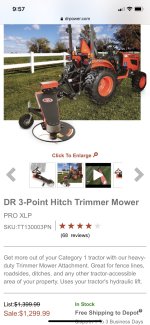
As I recall, somebody ( DR ? ) makes a 3 point fenceline following industrial strength weed whip that can cut under a wire fence and dodges fence posts with a spring loaded follower arm.
 
/ question on field fence #5  
As I recall, somebody ( DR ? ) makes a 3 point fenceline following industrial strength weed whip that can cut under a wire fence and dodges fence posts with a spring loaded follower arm.

You are correct. Plus it is on sale!

IMG_1174.JPG

MoKelly
 
/ question on field fence #6  
Tips and advice? Unless you can't live without them,ditch the horses,with exception of "No Climb"they destroy net fence. If sheep are for yard art,consider goats instead,they are far less likly to be killed by dogs and coyotes. If you go with sheep,consider a donkey to discourage dogs and coyotes coming around. Wild hogs? There's a long standing rule about hogs and fence. "If a hog can get his nose through it,he can go through it if he wants to". Depending on how you train it,a dog can be your best friend or worst nightmare on the farm. Catahoulas have been all around best for us but I don't reccomend them unless you are capiable and willing to train. Most folks are better off with a 20-30 lb dog that thinks they own the place but incapiable of maiming humans or livestock. The small dog alert's so master can handle it.
If only follow my advice on one thing,fit in and make friends with neighbors.
 
/ question on field fence #7  
6-8" off the ground won't even slow up hogs.....they'll just raise it up and be under as if there were no fence.

Here's handy dandy fence dispenser I made to feed the wire out...you're probably gonna want something for 3200' of fence. There is a pc of 2" square tubing up the center of the roll. To load a roll, I remove the top link pin, raise the lift and let the vertical go horizontal, slide the roll on while on the ground, then lower the lift, tip the roll up and reinsert pin.

I nail the wire to the first post or two, the drive down the line letting it spool off. I'll stop after about half the roll is played out, stick a crowbar in the roll letting it come around it hit the lift arm, the use the tractor to carefully inch forward and stretch the wire. All in all, a pretty hand setup.

One improvement from the photo...don't use a square plate at the bottom...It catches the wire on the corners. I had to sandwich a round plywood plate on top the metal plate to prevent that.

enhance
 
/ question on field fence #8  
If I was trying to keep hogs out that fence would be on the ground and I'd welcome all vines/weeds/crap that wants to grow into it. It wont stop them but if there's nothing they want on the other side they might walk around it.
 
/ question on field fence #9  
You do barbed wire....ditch the horses. They will find it in the worst sort of way.
 
/ question on field fence #10  
I have 3600 ft of 48” field fence, down to ground, with barb wire on top of that. Because We grow wine grapes, that the local deer think is delicious, I have barb wire over the top up to 8 ft high. The woven wire part is over 30 years old, and still in decent shape.

A lot of work to install initially, but many years ago, I got side tracked on a major building project, and the deer broke through a stretch in the back, and ate 20% of the crop that year. It was a significant loss.
Anything smaller than a coyote can still get in, but I welcome them for their varmint control results.
 
/ question on field fence #11  
I have seen coyote go right over my 48" and barbed wire on top....no problem. I put up the woven field fence and it is a pain keeping the mulberry and buckthorn from growing where the birds plant them. :mad: If you spray twice a year, it will stay pretty clear. Then, if you stop spraying, nasty weeds take over. I am now trying to get back to nice grass on the fence line. The horse neighbor has the 5 string wire fence and uses a string mower under the bottom wire. That is better and cleaner looking.

BTW....I found these fasteners to be GREAT for wood posts....I love them.

Murdoch's – Cat's Claw Fasteners - Fence Fastening System
 
/ question on field fence #12  
And field ready packaging! Whatever that means. :rolleyes:

Those cat claws are expensive. :eek: I bet I can get staples in faster. What takes a lot of time is those silly T-post wires. :mad:
 
/ question on field fence #13  
I put up 4ft woven wire (red top like in picture) fence for horses. I augered in 8-9" treated posts 30" in ground well tamped in every 50 ft, then four 7ft T posts between. A string between end wood posts so everything was straight. Used a 10ft PVC 1/2" conduit for a marker between Ts so they were spaced. Any property bend or corners or gates I used 3 posts with a 5-6" post horizontal near top, drilled with spikes then cross X wire on ratchets.
Fence I rolled out up to posts. Posts I pencil marked 10" up from ground. At start I wrapped post with fence, securely wrapped wire on itself tight, nailed every cross wire with galvanized barbed 2" staples (2.5" top & bottom).
I cut a 2x4 in half, drilled 5 holes, used carriage bolts, nuts, washers clamped near end tightly to fence & used four ratchet straps to stretch fence. It was super tight, then nailed to posts up 10", then wired to T posts. Top of T posts I used insulators and top of wood posts, white electric ribbon on a solar charger.
Ten inches up I can bush hog under. I don't want barbed wire anywhere around horses.
 
/ question on field fence #14  
And field ready packaging! Whatever that means. :rolleyes:

Those cat claws are expensive. :eek: I bet I can get staples in faster. What takes a lot of time is those silly T-post wires. :mad:
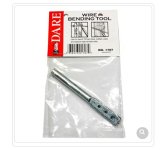
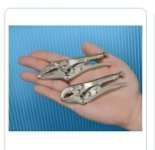
T post clamps aren't too bad with the bending tool and I use small vice grips where I can.20210211_152942.jpg20210211_153541.jpg
 
/ question on field fence #15  
Horse owners with large pastures that also have cows use barbwire all the time. If it is a large pasture and fence is visible. it is ok most of the time. I know of horses hurt on wood fence. I have never had a horse more than scratched on barb wire that is tight. I did have an uncle that had a dog that died from trying to go under it. My bottom strand is smooth wire and my wire is tight. You can use all smooth wire if you can also run hot wire. But nothing will keep hogs out.
 
/ question on field fence #16  
Field fence and horses don't get along too well. They'll tear it up by stomping it and trying to nose through it. How do I know? I put up field fence several years ago when it was what we could afford. Last year I replaced much of it with no climb horse fence, much better and safer. When I installed either fence I raised it above the ground about 2 inches or so. Mostly so I could weedeat if I wanted to but also to keep the bottom wire off the ground and not rust away after 20 years or so.
 
/ question on field fence
  • Thread Starter
#17  
Thanks for all the good practical advice and equipment recommendations. I'm going to give this some thought and study up a bit more.
 
/ question on field fence #18  
/ question on field fence #19  
I'm also in the planning stages of upgrading my fencing with similar issues. Hogs and coyotes are a big issue for me and I want to do everything that I can to keep them out. From talking to several owners of high fence properties, they set their corners and run barb wire along the ground to create a straight line for their posts. Then they install the fence a couple inches off of the ground so it lasts longer. Most fence will be Class 1 galvanized, which is OK. Class 3 has three times more protection from rust over Class 1, so it's more then worth the extra upfront cost. Keeping plants off of the fence will help keep the fence dry, which will also extend the life of the fence. I'm told that there are other products out there that do not contain salt like Round Up does, but I forget what they are right now.

I have goats and I found out real fast that they will stick their head into anything they can and get stuck from their horns. My fence will be 2x4 woven horse fence. I've wasted way too much time trying other types of fencing to learn that it's faster, cheaper and less stressful to spend the money upfront and get the best possible fence then trying to get by on something that costs less.

If sheep have horns, I bet they will stick their heads through a field fence too. When deciding between sheep or goats, I went with goats because they do so much better in my climate. I read that sheep look for a way to die. Sheep also cannot process zinc, so you have to feed them separately from horses. Goats eat everything. Goats are easy to sell, especially small ones as pets.

I have horses. That was my biggest mistake ever!!! But now that it's done, I have to deal with it, which is another reason for the 2x4 fencing. I currently have a hot wire around the inside of my fence, at the top of my fence, and at the bottom of the outside of my fence. The hot wire keeps the goats and horses off of the fence. I'm not as worried about them getting out, or breaking through the fence, it's the scratching on the fence that does all the damage. Once each horse touched the hot wire, they learn real fast and never do it again. My biggest girl actually jumped several feet into the air, and spun in the air almost all the way around before hitting the ground and running away. I've been zapped twice, so I know what it's like. I wanted to run away from it too!!! Goats are not affected by the hot wire like the horses are, but they still respect it. Coyotes, hogs and even racoons, all learn quick to avoid the hot wire. I have it about 6 inches off of the ground outside of the fence and we've actually heard a coyote touch it and start screaming as it ran away. Yelp Yelp Yelp for at least five minutes, until we couldn't hear it again. I walk the fence all the time and look at the tracks on the ground. It's real easy to see where an animal has touched the fence, they tear up the ground getting away from it!!!! Since installing the hot wire, I have not lost a single chicken to coyotes or racoons. I added a single strand around my deer hunting food plot a few yeas ago to keep the hogs out. Before, they would destroy everything, eat all the corn and scare off the deer. I tried shooting as many of them as possible, but never got enough to make a dent. The hot wire is six inches off of the ground and it's stopped them cold. the deer step over it, the hogs don't even test it.

My new fence will have 3 hot wires just like I have now. It's proven to work great. All my corner posts and gate posts will be set in concrete. My line posts will be packed soil, but I'll probably set them in concrete every 100 feet just for the added strength on long runs. I will drill all my holes with a 12 inch auger. I really like the one I bought from Tractor Supply that is made by Country Line. It's my third auger and the first one that actually digs through hard packed red clay.
 
/ question on field fence #20  
I ran high tensile for my fences on my horse pastures, 18", 36" and 54" and I haven't had any issues. I have about 7 acres of pasture, 1 being 1/2 and acre and the others in the 2- 2 1/2 acre range, typically they have good grass in them, some have shade areas, they can always go into the barn if they want and they always have access to water. I have found with them if they have plenty to eat, water and nothing is scaring them through the fence they don't both with the fence. the 36" height wire is hot.

We don't have hogs (yet in this area), coyotes and deer pass through it freely but don't bother the horses. dogs bothered them once (they aren't able to anymore) and per foot it is the cheapest to run.
 
 
Top