A question for a dairy farmer

/ A question for a dairy farmer #1  

Bsavulis

Bronze Member
Joined
Dec 21, 2016
Messages
51
Location
Putnam, Connecticut
Tractor
Kioti CK25
I know i could google for the answer to my question, but I prefer actually communicating with a real live person whenever possible. I hope it makes others know their experience and expertise are appreciated.


How much milk on average does a cow produce in a day, that can be collected? I am sure some must go to the calf? How long do they produce milk after having a calf? How many calves can they have in a lifetime?

No I am not getting a cow! I was behind a big tanker truck full of milk during my commute. Got me thinking about cows, and just how many or how long it must take to fill that rig. Just trying to be a bit smarter.

Thanks
Brian
 
/ A question for a dairy farmer #2  
There are many breeds of cows that provide different amounts and quality of milk...

We've got a Jersey that's feeding a calf and we collect about a gallon to a gallon and a half today from. We could probably get closer to two gallons a day if we locked the calf up at night. A Holstein would easily double that. Usually you get milk a cow 8-9 months a year and you'll probably have 7-10 years of production.

I'm not a dairy farmer but I did sleep at a holiday in once so these are more opinions from limited experience than they are solid facts.
 
/ A question for a dairy farmer #3  
A friend of mine has a small dairy farm. He milks about 60 cows twice per day, and says he gets about 6-7 gallons per day from each cow.
 
/ A question for a dairy farmer #4  
Holsteins often can produce 8-10 gallons a day. They are the highest producing milk cow. Jersey's have the lowest milk production of the dairy breeds but the highest butterfat content (Edit: Of the breeds in the US, not sure about around the world). Like everything else, there are tradeoffs .

They produce milk about 9 months out of 12.

I actually grew up on a beef farm/ranch but worked at a dairy milking 200 head morning and night in High School. (Edit: To clarify, While they milked morning and night, I only milked 5 weeknights after school and morning and night one day of the weekend, the other was my day off.)
 
Last edited:
/ A question for a dairy farmer #5  
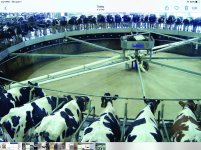
There's a dairy over in NE Indiana called Fair Oaks Farms. They have 36,000 cows. 9 barns spread out over thousands of acres. Each barn has a merry-go-round that will milk 72 cows at at time. They also told us they get 8ish gallons per cow. The cows are free to come and go as they please. When they feel like getting milked, they stand in line and wait their turn for the merry-go-round, and climb on board as it goes around. A worker puts a chain across the back, cleans their teats, and sticks on the miller. The cow takes a ride around the thing and gets off at the end and heads back to the barn on its own to eat/sleep socialize with the other cows. It's a strange thing to watch, but they are herd animals and just follow each other around all day. Each animal is kept track of by RFID ear tags. Weight and milk production, etc...

2B6F4576-32E8-4755-8A7E-DA81EA876645.jpg
 
/ A question for a dairy farmer #6  
Growing up we knew a family that had 11 kids. They always had a cow and calf. It provided them with milk and cheese. Anything left over was given to the pigs and turned into pork. The guy was a professor at Notre Dame and quite an interesting guy. Pretty calm man for 5 boys and 6 girls. :laughing:
 
/ A question for a dairy farmer #7  
There's a dairy over in NE Indiana called Fair Oaks Farms. They have 36,000 cows. 9 barns spread out over thousands of acres. Each barn has a merry-go-round that will milk 72 cows at at time. They also told us they get 8ish gallons per cow. The cows are free to come and go as they please. When they feel like getting milked, they stand in line and wait their turn for the merry-go-round, and climb on board as it goes around. A worker puts a chain across the back, cleans their teats, and sticks on the miller. The cow takes a ride around the thing and gets off at the end and heads back to the barn on its own to eat/sleep socialize with the other cows. It's a strange thing to watch, but they are herd animals and just follow each other around all day. Each animal is kept track of by RFID ear tags. Weight and milk production, etc...

View attachment 682417

On the high tech farms, that RFID ear tag or usually a RFID tag on a chain around their neck, can also meter the optimum amount of feed for that cow, to maximize the milk output per pound of feed.
 
/ A question for a dairy farmer #8  
Bearsixty7 answered most of your Qs. Usually take the calf out of the picture very quickly by weaning it.

I grew up on a dairy farm, but we only milked maybe 40 head morning and night, mostly Holstein but with 2 or 3 Jerseys. I was sooo glad when we moved to a small town and took up service station business instead. I hated dealing with the animals.

Ralph
 
/ A question for a dairy farmer
  • Thread Starter
#9  
Thanks to all for the great answers. I am certainly more informed now than just a couple of hours ago. I like information like this, you never know when it might prove handy. About 18 years ago I was with a coworker listening to the radio. There was a contest for tickets for a family of four to Disney on ice, or something like. The question was, What company was the largest toy distributor in the world. I told the guy, call and tell them McDonald's. His family had a great time at the show.

Thanks again.
 
/ A question for a dairy farmer #10  
Bearsixty7 answered most of your Qs. Usually take the calf out of the picture very quickly by weaning it.

I grew up on a dairy farm, but we only milked maybe 40 head morning and night, mostly Holstein but with 2 or 3 Jerseys. I was sooo glad when we moved to a small town and took up service station business instead. I hated dealing with the animals.

Ralph

I have a great respect for dairy farmers, it's a 24/7 kind of job, and where I came from, the kids all did their part. My buddy in high school used to come to school smelling like disinfectant, and even occasionally with his barn shoes on. He got up, helped with the milking, rode the bust to school and helped with the milking that night...and every night. My hat comes off to you guys.
 
/ A question for a dairy farmer #11  
There's a documentary on Amazon called 'Milk Men' about dairy farms in the PNW, it's well done and I know several of the people in it personally, worth watching if the subject interests you.
 
/ A question for a dairy farmer #13  
Almost all of the small dairy farms have gone out of business.
The 40 - 60 cow dairies started going out in the early 70's,
by the 90's anything under 200 cows was small and now most of the dairy's left
are 3-5000 cow and getting larger.
For awhile it was hoped that the robotic milking machines would save some of the smaller
(under 200 cow) dairy's but it didn't happen. When they work right it is simply amazing to watch them in action.
 
/ A question for a dairy farmer #14  
There's a dairy over in NE Indiana called Fair Oaks Farms. They have 36,000 cows. 9 barns spread out over thousands of acres. Each barn has a merry-go-round that will milk 72 cows at at time. They also told us they get 8ish gallons per cow. The cows are free to come and go as they please. When they feel like getting milked, they stand in line and wait their turn for the merry-go-round, and climb on board as it goes around. A worker puts a chain across the back, cleans their teats, and sticks on the miller. The cow takes a ride around the thing and gets off at the end and heads back to the barn on its own to eat/sleep socialize with the other cows. It's a strange thing to watch, but they are herd animals and just follow each other around all day. Each animal is kept track of by RFID ear tags. Weight and milk production, etc...

View attachment 682417

I remember seeing Mike Rowe on Dirty Jobs do a show on that dairy! It apparently revolutionized the show and what the Discovery channel was willing to cover. At the time it was already the #1 show on Discovery. A Farm Changed Mike Rowe?s Career - Ellinghuysen.com

Free flow dairies are becoming more normal. Growing up, we had cows nearby that were trained to climb stairs to the milking parlor. Fun to watch.

Holsteins average 23,000 pounds of milk in a year (nine months). That's over ten gallons a day during the nine month lactation. For perspective, they are about five feet tall at the shoulder. Having grown up around dairy farmers, I can attest to the 24x7x365 lifestyle. One year, one of our neighbors went to Disney world for a week. It was his first time of the farm for longer than three hours for forty years. But "If you love what you do..." Made me think about other careers...though I now raise cattle, just not as a dairy farmer. My life isn't that regular, and dairy cows are big on every day being exactly like yesterday, but even more perfect.

All the best,

Peter
 
/ A question for a dairy farmer #15  
Milk production from a cow is measured in pounds per year, and as others have said Holsteins are the most productive 8-10 gallons a day. The top producing cows are 30,000 to a high of about 36000 pounds a year. So a cow producing 10 gal a day @ 8.6 pounds per gallon is 31,400 pounds annually.

Cows must be bred annually to continue to produce milk, so each year they are bred. The goal is to inseminate them with a high production bull lineage so to get the most milk output. For the female calves, they become part of the milking herd after their first year they are bred then once they calve and start producing milk.

As others have said Jerseys have the highest butter fat/richest milk at 4.5% vs Holsteins at 3.5%.

I was raised with Jersey's on the farm, and my father and grandfather milked, bottled, and delivered fresh milk daily for many years in a small community in NE PA from the 1930's to the late 50's until regulations on pasteurization (cooking the milk) and larger firms made it no longer viable for a small enterprise to compete. What's interesting is this is now coming back, like beef, and craft beer and other locally sourced food.
 
/ A question for a dairy farmer #16  
I remember seeing Mike Rowe on Dirty Jobs do a show on that dairy! It apparently revolutionized the show and what the Discovery channel was willing to cover. At the time it was already the #1 show on Discovery. A Farm Changed Mike Rowe?s Career - Ellinghuysen.com

Free flow dairies are becoming more normal. Growing up, we had cows nearby that were trained to climb stairs to the milking parlor. Fun to watch.

Holsteins average 23,000 pounds of milk in a year (nine months). That's over ten gallons a day during the nine month lactation. For perspective, they are about five feet tall at the shoulder. Having grown up around dairy farmers, I can attest to the 24x7x365 lifestyle. One year, one of our neighbors went to Disney world for a week. It was his first time of the farm for longer than three hours for forty years. But "If you love what you do..." Made me think about other careers...though I now raise cattle, just not as a dairy farmer. My life isn't that regular, and dairy cows are big on every day being exactly like yesterday, but even more perfect.

All the best,

Peter

The guy I know that has the dairy farm got it from his parents and brothers. They have a very nice pond on the farm. Probably 15 acres. There's an old wooden pier and a couple sunken rowboats buried in the weeds. I asked them about it. The kids didn't know it was there. They were in their late 20's and had never been on a boat in that pond. They never swam in that pond. The only thing they did with that pond was throw in an irrigation line to water their corn. They got up, milked the cows, went to school, milked the cows, went to bed, repeat. The only time they left the farm was during the 4H fair.

Don't get me wrong. They are nice people. Extremely nice. But I can't imagine living on a farm, with that beautiful pond, for 20 years, and never dip your toes in the water, hop in a rowboat, or go fishing at least once.

One of the boys got married and moved to a horse farm that his wife's family owned. Two more went away to college and started their own farms, no cows. The 4th one stayed at the dairy. His father retired, and unfortunately died in a car accident after having a heart issue. So it's just him. His mom lives on the property in the other house. They are still a close family, however, most days it's just him and the cows.
 
/ A question for a dairy farmer #17  
Mom grew up on a family dairy farm and she had cows to milk by hand before and after school...

The farm had been in the family for generations but my cousin sold off the herd and got a job driving city buses and loves not being a farmer...

My Grandparents only left the farm 2 nights for thier honeymoon and 35 years later when they traveled to California and spent 3 weeks with us.
 
/ A question for a dairy farmer #18  
That life suits some people just fine. I couldn't do it. I like to travel and see new things. As our kids were growing up, we would take one big 2-week vacation every other year, and the other years we would take 2 small 1-week vacations. We wanted them to see and try things out of their regular routine and lifestyle. They remember that and still enjoy traveling.
 
/ A question for a dairy farmer #19  
Small farms have been disappearing because it's too hard to pay the bills on a small scale farm.
Property taxes are out of control nearly every where nationwide, Feed prices are double or triple, fuel prices to operate up 3-4x (I remember 60-70cent/gallon gas), medical and insurance is 5-8x higher if they even have any.

A gallon of milk back in the 70's was under $2. Today, 50 years later, you can still get milk for around $2 a gallon some places but much is closer to $3-4 gallon and most of that increase in price goes to the dairy that collects and distributes the milk and to the stores that sell it. Dairy farms barely see a 50 cent per gallon increase in 50 years. Do the math. No one today wants to work so hard for so little pay.
 
/ A question for a dairy farmer #20  
Almost all of the small dairy farms have gone out of business.
The 40 - 60 cow dairies started going out in the early 70's,
by the 90's anything under 200 cows was small and now most of the dairy's left
are 3-5000 cow and getting larger.
For awhile it was hoped that the robotic milking machines would save some of the smaller
(under 200 cow) dairy's but it didn't happen. When they work right it is simply amazing to watch them in action.

Small dairy farms are alive an well in Ohio.

They are all around me.

Yes, they cry a lot, but farmers do that, a lot.
 
 
Top