Working rail roads and their tracks.

/ Working rail roads and their tracks. #501  
What are the ramifications of having an old line no longer used run through a property?
 
/ Working rail roads and their tracks. #502  
What are the ramifications of having an old line no longer used run through a property?

It depends. In our case, the railroad officially abandoned it, so it reverted back to the property owners, so just like any other private property now. As soon as they officially abandoned it, most of the farmers that owned land on each side of it scooped up all the ballast rocks to reuse elsewhere and converted it back to farm fields. The section through our place isn't conducive to crops, so we just let it grow over, which stopped the dirt bikers and snowmobilers in a few short years. The section on our place was also the location of a siding about 1/2 a mile long, so the grade is double wide on half of our place. They had to cut through a hill to make the grade and that area of the property is so steep and overgrown that I've only seen the back acre twice since 1989! :laughing:

If they hadn't abandoned it, it would have remained an easement in our case. I wish they would have converted it to a rails-to-trails instead of abandoning it. It would have been nice having a hiking/biking trail right there.
 
/ Working rail roads and their tracks. #503  
Yes, I can read, your point was 14k acres was a big ranch on the East Coast. My point was 14k acres is a small farm in Arizona:laughing:

Yea but 14,000 on the East coast can feed more cows then a million of non irrigated acres in Arizona.
 
/ Working rail roads and their tracks. #504  
What are the ramifications of having an old line no longer used run through a property?

I'd say theres 4 scenarios for the most part:

1. It stays abandoned, but the RR company keeps the property ROW-that is what is happening with the rails I just posted pictures of. Its kind of in limbo.
2. It stays abandoned, but the Railroad gives up on the ROW and the adjoining landowners take it over, like Moss just explained.
3. It reverts back to an active Railroad, which just happened in my area between Media, PA and Wawa, PA :) Hopefully it extends even further.
4. It becomes a rails to trails project
 
/ Working rail roads and their tracks. #505  
It depends. In our case, the railroad officially abandoned it, so it reverted back to the property owners, so just like any other private property now. As soon as they officially abandoned it, most of the farmers that owned land on each side of it scooped up all the ballast rocks to reuse elsewhere and converted it back to farm fields. The section through our place isn't conducive to crops, so we just let it grow over, which stopped the dirt bikers and snowmobilers in a few short years. The section on our place was also the location of a siding about 1/2 a mile long, so the grade is double wide on half of our place. They had to cut through a hill to make the grade and that area of the property is so steep and overgrown that I've only seen the back acre twice since 1989! :laughing:

If they hadn't abandoned it, it would have remained an easement in our case. I wish they would have converted it to a rails-to-trails instead of abandoning it. It would have been nice having a hiking/biking trail right there.

Any idea when the last locomotive passed through and when were the rails pulled?

Sounds like their could be some interesting finds at least from what the metal detector guys tell me...

Probably not worth reclaiming with some dozer time?
 
/ Working rail roads and their tracks. #506  
I'd say theres 4 scenarios for the most part:

1. It stays abandoned, but the RR company keeps the property ROW-that is what is happening with the rails I just posted pictures of. Its kind of in limbo.
2. It stays abandoned, but the Railroad gives up on the ROW and the adjoining landowners take it over, like Moss just explained.
3. It reverts back to an active Railroad, which just happened in my area between Media, PA and Wawa, PA :) Hopefully it extends even further.
4. It becomes a rails to trails project

Ya, that about covers it. :thumbsup:
 
/ Working rail roads and their tracks. #507  
Any idea when the last locomotive passed through and when were the rails pulled?

Sounds like their could be some interesting finds at least from what the metal detector guys tell me...

Probably not worth reclaiming with some dozer time?

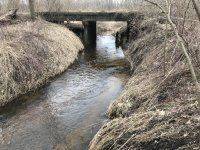
Trains still ran through there well into the 80's, as I used to have to stop for them when my wife and I were dating. They pulled the tracks and ties sometime before 1989 when we bought the property. The ballast is still there, as is the wooden single-span trestle. Apparently it's still pretty stout, as some doofus the county contracts with drives an excavator over it about every 5 years to clean out the ditch it spans. Hasn't fallen in yet. I may have to inquire about that with my insurance agent. I'd kinda like to have the trestle removed, but I only own half of it length-wise. Property line goes right down the middle.

I've found the occasional spike or plate here and there, as well as a cement marker. I imagine I could find a lot more with a metal detector.

Whenever I need rocks of that size, I go down there with my toothed bucket and grab a load.

A2641808-14E6-4683-A9D1-E9E477982557.jpeg
 
/ Working rail roads and their tracks. #508  
You have your own trestle??? and it goes over water???

Friends have been trying for years to get to their 9 acres across a small creek with no luck... the old bridge deteriorated... very old and they took it out... funds were tight so they did nothing... ten years later they have the money and county said there was never a bridge there so no luck... where as a repair permit would not be a problem... their bridge dated from the 1920's...
 
/ Working rail roads and their tracks. #509  
You have your own trestle??? and it goes over water???

Friends have been trying for years to get to their 9 acres across a small creek with no luck... the old bridge deteriorated... very old and they took it out... funds were tight so they did nothing... ten years later they have the money and county said there was never a bridge there so no luck... where as a repair permit would not be a problem... their bridge dated from the 1920's...

Yep. Sounds romantic, but it's a RR bridge over a drainage ditch. :laughing: Water runs all year. Has frozen solid twice since 1989. It drains probably 9-10 square miles and eventually dumps into the Kankakee river, which joins the Des Plaines river SW of Joliet, IL to form the Illinois River, which dumps into the Mississippi at Grafton, IL just NW of St. Louis. The Kankakee river was originally 250 miles long, but was straightened to 90 miles long and drained the Grand Kankakee Marsh, which was known as the Everglades of the North. Interesting story. 500,000 acres drained.


Have you ever gone on Google Earth on a PC and used the time button to go back in time? It shows satellite and sometimes aerial photos of areas going back from just a couple years to as far back as the 30's in some urban areas. Their bridge might show up on it.
 
/ Working rail roads and their tracks. #510  
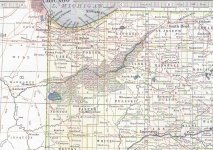
This map shows the abundance of rail lines through the area. I don't know the date of the map. South Bend is towards the upper right corner.

447CC458-9895-4121-BB27-CF3D2022450D.jpeg
 
/ Working rail roads and their tracks. #511  
There's also a continental divide here, just south of South Bend. There's an area near the AM General plant on the south side of town, where the water drains off of two hillsides. One side, all the water flows south down to the Mississippi and out to the Gulf of Mexico. The other side, all the water flows north to the St. Joseph River, into Lake Michigan, 3 other great lakes, and the St. Lawrence river out to the north Atlantic.

So this area was a great portage between those two watersheds. The French explorer Bad title - Wikipedia called locally just LaSalle, was one of the first Europeans to come through the great lakes and up the St. Joe to the area that is now South Bend. At a bend in the river, in the backyard of my parents' house, there is a ravine that he walked up. Then they walked about a mile and a half over to the headwaters of the Kankakee, and down south they went.

There used to be a tree about 400 yards from my parents' house called the Council Oak Tree. It was located in a cemetery. Supposedly, that's where LaSalle met with the local Native Americans, the Potawatomi, and did a treaty with them...
The Potawatomi at Council Oak – Citizen Potawatomi Nation

Anyhow, I could go on and on. The tree fell down in the early 90's. My father ran over and cut off a short piece before the city blocked it off from other souvenir hunters. I still have it today. There are hundreds of descendants of that tree in the cemetery and around town. My parents are buried in that cemetery, where if I stand, I can see the tree stump, my childhood house, and the spot where LaSalle came up from the river. Neat history. :)
 
/ Working rail roads and their tracks. #513  
I'm always surprised how many railroads were in eastern states. Seems like one every 5 miles or so.

In the intermountain west there are several places where you could go several hundred miles without crossing one.

http://www.personal.psu.edu/staff/r/p/rpt117/sra211/national_rail_map.jpg

Bruce

Yep. And the roads are narrower out east, and more numerous, too.

I think it's a combination of the age of the country, the progression of Europeans from East to West, the abundance of water in the East VS the West, the coal and timber in the East VS the prairie from about mid Ohio to the West, industry in the East Vs the West, etc....
 
/ Working rail roads and their tracks. #514  
There's also a continental divide here, just south of South Bend. There's an area near the AM General plant on the south side of town, where the water drains off of two hillsides. One side, all the water flows south down to the Mississippi and out to the Gulf of Mexico. The other side, all the water flows north to the St. Joseph River, into Lake Michigan, 3 other great lakes, and the St. Lawrence river out to the north Atlantic.

So this area was a great portage between those two watersheds. The French explorer Bad title - Wikipedia called locally just LaSalle, was one of the first Europeans to come through the great lakes and up the St. Joe to the area that is now South Bend. At a bend in the river, in the backyard of my parents' house, there is a ravine that he walked up. Then they walked about a mile and a half over to the headwaters of the Kankakee, and down south they went.

There used to be a tree about 400 yards from my parents' house called the Council Oak Tree. It was located in a cemetery. Supposedly, that's where LaSalle met with the local Native Americans, the Potawatomi, and did a treaty with them...
The Potawatomi at Council Oak – Citizen Potawatomi Nation

Anyhow, I could go on and on. The tree fell down in the early 90's. My father ran over and cut off a short piece before the city blocked it off from other souvenir hunters. I still have it today. There are hundreds of descendants of that tree in the cemetery and around town. My parents are buried in that cemetery, where if I stand, I can see the tree stump, my childhood house, and the spot where LaSalle came up from the river. Neat history. :)

Neat history Moss.
 
/ Working rail roads and their tracks. #515  
Thanks. Lifelong resident, as was my father. Still live in the same ZIP code. Of course, ZIP codes weren't implemented until I was two years old, but you get the idea. :laughing:
 
/ Working rail roads and their tracks. #516  
Very interesting. Sounds like you could kayak to Mexico.
 
/ Working rail roads and their tracks. #517  
I'm always surprised how many railroads were in eastern states. Seems like one every 5 miles or so. .. In the inter-mountain west there are several places where you could go several hundred miles without crossing one. .. Bruce

When some one asks. "Why do we always wait for trains?" ...

Same response, esp E of the Mississippi: Which was here first? What were roads like anywhere in NA in the late 19th century? What commerce or travel was available, and then once railroads connected the East to the West? :D

btw, how long before cars and trucks happened? Radio was as good as fiber internet and 5G "for a minute". ;) (~2 decades) There are plenty of TV "crow's feet" remaining on rooftops and towers to this day, working or not. (mine isn't :cool:)

Anyway, props to Bruce, Moss, and of course ArlyA & others for all the great pics and links!
 
/ Working rail roads and their tracks.
  • Thread Starter
#518  
You can kayak to Mexico from NW Montana, northern MN and of course ND. The water shed does go up to Hudson bay at various locations up there like the red river valley. In northern Mn where my spouse came from, all that water flows NE to the bay and folks have kayaked to it.
 
/ Working rail roads and their tracks. #520  
I'm always surprised how many railroads were in eastern states. Seems like one every 5 miles or so.

In the intermountain west there are several places where you could go several hundred miles without crossing one.

http://www.personal.psu.edu/staff/r/p/rpt117/sra211/national_rail_map.jpg

Bruce

Youd be amazed how many railroads are out here. More abandoned than running it seems like....
The first to go are the short lines. :(
We got tons of em.
Im actually surprised at the ones we have that still run. Very few customers left.
 

Marketplace Items

207278 (A52708)
207278 (A52708)
2016 Cadillac XTS (A61569)
2016 Cadillac XTS...
2025 GPS Trailer (A56858)
2025 GPS Trailer...
1988 Ford 8210 (A60462)
1988 Ford 8210...
BOBCAT 68 INDUSTRIAL GRAPPLE BUCKET ATTACHMENT (A60736)
BOBCAT 68...
2002 Bobcat 863 High Flow Compact Wheel Loader Skid Steer (A61567)
2002 Bobcat 863...
 
Top