Ballast Centre of Gravity

/ Ballast Centre of Gravity #1  

kenlip

Silver Member
Joined
Nov 3, 2017
Messages
233
Location
NSW Australia
Tractor
Kubota MX5100 with Challenge FEL and 4:1
I have a Kubota MX5100, with an FEL to which I attach either a 4-in-1 bucket or pallet forks.

The tyres are filled.

I need to make a ballast box.

My property is very hilly.

I have seen some very impressive ballasts on this forum. However, they all seem to have rather high centres of gravity (COG). Given the topography of my property, it makes sense to me to try to get the COG as low as possible. Does this make sense to you folks?

I have access to dozens of brake rotors to use in the ballast.

All advice and hints on how to design and build the ballast with the lowest possible COG in mind would be greatly appreciated.

Cheers
Ken
 
/ Ballast Centre of Gravity #2  
Hang stacks of the rotors under the engine/transmission as much as possible. You'll get the additional advantage of balancing the sidebite of the front and rear tires if you should start sliding sideways.

change the muffler configuration. place it down and low.

Change the fuel tank layout. Fuel is heavy. Get it lower.

No cab ( ! ).
 
/ Ballast Centre of Gravity #3  
Start by setting rear wheels/tires wide. Increasing rear wheel spread 4" to 6" increases stability a lot.
If you have R1/ag wheels/tires increasing wheel width is easy. If you have R4/industrial tires increasing wheel spread may require wheels spacers on an MX.


Few use ballast boxes on tractors weighing over 2,000 pounds. Most use Three Point Hitch implements as counterbalance, which can be carried low to the ground. Implement protrusion increases effective weight as counterbalance.

For 98% of my Loader work I carry a 620 pound/60" Rollover Box Blade or a 650 pound/60" Cultipacker. Both mount low. (My L3560 with LA805 Loader is only a tad lighter than your MX and my tires are inflated with air. ) (( Your implements will be wider and possibly heavier than mine.)) On the infrequent occasion when I need to unload an 1,700 pound pallet from a low trailer I mount a 950 pound Disc Harrow, which protrudes far to the rear.

Your Loader has more lift than mine, however your tires are loaded. Your counterbalance need will be 800 pounds max with loaded rear tires.

Once you have counterbalance proportional to your Loader capacity, more-more-MORE TPH weight does nothing for you.


YES
 
Last edited:
/ Ballast Centre of Gravity #4  
For very hilly terrain I'd also recommend reversing the front tyres/wheels so that the tread goes the opposite way. :thumbsup:
 
/ Ballast Centre of Gravity #5  
We have a MX5800 with R4 tires. I definitely agree about setting the rear wheels as wide as possible. On our MX the rear wheels do have different settings for different widths without the use of spacers. The first thing we asked our dealer to do was to set the rear wheels as wide as possible. As a result, the rear wheels won't fit within the fenders on trailers with 78" between the fenders. Our MX measures about 77" wide where the tires hit the ground but a little more than 78" a little higher up.
 
/ Ballast Centre of Gravity
  • Thread Starter
#6  
Thanks, Jeff,

Start by setting rear wheels/tires wide. Increasing wheel spread 4" to 6" increases stability a lot.


Already done


Few use ballast boxes on tractors weighing over 2,000 pounds. Most use Three Point Hitch implements as counterbalance, which can be carried low to the ground. Implement protrusion increases effective weight as counterbalance.

I don't have any implements other than the loader and the forks. I am not farming. It's a weekender hobby property. I have used the tractor a lot for hauling and lifting stuff. I was hoping to use the 4-in-1 for road maintenance, but the hills and the amount of loose rock in the ground make it extremely difficult to achieve a meaningful result. With this problem in mind, I am not against buying a suitable implement that I could use to maintain the roads (these are not the lovely level driveways that we see in all the videos about box scrapers and the like).

One of the lifting tasks I have struggled with has been moving 1,000 litre IBCs filled with water. They weigh 1,000kg /2,200lbs! Hence, my desire to get some decent ballast.

Your Loader has more lift than mine, however your tires are loaded. Your counterbalance need will be 800 pounds max with loaded rear tires.

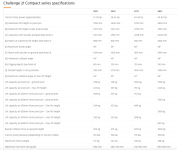
I don't have a Kubota loader. I have a Challenge 2821 loader. The specs are in the attached screengrab.


Once you have counterbalance proportional to your Loader capacity, more-more-MORE TPH weight does nothing for you.

This is part of my problem - working out the maximum amount of ballast that will match the loader capacity.

I have given some thought to using the money the ballast would cost towards buying an implement to help with grading the roads, and to possible add weight to it as required if I am doing maximum lifting.

The is no cab, but definitely a ROPS and seatbelt!

Ken
Screen Shot 2020-08-27 at 9.24.54 pm.png
 
/ Ballast Centre of Gravity
  • Thread Starter
#7  
For very hilly terrain I'd also recommend reversing the front tyres/wheels so that the tread goes the opposite way. :thumbsup:

Thanks, Wagtail.

Please elaborate. Are you suggesting this so that one might get a bit more traction from the front wheels when going down hills? In other words, rely mostly on the rear wheels for traction when going uphill and on the front wheels for traction when going down hills.
 
/ Ballast Centre of Gravity #8  
Use a rear lift forks to move the totes, put some weight in the bucket. Why would you want to stress the front axle with that much weight, especially on rough surfaces ?
 
/ Ballast Centre of Gravity #9  
I agree with carrying a loaded tote on the 3PH for your counter balance ballast. Purchase a heavy duty carry all frame or a set of 3PH pallet forks to carry the totes. While I agree that you gain little with additional weight for ballast, that all changes when that additional weight is something you want to be relocating! Hay farmers do this all the time and have for years! One round bale on the rear on a hay spear and one on a hay spear on the loader. If loading on a trailer, load the tote on front the set down the rear one and then pick it up ti load. Hopefully you are loading your trailer (if loading a trailer) on level ground!
 
/ Ballast Centre of Gravity #10  
I made a 2x2x1 foot ballast box that weighs in at about 500-600 pounds (concrete weighs about 150 pounds per cubic foot), and it mounts "vertical", but there is no reason same dimension box could not be mounted "horizontal" if CG is of concern.... It just makes tractor longer and you have to be more concerned/aware about what is behind you....

20190513_134501.jpg

Dale
 
/ Ballast Centre of Gravity #11  
Thanks, Jeff,

[/i]

Already done


I don't have any implements other than the loader and the forks. I am not farming. It's a weekender hobby property. I have used the tractor a lot for hauling and lifting stuff. I was hoping to use the 4-in-1 for road maintenance, but the hills and the amount of loose rock in the ground make it extremely difficult to achieve a meaningful result. With this problem in mind, I am not against buying a suitable implement that I could use to maintain the roads (these are not the lovely level driveways that we see in all the videos about box scrapers and the like).

One of the lifting tasks I have struggled with has been moving 1,000 litre IBCs filled with water. They weigh 1,000kg /2,200lbs! Hence, my desire to get some decent ballast.


I don't have a Kubota loader. I have a Challenge 2821 loader. The specs are in the attached screengrab.


This is part of my problem - working out the maximum amount of ballast that will match the loader capacity.

I have given some thought to using the money the ballast would cost towards buying an implement to help with grading the roads, and to possible add weight to it as required if I am doing maximum lifting.

The is no cab, but definitely a ROPS and seatbelt!

Ken

I am no expert, but I can share my experience.

Like you, my property is sloped and I do not have heavy attachments so I built a 3pt concrete counterweight. My tractor lift capacity is quoted at about 1200Kg, both the loader at pins and the 3pt (50 cm back). I have loaded tires - 200Kg each.

First of all, my tractor feels soooo much more stable with the counterweight. Hills are easy and I can safely lift so much more with the forks so do not delay, get building! I still avoid side slopes as much as possible.

For low COG, just build wide low forms with 3pt hookup and steel reenforcement and fill with concrete.

How heavy? I struggled to decide on the counterweight size and in the end decided on 600Kg. I soon learned it should have been heavier. Lifting my newly poured 600kg counterweight off my trailer with my forks (and no counterweight yet) lifted my rear slightly - not safe or fun!! Here is the math... 1200 tractor loader capacity - 500 max safely = 700kg counterweight required plus add 100 for extra safety factor. With my 600kg counterweight attached I can now lift 900Kg but have to keep it low. I wish my counterweight was 700 or 800 so I could be comfortable lifting 900 to 1000 (eg: a full pallet of sheetrock). For you, lift one of your IBC totes of water and determine what percentage of a full tote makes your rear end light or maybe even lifts your wheels and then do some math. 1500kg max loader capacity minus comfortable lift capacity = minimum counterweight size plus 100 for safety. Of course, do not stain your 3pt capacity.
 
/ Ballast Centre of Gravity #12  
A box blade isn't just for nice driveways. It will move dirt from uneven surfaces too. I've used mine to level out parts of my land. Our soil has a lot of large rocks in it. The BB still works. It's a better way to move dirt than the loader bucket. I bought a ballast box to fill with concrete but I haven't gotten around to it yet, so I have been using my box blade. I'd like a little more weight but it's much better than nothing on the back.
 
/ Ballast Centre of Gravity #13  
The further the counter weight is from the 3 pt lower arm hookups the more effective it is balancing the loader. If you make one keep it's center of gravity a little to the rear by extending the 3pt hookup a little.

Loaded tires have center of gravity at the axle closer to the loader and this is why they are not as effective as an implement on the back.
 
/ Ballast Centre of Gravity
  • Thread Starter
#14  
Use a rear lift forks to move the totes, put some weight in the bucket. Why would you want to stress the front axle with that much weight, especially on rough surfaces ?

I wasn't clear enough in my description (the devil is always in the details). The totes are stored on a flat area and are only moved a few metres/yards.

I am seriously considering rear forks as an option. Another advantage I see with forks is that I can quite easily adjust the weight of the counterbalance to better match the load of the FEL.
 
/ Ballast Centre of Gravity #15  
Thanks, Wagtail.

Please elaborate. Are you suggesting this so that one might get a bit more traction from the front wheels when going down hills? In other words, rely mostly on the rear wheels for traction when going uphill and on the front wheels for traction when going down hills.

Yes, in 4WD, more traction and braking ability for very steep gradients.

Friends of mine in Pyengana (VERY hilly) have 4 tractors and all but the little Massey have the front wheels/tyres reversed + all tyres 'loaded'. They run a sheep/cattle operation which includes round-bale haying. They wouldn't have gone to all that trouble if it didn't pay dividends.
 
/ Ballast Centre of Gravity
  • Thread Starter
#16  
Yes, in 4WD, more traction and braking ability for very steep gradients.

Friends of mine in Pyengana (VERY hilly) have 4 tractors and all but the little Massey have the front wheels/tyres reversed + all tyres 'loaded'. They run a sheep/cattle operation which includes round-bale haying. They wouldn't have gone to all that trouble if it didn't pay dividends.

Excellent info. Thanks!
 
/ Ballast Centre of Gravity #17  
Excellent info. Thanks!

Be very cautious going down hill. I know of no tractors that have brakes on the front axles. While being in 4x4 in a low range and low gear will provide greater traction on the front axle and help to control movement. If the rear tires lose traction so does your ability to brake—again be cautious!
 
/ Ballast Centre of Gravity
  • Thread Starter
#18  
Be very cautious going down hill. I know of no tractors that have brakes on the front axles. While being in 4x4 in a low range and low gear will provide greater traction on the front axle and help to control movement. If the rear tires lose traction so does your ability to brake—again be cautious!

Noted. I never take my tractor out of 4x4.
 
/ Ballast Centre of Gravity #19  
I have 80 acres and a mile long gravel driveway. My rear tires are loaded with RimGuard and I always have something on the 3-point. About 99% of the time it's my Rhino rear blade @ 1050# on the 3-point.

This combination allows me to max lift with the grapple on the FEL.

However - I'm always cautious. A heavy load on the grapple( large pine log ) and an unseen hole could spell trouble. I never carry a heavy load more the 6" off the ground.
 
/ Ballast Centre of Gravity #20  
Use Three Point Hitch Pallet Forks to move the totes, put some weight in the bucket.

Do not stress the front axle with that much weight, especially on rough surfaces.

Good advice.

With TPH Pallet Forks you can incrementally increase weight in a tote until you have the perfect amount of counterbalance for FEL lifts calculated, then purchase an appropriate weight road maintenance implement.

If you do NOT have rear hydraulic ports that may be a Rollover Box Blade.

If you have two pairs of rear hydraulic ports that may be a (standard) Box Blade with hydraulically actuated scarifiers, a Box Scraper with rear wheels or a rear/angle blade. You can solicit advice for which one of the three implements will best fill your specific conditions when you are ready for a road maintenance implement. Primo/heavy rear/angle blades utilize three pairs of rear hydraulic ports.

In order to PUSH dirt with a road maintenance implement you need rigid stabilizers controlling your TPH Lower Links. Chain/turnbuckle stabilizers are fine when you PULL but rigid stabilizers are necessary when you need to PUSH. I learned this truth by destroying one chain stabilizer when PUSHING/bulldozing dirt with my Rollover Box Blade.
 
Last edited:

Marketplace Items

2018 22ft. Tycorp Vector Belt VB-16H (A60352)
2018 22ft. Tycorp...
2015 Chevrolet Traverse SUV (A61574)
2015 Chevrolet...
2014 F-150 STX (A56438)
2014 F-150 STX...
Coats 5060AX Rim Clamp (A63689)
Coats 5060AX Rim...
2014 Chevrolet Silverado Pickup Truck (A62613)
2014 Chevrolet...
2022 EZ-GO ELITE ELECTRIC GOLF CART (A63276)
2022 EZ-GO ELITE...
 
Top