Box Scraper Beginners guide to using a box blade

   / Beginners guide to using a box blade #221  
This thread should live on. Thank you! Because of this thread I was able to understand and successfully use my box blade to level out an area and also smooth out a driveway. Good stuff!

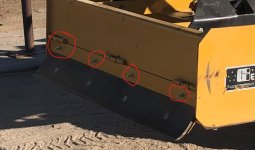
Picked this box blade up cheap
9Cm4bFG.jpg

I’ve shared the link to this thread in the Mahindra owner’s group on Facebook several times.

Happy box blading!
 
   / Beginners guide to using a box blade #222  
FWIW, I lurk & read a lot here, but don't post much; this makes post #7 in more than six years... :D

I just read all 23 pages of this thread today, and learned a ton. I'm sure there's also a lot more that I missed, but it's like drinking from a fire hose I guess - I can only take in so much at one time.

I bought a 5' County Line box blade from TSC this week, to go on my Kioti CK3510HST. I'd read that County Line box blades were usually made by King Kutter, but mine looks more like a Tarter. When I bought it, I was told by both TSC people there to "just set it level, put your 3-pt lever all the way down so it'll float, and drive". I did that on a test run on a fairly inconspicuous area and of course achieved less than stellar results. The info in this thread, along with numerous youtube videos by Everything Attachments & others, should help tremendously.

A specific question regarding leveling - our yard is about 1.5 acres of the 40 we own, has never been landscaped or even farmed; never had an implement on it until the digging that was necessary for our house build. The land has never been worked at all, is on a sloped grade (house with a walkout basement) and has a lot of rolling high & low spots that I'd like to smooth out. "Level" isn't really possible, as everything here is part of a slope that averages around a 3/12 pitch, but I'd like to smooth out the rolls a bunch. If they were more like piles (like dumped from a truck), I'd understand how to level them, but this ground is more slow-rolling (undulating?), like a relatively calm sea I guess is the best visual I can offer. What's the most efficient way for a box-blade noob to approach this kind of smoothing/levelling, when the undulations are so gradual & shallow?

Thanks
 
   / Beginners guide to using a box blade #223  
Without knowing more about your land, I would disk or otherwise make it loose-surfaced, then drag a long beam, maybe 6x6x16, all over it in all directions. That would make it smooth without trying to make it level.

Bruce
 
   / Beginners guide to using a box blade #224  
I'd read that County Line box blades were usually made by King Kutter, but mine looks more like a Tarter. When I bought it

...

If they were more like piles (like dumped from a truck), I'd understand how to level them, but this ground is more slow-rolling (undulating?), like a relatively calm sea I guess is the best visual I can offer. What's the most efficient way for a box-blade noob to approach this kind of smoothing/levelling, when the undulations are so gradual & shallow?

Thanks

Both KK & Tarter have been the OEM for County line at various points in time & various parts of the country. It could be either depend on when & where you bought it or how long it was in the yard. They are both lighter but decent box blades.

Getting things smooth (not level) is tricky without experience or a land plane. A box blade is really short. A land plane or the big road graders are really long for a reason. The length makes them move less in the middle when hitting a bump or a dip. If you add long skids or wheels behind your box blade it makes it act more like a grader or land plane.

A toplink is REALLY helpful for grading. I use my toplink more than my 3pt when working my box blade.

The good news is you own a tractor & box blade so you can get plenty of seat time to work on your skills. Take small bites & small adjustments to scrape dirt off high spots & move it to the low spots. In time you'll be able to fix the mistakes of the unskilled guy that started the project
 
   / Beginners guide to using a box blade #225  
Without knowing more about your land, I would disk or otherwise make it loose-surfaced, then drag a long beam, maybe 6x6x16, all over it in all directions. That would make it smooth without trying to make it level.

Bruce
I actually tried the I-beam thing, but didn't have the right size beam. We have a section of 10"x10" I-beam with ~3/4" web, maybe 7' long that was left over from a basement (under the garage floor) concrete pour. I dragged it around a bunch with the tractor, but the CK3510 just couldn't pull it, it was so heavy. I used a larger borrowed tractor and did some good but not a lot. I may see if I can borrow a disc from a family member; that's a good idea, thanks.

...The good news is you own a tractor & box blade so you can get plenty of seat time to work on your skills. ...In time you'll be able to fix the mistakes of the unskilled guy that started the project
I definitely expect it to take a while. (And the guy that started the project is unquestionably a big motard sometimes... :D )
 
   / Beginners guide to using a box blade #226  
John in AR, is it currently 1.5 acres of bare ground or is there grass/weeds, etc as ground cover? If you want to move much soil around with light equipment, the vegetation has to go. In my limited experience, the grass, weeds, and their roots ball up under the implement after a few feet and won't allow it to penetrate.
 
   / Beginners guide to using a box blade #227  
Grass, weeds, etc, over probably 60% of it and bare dirt over the rest. I started in the bare dirt part, mainly to see how it went. One thing I failed to mention above was that I do have a ratchet rake for my fel (largely due to first hearing about them here), and that痴 a big part of why some of it is bare dirt; the ratchet rake scraping off some of the grass. In forward, if the fel isn稚 in float, when going forward the RR alternates between digging in too deep and rising up off the ground completely. If the fel IS in float mode when going forward the RR occasionally grabs tight and the front wheels of the tractor come completely off the ground. In reverse it works fairly well, sometimes in float mode and sometimes with some downpressure to make it bite harder. If the RR worked as well for grading in forward as it does in reverse, I?d just use it, but wanting to avoid smoothing the whole thing in reverse.

(Fwiw, not meant as a knock on the RR at all. It is a very handy and surprisingly capable attachment, and other than a ballast box is probably the best bang for the buck I?ve spent on anything tractor related.)
 
   / Beginners guide to using a box blade #228  
John, I've been working to "level" my back yard for a couple of months now. One thing I've learned is to disc it first so you have loose dirt to work with and to break up the grass. I have Bermuda grass which is propagated by runners across and under the ground. Very tough grass. Once you've disced your yard a dozen times or so, both cross, forward, sideways and up and down, you'll be ready to move some of the dirt. I have a box blade which I found will move the dirt but not the grass. Take small, long runs to move a little bit of dirt at a time and find a place to dump it. I suspect my tractor is smaller than yours :( but it does the job (2004 Case IH DX24e) but the box blade and disc are small enough to work. I have watched my neighbor level his fields (he has about 1000 acres) and he has very long trails on the box blades (these will probably hold ten yards) he uses to level the field after he has disced it very well. All of his fields are lazer leveled so the water will flow. Best of luck in your learning curve; my curve has been on-going for about 8 years, but I still haven't scratched the surface of knowledge yet.
 
   / Beginners guide to using a box blade #229  
I redid my yard in the past year. I didn't have a disc available, but I did rototill the whole thing. The result was probably about the same, loose dirt that could be moved with the box blade or back blade. I just redid my driveway too using the box blade. I used the scarifiers with a shortened top link to move gravel, when I got the gravel to a low spot, I had a stop set up that would allow the blade to lift about 1-2 inches and keep rolling until the box was empty. When I got it all moved, I set the top link to level the box to get to a rough grade and to finish I lengthened the top link so that the front cutting edge was about 1/4-3/8s off the ground while the back edge was touching and it all smoothed out quite well. I hadn't done much work with a box blade before but everything turned out pretty good. My fallback was, even if it isn't perfect, it's a lot better than it was when I started.
 
   / Beginners guide to using a box blade #230  
One of the biggest challenges I have is figuring out what size of top link to use. With my disc (two rows of eight blades) I need a long top link so it will not dig in. With the box blade I use a smaller top link but even then it is not short enough for me to adjust so the cutter will dig in to pick up dirt. I use the longer top link with the mud plow since I can't let the plow go too deep or the tractor stops dead. My question: What is the correct length of top link to use? How do you determine the correct length? Thanks!
 
   / Beginners guide to using a box blade #231  
One of the biggest challenges I have is figuring out what size of top link to use. With my disc (two rows of eight blades) I need a long top link so it will not dig in. With the box blade I use a smaller top link but even then it is not short enough for me to adjust so the cutter will dig in to pick up dirt. I use the longer top link with the mud plow since I can't let the plow go too deep or the tractor stops dead. My question: What is the correct length of top link to use? How do you determine the correct length? Thanks!

I bought my box blade mostly for gravel road maintenance. I have a steep driveway and heavy rains create ruts. When I got the blade and set it up fairly neutral it worked, but not great. Shortening the top link dug deeper, but I didn't always want to dig deep. I wasted a lot of time adjusting the top link for simple jobs that should've only taken 15 to 30 minutes. When I saw "Dave knows how" you tube video about the box blade and the "angle of the dangle" I knew I had to get a hydraulic top link. Having the ability to go from digging to smoothing instantly from the drivers seat made me look semi-competent :). I love it. I wish I would've had it from the begining
 
   / Beginners guide to using a box blade #232  
I bought my box blade mostly for gravel road maintenance. I have a steep driveway and heavy rains create ruts. When I got the blade and set it up fairly neutral it worked, but not great. Shortening the top link dug deeper, but I didn't always want to dig deep. I wasted a lot of time adjusting the top link for simple jobs that should've only taken 15 to 30 minutes. When I saw "Dave knows how" you tube video about the box blade and the "angle of the dangle" I knew I had to get a hydraulic top link. Having the ability to go from digging to smoothing instantly from the drivers seat made me look semi-competent :). I love it. I wish I would've had it from the begining

The way to stop storm water runoff from causing ruts is to stop the water from running DOWN the road...The key is either ditching both sides and creating a crown or by ditching one side and pitching the lane to that side...you want the water to run ACROSS the lane/tracks and not down it...

To accomplish the above you will need to adjust the side link...personally when I am grading the roads I have to deal with I make more adjustments to the (hydraulic) side link than the top link...
 
   / Beginners guide to using a box blade #233  
The way to stop storm water runoff from causing ruts is to stop the water from running DOWN the road...The key is either ditching both sides and creating a crown or by ditching one side and pitching the lane to that side...you want the water to run ACROSS the lane/tracks and not down it...

To accomplish the above you will need to adjust the side link...personally when I am grading the roads I have to deal with I make more adjustments to the (hydraulic) side link than the top link...

Exactly. Erosion happens when the water is allowed to pick up speed. It won't pick up enough speed to cause much, if any damage if it runs from the center crown to the ditch.
 
   / Beginners guide to using a box blade #234  
It's a narrow driveway in northern Wisconsin with giant boulders and rocks just underneath the surface. It's virtually impossible create much of a crown, but it is slightly crowned. The edges are where the errosion is so the water does run along the sides, but it is narrow so those ruts need to be filled in. With ample gravel it isn't much of problem to fix it up quickly. We have had some heavy rainfalls up here the last several years. 3" fell last week in only a few hours time. The ruts were small, but I didn't want let them grow. In the 00's we had drought so I didn't need to do much at all to keep the road smooth.
 
   / Beginners guide to using a box blade #235  
I managed to do a reasonable job without a hydraulic top link. Just using the draft control to dig, stop digging and transport, then unloading in a one inch thin spread. There was a definite learning curve and there is no doubt a hydraulic top link would have been better. The main thing that made a difference was my speed. I used low range and first or second gear. Working in the construction industry, I've seen lots of graders operate and the one thing I remember is that when doing a finished or near finished grade, the always went very slow and moved small amounts of material.
 
   / Beginners guide to using a box blade #236  
I managed to do a reasonable job without a hydraulic top link. Just using the draft control to dig, stop digging and transport, then unloading in a one inch thin spread. There was a definite learning curve and there is no doubt a hydraulic top link would have been better. The main thing that made a difference was my speed. I used low range and first or second gear. Working in the construction industry, I've seen lots of graders operate and the one thing I remember is that when doing a finished or near finished grade, the always went very slow and moved small amounts of material.
Yup, slow is key. Gives you more time to figure out what is going on & to react with minor corrections.
 
   / Beginners guide to using a box blade #238  
Still a bit of a noob on box blades... been reading through this and other similar threads but still have a question..

I got a super deal on a General-branded BoxBlade for my MT125. Thanks to learning curve it took a few hours to get the hang of it enough to level the area where I'm putting up a new shop.
Mine has a hinged rear-facing blade. I ended up running some bolts through it to make it fixed and that worked great, but I have to wonder what use that blade would be when it's swinging free?
 
   / Beginners guide to using a box blade #239  
A rigid rear blade limits how deep the front blade can cut in a concave location like the bottom of a steep hill.

I can cut with mine coming down a hill, and after being on flat ground, but it won't cut in the transition, even with the top link fully short.

This would also apply at the start of a "trenching" cut.

boxbladediagram.jpg


Bruce
 
Last edited:
   / Beginners guide to using a box blade #240  
A rigid rear blade limits how deep the front blade can cut in a concave location like the bottom of a steep hill.

I can cut with mine coming down a hill, and after being on flat ground, but it won't cut in the transition, even with the top link fully short.

This would also apply at the start of a "trenching" cut.

View attachment 683509

Bruce

ya, that I know.. that's why I bolted mine down to it wont swing.. what I'm wondering is what the advantage is when it swings? they made it that way for a reason.. why?

Nice diagram though :)

Screenshot 2021-01-17 084933.jpg


Tractor & Equipment Auctions

2000 Freightliner FL112 S/A Day Cab Truck Tractor (A59230)
2000 Freightliner...
SD Launch SDLB25 (A53317)
SD Launch SDLB25...
2010 Case 580N (A60462)
2010 Case 580N...
2020 CATERPILLAR 242D3 SKID STEER (A60429)
2020 CATERPILLAR...
2015 AMERITRAIL MANIFOLD TRAILER (A58214)
2015 AMERITRAIL...
207269 (A52708)
207269 (A52708)
 
Top