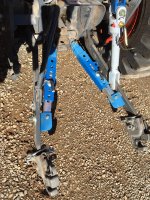
Flail Mower Confusion

/ Flail Mower Confusion #1  

SpaceRage

Member
Joined
Nov 7, 2018
Messages
25
Location
Newcastle, NSW
Tractor
Kubota B26
Hey folks, I'm looking at getting a flail mower for my B26 TLB.

I have been looking through the manual and am really confused, there appear to be different allowable lifting weights for the 3PL (either 760kg or 360kg)?
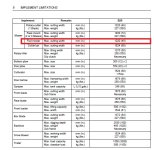
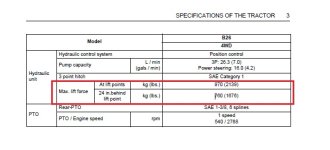
kb1.jpgkb2.jpgkb3.jpg

The flail mower I'm looking at has weight of 360kg, will the B26 be able to lift and operate this mower?

FLAIL MOWER PREMIUM 14 MECHANICAL SIDESHIFT - Hayes Products - Tractor Attachments and Implements

Thanks from Australia!
 
/ Flail Mower Confusion #2  
You may wish to talk with your dealer. Permissible loading is also dictated by how the loading arms are connected to the tractor.
 
/ Flail Mower Confusion #3  
I've got a Woodmaxx 62" Flailmower that I use on my little BX2200 and it lifts and turns it just fine.

I just don't expect to use it to knock down tall grasses -- for obvious reasons.

I use mine to compliment my rotary finish mower if life gets in the way and I miss a couple mowing sessions. WAY better than clumps!

However, I am going to be getting a bigger machine (L3901 or equiv.) down the line.
 
/ Flail Mower Confusion #4  
Space Rage,
Since the 1st and 3rd charts are in the implementation limitation section of the manual and I'd go with them. The middle chart from the general specifications section talks to max pump output which presumably does not take into account structural limitations in the arms, links, and frame. I must admit I never looked close at that number and 760 KG (1676 lbs) seems pretty high - I guess if there's ever a 3PT failure it won't be the pump!
You're 360 kg mower weighs in at the max lower arm end weight with a cg that's probably about a foot behind the end of the arm. While the hydraulics should pick up the mower just fine the more important concern at least to Kubota, is that it's 6 inches wider than allowable max width. Its interesting that they feel flail mower width is the key limiting factor - my walking around sense says the mower weight and CG should be more of a factor than width. I have to assume Kubota factors in typical implement weight & cg estimates along with worse case dynamic loading on all their ratings which should make their implement limitations pretty conservative.

Bottom line is you'd probably be OK but if you read the first paragraph of the Implement limitation section, since you'd be exceeding the max width any resultant failures would invalidate the warranty (if that still matters).
 
/ Flail Mower Confusion #5  
From experience running a larger (wider) implement on my machine, when you make turns, the implement kind of pulls the machine a little bit. That is partly the reason with the width limitation. I also don't know if you are suppose to be turning with a flail mower down either.

Like CurtisC said above, it has a lot to do with dynamic loading to keep everything in check within a "safe" zone in case of failure.

Also the 760 KG (1676 lbs) is at the holes on the 3 point hitch. Normally loading is measured 24" behind those holes, which usually breaks down to about half the weight.

I know, and totally understand that if my 62" Flailmower breaks my little BX2200, it's because I overloaded it and I take responsibility. However, I'm just careful and mindful using it.

I've used my flail quite a few times without any issues.

Do I agree it was meant to be put on a larger machine - absolutely.

In relation to all this, you can go on Woodmaxx's website and you'll see they are using what appears to be a B2650/3350 attached to a 62" flail mower.

For what it's worth my Woodmaxx 62" flail weighs about 650 lbs and the max capacity 24" behind the holes is 680 lbs. So the lift capacity is right around ~1,100 lbs at the holes on the 3 point hitch. Again, this is for a BX2200.
 
/ Flail Mower Confusion
  • Thread Starter
#6  
I've got a Woodmaxx 62" Flailmower that I use on my little BX2200 and it lifts and turns it just fine.

I just don't expect to use it to knock down tall grasses -- for obvious reasons.

I use mine to compliment my rotary finish mower if life gets in the way and I miss a couple mowing sessions. WAY better than clumps!

However, I am going to be getting a bigger machine (L3901 or equiv.) down the line.

Thanks for the info diesel85, I reckon if the BX2200 can handle the Woodmax 62" then my B26 should be ok with the 360kg mower I liked even if the figures are quite close. Key is probably to take it easy when mowing like you said.
 
/ Flail Mower Confusion
  • Thread Starter
#7  
Space Rage,
Since the 1st and 3rd charts are in the implementation limitation section of the manual and I'd go with them. The middle chart from the general specifications section talks to max pump output which presumably does not take into account structural limitations in the arms, links, and frame. I must admit I never looked close at that number and 760 KG (1676 lbs) seems pretty high - I guess if there's ever a 3PT failure it won't be the pump!
You're 360 kg mower weighs in at the max lower arm end weight with a cg that's probably about a foot behind the end of the arm. While the hydraulics should pick up the mower just fine the more important concern at least to Kubota, is that it's 6 inches wider than allowable max width. Its interesting that they feel flail mower width is the key limiting factor - my walking around sense says the mower weight and CG should be more of a factor than width. I have to assume Kubota factors in typical implement weight & cg estimates along with worse case dynamic loading on all their ratings which should make their implement limitations pretty conservative.

Bottom line is you'd probably be OK but if you read the first paragraph of the Implement limitation section, since you'd be exceeding the max width any resultant failures would invalidate the warranty (if that still matters).

Thanks for great reply CurtisC,

Yes I found it strange that the width is limiting factor.........B26 has pretty narrow wheelbase, especially at the front so they might be concerned about COG etc...? My warranty is void now so not much of an issue anymore. B26 seems to be pretty sturdy bit of kit so I'll probably just go for the 360kg mower.....also considering buying a bigger tractor down the line as well so would be good to be on the upper margin in terms of width for future possibilities.
 
/ Flail Mower Confusion #8  
Had a B20 for over 20 years with a 6’ finish mower. Over 800#. Upgraded to B26. Run Pat’s quick hitch that puts the hitch point 3” back. I liquid ballasted the rear tires. 2” spacers on the rear tires. Runs good on our hilly ground with different equipment including the backhoe.

For an offset fail mower the weight straight behind shouldn’t be a problem. Offsetting May require ballast or wheel extensions.

Cheers to our down under friend!
 
/ Flail Mower Confusion #10  
You won't have any problems, you are lifting with 3pt, half your weight is hanging off the top link. WO is no top link rating.
 
/ Flail Mower Confusion #11  
You won't have any problems, you are lifting with 3pt, half your weight is hanging off the top link. WO is no top link rating.
 
/ Flail Mower Confusion #12  
You won't have any problems, you are lifting with 3pt, half your weight is hanging off the top link. WO is no top link rating.

Sorry 100 td but all of the implement dead weight plus live/operational vertical loads are supported by the 2 lower or lifting arms. The top link controls tilt of the implement and sees only horizontal dead loads due to the implement cg offset (almost always aft of the lift arm connection) and any additional live rotational loads encountered during use.
 
/ Flail Mower Confusion #13  
Half isn't exact, it's general jargon, meaning weight is transferred.

If the weight was "directly" centered above the lower pivot point, it would take all the load. But normally this is not the case. Replace the top link with your hands and see how much load is transferred to the tractor via the top link .
The tractor carries the entire weight but it is carried on the lift arms(transferred back to the tractor) and on the top link ( transferred back to the tractor)
I'm not going to do all the drawings and angles and calculations of weight/force but this may help out.


Think of a box, 1 yard x 1 yard x 2ft high. The box weighs 500lbs (but can weigh anything).
Person 1 lifts one end up 2", leaving the other end on the ground (pivot point), Person 1 is lifting 250lbs. Person 2 now lifts the other end 2" off the ground at the same time, Person 1 and Person 2 are now both lifting 250lbs each.

The 3pt arms connect to the bottom end of the box. You don't have a top link connected
Person 1 raises the lift arms up 2", the tractor has 250lbs transferred onto it. Person 2 now lifts the other end 2", the tractor still has 250lbs and Person 2 has 250lbs. Person 1 attaches the top link to the top of the box.
Tractor now has 500lbs load on it. But it doesn't have 500lbs on the pivot point, as a percentage is transferred to the tractor via the top link. I would need to find my old trigonometry books and draw it up exactly to spec to calculate it.
 
/ Flail Mower Confusion #14  
Half isn't exact, it's general jargon, meaning weight is transferred.

If the weight was "directly" centered above the lower pivot point, it would take all the load. But normally this is not the case. Replace the top link with your hands and see how much load is transferred to the tractor via the top link .
The tractor carries the entire weight but it is carried on the lift arms(transferred back to the tractor) and on the top link ( transferred back to the tractor)
I'm not going to do all the drawings and angles and calculations of weight/force but this may help out.


Think of a box, 1 yard x 1 yard x 2ft high. The box weighs 500lbs (but can weigh anything).
Person 1 lifts one end up 2", leaving the other end on the ground (pivot point), Person 1 is lifting 250lbs. Person 2 now lifts the other end 2" off the ground at the same time, Person 1 and Person 2 are now both lifting 250lbs each.

The 3pt arms connect to the bottom end of the box. You don't have a top link connected
Person 1 raises the lift arms up 2", the tractor has 250lbs transferred onto it. Person 2 now lifts the other end 2", the tractor still has 250lbs and Person 2 has 250lbs. Person 1 attaches the top link to the top of the box.
Tractor now has 500lbs load on it. But it doesn't have 500lbs on the pivot point, as a percentage is transferred to the tractor via the top link. I would need to find my old trigonometry books and draw it up exactly to spec to calculate it.

The problem with your example is that person 2 doesn't "lift" the other end. Person 2, or the top link, can only pull (or push) the top of your box horizontally and is unable to provide any vertical ("lift") force. Person 1 has to not only lift the box vertically at the 2 lower connection points but also counteract any horizontal force person 2 exerts on the single point above. Those three connection points are the only external forces applied to your box when its off the ground. To make the math simple lets modify your box to a 500 lbs. box that's 2 ft. X 2ft. X 2ft with the CG dead center. To hold the box off the ground, the lower arms together (person 1) must exert a total of 500 lbs of upward vertical force since the top link can provide none. To keep the top of the box from simply rotating away from the tractor, the top link (person 2) has to pull the box toward the tractor with 250 lbs. of force. To keep the box stationary the lower arms (person 1) subsequently have to push in the opposite direction with a combined force of 250 lbs. in addition doing all the lifting. With all due respect, I'd suggest a book on basic static mechanics not trigonometry.
 
/ Flail Mower Confusion #16  
You won't have any problems, you are lifting with 3pt, half your weight is hanging off the top link. WO is no top link rating.

Curtis is correct. Open and shut. Do not get drawn into any kind of complex description or people carrying boxes examples. All that is erroneous.

In case there is an engineer around, this is a grossly simple Statics problem. With the implement attached and lifted just enough to clear the ground, break the lift arm force into vertical and horizontal components. The vertical ( counting both lift arms) is the weight of he implement. The horizontal component is opposite polarity and equal to that of the top link.

Now take the force on the (free to rotate about the attachment pin...) top link. The vertical component is zero. Has to be zero because the rotation about the pin is unhindered. Horiz component is opposite polarity and equal to that shared by the lower lift arms.

Bottom line: Top link provides NO lift. Bottom lift arms provide 50% of the lift force for the implement each. End of story.

p.s.: Ok, sure there is a TINY vertical component at the toplink to the extent that it is not level with the ground. Completely negligible in context of this discussion.
 

Marketplace Items

2025 SDLANCH SDLC2020 High End Carport (A60352)
2025 SDLANCH...
500 BBL FRAC TANK (A58214)
500 BBL FRAC TANK...
2019 CATERPILLAR 259D3 SKID STEER (A62129)
2019 CATERPILLAR...
2010 Ford F-150 Crew Cab Pickup Truck (A61568)
2010 Ford F-150...
LandHonor LHR-MC2113 Metal Carport (A60352)
LandHonor...
Auger Bit (A61567)
Auger Bit (A61567)
 
Top