new construction - insulation (East Texas)

/ new construction - insulation (East Texas) #1  

Corkpuller

Silver Member
Joined
Nov 14, 2018
Messages
139
Location
DEEP EAST TEXAS
Tractor
John Deere
pardon my typing skills, im left handed and only have use of my right, due to recent surgery.

lookin for hard facts / experience, concerning insulation on new construction. have got started on land clearing and road building to our little slice of heaven to where i'll be retiring to, and seeing my last sunset in deep east texas.

there seems to be a strong push towards this idea of making a house act like an igloo cooler with this closed cell foam insulation.
no ridge vents, no soffit vents. spray foam in walls and on roof decking i believe. no insulation laid between ceiling joists.

from what i understand, you dont seal the living area from the attic, the attic will attain close to the same temp as the living.

i just cant wrap my head around no attic ventitation in the east texas humidity. seems there would be a problem with mildew.

ive spoke with 2 different home owners and they claim its the cats ***. there are custom home builders in lufkin that see it the same........

any y'all have first hand knowledge about it all
 
/ new construction - insulation (East Texas) #2  
The style you speak of is something I’ve seen a few times in the south. I’m not a fan of spray foam but if that’s your flavor I get what they are going for. Basically all spaces are conditioned with the ceiling drywall/paint combo working to keep the attic and living area in two different temp ranges.

Check out buildingscience.com for a lot of good studies and ideas for your climate zone.
 
/ new construction - insulation (East Texas) #3  
It's my policy not to jump onto new technology,beit appliances,cars or health fads until it is proven. One comlaint I've heard is roof leaks are difficult to detect before major structrial damage is done. The debate continues but I'm not convinced cooling more space save's enough energy to make it a good idea. If you find a contractor with experience and track record,get a proposal for ground source heat pump. IMO,the best thing in Texas is a couple of big trees shading the roof. Foil faced decking has proven to save energy.
 
/ new construction - insulation (East Texas) #5  
I would think that insulation to save energy is as important in Texas as it is in Canada. Our building guidelines call for R60 attics and R32 walls. Insulating basements or under slabs is equally important in Canada.
Roof trusses are built with a raised heel allowing more insulation above the walls. Adding 2" of rigid insulation to the outside before installing the siding reduces thermal bridging - where cold travels through the wall studs.


Check out these guidelines
Keeping the Heat In | Natural Resources Canada
 
/ new construction - insulation (East Texas) #6  
I have a house built with spray foam done by a builder in Lufkin. In my opinion, the spray foam is - - well, there are pros & cons. 1st the con is that since you're heating & cooling the attic as well, I don't see much of a savings there. 2nd, the pro is that it seals the envelope and reduces air infiltration which is a big energy savings. I think the air infiltration offsets the attic, but not by much.

As for the problem that leaks won't show up until there is a real problem, I don't know. On one hand I'm inclined to agree, but on the other, the spray foam is a chemical that acts like a polyurethane glue and may tend to localize any leaks or damage. And because it's a glue it helps to reinforce the walls and roofs.
 
/ new construction - insulation (East Texas)
  • Thread Starter
#7  
I have a house built with spray foam done by a builder in Lufkin. In my opinion, the spray foam is - - well, there are pros & cons. 1st the con is that since you're heating & cooling the attic as well, I don't see much of a savings there. 2nd, the pro is that it seals the envelope and reduces air infiltration which is a big energy savings. I think the air infiltration offsets the attic, but not by much.

is that builder mike, with dream homes?

how old is your home?
you aren't seeing significant savings in yer light bill?

thanks
 
/ new construction - insulation (East Texas) #8  
My neighbor did this about ten years ago and he says that his electric bill has never been over $50. He also travels a lot and that might be part of that. He said his only issue is that he has to open a window to get his fireplace to burn good. It's too air tight for it to get a good fire going in winter.
 
/ new construction - insulation (East Texas)
  • Thread Starter
#9  
well Eddie, i suppose your neighbor would be about the closest to me considering climate. i just cant wrap my head around no attic ventilation in this HOT and HUMID climate.
 
/ new construction - insulation (East Texas) #10  
I know several people that have built several houses for themselves and both say there is no comparison, they claim their electric bills are less than $100.00 per month during the heat of the Florida summer which should be awful close to what you are dealing with, verses around $200.00 per month with a conventional framed home with R-13 in the walls and R-38 in the attic. It makes sense to me that if you don't allow the heat to transfer into you're attic it can't transfer into you're living area, and if you are worried about roof leaks just sheet it with tin screwed in the ridge and there won't be any, problem solved.
 
/ new construction - insulation (East Texas) #11  
is that builder mike, with dream homes?

how old is your home?
you aren't seeing significant savings in yer light bill?
No. Different builder. House is about 1.5 years old. Our house is a little under 2200 sq ft and we run about $160 for electric in the summer time with the air conditioner. I don't know what to tell you about energy savings we see since it's the only way the house has ever been so we have nothing to compare it to. It was also designed to use LED bulbs (regular bulbs will burn up the dimmers and blow circuit breakers). Those LEDs do not work as well with the dimmers as I'd hoped even though I matched the bulbs and dimmers and even tried them out in advance.

corkpuller - I sent you a PM
 
/ new construction - insulation (East Texas) #12  
Th only difference between southern climates is where you put the vapor barrier. I was involved for awhile with modular construction. We put the vapor barrier on the outside instead of the inside.Those were engineered designs for Florida, Gulf Coast, and Hawaii.

Ron
 
/ new construction - insulation (East Texas) #13  
there seems to be a strong push towards this idea of making a house act like an igloo cooler with this closed cell foam insulation.
no ridge vents, no soffit vents. spray foam in walls and on roof decking i believe. no insulation laid between ceiling joists.

from what i understand, you dont seal the living area from the attic, the attic will attain close to the same temp as the living.

i just cant wrap my head around no attic ventitation in the east texas humidity. seems there would be a problem with mildew......

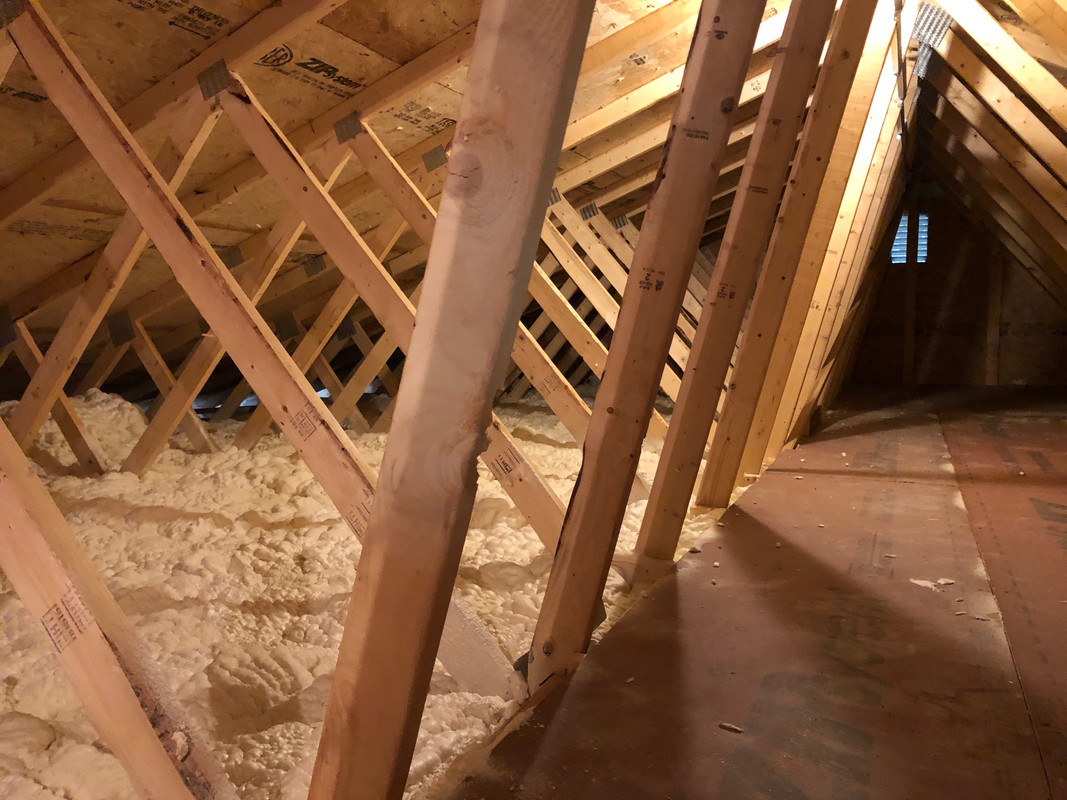
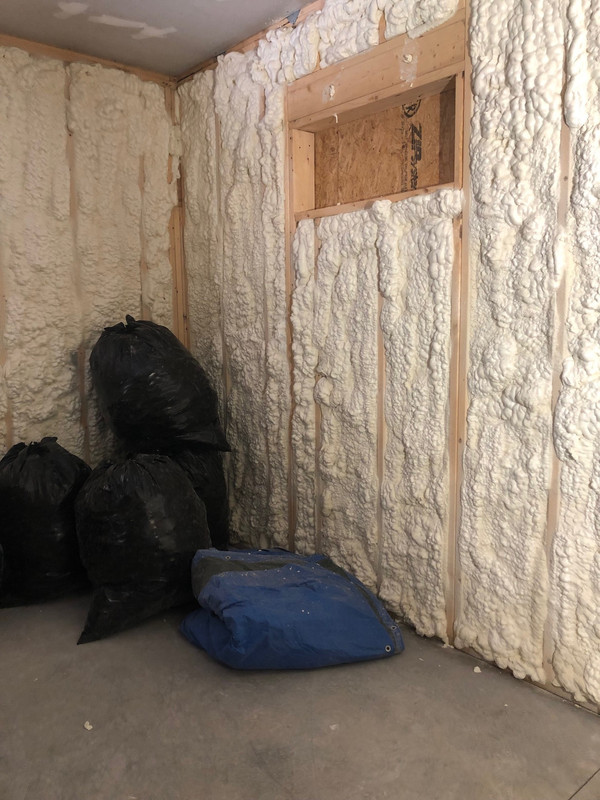
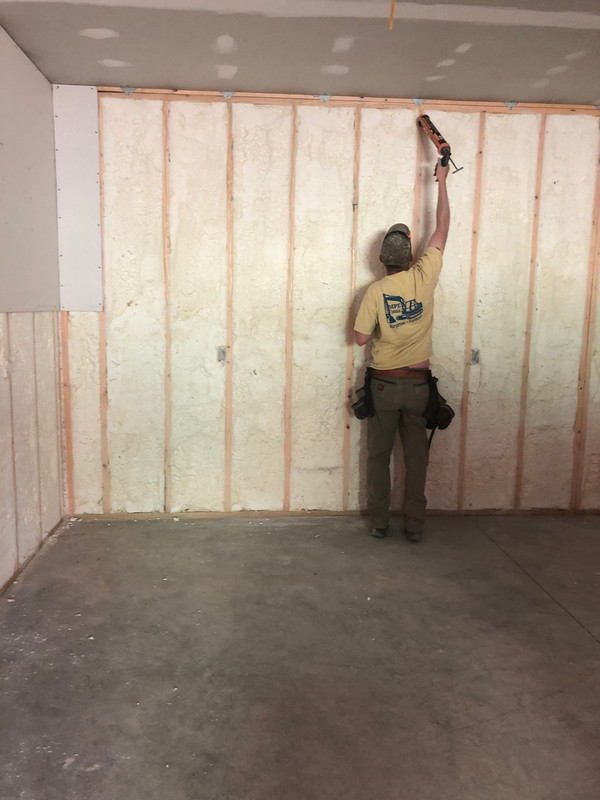
I know that technique is promoted by some but personally I don't like the idea for a couple reasons. Having to condition the attic, I don't want to heat and cool the attic. And the roof decking and shingles are going to literally bake without the benefit of any cooling air underneath. Otherwise I'm convinced spray foam insulation is the best way to go and used it in my house built in 2002 as well as the shop I just completed. Watching it done and seeing the foam completely seal to the studs and back side of the sheathing and fill every little gap is was pretty impressive to me. Places like electrical wiring, wall boxes and ceiling fixture boxes which are hard to get fiberglass effectively behind are completely filled. Headers were made hollow from (2) 2x12"s with 2x4 ends then filled with foam.
In both cases we framed outside walls with 2x6 but before insulation was sprayed the ceilings were drywalled and joints taped. After spraying the walls they went to the attic and sprayed down covering everything including the truss bottom chord.


It appears in the pic that the OSB attic flooring is on the bottom chord but actually 2x6's were scabbed up higher to the truss sides then the OSB was laid down after insulating.


Excess shaved off.
 
/ new construction - insulation (East Texas) #14  
In hot North Florida, I am sold on installing a radiant barrier. I put one under a new metal roof, and my vented attic stays at outside ambient air temps, as opposed to 120+ degrees , before3 the foil. 1600 sq ft double wide, electric bill is always less than $150.
 
/ new construction - insulation (East Texas) #15  
If I were building again (we have SIPs now for whole house (all exterior walls, roof, floor), I would look seriously at the t-studs and spray foam for whole house. I would put in mini splits and an air exchanger.
 
/ new construction - insulation (East Texas) #16  
If you’re going to spray foam everything you will need an air exchanger. Without one you are very likely to end up with serious moisture issues and mold. The air exchanger runs about $2000 that expense plus having to cool the attic I can’t imagine much expense saving. I’d install 24 inches of blown in fiberglass and a radiant barrier on the roof side and call it good.
 
/ new construction - insulation (East Texas) #17  
If you’re going to spray foam everything you will need an air exchanger. Without one you are very likely to end up with serious moisture issues and mold. The air exchanger runs about $2000 that expense plus having to cool the attic I can’t imagine much expense saving. I’d install 24 inches of blown in fiberglass and a radiant barrier on the roof side and call it good.

I was scrolling down to type this response. Thanks for doing it for me. :)
 
/ new construction - insulation (East Texas) #18  
Something to consider. I went to look at a house with one of my clients who was thinking about buying it. Price was $750,000, which is really a lot of money for a house here. I didn't know how old it was, or what the value of it was. I was just there to see if everything looked right. The main thing was that the shingles looked worn out. Lots of discoloration and loss of rock from the surface of them. Just looking at them, I guessed that the house was 20 plus years old and that it had been through some severe storms. This didn't make sense because they where still building new houses in the neighborhood, and even on the lot next door. I went up into the attic and it was all spray foamed under the sheeting of the roof. When I touched it, it felt soft. They used open cell foam. It turns out that the house is 2 years old!!!!

There are some examples of using open cell foam on a house, but they are pretty detailed and not very easy to accomplish. There are also a lot of stories out there that I found for my client with this exact problem of roofs rotting away, deteriorating and failing prematurely because of the moisture held in the open cell foam. Fortunately she realized the severity of the problem and what it would cost to fix, and she walked away from that house.
 
/ new construction - insulation (East Texas)
  • Thread Starter
#19  
The more I read about it all, the more I think I'll build the next place with the "old way" of insulating. It's served me pretty well over the last 30 yrs.
It will be just me and the old lady, in a 1600 - 2000 sq ft. home. Not gonna break the bank if the August light bill is $175 compared to $100. And I won't be wondering if I got moisture trapped in my home or a roof leak that I can't detect.

I got another year before I have to decide, so still plenty time to investigate my options.
 
/ new construction - insulation (East Texas) #20  
If you’re going to spray foam everything you will need an air exchanger. Without one you are very likely to end up with serious moisture issues and mold. The air exchanger runs about $2000 that expense plus having to cool the attic I can’t imagine much expense saving. I’d install 24 inches of blown in fiberglass and a radiant barrier on the roof side and call it good.

The more I read about it all, the more I think I'll build the next place with the "old way" of insulating...... And I won't be wondering if I got moisture trapped in my home or a roof leak that I can't detect.


If you insulate perfectly with fiberglass which includes a vapor barrier attached you'll need an air exchanger also. Fortunately, or actually unfortunately, fiberglass can't realistically be installed perfectly, there are so many little gaps and voids where air flows freely, especially in walls. Warm, moist outside air condensates in those areas of a wall cavity cooled by AC. So not only are you loosing AC or heat it's allowing moisture in the wall cavity. Just Google "fiberglass insulation and mold".


Eddie Walker described how to insulate the wrong way with the wrong type of foam.
 

Marketplace Items

CHALLENGER VACUUM PUMP (A60736)
CHALLENGER VACUUM...
MORBARK WOOD HOG 6400 XT HORIZONTAL GRINDER (A60429)
MORBARK WOOD HOG...
John Deere 690B Excavator with Auxiliary Hydraulics (A57024)
John Deere 690B...
Snap-On Gold Medal Tribute to Excellence Limited Edition 3-Bay Tool Box (A61307)
Snap-On Gold Medal...
2012 MACK Tender Truck w/ADAMS Rear Discharge Bed Auger (A61307)
2012 MACK Tender...
1604 (A57192)
1604 (A57192)
 
Top