Trailer questions

/ Trailer questions #1  

1930

Platinum Member
Joined
Sep 9, 2018
Messages
933
Location
Brandon/Ocala Florida
Tractor
Kubota B6100E Kubota L 2501 Kubota T1460
Some months ago I bought a trailer off Craigslist.

On the way home with the trailer empty and hooked up to my Ford ranger it started swaying from side to side really bad.

So bad I had to stop get out of my truck and scratch my head.

I got the trailer home, put new tires on it because the tires were worn on the inside terribly, that made no difference.

It's a very heavy duty trailer commercial grade.

I can't post pictures now because they're not saved on my phone, I'll post some tonight

Dual axle it was built to haul one of those high reach machines

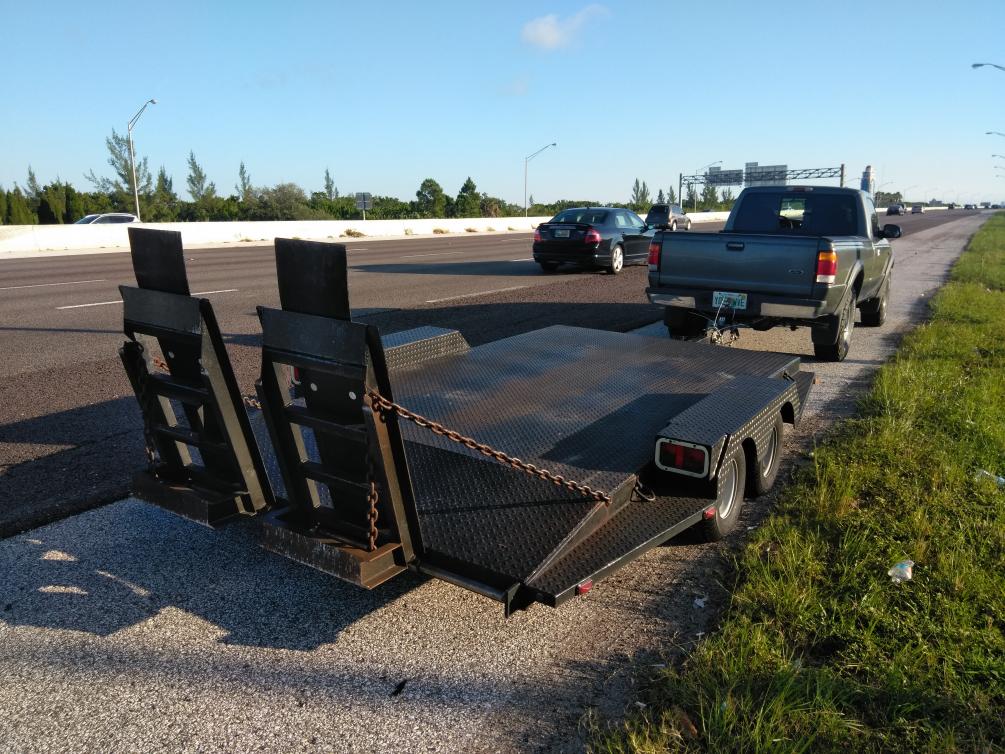
I'm thinking that because the two ramps on the back are so heavy and stand straight up that the windflow going down the road is just picking up the back of the truck and causing the problems I'm having.

At this point the ramps the way the trailer was built can't be positioned any other way..

The trailer is on my property in Ocala, I used it to bring my new Kubota tractor to my property and couldn't go above 25 or 30 miles an hour.

I pulled the tractor onto the trailer with the loader facing toward the front of the vehicle.

I don't know how to properly load the tractor..

From what I've read online I guess I should have backed the tractor up onto the trailer and had more weight over the axle or beyond the axles toward the front of the trailer.

Can someone here tell me the proper way loading my l2501?

When the tractor is loaded should the back of the truck be squatted just a little bit or should it be level?

If the tractor is properly loaded onto the trailer and the trailer still sways side to side violently is that definite bent axles?

I may try to bring home my B series tractor to do some maintenance after the weekend, if I've got to replace axles in the trailer than I would do it all at the same time.

Thanks
 
/ Trailer questions #2  
My understanding is that trailer swaying is the result of inadequate tongue weight. I doubt the wind flow around the ramps was the cause. Other experts will be along shortly.

Doug in SW IA
 
/ Trailer questions #3  
A properly designed and maintained trailer should tow fine empty. I think you are on the right track to suspect axle problems, particularly when considering the poor tire wear.
There should be 10-15% of the trailer weight on the tongue. I personally use a hydraulic scale (Sherman?) to check the tongue weight, then marked the trailer bed for various loads. For one time loads I listen for the metal clunk when the trailer hitch comes down onto the ball, then move forward enough to see the truck squat a little bit.... Not very scientific, but at least I know there is some weight on the tongue.
Good luck getting your trailer squared away.
 
/ Trailer questions
  • Thread Starter
#4  
My understanding is that trailer swaying is the result of inadequate tongue weight. I doubt the wind flow around the ramps was the cause. Other experts will be along shortly.
A picture is worth a thousand words and I will post some tonight, ramps are solid, they prob weight easily 60-75 pounds a piece. I've been told it's a poorly designed trailer online, I can't say myself, I do know that it is super heavy duty.
Doug in SW IA

A properly designed and maintained trailer should tow fine empty. I think you are on the right track to suspect axle problems, particularly when considering the poor tire wear.
There should be 10-15% of the trailer weight on the tongue. I personally use a hydraulic scale (Sherman?) to check the tongue weight, then marked the trailer bed for various loads. For one time loads I listen for the metal clunk when the trailer hitch comes down onto the ball, then move forward enough to see the truck squat a little bit.... Not very scientific, but at least I know there is some weight on the tongue.
Good luck getting your trailer squared away.
Yes, tires were worn down to nothing on the inside, all 4 tires, tires are very small, maybe 10 diam off the top of my head
 
/ Trailer questions #5  
Worn on the inside could mean the trailer was ran overloaded. Possible bent axles.
 
/ Trailer questions #6  
On the way home with the trailer empty and hooked up to my Ford ranger it started swaying from side to side really bad.
As the others have said usually needing more tongue weight.

the tires were worn on the inside
bent axles from overloading or running with loose wheel bearings

It's a very heavy duty trailer commercial grade.
I'm surprised that a HD trailer would have that small a tire on it,
they would put severe stresses on an axle hitting potholes and such on the road


When the tractor is loaded should the back of the truck be squatted just a little bit or should it be level?
An easy and unscientific way to get a rough idea of how your truck will sit with tongue
weight is to stack a few sacks of heavy material on your open tailgate and measure the bumper heights
at different weights, and yes it should have squatted a couple of inches when loaded

good luck
 
/ Trailer questions #7  
Post some pics of the trailer when you can.
10" wheels? Sounds kind of small to be hauling your tractor.
Is this a homemade trailer? Axles may be placed too far forward not allowing enough tongue weight.
All 4 tires worn down on the inside indicates axles may be bent possibly from overloading.
 
/ Trailer questions #8  
How heavy is the trailer and what's your truck's tow rating?

A heavy duty commercial equipment trailer with an L2501 with FEL seems like it might be pushing it for a Ranger.
 
/ Trailer questions
  • Thread Starter
#9  
I hope this works IMG 218121 83744 — Postimage.org
IMG-20181021-083744.jpg
 
/ Trailer questions #10  
Some months ago I bought a trailer off Craigslist.

On the way home with the trailer empty and hooked up to my Ford ranger it started swaying from side to side really bad.

So bad I had to stop get out of my truck and scratch my head.

I got the trailer home, put new tires on it because the tires were worn on the inside terribly, that made no difference.

It's a very heavy duty trailer commercial grade.

Dual axle it was built to haul one of those high reach machines

I'm thinking that because the two ramps on the back are so heavy and stand straight up that the windflow going down the road is just picking up the back of the truck and causing the problems I'm having.

I pulled the tractor onto the trailer with the loader facing toward the front of the vehicle.

I don't know how to properly load the tractor..

From what I've read online I guess I should have backed the tractor up onto the trailer and had more weight over the axle or beyond the axles toward the front of the trailer.

Can someone here tell me the proper way loading my l2501?

When the tractor is loaded should the back of the truck be squatted just a little bit or should it be level?

If the tractor is properly loaded onto the trailer and the trailer still sways side to side violently is that definite bent axles?

I may try to bring home my B series tractor to do some maintenance after the weekend, if I've got to replace axles in the trailer than I would do it all at the same time.

Thanks

You talk about the HD trailer, made to move bigger equipment.... and your pulling with a Ford Ranger. God bless that little Ranger.

The empty trailer is typically light on the front compared to when loaded, so very little down pressure. The trailer is HEAVY if it is like you have me picturing. The empty trailer could be anywhere from 1,800 to 3,000 lbs alone. Likely nearing the capability/capacity of a mini truck!

Backing your tractor on the trailer is preferred especially if the trailer is shorter and you do not have deck to allow you to drive the rear axle at least to being centered between the tandem trailer axles. You do always want to "front load" a trailer a bit, so if pulling the tractor on, getting your tractor rear axle centered over the pair of trailer axles would center your heavy rear end and the front axle weight (not nearly as much) would be transferred partially to the tongue/truck. If the rear axle was behind the trailer axle center line, my opinion is that it was loaded wrong.

If you back it on the trailer you are pretty much ensuring that you are front loaded... or heavy to the truck. The problem here is (not trying to be offending at all) you do not have a truck sufficient to handle much front loading weight. You'll squat the bajeezus out of and possibly bottom out that truck pretty fast. I had a 2001 Nissan Frontier that I once thought I could MOVE my 24.5' car hauler with in my driveway. I was wrong. I screwed the trailer jack up and the trailer frame smashed my truck until the trailer sat on the asphalt! It was not a "real truck", and I suspect that your Ranger is facing the same dilemma!

Also, what was the L2501 set up like? Bare tractor with air filled tires? Loader and filled tires? Backhoe or mower on back? You add about 1,000 lbs for a HD mower, same for a backhoe.... 800-ish loading tires..... 1,000-ish for loader assembly. So your 2,800 lb bare tractor could be 4,600 with loaded tires and a loader. And a trailer that is likely 2,500+ lbs.... so you are easily hitting 7,000 lbs..... WITH A RANGER! You may be more like 8,000+ lbs depending on what may be attached.
 
/ Trailer questions #12  
Nice looking little trailer,
hope you get it figured out
 
/ Trailer questions #13  
IMG-20181021-083744.jpeg IMG-20181021-083759.jpeg
That is a very unique looking trailer. I suspect that you are on track thinking that the lack of tongue weight is causing your problem.
How much does the tongue weigh when the trailer is empty? Is it something you can pick up by hands or do you have to use the jack? Will the ramps flip forward any further then you have shown in the pictures?

Generally speaking, a tractors front to rear center of gravity is right about where the steering wheel is. As such, you would want to have that be just forward of the front axle on the trailer. Most of the time that means that you need to back the tractor on to get the center of gravity in the right place to make sure that the trailer has more weight on the tongue then on the tail.

I like to use a tape measure to check and make sure that I have tongue weight, I measure the distance from the hitch of the trailer to the ground (or the back bumper of the truck to the ground) and from the tail of the trailer to the ground.
Both should be closer to the ground but the tongue should go down a little bit more than the tail does.

if you look on a tires, do they have a weight rating listed on them? I agree with those who suspect that the axels may be bent to cause wear on the inside of the tires.
When the trailer is level side to side, if you stick a short level on the side of the tire does it say that the tires are level?

Aaron Z
 
/ Trailer questions
  • Thread Starter
#14  
Worn on the inside could mean the trailer was ran overloaded. Possible bent axles.
that's what I'm thinking

good luck
Thanks
Post some pics of the trailer when you can.
10" wheels? Sounds kind of small to be hauling your tractor.
Is this a homemade trailer? Axles may be placed too far forward not allowing enough tongue weight.
All 4 tires worn down on the inside indicates axles may be bent possibly from overloading.
not sure if it's homemade, well built if so

How heavy is the trailer and what's your truck's tow rating?

A heavy duty commercial equipment trailer with an L2501 with FEL seems like it might be pushing it for a Ranger.
Not sure of the weight of the trailer, ranger is 4wd with heavy tow package, pulls everything I've towed without issue. 4.0 liter. Basically a small block V8 with 2 cylinders cut off


You talk about the HD trailer, made to move bigger equipment.... and your pulling with a Ford Ranger. God bless that little Ranger.

The empty trailer is typically light on the front compared to when loaded, so very little down pressure. The trailer is HEAVY if it is like you have me picturing. The empty trailer could be anywhere from 1,800 to 3,000 lbs alone. Likely nearing the capability/capacity of a mini truck!

Backing your tractor on the trailer is preferred especially if the trailer is shorter and you do not have deck to allow you to drive the rear axle at least to being centered between the tandem trailer axles. You do always want to "front load" a trailer a bit, so if pulling the tractor on, getting your tractor rear axle centered over the pair of trailer axles would center your heavy rear end and the front axle weight (not nearly as much) would be transferred partially to the tongue/truck. If the rear axle was behind the trailer axle center line, my opinion is that it was loaded wrong.

If you back it on the trailer you are pretty much ensuring that you are front loaded... or heavy to the truck. The problem here is (not trying to be offending at all) you do not have a truck sufficient to handle much front loading weight. You'll squat the bajeezus out of and possibly bottom out that truck pretty fast. I had a 2001 Nissan Frontier that I once thought I could MOVE my 24.5' car hauler with in my driveway. I was wrong. I screwed the trailer jack up and the trailer frame smashed my truck until the trailer sat on the asphalt! It was not a "real truck", and I suspect that your Ranger is facing the same dilemma!

Also, what was the L2501 set up like? Bare tractor with air filled tires? Loader and filled tires? Backhoe or mower on back? You add about 1,000 lbs for a HD mower, same for a backhoe.... 800-ish loading tires..... 1,000-ish for loader assembly. So your 2,800 lb bare tractor could be 4,600 with loaded tires and a loader. And a trailer that is likely 2,500+ lbs.... so you are easily hitting 7,000 lbs..... WITH A RANGER! You may be more like 8,000+ lbs depending on what may be attached.
L2501 with backhoe and loader. Thanks
Nice looking little trailer,
hope you get it figured out
Thanks

View attachment 605854 View attachment 605855
That is a very unique looking trailer. I suspect that you are on track thinking that the lack of tongue weight is causing your problem.
How much does the tongue weigh when the trailer is empty? Is it something you can pick up by hands or do you have to use the jack? Will the ramps flip forward any further then you have shown in the pictures?

Generally speaking, a tractors front to rear center of gravity is right about where the steering wheel is. As such, you would want to have that be just forward of the front axle on the trailer. Most of the time that means that you need to back the tractor on to get the center of gravity in the right place to make sure that the trailer has more weight on the tongue then on the tail.

I like to use a tape measure to check and make sure that I have tongue weight, I measure the distance from the hitch of the trailer to the ground (or the back bumper of the truck to the ground) and from the tail of the trailer to the ground.
Both should be closer to the ground but the tongue should go down a little bit more than the tail does.

if you look on a tires, do they have a weight rating listed on them? I agree with those who suspect that the axels may be bent to cause wear on the inside of the tires.
When the trailer is level side to side, if you stick a short level on the side of the tire does it say that the tires are level?

Aaron Z
I can pick up by hand but not easy, ramps will not go any further forward unfortunately
 
/ Trailer questions #15  
Trailer axles are actually cambered positive (top of tire outward) at the top while unloaded, or the tube is arched upwards to the center. This is so that as you load the trailer the axles take the load and deflect, thus giving up that camber and being somewhere nearer to level across the wheel/tire. It's a poor place to use a level because empty it should not be level across the tires. At some load weight, it could be perfectly level.... pass that up and you go camber negative (top of tire leaning inward).

The inside edge of tire being worn is an indicator that the axles are not running true, be it bent or worn brackets/bushings. But the tire is "scrubbing" sideways, I bet the tread blocks are pulled and have a sloped ramp like wear pattern? If so, you have issues. What they are would be tough to say as a keyboard warrior who can't inspect the bolts, brackets and bushings for wear. Something is not being maintained in alignment though.
 
/ Trailer questions
  • Thread Starter
#16  
I've looked a little online, seems like axles aren't ungodly expensive.

Prob when I get into it though I'll find out mine are special, only built on the planet uranium.
 
/ Trailer questions #17  
That little Ranger is so out of legue pulling a L2501 (2700 lbs) with a 1,000 loader and a 1,000 backhoe on a 2,500 lb trailer! A towing package on a mini truck is still rated way less than you are trying to do. What year Ranger, I would love to look up the towing specs! Your around 7,000 - 7,500 lbs behind a Ranger! I bet your legal tow rating is around 3,000 lbs.... maybe 4,000 lbs at best... and I would surprised.

What year 4.0L Ranger, what bed/cab setup and what gear ratio? I bet you'll be shocked to see how bad it is! I suspect that your breaking laws like Bonnie and Clyde as you go down the road!
 
/ Trailer questions #18  
Whipping or swaying is almost always caused by inadequate tongue weight. The axles look to be placed correctly so the tongue weight should be sufficient when empty. Before going to replace the axles, just remove those massive loading ramps and take the trailer for a spin to see if it still whips. Those things are large enough to act as a sail back there to pull the weight off the front of the trailer. Being as massively heavy as they look, and the full plate decking on them, they are going to offset the tongue weight considerable especially at higher speeds when wind resistance starts to lift the front of the trailer.

The tire wear could be just from hauling overloaded and not necessarily bent axles (although that could be another problem). Unless you are going to be hauling massive equipment (which would overload the axles anyway), get rid of those super duty fold up ramps, build some slide in type (maybe use a portion of the ones on the trailer minus the sheet metal) that fit under the rear of the trailer so as to avoid the wind load which really eats on your fuel mileage.
 
/ Trailer questions #19  
That little Ranger is so out of legue pulling a L2501 (2700 lbs) with a 1,000 loader and a 1,000 backhoe on a 2,500 lb trailer! A towing package on a mini truck is still rated way less than you are trying to do. What year Ranger, I would love to look up the towing specs! Your around 7,000 - 7,500 lbs behind a Ranger! I bet your legal tow rating is around 3,000 lbs.... maybe 4,000 lbs at best... and I would surprised.

What year 4.0L Ranger, what bed/cab setup and what gear ratio? I bet you'll be shocked to see how bad it is! I suspect that your breaking laws like Bonnie and Clyde as you go down the road!
If it's a 2006 or earlier, they were rated at up to 6000#.
After 2007 they dropped it to under 3000#.

Aaron Z
 
/ Trailer questions #20  
A few things come to mind.

1. Your truck is way, way, undersized for that trailer.
2. That is a very heavy trailer. 2500 to 3000 lbs.
3. If you can easily lift the tongue, the weight distribution is off.

Even if you get the weight distributed perfectly on the trailer, your truck is still undersized. Any small movement from the trailer will push your truck around. Your Ranger is far too light.
 

Marketplace Items

HYUNDAI HLF25-5 STRAIGHT MAST FORKLIFT (A59823)
HYUNDAI HLF25-5...
2020 Case 5550 Trident (A61307)
2020 Case 5550...
GOODYEAR SET OF 12.4/11-24 TIRES WITH 5 BOLT HUB WHEELS (80% TREAD) (A55315)
GOODYEAR SET OF...
KJ K0720 7'x20' Metal Gate (Deep) (A60463)
KJ K0720 7'x20'...
EZ loader trailer (A56857)
EZ loader trailer...
2005 Isuzu NQR 4 door box truck with folding gate (A61307)
2005 Isuzu NQR 4...
 
Top