Hydraulic Remotes...Again!

   / Hydraulic Remotes...Again! #1  

reguy

New member
Joined
Feb 4, 2009
Messages
9
First time posting.
I need to add remote hydraulic ports onto the rear (for log splitter) of my Branson 3510i and likely to the front for a grapple sometime in the future. I currently am powering the log splitter by disconnecting one of the quick disconnect outputs on my FEL joystick and plugging in my log splitter. I then use a bungee cord to pull the joystick lever energizing the circuit to the log splitter plugged into the joystick valve. It works ok but the splitter is slow due to the lack of adequate hydraulic fluid volume.

I understand I can install a Power Beyond fitting to my joystick hydraulic valve. That would then provide pressurized fluid to what ever implement is plumbed into this point. One of my concerns about this is that the fluid volume might still be less than ideal.

As an alternative, can I disconnect the pressure line to the input of the FEL joystick valve and connect a hydraulic manifold which would feed the FEL joystick valve from one output and the log splitter (or what ever I plug into it) from another output? This makes sense to me but am I possibly creating some problem?

Any help/advise would be greatly appreciated .
John
 
   / Hydraulic Remotes...Again! #2  
Seems you first need to figure out what's the limiting factor ....

Any idea what your Branson's implement hydraulic pump flow is vs what your log-splitter would like to see? (might be that the tractor pump is limiting no matter what valve arrangement you use)

What about the flow curves for your loader valve (may differ for inlet>working port vs inlet>PBY port)? Note that the 'nominal' flow-rating given / advertised for many FEL control valves isn't at max pressure, you need to see the valve curves to determine that. (might be that the FEL valve is the limiting factor / 'bottleneck' and might remain so even with a splitter valve after it on the PBY port as you speculated)

If the FEL valve is the limiting factor you might consider inserting a higher-flow capacity logsplitter control valve with high-capacity PBY in series before the loader valve so it can give full system volume to the splitter and also pass that via PBY to the FEL control valve that's working fine now.

EDIT - If your Branson has a constant-flow hydraulic pump serving the implements it's my understanding that the 'open manifold approach' won't work because the fluid will take the path of least-resistance which will be via the return on the other open/tandem-center valve, not allowing either valve to pressurize a working port. For that type system you must use open/tandem-center PBY control valves in series as is the intended design. Using a valve to direct flow from the manifold to 'one-or-the-other' is a no-no because of the risk of deadheading the constant flow pump and damaging it. If the Branson has a variable-output implement pump with closed-center control valves that's probably a non-concern.
 
Last edited:
   / Hydraulic Remotes...Again! #3  
Not familiar with Branson but most CUTs/SCUTs that have FELs use control valves that already have power beyond...the PB port is then usually plumbed back to power the 3PH...(how many hoses on the FEL valve?)

If this is the case the PB port can then be used as the pressure line to a new valve (must also have a PB port) that can be used to control one or more sets of remotes...
...The PB port on the NEW valve is then plumbed back to the 3PH...return lines can be 'T'ed together...
 
   / Hydraulic Remotes...Again!
  • Thread Starter
#4  
Thanks for the reply. Don稚 have flow curves for anything. What I do know: when I connected splitter to friends tractor w/remotes the log splitter worked noticeably faster. The the tractor on board hydraulic pump puts out 8.9 gpm. It is a 35 hp tractor. Since the FEL is not moving nor is the PTO running and the tractor is not moving, I would estimate that there is enough capability in the pump to power a log splitter to the splitters max capability (what ever the splitters control valve will allow). As I speculated before, I believe the joystick valve is limiting the the flow when I connect the splitter in the jury-rigged, kludged up fashion I am using. So getting back to my original question...

Since I am questioning the FEL valves throughput, does anyone think that there might be a problem using a hydraulic manifold before the FEL valve to parallel some hydraulic oil off to the splitter?

I have not heard of this solution before which is why I ask. I do know that when one parallels a fluid flow more fluid is going to flow down the path of least resistance. Relevant or not, I don稚 know. Since the normal condition of the FEL when using the splitter would be no movement. By activating the splitter hydraulic valve, I would think the fluid would like to move toward the splitter. My rational is that the full 2500-3000 psi and most of the 8.9 gallons of hydraulic oil should be available for the log splitter to use. Yes...No? Any help is greatly appreciated.
 
   / Hydraulic Remotes...Again! #5  
I believe the volume problem you are having is due to the FEL coupler size, not the actual valve. 3/8" coupler size I believe??? 3/8 couplers are only good for 6 GPM.

Run a power beyond loop off of your loader valve and use 1/2" couplers. (1/2" QDs are rated at 12GPM)

That will be the easiest and least costly to do and is all you need to power a log splitter, no aux valve required.
 
   / Hydraulic Remotes...Again! #6  
I believe the volume problem you are having is due to the FEL coupler size, not the actual valve. 3/8" coupler size I believe??? 3/8 couplers are only good for 6 GPM.

Run a power beyond loop off of your loader valve and use 1/2" couplers. (1/2" QDs are rated at 12GPM)

That will be the easiest and least costly to do and is all you need to power a log splitter, no aux valve required.
Brian, would that '~6 GPM bottleneck' remain if the pressure line from the tractor to the FEL control valve has any 3/8" (or #6) hose or fittings?

In other words, does everything in the path from the tractor connection point to the splitter need to be 1/2" (#8) to flow more than ~6 GPM to the splitter?

I understand your point that most any FEL valve will flow more than the tractor output of 8.9 GPM.
 
   / Hydraulic Remotes...Again! #7  
Brian, would that '~6 GPM bottleneck' remain if the pressure line from the tractor to the FEL control valve has any 3/8" (or #6) hose or fittings?

In other words, does everything in the path from the tractor connection point to the splitter need to be 1/2" (#8) to flow more than ~6 GPM to the splitter?

I understand your point that most any FEL valve will flow more than the tractor output of 8.9 GPM.


Yes, all 1/2" hose and #8 fittings should be used. While a single #6 fitting may not slow the flow noticeably, it will for sure heat everything up.

Assuming that the pressure feed and power beyond lines on his tractor are all 1/2" with #8 fittings?? If not, then there might be potential problems down the road depending on how hard the tractor is used.
 
   / Hydraulic Remotes...Again! #8  
Brian, would that '~6 GPM bottleneck' remain if the pressure line from the tractor to the FEL control valve has any 3/8" (or #6) hose or fittings?

In other words, does everything in the path from the tractor connection point to the splitter need to be 1/2" (#8) to flow more than ~6 GPM to the splitter?

I understand your point that most any FEL valve will flow more than the tractor output of 8.9 GPM.

I've often wondered what affect a 3/8" sized hydraulic system does to flow capability when pumps get to the 8 GPM area and beyond. I realize there is restriction but how much does it actually reduce flow?

I see in charts that 3/8" hose creates a 40 PSI pressure drop in 10 feet of length.

It would be interesting to see some data as to where, in general, the CUT industry goes to 1/2" hose and fittings.
 
   / Hydraulic Remotes...Again!
  • Thread Starter
#9  
As I said before, I we installed it on my friends tractors remote hydraulics and it ran noticeably faster. Nothing was changed. All hoses and quick disconnects the same.

Back to my question. Does it seem reasonable to interrupt the pressure line to FEL valve, install a hydraulic manifold , then take outputs from the manifold to the FEL valve and to the the log splitter (or whatever is plugged into that output)? It acts as a splitter. I presume that if the manifold has enough throughput it should work fine. I am tempted to just go ahead and try it. Thanks
 
   / Hydraulic Remotes...Again! #10  
Could be that you can't get full flow through the spool of your FEL valve. However, I would think you would through the power beyond port. I would not use a manifold.

Does your friend's tractor use PB for his remote valve?
 
   / Hydraulic Remotes...Again! #11  
Reguy
If your system has a fixed displacement gear pump then Yes you can install a selector / diverter style in the pressure line before your FEL valve but you must also have a relief valve and tank line for the relief to protect the pump.

Have you checked your operating pressure on your tractor? With a fixed displacement pump oil is going somewhere. Smaller quick disconnect just increase the pressure drop they will only restrict flow once you get to the relief valve setting but not before that. Same with smaller hoses.

Does your tractor require installing a plug in a block before the FEL valve to divert the oil to the FEL? If yes The seals on this plug could be leaking allowing oil to bypass the FEL valve a couple of members have recently experienced this problem
 
   / Hydraulic Remotes...Again! #12  
When attaching my grapple I had to change the quick disconnects from the skid steer type 1/2” to a 3/8” 7241-1b type.

Found it interesting that all FEL lines (and third function lines) were 3/8ths while all 3 rear remotes were fed with 1/2” and equipped with 1/2 qd.
 
   / Hydraulic Remotes...Again! #13  
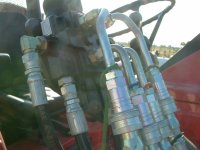
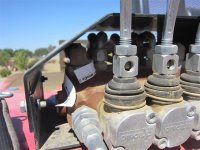
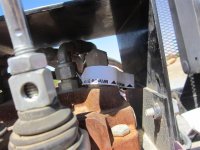
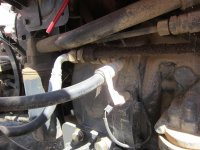
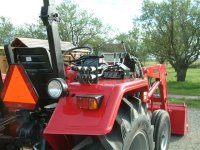
Here are a few photos of the triple rear remotes I had the dealer install on my new 2008 Mahindra 5525 when I bought it. Dealer's design. $750.


DSCF0138 (Medium).JPG

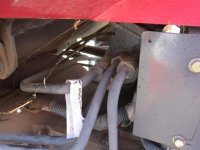
The connection to the power beyond (PB) port on the side of the FEL joystick block .

IMG_3886 (Medium).JPG

The output (return) line from the triple remote valve block (white tag).

IMG_3887 (Medium).JPG

The input line to the triple remote valve block from the PB port (white tag).

IMG_3888 (Medium).JPG

The return line from the triple remote valve block connection to the hydraulic reservoir (white tag).

IMG_3889 (Medium).JPG

The connection to the reservoir (white tag)

Remotes 5525-1.JPG

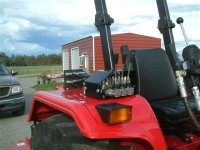
The triple control valve block for the remotes.


Remotes 5525-2.JPG

The three pairs of quick disconnects for the rear remotes.

Hope this helps.

Good luck
 
   / Hydraulic Remotes...Again! #14  
.... Back to my question. Does it seem reasonable to interrupt the pressure line to FEL valve, install a hydraulic manifold , then take outputs from the manifold to the FEL valve and to the the log splitter (or whatever is plugged into that output)? ....
In part the answer to that question depends on your answer to a previous question: How many lines does your current FEL control valve have?

From looking at Branson parts, loader and tractor manuals I found on a Branson Dealer website in Austrailia I'm almost certain you will find you have:
4 each - hoses to the FEL cylinders ('working ports')
1 each - pressure feed from tractor to the FEL valve ('P' port)
1 each - power beyond back to the tractor ('PB' port)
1 each - relief flow back to the tractor tank (the right side of transmission case) ('T' port)
TOTAL - 7 lines connected to your FEL control valve

IF that is correct, you have a constant-flow hydraulic system and your FEL control valve is the open/tandem-center type and already has Power Beyond capability.

______
IF that is correct and you insist on the 'manifold approach' then the manifolds (yes, multiple manifolds, keep reading) must be a selector-type where you select which control valve is in-use (one at a time only) and it must incorporate a relief valve with return to the tractors tank as described by oldnslo in his post above.

Why all of that? Because:
1. If you install an 'open' manifold where fluid can flow to either control valve all the time, then the fluid will always flow to the 'other' valve when you try to operate one, passing freely through the 'other valve' open center. No working port will get anything near operating pressure.
2. If you install a selector-type manifold (use either/or control valve but not both simultaneously) to avoid problem 1, then you can easily 'deadhead' your tractor pump during switchover which will cause instant over-pressure and destruction of the 'something' that has to 'give' when that happens (pump casing, pump drive coupler, a pressure pipe .... whatever is the weakest link and it won't be good, may be dangerous to the operator, will be expensive to fix).
3. Problem 2 can only be avoided by the added complexity of a manifold pressure relief valve and return hose to the tractor tank - that's the 'bypass' to avoid damaging deadhead during switchover of the manifold selector.

Why multiple manifolds? Because:
4. You have to address not only the 'P' pressure feed to each control valve, you also have to address the 'PB' pressure feed back to the tractor for each of those separate control valves. There's also the multiple low-pressure 'T' returns to tank/transmission that'll have to be addressed, but those can be an 'open' junction.

^^That's all a very complex approach, fraught with risk if the switchover of both 'P' and 'PB' isn't coordinated, a PITA to juggle all the manual switchover stuff, that's why ....
.... I have not heard of this solution before ....

_______

IMHO the "proper" and "safe" solution, the KISS solution intended and traditionally used for a system design like yours (and many other CUT's) for good reason:
  • Install correct open/tandem center control valves with 'PB' and 'T' ports/hoses (which is what your FEL control valve already is) in series for any/all aux implement controls.
  • In order to ensure delivery of the full ~8.x GPM that your tractor pump is capable of, all of the 'P' and 'PB' lines and fitting in that series-path should be 1/2" (#8) as previously stated by Brian (even if the implement itself uses a smaller hose/fitting at the working port connection).
Note that all of these same control valve-type and hose/fitting size rules apply even with the 'manifold approach'.

The "proper" solution is fully passive - you can use whatever external implement at-will with no manual switching of anything and it serves for lot's more other common and convenient rear-aux implements than just a static log-splitter (e.g. bucket grapple, hyd top link, etc, the list is endless when you have a rear aux that's 'conventional').

So why would one choose the 'manifold approach' which does nothing but add parts (more cost), complexity and the inconvenience of 'only-one-or-the-other-selection' when compared to the 'traditional' solution?
 
Last edited:
   / Hydraulic Remotes...Again! #15  
TX
Very nice explanation on adding valves in a fixed displacement pump circuit.

Reguy
None of this addresses the current issue of where is the flow going on your present system.
 
   / Hydraulic Remotes...Again! #16  
Reguy
None of this addresses the current issue of where is the flow going on your present system.
Absolutely agree.

Reguy .... Does your tractor require installing a plug in a block before the FEL valve to divert the oil to the FEL? If yes The seals on this plug could be leaking allowing oil to bypass the FEL valve a couple of members have recently experienced this problem
FYI from review of the Branson docs I found they do not use an internal plug in a divider block (as does my Yanmar, for example). Instead, they show that without an external valve installed, the divider block with 'always hot' P & PB ports has an external "U" assembly connecting those two ports installed outside the divider block; that external "U" assembly is removed to allow connection of the P and PB lines when an external valve is installed. KISS and effective approach, IMHO.

Unfortunately, all the docs I found use proprietary PNs for the fitting references .... I found no indication of the P & PB port sizes at the tractor divider block or the Branson FEL control valve for the external connections. One would hope they are nominal 1/2" flow ID / SAE #8 but who knows other than Reguy and his mic (?)

Reguy, if you want to determine any of your line fittings sizes, this might be of help:
http://www.discounthydraulichose.com/v/vspfiles/downloadables/thread_guide.pdf
https://www.discounthydraulichose.com/v/vspfiles/downloadables/qd_sizechart.pdf
 
Last edited:
   / Hydraulic Remotes...Again! #17  
Smaller quick disconnect just increase the pressure drop they will only restrict flow once you get to the relief valve setting but not before that. Same with smaller hoses.

That doesn't sound right but maybe it is. Putting a restrictor in the line will reduce flow but I realize there are other fluid dynamics at work. Can you elaborate?
 
   / Hydraulic Remotes...Again! #18  
Smaller quick disconnect just increase the pressure drop they will only restrict flow once you get to the relief valve setting but not before that. Same with smaller hoses.

That doesn't sound right but maybe it is. Putting a restrictor in the line will reduce flow but I realize there are other fluid dynamics at work. Can you elaborate?

npalen,
On systems with a fixed displacement pump (gear pump) the flow must go somewhere. On simple systems like those used on small tractors the oil typically flows through the FEL valve, to the 3 PH and then to tank. When any restriction or load exceeds the relief valve setting flow is then bypassed to tank through the relief valve.

If a pressure gauge, flow meter & flow restrictor are installed in the power beyond line you could watch the pressure climb as the the flow restrictor is closed but the flow would stay pretty much the same until you reach the set point of the system relief valve. at this point the pressure will stay relatively constant and the flow will start to drop as as the restrictor is closed further.

Does this help explain the concept at all?
 
   / Hydraulic Remotes...Again! #19  
Yes, that makes perfect sense. The fluid has to go somewhere as you say.
I suppose that on an older system, some wear in the pump would let it "slip" a bit thus reducing the pump output somewhat when the resistance is increased. But it that case, the pump would no longer be fixed displacement per se.
Thanks for the explanation.
 
   / Hydraulic Remotes...Again! #20  
.... I currently am powering the log splitter by disconnecting one of the quick disconnect outputs on my FEL joystick and plugging in my log splitter. .... It works ok but the splitter is slow due to the lack of adequate hydraulic fluid volume. ....
..... when I connected splitter to friends tractor w/remotes the log splitter worked noticeably faster. .....
Stepping back for a moment ....

Is one possibility that reguy's system is delivering all of the his Branson's 'rated' ~8.x GPM pump's capacity to the splitter, but his friend's tractor is working the splitter faster simply because it has a higher pump design capacity?

We've not heard back but if reguy's hoses and fittings are all nominal 1/2" (#8), and the hose/fitting on the splitter is the same, then there's about 30% GPM additional (or more, 'overhead' in those hoses and fittings unused by reguy's Branson) that could be delivered through that to the splitter by his friend's tractor if it has a higher capacity pump.

Even though the max 'rated' flow of either tractor probably isn't 'in-play' when the splitter engages a log, wouldn't a pump with higher design max flow rate likely also have higher flow rate at any given working pressure, thereby yielding faster operation of the splitter (back to the missing pump-curves)? And certainly higher GPM with faster operation during un-loaded splitter-cylinder recycle?

Just stepping back and wondering if the comparison to the friend's tractor isn't revealing any 'problem' with reguy's system at all .... just revealing a difference between the respective tractor inherent pump capacities (even with identical hose & fitting sizes)?
 
Last edited:

Tractor & Equipment Auctions

(INOPERABLE) DYNAPAC DOUBLE DRUM ROLLER (A58214)
(INOPERABLE)...
2014 International WorkStar 7300 4x4 Altec A55F 55ft. Material Handling Bucket Truck (A60460)
2014 International...
20FT X 12FT LIVESTOCK METAL SHED (A58214)
20FT X 12FT...
Freighliner Tender Truck (A56438)
Freighliner Tender...
2006 Freightliner Auger Truck (A56438)
2006 Freightliner...
2004 JOHN DEERE 310G BACKHOE (A60429)
2004 JOHN DEERE...
 
Top