Water heater direct-vent vibrations

/ Water heater direct-vent vibrations #1  

ning

Elite Member
Joined
Mar 30, 2017
Messages
4,393
Location
Northern California
Tractor
Branson 3520h
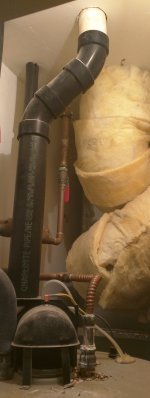
Our house has a (propane) power-vented water heater - there's a fan mounted on top of the heater which sucks air and cools the exhaust, which blows into some 3" black pipe up to the ceiling etc.

Anyhow, vibrations from the fan go right into the pipe, which is solidly attached, and thence into the ceiling joists which it's probably attached to above (and that's almost right below our bedroom).

I'd like to cut a chunk out of the black pipe, and use some sort of (silicone?) rubber coupler to keep the vibrations from traveling up the pipe. Anyone know of something appropriate for the part? There is heat in the exhaust, though not a lot; I'd like to stay within code for the application.
 
/ Water heater direct-vent vibrations #2  
Yes. The rubber pipe section is called a "Fernco". An EPDM rubber hose designed to fit over, and clamp to pipe. Typical WH exhaust is either 2" or 3" pipe. Either a measurement of about 2 1/4" or 3 1/2". Find out which one you have and go to a plumbing supply and ask them for a 3" or 2" Fernco. They have a stainless band clamp on each end. 3" ones are about 7" long. Cut a section out of the exhaust pipe you have, about 2" shorter then the Fernco. Slip it into place and tighten the clamps.

It might also be that your fan is failing. Usually the fans are very smooth running. You said vibration, but maybe it's just telegraphing noise.
 
/ Water heater direct-vent vibrations #3  
Our house has a (propane) power-vented water heater - there's a fan mounted on top of the heater which sucks air and cools the exhaust, which blows into some 3" black pipe up to the ceiling etc.

Anyhow, vibrations from the fan go right into the pipe, which is solidly attached, and thence into the ceiling joists which it's probably attached to above (and that's almost right below our bedroom).

I'd like to cut a chunk out of the black pipe, and use some sort of (silicone?) rubber coupler to keep the vibrations from traveling up the pipe. Anyone know of something appropriate for the part? There is heat in the exhaust, though not a lot; I'd like to stay within code for the application.

How old is the WH? Is this a new occurrence? Or is it something always there but getting irritating? Those heaters are usually pretty vibration free. The above answers may open some new responses. Like is the condensate draining out?

Ron
 
/ Water heater direct-vent vibrations #4  
Ron,
The OP is describing a power vented exhaust, not a condensing unit.
 
/ Water heater direct-vent vibrations #5  
pictures?
make/model of WH (water heater)?
 
/ Water heater direct-vent vibrations #6  
Ron,
The OP is describing a power vented exhaust, not a condensing unit.

I may have mad a wrong assumption. If the black pipe the OP describes is ABS; then, it may be a condensing type heater. The information provided was sketchy at best; hence, the questions.

Ron
 
/ Water heater direct-vent vibrations
  • Thread Starter
#7  
Believe it or not, the vibration has been there since installation. It bothers me to varying extents, and I've always had things much higher on my "to do" list to bother with it. At its worst, it's a minor annoyance really as I only notice it when I'm in bed and the thing comes on, which is almost never.

I've attached a pic of the top of the heater & vent setup.
1.jpg

The water heater is a State Select 75. It's not made any more. The installation is about 20 years old.
 
/ Water heater direct-vent vibrations #8  
Until we installed geo-thermal, we also had a similar issue. I just lived with it but it was a little annoying at times.
 
/ Water heater direct-vent vibrations
  • Thread Starter
#9  
Yes. The rubber pipe section is called a "Fernco". An EPDM rubber hose

That looks reasonable; my question is, is it appropriate for the heat? The vent isn't hot (being mixed well with cooler air) but it's definitely warm.

The water heater is an older (~20 years old) State Select: SS8-75-PQVT1. I can't find data on it on the net unfortunately, I'd like to see installation specs.
 
/ Water heater direct-vent vibrations #10  
The Fernco will take more heat than the ABS black plastic vent pipe. So, yes.
 
/ Water heater direct-vent vibrations
  • Thread Starter
#11  
The Fernco will take more heat than the ABS black plastic vent pipe. So, yes.

I went to verify, and found this for plastic pipes (180?コF) and this for Fernco standard couplings (140?コF). Did find the Fernco proflex coupling which does have 180?コF but it has a stainless band around the neoprene, so more vibration would get through (though still better than the solid ABS).

I also found in their FAQ, "Our couplings are rated up to 140 degrees, but sporadically". That sporadic event is probably dumping a sink full of hot water down a pipe.

There are silicone hoses for turbo setups which are rated well over 350?コF (link, link).

I think I'll measure the exhaust temp next time it kicks on (ie, next time I notice it kick on).

ugh sorry I can't get the degree symbol to come out right here
 
/ Water heater direct-vent vibrations #12  
there is some differences in rubber fittings.

--there are cheap rubber fittings. and the pipes just slide into the fittings,
--then there are rubber fittings that actually have a more of "female fitting" like a sch 40 PVC fitting would have. were the pipe will only go so far into the fitting. (stops pipes from fully sliding through the fitting)
--then there is also rubber fittings that have like a "metal jacket" around them. (adds structural support to rubber fitting, to help prevent it from collapsing and/or cracking under weight, also helps from the "balloon" effect that might happen)

with above said. look for "no-hub" fittings. more likely get what you want closer than just searching for "rubber fittings".
if you get a combo of metal jacket, ends of rubber fitting only allow pipe to slide so far in, and has 2 and more likely 4 pipe clamps on it. you will end up getting something more likely to support some weight, keep pipes in place. and still allow some reduction in vibrations.

=============
with above said....
if you can get into the walls, ceiling, Attic, roof. and follow the actual vent pipe all the way out. see if the vent pipe is rubbing on anything. good chance when pipe was put in. that hole was not cut big enough, or pipe is leaning up against a 2x4 or like.

also check for any sort of support clamps. goto a couple local hardware stores (menards, lowes, homdepot) at least 2 of them and look at the supports they offer for pipes. (i say 2 due to 1 will have some, and the other will have the rest most likely)

there are some with springs. (attach one part to house, then a spring, and then a clamp around pipe), and then there are some more rubbish stylish clamps, along with metal pipe hangers. you may also find in the insulation isle for pipes. a roll of "wrap on rubber insulation" that you might try wrapping once or twice around pipe. before clamping a larger metal pipe hanger around pipe.

the roll of rubbish pipe insulation, might help reduce vibrations. if pipe is covered in it all the way up. but am guessing you have multiple issues with overall installations. and will need to find out were pipe is rubbing some place on the frame work of home, and re check screws that hold vent on top of water heater. and perhaps add some additional support hangers. or cut and redo some fittings. and still possibly add a rubber fitting in.

===============
just adding a rubber fitting in. most likely will only be a band-aid. and may not resolve issue, find the root cause.

example what happens if you can place your hand on pipe when water hater and vent kick on? does it help reduce vibration? if you slightly push/pull pipe in different directions. does noise go away?

is vibration more of an "echo" effect. errr renascence effect. (eerrr i can not remember correct word), the vent pipe acting like a trumpet, flute, etc.... and causing additional sound to be created.
 
/ Water heater direct-vent vibrations
  • Thread Starter
#13  
Where the exhaust goes into the ceiling (in this small utility space; and the ceiling here is between two floors of a house) is sheetrocked, and then goes into another room's ceiling.

The vibration isn't strong and the pipe is very solid; there's virtually no motion in the pipe which seems to be quite attached. I can dampen it slightly by holding on to it, but it's like trying to dampen the vibrations of a motorcycle with bar-end weights - it only does so much.

While it's possible that having originally installed dampened connections wherever the exhaust is attached in the ceiling above would be the right thing, it's a huge amount of work vs the quite likely fix of a sawzall + rubber connector. Is it still a bandaid fix if it completely solves a problem with almost no outlay?
 
/ Water heater direct-vent vibrations #14  
Google "hump coupling" for silicone fittings. I've read about them being used for exactly what you are trying to accomplish, and they are silicone so they are rated to 500*.
 
/ Water heater direct-vent vibrations
  • Thread Starter
#15  
Google "hump coupling" for silicone fittings. I've read about them being used for exactly what you are trying to accomplish, and they are silicone so they are rated to 500*.

Looks perfect, thanks.
 
/ Water heater direct-vent vibrations #16  
ning,

You can probably find silicone tubing that will be rated higher than the Fernco. But if the plastic pipe you have hasn't distorted over the years, the Fernco will be fine. No need for "stops" in the tubing, like a "no Hub" has with the pipes securely mounted.

The nice thing about a Fernco is that it takes out the vibration and it takes out the strain by allowing some mis-alignment. The internal stops of a no-hub inhibit the installation where the top of the boiler and the pipes are fixed and they are thinner where they are clamped.

You can cram a Fernco in there and slip it over one side and then bring it down on the other cut end with no problem.

I can recommend these because I've been using them for many years on boiler vent installations for just the reason you stated and to allow some misalignment or for future disassembly. Never a failure. Often the boiler runs at 186 degrees with its exhaust near that temp. Try one.

Those hump couplings look good to, but they are about six times the cost.
 
/ Water heater direct-vent vibrations #17  
Since they deemed it OK to use plastic vent pipe the heat is not critical so you could use just about any flexible section and not go the hi temp costly route.
Heck cut out 2-3" of pipe and wrap 2-3 layers of shower stall liner and clamp tightly.
The burn off of propane is mainly water vapor.

Most heating supply outlets would have a fabric that they use to isolate plenums from the actual furnace just for the purpose to isolate noise and vibrations.
That would be a rubberized fabric that is sold 'by the yard' so to speak. (very similar to shower liner in appearance and feel)
 
 
Top