$11,000 Water Bill

/ $11,000 Water Bill #81  
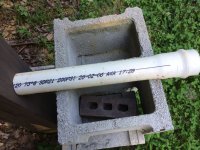
Please put down your pitchfork and look at the picture again, it does say DWV, but it also says 280PSI.
I suspect that it is schedule 40 or 80 pipe that is also DWV rated.

Aaron Z

Okay....But I never put down my pitchfork....
 
/ $11,000 Water Bill #82  
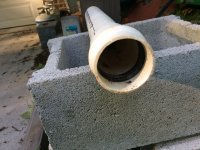
We had to have the local water department installation contractor install our "water line" about 1500 ft down our "driveway" because they were the only outfit around that had the "rocksaw" to saw a trench through our solid rock. They didn't give me much choice about the material used because by FAR the cheapest was what they had miles and miles of already laying around for lines they ran for the water department. It is 2" x 20 ft sections of PVC slip-joint (rubber o-ring gaskets with lube). Quite thick, and the PVC seems much more pliable than your typical DWV stuff.
The rubber-ringed slip joints are specifically designed and intended for underground water service lines (I was told). They allow "give" as the earth and the line each move.

If it's good enough for the municipal water department mains that are installed along the roads and last for decades, it's good enough for me.

I only have a small section left with partial markings. All I can tell for sure is 200psi. Looks like "SDR21".

p.s. yeah, here it is - Cresline Plastic Pipe Company

IMG_0542 (768x1024).jpg

IMG_0543 (1024x768).jpg

Just as a blatant thread hijack, the rocksaw was one awesome (and expensive) piece of machinery.

Rocksaw (1024x768).jpg
 
/ $11,000 Water Bill #83  
When we put in our well, it was about a 500 ft run up the hill and we have rocky clay. We ran it through 4" corrugated pipe to stop the rocks from working around rubbing it.

Same here......1500' from house to our spring storage tanks. We used glue together PVC (pressure water line, NOT DWV) in 20' joints, glued 100' together at a time and slid it inside a 100' roll of 4" corrugated pipe to protect it best we could. Been in the ground since 1982, zero problems.....35 years, zero problem.

In fact, I pulled some out with a backhoe to make some changes about 10 years later, and NONE of it would separate out of the socket fittings.....I could kink the line in the backhoe bucket and break it that way, but full force pulling on it would not pull the joints apart.

My wife of now 45 years helping straighten out a 100' coil to run the PVC in, back in 1982.

ry%3D400
 
/ $11,000 Water Bill #84  
I see the DWV marking, but also see the NSF which usually means ok for drinking water if I recall. We have black ABS for DWV here, but daughter in Maryland says all the DWV is white PVC there..

We had a leak at our first house, within a few feet of the meter in black poly. It was running a bunch of water and not any indication (buried 4+ feet deep, rocky soil that drained well). I heard water running at night when nothing was on. When I checked the meter with the main valve off at the house, the meter was spinning crazy fast. We turned the main valve off at the meter and it stopped then, so we knew for sure it was our side. Called the water company and asked for help. They promised someone would come right out, no one showed, 3 days later, I called a bit upset saying that I knew if was my responsibility but they keep promising someone would come out and help locate with their fancy equipment. Right after the 3rd day call, a manager came out in a suit. He took his jacket off, rolled up his sleeves, got a shovel out of the truck and said, let's find that leak. I asked about equipment and he said most times the leaks are close to the meter. We dug a deep by the meter and found the leak. Damaged section had a scuff mark running along the side, water guy said usually a sign of getting caught with backhoe, slight crease causes the inside to wear and over time develops a leak. They waived the water bill (it was 3600% increase over normal, but don't remember the $$).

Your leak looks like joint was not done properly (may be wrong glue, don't know). I am getting ready to make a device that uses 2" PVC and the video instructions stress doing it correctly or it will leak (even suggest marking depth it needs to be and especially making sure the sections are twisted at least 180 (half a rotation) as they are put together to avoid and air bubbles causing a straight line defect in glue joint that can leak over time). It would not surprise me if they did not twist the joint as they inserted and ended up with some defective joints. I suspect that perhaps the pressure was high when initially connected (stressing any weak joints) and then the pressure reducer was added. Perhaps after a couple initial leaks the pressure reducer was added.

If the whole situation does not go acceptably, then also consider notifying your federal representative.

Thanks for your families service.
adding to...

pending on glue (chemicals used), and by code. it is a good chance the glue needs to be of some color so as to quickly inspect to see joint has been at min primed. code may allow for clear solvent to be used after primer is applied. and/or using a combo primer/solvent all in one chemical.

de burr the ends (many times even new pipe. i have found i have scratched the end up some how. or it came that way with a "burr" little pieces of plastic sticking out off the end. the burrs will cause scraping and goouging of the fittings, which can cause leaks.

if you just insert a pipe directly into the fitting. it can leave "streaks", kinda like using a steak knife on a stick of butter, you see kinda of a drag marks on the butter were the knife sliced through. these can cause leaks.
by turning the pipe and/or fitting 180 degrees it is like smearing peanut butter on a piece of bread. as in you blob some peanut better and spread it out in a 1 direction, and then come at it 90 degrees at another direction to spread the peanut butter out. the turning 180 degrees is that spreading the solvent out. so any leak that might of had a chance to go directly between fitting and pipe is no longer there.

different types of solvents/primers. some are better for small size pipe example 1/2", 3/4", 1" while other solvent/primers, are better for larger pipe. the larger pipe stuff tends not to dry as quickly, but also more thick. (instead of water, more of a syrup or honey like doing. so as you are getting things together the solvent does not drip down and go some place else.

some solvents/primers are rated for only certain types of pipes and uses (abs, pvc, cpvc, etc...) most require to be used during certain temperatures, to cold or to warm. and there can be issues.

larger pipe generally requires "much more muscle" and 3" to 4" pipe it can get to point of needing a 2nd person. one holding fitting while other turns pipe.

to much can be a bad thing. i have had issues were i "gobbed" to much solvent and/or primer on. and the joint ended up being bad.

i have had plenty of pipe "slip back out" of a fitting. the need to hold for a min of 30 seconds. when initially putting the fittings together can be critical.

===========
pulling out old electrical, to water lines, to gas lines... having clean fill can be a major issue. once i start pulling out the old stuff. i required clean sand to be brought in. to compact below the pipe, around its sides and a couple inches above the pipe. you could clearly see places were rocks even river rock like places were stuff was about to split / crack / major damage soon enough about to happen.

============
other blah blah...

tv stations, most likely is not going to do OP much good.

state attorneys office, might help as a negotiator, but still may not resolve issues. it may take a few weeks before they even get to you, once you file a complaint with them.

BBB.org might help, might not. act same as state attorney office, but there would be a ticket made against company/s. BBB will stall ask what has been done to resolve issue.

get a third party plumber in there to get a couple bids. for repairing and replacing the line. so you have documentation. do not tell them the whole truth, tell them you getting bid to fix, and/or replace entire line. if it is more hassle for them, they will want to walk away. make it easy for third party.

small claims if the overall amount can fit in small claims court. if you win, you still have to collect fees. it can be a hassle, pay for the claim, pay for the summons, then you may or may not get delayed at court, filling in small claims make sure you type in "fees", with amount you ask. so it gets added in / dealt with if judge gives you that. if you win you still have to collect fees. if installer/plumber does not give you money. and there are rules of what you can and can not collect from. pending on state, small claims most likely will not cover any lawyer fees. regular court there might be a chance lawyer fees can be obtained with judgement.

insurance company both yours and installers/plumber, might be a good place to start. you need water, they might pay up quicker and less hassle.

the installer / main contractor should be required to keep all the documents of who they hired as sub contractors. pending on how house was built/bought, you may have had copies sent to you of who the sub contractors are as in documents.

============
what ever happens get it in writing. "word by mouth" will only go so far. and make sure you get something stating it will be done by X,y,Z date.

certified mail, and make yourself a copy of stuff sent to installer/plumber. scan it, take a picture of it, email it back to yourself. something to show, so if in front of judge, you have something say hey i went through this trouble of sending myself a copy, and showing certified mail that it was also obtained by whom ever and on given date.

if you have phone records. keep them. if you have text messages keep them. documentation. showing you have attempted to work issues out, and continuing issues still happen, and things are not getting resolved.
 
/ $11,000 Water Bill #85  
Poly pipe has a horrible history of failure. I wouldn't use it.

Never heard of one. It's all that is used around her for probably 50 years. Mine has been in the ground since 73. The pipe has not failed, and I don't see how it could. It's probably good for 400psi, though it's rated at 200. It's so thick and tough you can't put a barbed fitting into it without soaking it in hot water first. Once it's back at room temp, you can't get that fitting off without cutting it off.

I think you must be thinking of a different kind of pipe.
 
/ $11,000 Water Bill #86  
Never heard of one. It's all that is used around her for probably 50 years. Mine has been in the ground since 73. The pipe has not failed, and I don't see how it could. It's probably good for 400psi, though it's rated at 200. It's so thick and tough you can't put a barbed fitting into it without soaking it in hot water first. Once it's back at room temp, you can't get that fitting off without cutting it off.

I think you must be thinking of a different kind of pipe.

I was scared to death of my plumber. He cut the black pipe flush with the wall. I thought how the heck is he going to get any kind of fitting on there to get to the pressure tank. He whipped out a propane torch and started melting it and jabbed in a 90 degree barb. He said there was no way anything other than cutting that off will remove it.
 
/ $11,000 Water Bill #87  
That pipe isn't meant to be buried. It is intended to be used inside. Does your municipality require the water line to be inspected before being covered up? If so, have your wife contact the inspector and/or water department and get them involved. They may go after the contractor for you to get it replaced properly.
 
/ $11,000 Water Bill #88  
Please put down your pitchfork and look at the picture again, it does say DWV, but it also says 280PSI.
I suspect that it is schedule 40 or 80 pipe that is also DWV rated.

Aaron Z

Correct. That pipe can be used for multiple applications. pressure, waste, vent, or waste. The way it is here. If the pipe isn't labeled for it's use, inspectors won't allow you to use it. With this pipe stamped this way, I can carry one type of pipe for draining condensate, water drain (waste), or as water line repair.
If I were going to replace it all. I would use pex over anything else.

is there anyway lightening struck something. tracer wire, tree, etc, traveled what ever it struck and burn a hole in the pipe ? I have seen this happen
 
/ $11,000 Water Bill #89  
Having installed lots and lots of pvc pipe buried in the ground that is an odd looking leak. I have seen leaks before but it's almost always due to a split in the pipe. At first I thought maybe the pipe was damaged during loading/unloading but then I noticed both male and female part have the same hole. I feel confident it's not the glue as the joint is intact but it's the pipe that's damaged like something hit it.

I am like Eddie and have experienced terrible luck with buried poly pipe. I never use it and don't know anybody who does. I have since found out that for some reason most of the poly pipe sold in Tx is only rated for 80-100 psig while for some reason up North they can get 160-200 psig pipe.

Good luck getting it resolved.
 
/ $11,000 Water Bill
  • Thread Starter
#90  
Correct. That pipe can be used for multiple applications. pressure, waste, vent, or waste. The way it is here. If the pipe isn't labeled for it's use, inspectors won't allow you to use it. With this pipe stamped this way, I can carry one type of pipe for draining condensate, water drain (waste), or as water line repair.
If I were going to replace it all. I would use pex over anything else.

is there anyway lightening struck something. tracer wire, tree, etc, traveled what ever it struck and burn a hole in the pipe ? I have seen this happen
I thought about PEX, but it seems like it's pretty hard to come by in 2". Also - fittings of that size seem difficult to find. Is this something that's available through a plumbing supply store?
 
/ $11,000 Water Bill #91  
I've never heard of PEX being that large. I've only seen it used for indoor water/heating systems (my home) replacing copper. You'd have to check to see if that size is available and suitable for in ground installation.
 
/ $11,000 Water Bill #92  
OP,

This still boils down to a contractor problem. I don't care if he used unicorn intestines for water pipe.

You've had several leaks on this same pipe run.

You are still under warranty from the original builder.

This is All. On. The. Builder. To. Fix.

On his dime.

Get your base legal office involved. This is EXACTLY the kind of thing they are there for. I used them several times for legal help back when I was in.

Either way, builder fixes. Full. Stop.

Builder pays the water bill. Full. Stop.

This is what the court system is designed for. Take him to court. Sue for a damage multiple (if such thing is allowed in your area).

Make sure the new line gets inspected properly before you allow him to bury it again.

The rest of this is all about how many pixies can dance on the head of a pin.
 
/ $11,000 Water Bill #94  
Never heard of one. It's all that is used around her for probably 50 years. Mine has been in the ground since 73. The pipe has not failed, and I don't see how it could. It's probably good for 400psi, though it's rated at 200. It's so thick and tough you can't put a barbed fitting into it without soaking it in hot water first. Once it's back at room temp, you can't get that fitting off without cutting it off.

I think you must be thinking of a different kind of pipe.

I have no doubt that there are plenty of cases where black poly is used without any problems. The shorter the run, the less likely you are to have problems. You didn't mention how long your water line is? To clarify, when I said that I would never use it and that it has a terrible history of failure, I'm talking about over a long distance and just guessing, probably a one or two percent failure rate. For me, that's too much and it's why it's not allowed anymore. The longer you go with water lines, the more movement you have on it.

TNAndy solved the movement problem by running his pipe inside another pipe. This way his water line is never affected by the movement of the earth. Think of ice cubes popping out of the tray. The ground gets saturated, it freezes, and it expands. This destroys foundations, it moves fence and telephone poles, and it breaks water lines.

Since you are in Virginia, I googled what they use for water lines there. From the links I found, DR21 and DR18 are used for anything 1 1/2 inch and up to 4 inches. Then you go to something like C900

Look at page three. https://www.loudoun.gov/documentcenter/view/105795


There is only one pipe to use for this long of a run. All other suggestions are just guys being helpful without knowing what else is out there and what is the best product to use.
 
/ $11,000 Water Bill #95  
All other suggestions are just guys being helpful without knowing what else is out there and what is the best product to use.
I believe that goes without saying about anyone in any internet forum group.

While people are trying to be helpful and give their input, still, nobody knows everything about anything. ;)

Beside that, technology, materials, and engineering are constantly changing what we use and how we use them.
 
/ $11,000 Water Bill #96  
Interesting to me that posters on this thread report problems with black poly pipe. When I ran a water line to my barn, and later extended it to the orchard, I used about 400 feet of black poly.
31 years later, no problems of any kind. My home is at 800 ft elevation on a basalt rock mountain. I don't doubt the bad experience others report.
I'm guessing there are different grades made by different manufacturers coming into play here.
 
/ $11,000 Water Bill #97  
there are many products available for him to use as a water line. PVC is most likely the least expensive of all the others.
I have installed many miles of PVC for water line and have incurred very little issues.
Most of the issues I have seen is someone damaging the line while digging in their yards,etc,
I can't understand you having numerous leaks with PVC. Something just doesn't seem right.
 
/ $11,000 Water Bill #98  
I have been using a BLUE pipe that is commonly the choice for wells.
I think it is actually POLY-B and is close to 1/4" wall and comes in 3 ft coils, pressure rating is well up there.
Our city allows it for connection to city mains as long as we use the special fittings vs barb type and collars.
When I use barbed fittings I like to gently heat B4 inserting the barbed part as then when clamps are installed the barbs actually get molded into the Poly B line.
I always use 2 barb clamps per fitting with the screws 180 deg apart.
 
/ $11,000 Water Bill
  • Thread Starter
#99  
I know this is going to probably sound crazy, but what are the chances that a plumber can run 1.5 inch 200 psi roll pipe through the existing 2 inch line??? He would need to remove any sections of the pvc had have been repaired, but as long as the od of the 1.5 hdpe is less than the ID of the pvc it should work in theory..... any thoughts?
 
/ $11,000 Water Bill
  • Thread Starter
#100  
Looking at the SDR9 250 psi poly at menards - shows an ID of 1.26 and an OD of 1.625. Do you think capacity would still be enough at 1.26 inches??
 

Marketplace Items

2020 Ford Fusion Hybrid Sedan (A64557)
2020 Ford Fusion...
2017 Ford F-350 Crew Cab Service Truck with Liftgate (A64556)
2017 Ford F-350...
1995 VOLVO A25C WATER TRUCK (A65053)
1995 VOLVO A25C...
2019 GMC SAVANNAH 3500 14' BOX TRUCK (A65054)
2019 GMC SAVANNAH...
7 FT Bush Hog Rotary Brush Cutter Tractor Attachment (A64553)
7 FT Bush Hog...
2016 Ford Explorer AWD SUV (A64557)
2016 Ford Explorer...
 
Top