Chain saw sharpening advice sought

/ Chain saw sharpening advice sought #1  

beowulf

Veteran Member
Joined
Dec 31, 2003
Messages
1,330
Location
Central California Foothills
Tractor
Kubota L3410 HST, J Deere riding mower
I have never tried to master chain saw sharpening so have a box full of used chain saw chains/blades. I usually try to keep a new one around but hate to see all those blades in the box that I can still use. My plan was to take them down the road to a guy who sharpens them - if he is still around. I estimate that I only go through only about three blades a year - so not really a heavy user. Anyway, I think I need to learn to sharpen these blades myself, if only to save me a trip to town when I need a sharp blade and have none. Saw is Husqvarna 455 Rancher 20 inch.

So, I see on Amazon that there are a number of options, a sharpening machine, a file kit, a bar-mount chain saw sharpener, and perhaps more. My current thinking is that a bar mount chain saw sharpener would work out - found one on Amazon for $35 without the files. It seems that it would be fairly easy to use and I can get the files separately.

Best advice?
 
/ Chain saw sharpening advice sought #2  
I sharpen by hand. After the chain teeth get worn down some I take it to my local shop and let him sharpen it. He adjusts the height of the drags so it gets an appropriate size bite again. He charges me $5 if he does that along with sharpening.

I had a bar mount sharpener. I got along with it fine. But once you understand the concept just using a file in a holder is much faster. I carry a file to the timber with me.

I've never used a sharpening machine.

Maybe visit your local Husky dealer and discuss this with them. They'll hook you up with the appropriate file holder and file size and offer some pointers.

There are a LOT of chain saw users here on TBN. This thread discussion may go on for several days. So get some popcorn and enjoy the education. :)
 
/ Chain saw sharpening advice sought #3  
I also file by hand. If I am in the woods, I just hit each tooth the same number of licks following the angle it is set at as best as possible and keep cutting. Once I'm back on the bench, I do have a guide that helps set the angles right and a guide for the depth on the rakers. Once you get the feel on the file sliding across the tooth, you will notice when it "smooths out" and you're done. Using the same number of strokes will keep your teeth close to the same length and lowering the rakers is as important as sharp teeth. They can't work if they can't reach the wood.

Play around some and you'll get a feel for what your saw likes. Flat file across the rakers 4 or 5 times and cut with it. Does it throw chips or dust? Hit em a few more times. Does it throw chips or grab and bog. If it's dust, they are too high. If it grabs too much, they are too low. Experimentation is your friend, but be carefull.

You can ask ten guys this question and you'll get 15 different answers. Take em all with a grain of salt but nothing beats getting out there and doin it.
 
/ Chain saw sharpening advice sought #4  
You can ask ten guys this question and you'll get 15 different answers. Take em all with a grain of salt but nothing beats getting out there and doin it.

I totally agree!!!

I'll only add, don't continue to try to cut wood with a dull chain. All you are doing is heating the chain and bar and wearing the bar out. As soon as it starts cutting badly, stop and "tune" it up.
 
/ Chain saw sharpening advice sought #5  
First, chain, not blade. Chainsaws don't have blades. I hand file chains also. Almost bought a grinder last week, but decided I wouldn't use it enough to justify owning it. They're really only better for fixing a chain that's been damaged by a rock or other foreign object. A file sharpens just as well, and doesn't risk heating and changing the temper the cutter.

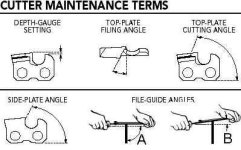
Filing by hand is cheap. Files only cost a buck or two and will sharpen a chain many times. Doing it by hand takes practice, though. Also, you need to understand what you're trying to accomplish. You need to sharpen the top plate of the cutter while maintaining the correct top plate angle, as well as the right amount of "hook". Also, you need to sharpen the top plate evenly across the entire length of the cutting edge.

Then there's the depth gauges aka "rakers" which determine how deep into the wood each cutter goes. These need periodic maintenance as well. I usually file my rakers about every third time I file a chain. I touch up my chains pretty much every time I fill the saw with fuel. A dull chain won't properly load the engine, and can result in an over revving, over heating situation and reduce the service life of the saw.

Then there's the gullets also. As you sharpen the top plate back, the gullets need to be cleaned out to make room for chips.

Now, all that said, it's not hard to do. Honestly the absolute best thing to do would be to find someone near you who knows what they're doing and learn from them. Next best would be to join arboristsite.com and spend 1-2 full days learning about chain filing. Then practice a bunch. A good thing to try for starters (once you have proper files) is to tighten up your chain pretty tight on your saw, and clamp the bar into your bench vise. You'll also want good lighting and safety glasses. Don't clamp the chain, just the bar, so that you can still spin the chain. Then examine a new chain and use your file to make the old one look the same.

It's a skill worth learning, but it is overwhelming the beginning. If you don't want to commit, I hear GREAT things about this product. Timberline Chainsaw Chain Sharpener | Timberline Filing Guides | Chain Filing Guides | www.www.baileysonline.com.com It's the only jig/clamp on sharpener I would consider buying. It uses carbide bits and low speed cutting, so it won't heat the cutters. I think the buyer are sold separately, and are sized differently for different sized chain.
 
/ Chain saw sharpening advice sought
  • Thread Starter
#6  
ovrszd, Thanks for the information. Hey, at $5 a chain - if that is what the local guy would charge - it would be a bargain since I am not a really heavy user. I probably have 20 chains that need sharpening. Still, I want to learn how to do it myself as well - hate to always depend on someone else. So, likely I will check out the local guy and also get a set of files and/or a bar mount unit. I see H-Freight has a cheap electric one (may be enough for my occasional use)- and there are several youtube videos re how to set up and use that. So, that may also be an option. It seems with the electric sharpener I can sharpen chains off the saw which is what I now need to take care of my box of chainsaw blades. Then if I learn how to use a file to sharpen the chain saw blades on the saw in the field I should be set. Thanks again.
 
/ Chain saw sharpening advice sought
  • Thread Starter
#7  
motownbrowne, thanks. A lot to consider. I do need to learn how to do this and like a challenge. It might impress my dogs if they see I can do this. My son in law was visiting and we were gathering firewood and this came up and he showed me how to mount the saw in a vice and use a hand file, but he was flying out that afternoon and we did not have any time to really work on it. I will take some time to learn about these parts of the chains and their functions and check out some youtube videos of hand sharpening.
 
/ Chain saw sharpening advice sought #8  
Not sure about Husky chains, but Stihl chains have a small slash mark on the top of each tooth, almost to the rear of the tooth. That's the angle to file the cutting edge at. I refer to it when I'm doing a quicky sharpening in the timber. Then all I have to worry about is keeping the file holder horizontal laterally across the chain.
 
/ Chain saw sharpening advice sought #9  
Not sure about Husky chains, but Stihl chains have a small slash mark on the top of each tooth, almost to the rear of the tooth. That's the angle to file the cutting edge at. I refer to it when I'm doing a quicky sharpening in the timber. Then all I have to worry about is keeping the file holder horizontal laterally across the chain.

Yes, the "witness mark" is super handy. Of course you also need to pay attention to if you're pushing the file downwards or lifting it upwards, basically, where does the cutting edge contact the file. This is the hook angle. If more of the file is under the cutting edge, that's an aggressive angle, which will cut very nicely, but wrong be as durable because the edge doesn't have as much support. By contrast, if less of the file is covered, and the edge contacts the file in a closer-to-perpendicular or more obtuse angle, the chain will cut a little less aggressively, but be more durable.
 
/ Chain saw sharpening advice sought #10  
I'm calling it the hook angle, but it's maybe better referred to as the side plate angle, like in this picture:

chain_angles.JPG

If you allow the file to ride up it will make the angle to blunt, but too narrow an edge isn't good either.
 
/ Chain saw sharpening advice sought #11  
I used to take my chains in for sharpening but found I ran them too long between sharpenings and it got to be a hassle. I use a file on my Stihl with the Stihl sharpening kit. it helps me keep the file at the right angle and straight. Now I can sharpen my chain almost faster than I can change it. Also it is nice to touch it up out in the woods to keep it very sharp for easier and safer cutting.

My local dealer charges $5 to sharpen one which I do if I damage one. The cost once a year at "Sawdust Days" is $2.50 so I usually hand him a couple at that time.

Also the chains last longer when they are used sharp and with the file you do not take as much off.
 
/ Chain saw sharpening advice sought #12  
$5 to sharpen a chain is a very good price, if I could get that I would not sharpen my own.

As it is I sharpened by hand for many years. Last year I bought the Northern Tools knock off of the electric grinder made by Oregon and it works very well.

One other thing, if you cut a lot, get the chain that is NOT the safety chain. The more aggressive teeth cut much faster and last longer, but be careful, more prone to kick back.
 
/ Chain saw sharpening advice sought
  • Thread Starter
#13  
Well, thanks to all. More detail to all this than I assumed (top plates, rakers, gullets, angles. .. ), but all useful. I will start, as recommended, by putting the saw in a vice, and getting a set of right-sized files, and a new chain so I can compare my filing angles to a new one. My Oregon chains are stated to be at a 30 degree angle so that helps figure things out. I may also start with a bar mount until my instincts tell me I am ready to do it by hand. I will also take a number of my old chains down to the local guy and hopefully he can do some of those while I wait so I can learn from that as well. . . or check out some youtube videos. I will also look at the Timberline bar mount sharpener as suggested by motownbrowne, but once I have a few of my old chains sharpened - hopefully while I watch - and work on a few more of my own, I should be set for a few more years.

Even if I get a bar mount to use in the shop, I want to know how to sharpen the chains in the field.
 
/ Chain saw sharpening advice sought #14  
According to the way my saws cut and the opinions of my in-laws that bring their chains to me for sharpening, I do an awesome job of sharpening using a dremel and the correct size cylindrical stone. For me, it is super easy. USE GOOD EYE PROTECTION! Just draw the dremel/stone lightly back and forth at the right angle on each tooth with the dremel held horizontal. High RPM, not too much pressure! I use the "witness marks" when they are present, otherwise just use a consistent angle for each tooth that is the same as what the original teeth are angled. If teeth are badly worn, I may resort to a little metal filing guide I bought from Baileys. Filemate Universal Filing Gauge (Each) | Depth Guage Maintenance Tools | Files & Filing Accessories | www.www.baileysonline.com.com
Make certain to use the correct diameter stone for your chain. Most "homeowner" saws/chains use the smaller 5/32" or 3/16" stones.

It is easiest to sharpen with the chain mounted on the saw; just rotate it by hand to get to all the teeth. Gloves are a good idea.

It is best to have the dremel on the engine side of the chain so that the stone rotation is from the top of the tooth DOWN into the gullet. This leaves a very sharp and clean grind under the top of the tooth which is where you need it. You can't help but also have a nicely clean and freshly ground gullet. Simply keep the stone pressure backwards into the gullet until you see the very top leading edge of the tooth cutter just begin to be cut. As was noted, strong light and some magnification is very helpful so you can really see exactly when that tooth leading edge gets just perfect. I like to use something like these - Magnifier Head Strap With Lights

I use the same stone to just touch the very tops of the depth guides and lower them a thousandth or two every couple of sharpenings. The same Baileys guide is good for verifying the correct depth.

As others have noted, determine when a resharpening is needed by paying attention to your "chip". A properly functioning chain will spit out nice, satisfying, largish chips or strings if ripping. No powder, no dust. You should need no downforce on the saw other than its own weight. When you no longer are getting nice chips, STOP before you overheat the teeth and ruin their temper. Sharpen or change chains.
 
/ Chain saw sharpening advice sought #15  
I have a whole bunch of files and guide I could send you. My advise is to get a TimberTuff? or Oregon electric bench mounted sharpener and enjoy the sharpening in your leisure.

I bought a Harbor Freight bench mounted electric and used it for quite a few years after my BIL showed me how to do it. I found it was a little to flimsy and bought a TimberTuff? sharpener and enjoy sitting down with a handful of chains and sharpen away for a couple hours.

I would take a chain to a chain sharpener and let him show you how to sharpen it. If he won't, find a different service man. Sooner or later someone will help you figure it out, then it is a breeze, and if done right they will be pretty close to factory specs.
 
/ Chain saw sharpening advice sought #16  
I actually get some satisfaction after sharpening a chain and watching it go through a tree like a hot knife through butter. I've never been shown how to do it but being a machinist for 30+ years it came pretty natural. I use a round file sometimes, other times I use the appropriate diameter Dremel. I would imagine everyone knows this but I've met people that don't so I'll mention it. Most files only cut in one direction and trying to make them cut in the wrong direction will only dull the file. Another thing I would mention is that when sharpening with a Dremel, don't overheat the teeth and ruin the temper of the steel. I run my Dremel on a fairly slow speed.

Kevin
 
/ Chain saw sharpening advice sought #17  
beowulf, I cannot cut a straight line through a 6x2 with a handsaw, but I can sharpen the chain of a saw (I can also sharpen a handsaw) because I did not have much option other than to learn when I lived 30 miles from the nearest person able to sharpen them for me in Australia.

I have used just the file with a cork stuck on the point, but now use the hand-held guide as used in this YouTube video HOW TO SHARPEN A CHAINSAW WITH AND WITHOUT A FILE GUIDE, ADJUST DEPTH ADJUSTERS - YouTube Old age means my hand and eye co-ordination is notquite as good as it was when I first started to sharpen my own chains and I find the guide prevents me straying off angle. I do not use a blade clamp, but think it is probably a good idea.

The full commentary of the video is printed as the uploader's first comment. Useful for novices once you have seen the video.
 
/ Chain saw sharpening advice sought #18  
Bringing back the edge on an almost new chain by hand in not too difficult after a little practice, however it is much easier to get all the teeth angles consistent with a machine. I also have been looking recently at various types of electric sharpeners. I enjoy sharpening by hand, however my right shoulder, like the rest of me, is getting old and some days is reluctant to file as often as I would like, which is generally after 2 or 3 fuel refills.

There seem to be very variable reports on the various low cost machines that use a disc. Some people are happy with them, others think they flex too much, or are just unpleasant to use. One thing to watch for is that on many you have to clamp each tooth by tightening a screw, then undo it again before moving on to the next. That could turn chain sharpening into a real chore.

The sharpener that appeals to me most for sensible money and what I have ordered is made in the USA by Granberg PRECISION GRINDER (12V) - G112XT - Granberg International. It gets mostly excellent reports and there are some good videos on youtube that show it working
How To Sharpen A Chainsaw Properly - YouTube
Granberg precision grinder and accurate depth guage raker setting for chainsaw chain - YouTube

You have plenty of chains, so once you get the hang of sharpening, you will be set up for a lifetime !
 
/ Chain saw sharpening advice sought #19  
I have always sharpened by hand (files) with the bar on the saw...........and the saw set level on my workbench.....the the bar clamped into a machinist vise....a goose neck lamp over the vise.
A neighbor gave me a brand new Oregon sharpener (top of the line).....it worked fine.....but i could do a single chain by hand faster than setting up the Oregon. If I had several chains to do at one time, I'd probably set up the Oregon.
 
/ Chain saw sharpening advice sought #20  
.... Another thing I would mention is that when sharpening with a Dremel, don't overheat the teeth and ruin the temper of the steel. I run my Dremel on a fairly slow speed.

Kevin

I totally agree - be sure to not overheat. You can tell if you're doing it because the thinnest part of the tooth (the leading/cutting edge) will start to blue. I have an alternate method to prevent overheating - use a HIGH RPM, but light pressure. Seems to work better (for me).
 
 
Top