Also look in the owners manual, if you want to believe them. My JD manual says to load tires plus have a rear weight (Ballast Box) plus put cast iron weights on the wheels. I ran out of money before I could put cast iron weights on so I do without.
The problem with Deere/Kubota/Massey, et al, manuals is they are pushing for dealer revenue. You put max weight on the wheels and compact the soil, then you have to buy heavier implements to break up the airless, compacted soil. An endless circle.
Certainly, you need enough ballast and/or counterbalance to accomplish your tasks but, in my OPINION, not a pound more.
I see my primary use for the loader being pushing snow and lifting logs.
If lifting
large logs with the loader will be a primary task and if you will be working on uneven ground, spreading the wheels and filling the tires to lower the center of gravity is important. Tractors have small front wheels, large rear wheels and high ground clearance; this sums to inherent instability. Safety first.
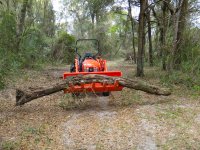
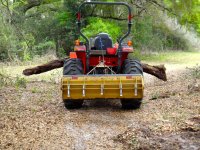
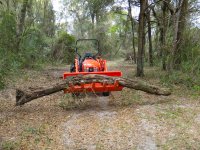
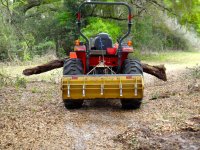
If you will be lifting logs on level ground, Three Point Hitch counterbalance will suffice. Soggy Water Oak in picture weighed about 1,400 pounds. Air in tires. Bush Hog (brand) 60" Rollover Box Blade, weight 625 pounds, as Three Point Hitch counterbalance. Smooth, level dirt. Rear a "little" light.
(Normally, I would cut a log of this weight and make two trips, or (easily) drag it from the center drawbar. But the trunk was full of dirt and I did not want to dull my chainsaw "chain" and the tractor was new, and I felt like a new tractor test. When I need a bit more counterbalance I tip my 88 pound Ratchet Rake on top of the 625 pound ROBB = 713 pounds together.)
I cannot address snow issue. I only know snow as theory. In their own words. You'll be sorry. What is everyone else experience with this? I will be doing firewood and pushing snow around in the winter and what ever else presents itself for loader work. Thanks.