Septic System - Infiltrator System

/ Septic System - Infiltrator System #1  

Pettrix

Platinum Member
Joined
Jan 17, 2012
Messages
622
Location
High Desert Southwest
Going to do the septic system on the home. Going with the infiltrator chamber system and a 2,000 GAL concrete (two chamber) tank.

Should I go with a Distribution Box or the installer offered an alternative that doesn't use a D-Box but just feeds directly into the leach fields first line?
I am leaning towards a D-Box since it distributes the waste evenly among all 4 leach field lines, instead of just feeding 1 field and then overflowing into the 2nd field.

The other question is in regards to the backfill over the infiltrator chambers. It can be native soil (which is rocky and silty). I am considering putting down washed 3/4" gravel over the chambers which will help prevent silt from getting into the chambers. I will also put down landscape fabric/geotextile OVER the chamber tops prior to backfilling to also help with preventing silt from getting into the chambers.

Any ideas or comments?
 
/ Septic System - Infiltrator System #2  
I would definitely go with a D box. I don't have your info for calculating the proper hydraulic loading rate for your field but a level D box with speedy levers so each run gets equal distribution. The chambers are louvered so infiltration of native soil isn't a problem. If the soil is such that it takes water well using it for back fill is fine as long as the field is not to deep 24 to 30" is ideal. So oxygen can can get into the field and feed the bacteria. If 4' deep I'd rec-comment either washed rock or coarse sand which is more reasonable to buy and will do the job filled to within 12" of the surface.
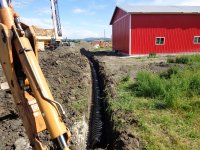
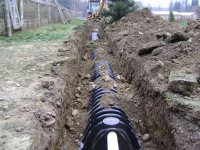
John & Cheryl Septic1 011.jpgJohn & Cheryl Septic1 010.jpg
Merle's Septic 012.jpg
Ulrike& Ulrich Undruh septic 010.jpg
These are pics. from 3 different fields.
 
/ Septic System - Infiltrator System #3  
Well - I designed on-site septic systems for over 20 years and infiltrators are a rather new step over simple 4" perf drain field.

The critical point on a D-box is to have it on good footing so subsequent freezing conditions will not cause frost heaving. Most D-boxes I've seen have adjustable outlets so you can fine tune the flow into each line.

IMHO - backfilling with gravel over the chambers is overkill. The soil the chambers are sitting on is already "rocky and silty". If you are really concerned wrap the landscape fabric/geotextile directly on the chambers then backfill with native soil.

For what its worth - - perhaps the best system I've seen is - - two compartment septic tank with sediment filter on the outlet,,, effluent into a single chamber pump tank with effluent pump ,,, into an infiltrator system with a perforated discharge pipe (1 1/2 inch) running down the ceiling of the infiltrators.

This system distributes filtered effluent down the entire run of all infiltrators at the same time. It prevents one condition found in all gravity distribution systems - progressive failure. IE - effluent discharges onto the ground in the first section of the infiltrator and over time the soil plugs - slowly but surely the soil progressively plugs down the length of the infiltrator. Based on multiple factors - soil, volume of effluent, maintenance of the septic tank--failure may be as soon as 8-10 years.

I'm not convinced that a gravity fed infiltrator system is any better than a standard 4" perf pipe distribution system and actually may not be as good. At least with 4" perf pipe the effluent discharges - basically- down the entire run of the pipe.
 
/ Septic System - Infiltrator System
  • Thread Starter
#4  
Is a concrete D-Box a good choice vs. plastic?

What kind of landscape fabric/geotextile should I get? Just one layer or two layers over the Infiltrator chambers?

Is it OK to leave a septic system dormant for a few months? I'm installing the septic system first and then the home gets built but it will set dormant during that period.
 
/ Septic System - Infiltrator System #5  
Ok, lets see. I've never seen a plastic D-box as shown in Billrog's pics. And even with the cement ones I've designed and have been used - some were set on a cement base with a couple feet of gravel under the base. I don't know where you are Pettrix but you must design/construct the D-box unit accordingly if you are in an area subject to ground freezing. Otherwise, set the D-box on a solid, well compacted gravel pad thats at least a foot thick. I see by the pic that Billrog shows you can gain entrance to the D-box at any later date and rotate the covers on the pipes to maintain equal flow just as you could with a cement D-box.

Since I've never experienced silt nor dirt backfill moving back into the infiltrator chamber and have never designed an infiltrator system using geotextile as you want to do - I'm kind of at a loss to tell you what to do. Whatever you do - DON'T use plain old roll plastic. You know that infiltrators are specifically designed to not allow backfill into the chamber. I guess if you are dead set on doing this - a single layer would be what you want. Just be sure the material is permeable and will allow air thru the fabric.

The only problem that will be of concern - leaving a septic system dormant. If you live in an area where the winters will get extremely cold (-10F or colder) for extended periods and the septic tank is full of liquid. There is a chance the liquid could freeze and fracture the cement tank. I would guess that leaving the septic system dormant, in your case, will be no problem since it will not have been in use yet. In the case of a septic system - biodegradation(bacteria digesting the poo) creates very little heat. Septic tanks do not freeze because they are buried in the ground and normal use brings warm water into them daily.
 
/ Septic System - Infiltrator System #6  
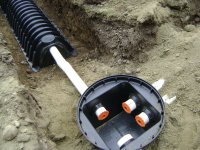
I have to agree with oosik on the fabric infiltrators are designed so it is not necessary. As for D boxes the only ones I've never had to replace are the plastic ones & I only recommend Polyloc D boxes as they are well built. I cannot add to the good advice as for how they should be placed 00sik has it covered well. This is what a Polyloc D box looks like.
Merle's Septic 011.jpg
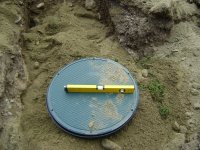
This is the re-enforced lid .
Merle's Septic 013.jpg
 
/ Septic System - Infiltrator System #7  
Well - I can see that when you are out of the field for a few years(such as I've been) technology will make giant leaps. That Polyloc D box looks like a really slick unit. Sure would beat trying to handle the installation of any concrete unit.
 
/ Septic System - Infiltrator System
  • Thread Starter
#8  
I am going to put down 4" of compacted AB where the 2,000 GAL concrete tank will sit so I will just get more AB for the D-Box area and put down 4" of AB.

The area I am in only has a frost depth of 18" and it never deep freezes. It's Northern Arizona high-desert.

Can't the inspection tubes at each end of the leach field also be installed with charcoal filters to allow for "breathing" of the chambers?

The landscape fabric will be the breathable type but it will keep out the silt that can get in. Out here some of the infiltrator chambers over years got filled up with sediment and it closed off the chamber. So the landscape fabric is added protection.
 
/ Septic System - Infiltrator System #9  
I never put inspection ports at the end of the runs except in pressure distribution systems some contractors do. I've dug up many systems that have been in the ground 30 years and more which have been properly maintained and the effluent has never gone beyond 1/3rd of the fields length. The less sticking out of the ground to get damaged in my opinion is better. Have a proper map and pics. of the system and you'll know where everything is if it's ever necessary to work in the area or have a repair. As for aeration any soil other than clay will allow plenty.If there is a silting problem with the soil filling chambers in your area then your plan is the right thing to do at least defiantly won't hurt.
 
/ Septic System - Infiltrator System #10  
Yes, the inspection tubes can allow air flow thru the chambers. I don't think you would need something as exotic as charcoal filters. Fine mesh screen - like on a screen door - wrapped around holes drilled near the top of the inspections tubes. Hold the screen on with UV resistant nylon wire ties. I would suggest fine mesh stainless screen - if you can find it. Otherwise, standard metal, not plastic, screen.

This will then allow the system to breathe thru the infiltrators - thru the septic tank - and out the stack vent on the house.

If the infiltrator is properly installed and backfilled there should never be much, if any, sediments leaching back inside the infiltrator.

I'm somewhat surprised at you Pettrix. In all my years of design/inspection/maintenance of on-site sewage disposal systems - I could count on my two hands the number of people who took such an interest in the installation of their system. This is a good thing. With your knowledge and interest - your system has a good chance to outlive you. There is no reason that a properly designed, installed & maintained system can't function properly for at least 100 years.
 
/ Septic System - Infiltrator System #11  
I'm not convinced that a gravity fed infiltrator system is any better than a standard 4" perf pipe distribution system and actually may not be as good. At least with 4" perf pipe the effluent discharges - basically- down the entire run of the pipe.

Wow, do you have any evidence?

Now that chambers like Infiltrator have been around for 30y or so, there is a lot of evidence to the contrary. Our
adjacent county prefers them now, as well as the whole state of Oregon, from what I have read.

My own county gave me special permission to install the first new Infiltrator pump-up system here, back
in 1997. It has worked well, with 4 leach lines 6' deep on a 40% slope.

Now the county recommends them.
 
/ Septic System - Infiltrator System #12  
dfkrug -

No, I actually have no evidence and could be completely "wet" in my opinion. Its just with all my years of experience I've seen so many new "magic" solutions not prove out over the long haul. So often the state or local health authority will be conned by the manufacturer by claims that simply are not true. Many agencies do not have the time nor funding to fully test new solutions and go with what the manufacturer claims.

I guess I'm just "old school" and should make room for new technology.

Another thing that is upsetting - most homeowners completely forget about the septic system once its covered. New technology requires routine monitoring, testing and maintenance.
What do you think will happen when a new state of the art septic system is installed in a homeowners back yard and he completely forgets the system once its covered.
 
/ Septic System - Infiltrator System
  • Thread Starter
#13  
I'm somewhat surprised at you Pettrix. In all my years of design/inspection/maintenance of on-site sewage disposal systems - I could count on my two hands the number of people who took such an interest in the installation of their system. This is a good thing. With your knowledge and interest - your system has a good chance to outlive you. There is no reason that a properly designed, installed & maintained system can't function properly for at least 100 years.

Thanks :)

I am a very belt & suspender approach type of person when it comes to these things. I have seen some pretty shoddy trade work in house construction, vehicle repair, etc. so I question everything and try to gain as much knowledge as I can before approaching the issue, design or repair.

I work hard for my money and when I spend it and give it to installers/tradesmen, I want to make sure they are doing it correctly.

Most people wouldn't even ask any questions with a septic system install but years later when the system fails or has problems, that is when it is too late to question the install methodology.
 
/ Septic System - Infiltrator System #14  
. Have a proper map and pics. of the system and you'll know where everything is if it's ever necessary to work in the area or have a repair.

Having moved recently I don't have anything but a crude sketch of my leach lines. And that sketch references trees that were there 30 years ago, but not today. The previous owners did not know anything since they bought the house as well. The good news is the lines seem effective and trouble free but I know how all good things must end. The system is pumped uphill to the leach lines. Is there technology to locate the lines?
 
/ Septic System - Infiltrator System #15  
"Is there technology to locate the lines" I would check with the Public Works Dept in your area or the local Health Dept. One or the other may know a company, locally, that has the necessary equipment. I also thought of the power or telephone companies but their equipment might only find metal wires.

For that matter - the local Health Dept may have a more accurate diagram of your drain field.
 
/ Septic System - Infiltrator System
  • Thread Starter
#16  
Is it OK to go with an 90 feet in length for each Infiltrator leach field line?


  • 4 Infiltrator leach lines - 90 feet each
  • Inspection ports on each end of leach field
  • Concrete D-Box
  • 2,000 GAL concrete tank with 4" compacted ABC and 2 green risers for each side of the tank
  • Effluent Filter in tank at 2nd chamber exit line
  • Geotextile on top of Infiltrator chambers before back filling with native soil
  • 24" - 36" of native topsoil on top of chambers


One option is to go with a 2,500 GAL tank for another $700 more. Not needed but was given as option.
 
/ Septic System - Infiltrator System #17  
Pettrix,

The 90 foot length of each of four lines is fine. However, that specific amount of leach lines is not a feature that is established by mutual agreement between tractor owners. It must be what is required by local health codes. The local codes are based upon maximum expected daily effluent produced, soil conditions and to a degree - the type of disposal system that will be used. What local codes require - for sizing of the septic tank & drain field, are minimum requirements. Of course, you can increase both minimums - as long as you remain within normal design parameters.

Every jurisdiction has their own set of minimums for the design of on-site treatment/disposal systems - but, in general, they all follow the National Assoc. of Sanitarians field design handbook. The specs you have listed will be a fairly large treatment/disposal system - at least, for a single family dwelling.
 
/ Septic System - Infiltrator System #18  
The tank size is based on water use calculated by the size of home and no. of bedrooms so you have a min. of 3 day retention in the tank. For example a home up to 1,885 sq, ft. and 3 bedrooms would require a 1,200 gal. tank for a min. design flow rate of 300 gal. per day. I was installing lines up to 90 but now here interior health would like us to to stay at 60' ft. length and add more runs to to accommodate the soil conditions.
 
/ Septic System - Infiltrator System
  • Thread Starter
#19  
Pettrix,

The 90 foot length of each of four lines is fine. However, that specific amount of leach lines is not a feature that is established by mutual agreement between tractor owners. It must be what is required by local health codes. The local codes are based upon maximum expected daily effluent produced, soil conditions and to a degree - the type of disposal system that will be used. What local codes require - for sizing of the septic tank & drain field, are minimum requirements. Of course, you can increase both minimums - as long as you remain within normal design parameters.

Every jurisdiction has their own set of minimums for the design of on-site treatment/disposal systems - but, in general, they all follow the National Assoc. of Sanitarians field design handbook. The specs you have listed will be a fairly large treatment/disposal system - at least, for a single family dwelling.


It's all been reviewed and OK'd by the local environmental county department.
 
/ Septic System - Infiltrator System #20  
No, I actually have no evidence and could be completely "wet" in my opinion. Its just with all my years of experience I've seen so many new "magic" solutions not prove out over the long haul. So often the state or local health authority will be conned by the manufacturer by claims that simply are not true. Many agencies do not have the time nor funding to fully test new solutions and go with what the manufacturer claims.

Nothing wrong with some healthy skepticism, OOSIK. Experience from those who work in the field is quite
valuable, along with data acquired from studies performed by those with nothing to gain either way.

I like to see evidence and data, and I looked into this in depth back in the 90s. In our county, the main
resistance by the Health Dept. was that using modern sewage systems might allow smaller drainfields,
which would allow some parcels to become developable. The anti-development efforts here are very
strong.

So, my own system uses four 75-ft leach lines, just as a conventional system would have. It takes
up about a half acre, and I had to purchase the adjacent 9 acre parcel to add to my original 10 acres.

You are surely right that most homeowners forget about what's underground. Until they have a problem
and can't ignore it.
 

Marketplace Items

Year: 2016 Make: Ford Model: Explorer Vehicle Type: Multipurpose Vehicle (MPV) Mileage: Plate: Body (A55853)
Year: 2016 Make...
2015 FREIGHTLINER CASCADIA 6x4 T/A DAY CAB TRUCK TRACTOR (A59906)
2015 FREIGHTLINER...
Challenger MT275B 40HP 4WD Utility Tractor w/ 76in. Rotary Brush Cutter Attachment (A59228)
Challenger MT275B...
2024 Load Trailer 20ft T/A Flatbed Equipment Trailer (A56859)
2024 Load Trailer...
Cat CB24B (A60462)
Cat CB24B (A60462)
2018 INTERNATIONAL LT625 TANDEM AXLE SLEEPER (A59904)
2018 INTERNATIONAL...
 
Top