Bending a bucket cutting edge.

   / Bending a bucket cutting edge. #1  

Walker1

Bronze Member
Joined
Nov 15, 2015
Messages
61
Location
Phoenix, Az
Tractor
Case 530
I need to replace the cutting edge on the bucket of my Case 530. The original was a 1/2"x 3" single bevel, weld on cutting edge. I hunk 3" is a little too skinny, and 1/2" is a little too thin. I am hoping to find a 5/8"x4"or5" edge to use. The original has bent up sides, which I like, but don't like the price and they seem to be not available in bigger dimensions.
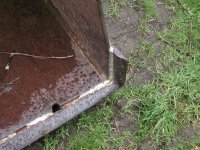
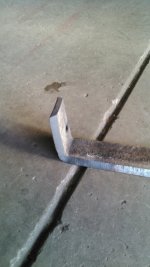
I took a scrap piece of cutting edge and bent one side hot by clamping the end to the table and bending a 90. It is a bit too broad of a curve. After bending, I quenched it. I then heated the other end and bent it in my ironworker (wont bend cold). The bend radius is good. I let this one just sit and cool. I am curious which one will retain more of its abrasion resistant qualities. On the second bend I put a firebrick on the dye to see how well I could restraint the heat from creeping down the bar and annealing it. It did pretty well, so I will likely do that to keep the heat is a fairly small area.
Is anyone aware of the thermal properties of AR, and how to best get them back after heating. I can't seem to find anything concrete on the net.

Thanks,
 

Attachments

  • image.jpeg
    image.jpeg
    219.1 KB · Views: 576
   / Bending a bucket cutting edge. #2  
There is a good chance that the one you quenched will break, depending on how hot it was when you quenched it. Knives that have been heated and quenched have been known to shatter when dropped. Ed
 
   / Bending a bucket cutting edge.
  • Thread Starter
#3  
Well, using my extremely scientific method I tested my results. I file tested the different spots and found that the file skips over easily in the center. The side I et cool was Rey soft, probably approaching mild steel hardness. The side I quenched was nearly as hard as the center. The spot that I kept the fire brick on in the forge, which was not quenched very quickly changed from hard to soft. I also did a brittleness test by beating on the quenched end with a big hammer (10# sledge) it didn't shatter, so I assume that once being welded to the bucket floor and sides it should be fine.
With those results I think I will brick off everything except a section about 3" wide and quench it after bending. Should worse come to worse and the bent area wear quicker than the rest, then I can add some hard facing.
 
   / Bending a bucket cutting edge. #4  
Sounds like you have the know how to do a good job with it, and sounds like you are on the right track. Ed
 
   / Bending a bucket cutting edge. #5  
When the edge is weldable, its low carbon steel like Borium 27 or Hardox 500 or a US equivalent. As a rule, if its weldable it will not become brittle when quenching it.
 
   / Bending a bucket cutting edge. #6  
Still I would temper it slightly. It all depends on how hot you got it to start with. I am assuming you took it all the way into the red zone which will affect the heat treat characteristics. I would take it into the red zone and form it as needed and then quench it in water which will make it hard and it may have a brittlizing effect. Then temper it it by reheating up into the blue-purple range but not into the red and letting it air cool and maybe even applying a little heat on the way down or insulating it a little to slow the cool down. this will allow the various consituents to rearrange themselves and not be so brittle but retain most of the hardness.
 
   / Bending a bucket cutting edge. #7  
If the upturned edge is for the bucket sides just weld some cutting edge on the side.
 
   / Bending a bucket cutting edge.
  • Thread Starter
#8  
If the upturned edge is for the bucket sides just weld some cutting edge on the side.

I am a glutton for punishment. Plus I always feel that if somebody makes them, why can't I? I realized they likely bend them pre heat treatment though. On my last one I just left the original sides on there and welded a new bottom edge on.
 
   / Bending a bucket cutting edge. #9  
Still I would temper it slightly. It all depends on how hot you got it to start with. I am assuming you took it all the way into the red zone which will affect the heat treat characteristics. I would take it into the red zone and form it as needed and then quench it in water which will make it hard and it may have a brittlizing effect. Then temper it it by reheating up into the blue-purple range but not into the red and letting it air cool and maybe even applying a little heat on the way down or insulating it a little to slow the cool down. this will allow the various consituents to rearrange themselves and not be so brittle but retain most of the hardness.
Or couldn't a guy just heat it to red and quench in oil? This is a slower quench that toughens the metal, but avoids brittleness. I've done it a number of times and had excellent results.
 
   / Bending a bucket cutting edge. #10  
Quenching in oil has a couple of drawbacks - not as hard so poorer wear characteristics and not everybody has enough oil just hanging around to quench a whole edge in.
 
   / Bending a bucket cutting edge. #11  
Or couldn't a guy just heat it to red and quench in oil? This is a slower quench that toughens the metal, but avoids brittleness. I've done it a number of times and had excellent results.
Doesn't the oil catch on fire?
 
   / Bending a bucket cutting edge. #12  
Nevermind. A weldable cutting edge is wear resistant because of the alloy, not because of the heat treatment. There simply isnt enough carbon in weldable steel to change the characteristics of the steel by heat treatments: You can only release inner material tension from cold forming or welding by heat treating it, but not change the hardness.

Welding itself is a heat treatment. If the steel had enough carbon to make it hardenable, it would be not (or hardly) weldable because welds that are cooled rapidly by the surrounding material, (or actually the HAZ) would become brittle.
 
   / Bending a bucket cutting edge. #13  
I think if you put your oil in something like a old piece of eve spouting,,,, one oil change on your truck should be plenty. The cutting edge is a wear item that lasts
a very long time.
 
   / Bending a bucket cutting edge. #14  
This is an old county grader blade I heated and bent. I didn't quench it. I used to use the left corner to gouge crushed rock out of a road cut, so it's kind of beat up, but it's been on there for 35 years. A file just slides on it where it wasn't heated. I welded it with stainless rod.


EPSN0036.JPG
 
   / Bending a bucket cutting edge.
  • Thread Starter
#15  
Doesn't the oil catch on fire?

Yes, it does. Mostly just burns on the surface and generally goes out when you pull the hot iron out. It is a stinky dirty mess regardless. I usually try to avoid using it.
 
   / Bending a bucket cutting edge. #16  
Welding itself is a heat treatment. If the steel had enough carbon to make it hardenable, it would be not (or hardly) weldable because welds that are cooled rapidly by the surrounding material, (or actually the HAZ) would become brittle.
I dissagree, in part.
You can weld high carbon steel. But you must take steps to prevent embrittlement and cracking. Pre-heating is the most common. If all the steel is hot, it won't pull heat from the weld, so the weld won't be quenched and hardened.

And then there is heat-treating. After welding and/or bending the whole piece is heated to its transition temperature. Then quenched(cooled rapidly). Now the piece will be hard and brittle, so it is then tempered. Tempering involves re-heating to to a specific temperature to un-do some of the hardening, making the piece less hard, but more tuff than it was after quenching.

Not likly any of us have the ability to heat treat a large piece like an entire cutting edge at home, but some good pre-heat might keep a weld from failing.
 
Last edited:
   / Bending a bucket cutting edge. #17  
Not likly any of us have the ability to heat treat a large piece like an entire cutting edge at home, but some good pre-heat might keep a weld from failing.

Thats the exception to the rule. As a rule, bucket edges that are "weldable" arent high carbon.
I repaired cast iron things too by preheating, stress peening and post-heating the area around the weld. But as for the OP, he can just weld ahead and dont worry about heat treatment.
 
   / Bending a bucket cutting edge. #18  
Heck, what I'd do is cut 1/2 way thru along the width, heat and bend and then I'd weld the cut side closed with maybe 2 passes.
That way I'd have a tight 90 deg bend and still retain the temper of the edge.
 

Tractor & Equipment Auctions

2019 Chevrolet Silverado 1500 Pickup Truck (A55973)
2019 Chevrolet...
401 (A52706)
401 (A52706)
Rooster Weathervane (A55853)
Rooster...
LEEBOY 8530 ASPHALT PAVER (A60429)
LEEBOY 8530...
Kubota B2301 (A53317)
2016 Ford F-150 4x4 Crew Cab Pickup Truck (A56858)
2016 Ford F-150...
 
Top