Testing elec breaker to verify trip

/ Testing elec breaker to verify trip #1  

s219

Super Member
Joined
Dec 7, 2011
Messages
8,607
Location
Virginia USA
Tractor
Kubota L3200, Deere X380, Kubota RTV-X
Anybody have a good procedure to test a breaker to make sure it trips?

My two year old daughter, who has all the makings of a tinkerer like me, managed to drop a penny across the two prongs of a night light plugged into the wall. The penny melted about halfway down the prongs before the whole thing fell off the wall. Pics below. This may actually be a good thing as she seems to have no interest in wall outlets now. Anyhow, the breaker on that circuit never tripped, which is not unreasonable, but I sure would like to verify that it will trip somewhere in the neighborhood of 15 amps, just for assurance. I have never run into a safe procedure to test that though.

The only thing I could think to try was put my compressor on the end of a long extension cord -- I know that SOB will trip a breaker when I am in the middle of a project if I don't have a heavy enough cord -- but damned if it didn't start (albeit with minor grumbling) on every 15A circuit I tried in the house, including the one in question. I didn't want to do that more than 3-4 times since it's not good for the motor.

By the way, I tore apart the old outlet when I replaced it with a new one, and there was no sign of arcing or damage inside the outlet, and all the wiring looked fine. So I do think this was a relatively quick event with only external arcing, and the nightlight must have popped out of the wall very fast. Our only clue as to the event was my daughter coming and telling mommy that she "heard a noise". She's a real punk... All of this happened in the space of 30-40 seconds when my wife left the room to refill my daughter's zippy cup with juice.

Based on the date on the penny, it's a version that is primarily zinc with copper plating. I have no idea how well zinc conducts, but the penny would have needed enough resistance to keep the current below 15A if it didn't trip the breaker, assuming the breaker is OK. The brass prongs on the nightlight had small divots, but it seems the penny bore the brunt of this encounter with electricity. I sure wouldn't trust a modern penny to bypass a fuse like people did in the old days!
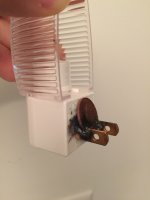
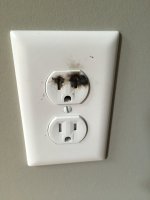
IMG_5734.jpg

IMG_5818.jpg
 
/ Testing elec breaker to verify trip #2  
I would replace the outlet with a GFI. Much better protection than a 15 amp breaker. There are testers available to plug in and test the breaker but not so cheap. A GFI tester will probably work. I have not tried it but it creates a short to test the GFI.
 
/ Testing elec breaker to verify trip #3  
That's why I flip the outlet with ground up. Thats code here.
 
/ Testing elec breaker to verify trip #4  
In commercial applications receptacles should be installed with the ground prong on the top...for this reason...granted the night lite with only two prongs would not make any difference in this case...
 
/ Testing elec breaker to verify trip #5  
arc fault breaker would have tripped a GFI maybe not in this case. You could build a breaker tester with heavy resistors and or a large load to test them however it may only show the breaker is stuck.

You should trip and reset all the breakers on a regular basis to make sure they dont seal up from lack of use.

M
 
/ Testing elec breaker to verify trip #6  
Most breakers have a AIC (amp interupting current) rating labeled on the handle (in small print). This is different than the overload amps. The MAIN need to be larger than the individual circuit breakers.
ex: MAIN could be 20,000 AIC and circuits being 10,000 AIC. usually making the circuit breaker trip first.
 
/ Testing elec breaker to verify trip #7  
Just curious on what brand of breakers you have. That penny should have tripped the breaker.
 
/ Testing elec breaker to verify trip #8  
That is why I sneak any new or used breaker into work and bench test it. A quick ballpark check is to load the breaker to twice it's nameplate rating. It should trip in approx 45 seconds , give or take 10 seconds .
I throw out approx 1 in four breakers.
Any breaker that has been exposed to short circuit current. Junk it as it can never be trusted after being highly stressed .
 
/ Testing elec breaker to verify trip #9  
One strand of #8 wire sticking out to the ground terminal in a welding machine plug was enough to trip my Square D 50 amp QO breaker. That penny should have tripped in microseconds. Hopefully you don't have the Federal Pacific from the 70's. I'll bet some of the electricians that follow this forum (and there are some really knowledgeable ones) can tell us some stories about these. Had them in my first house. Yuck!
 
/ Testing elec breaker to verify trip
  • Thread Starter
#10  
Just curious on what brand of breakers you have. That penny should have tripped the breaker.

It's a GE panel and GE breakers.

I would have thought a short of this nature would trip a 15A breaker too -- have seen it in the past when wires got accidentally cut for example -- but I wonder if this is one those cases where an arc fault interrupt would be required due to low current. We only have arc fault breakers covering bedrooms in our home. I understand that as of 2014 NEC, they are required in all living spaces in a home.
 
/ Testing elec breaker to verify trip
  • Thread Starter
#11  
I would replace the outlet with a GFI. Much better protection than a 15 amp breaker. There are testers available to plug in and test the breaker but not so cheap. A GFI tester will probably work. I have not tried it but it creates a short to test the GFI.

I don't think GFI would have done a thing in this case, since it really only detects a difference in current between what's flowing on the hot and what's flowing on the neutral. If they don't match to within a tolerance, it assumes current has been diverted to ground and trips.
 
/ Testing elec breaker to verify trip #12  
The circuit breaker operates on a time/current curve. It's conceivable that the zinc penny may have initiated an arc when it first hit and the active arc was of a high enough resistance that the current was below a value that would have tripped the breaker instantaneously. The burnt outlet and the fact the light fell out when when the metal connection in the outlet lost their springiness due to heating lends the idea that there was arcing and heating going on, so perhaps the amps, while high, wasn't sustained long enough to trip the breaker.
I've a feeling that if the penny were real copper it may have bridged the prongs with little or no arc and tripped fairly quick.

A thought on "testing" the breaker (not for the faint hearted) :D ... if you have a hardware store that carries the old screw in fuses, buy a few rated at around 20-25 amps (maybe slo-blo). Screw them into a lamp fixture (one that you could consider sacrificial... not the wifes favorite lamp) that has a fairly heavy cord and beefy switch. Wearing safety glasses and work gloves, throw the lamp switch on :eek:. If the time/current curves are similar for the breaker and screw in fuse, the breaker should trip before the fuse blows. If the other way around the breaker may have an issue and replacement should be considered.
 
/ Testing elec breaker to verify trip #13  
The circuit breaker operates on a time/current curve. It's conceivable that the zinc penny may have initiated an arc when it first hit and the active arc was of a high enough resistance that the current was below a value that would have tripped the breaker instantaneously. The burnt outlet and the fact the light fell out when when the metal connection in the outlet lost their springiness due to heating lends the idea that there was arcing and heating going on, so perhaps the amps, while high, wasn't sustained long enough to trip the breaker.
I've a feeling that if the penny were real copper it may have bridged the prongs with little or no arc and tripped fairly quick.

A thought on "testing" the breaker (not for the faint hearted) :D ... if you have a hardware store that carries the old screw in fuses, buy a few rated at around 20-25 amps (maybe slo-blo). Screw them into a lamp fixture (one that you could consider sacrificial... not the wifes favorite lamp) that has a fairly heavy cord and beefy switch. Wearing safety glasses and work gloves, throw the lamp switch on :eek:. If the time/current curves are similar for the breaker and screw in fuse, the breaker should trip before the fuse blows. If the other way around the breaker may have an issue and replacement should be considered.

A 30amp fuse will be gone in milliseconds on a typical household 15amp breaker. The breaker would not even twitch.
 
/ Testing elec breaker to verify trip #14  
I agree that it should have tripped. I have seen the smallest things trip breakers. Had a similar event where the chuck key to a drill slipped and crossed the prongs while I was unplugging it. Couldn't repeat that if I tried. Instant trip. After arc gouging out the prongs a bit... I have turned the ground plug up on a lot of things, but I don't do it so much anymore. I find that it really stresses the ground pin on extension cords such that they end up coming loose and pulling out of the plug at some point. The weight of the cord pulls down and bends the ground pin a bit constantly, so it eventually comes out.

Regular breakers are dirt cheap - typically under $5. If you have any questions, change it. If it is an AFCI, I can see your hesitation as they run $35-40 or so...
 
/ Testing elec breaker to verify trip #15  
I too am surprised it didn't trip.

Do you have an amp clamp?

Run a couple o hair dryers or similar to get over the amp ratinv of the breaker to see how long it takes to trip
 
/ Testing elec breaker to verify trip #16  
A 30amp fuse will be gone in milliseconds on a typical household 15amp breaker. The breaker would not even twitch.

You do know that fuses do have time curves based on thermal melt times, don't you? One of the reasons I threw in the suggestion for slo-blo to extend the clearing time a bit further to give the circuit breaker a chance to clear if it can.

Typical fuse time curve characteristic....
http://wiki.diyfaq.org.uk/images/f/fc/Curve-BS3036.png
 
/ Testing elec breaker to verify trip #17  
You do know that fuses do have time curves based on thermal melt times, don't you? One of the reasons I threw in the suggestion for slo-blo to extend the clearing time a bit further to give the circuit breaker a chance to clear if it can.

Typical fuse time curve characteristic....
http://wiki.diyfaq.org.uk/images/f/fc/Curve-BS3036.png

Post a chart with the response curve of a typical consumer grade breaker. The P fuse and even a D fuse will be gone long before the breaker responds. I used to setup protective relays and test breakers for a living.
 
/ Testing elec breaker to verify trip #18  
Post a chart with the response curve of a typical consumer grade breaker. The P fuse and even a D fuse will be gone long before the breaker responds. I used to setup protective relays and test breakers for a living.
I believe we have similar backgrounds :) Time curve for Square D QO 15 amp breaker attached.
 

Attachments

  • VernonStation15.jpg
    VernonStation15.jpg
    52.8 KB · Views: 106
  • VernonStation18.jpg
    VernonStation18.jpg
    65.9 KB · Views: 117
  • qo breaker.jpg
    qo breaker.jpg
    69 KB · Views: 140
/ Testing elec breaker to verify trip #19  
I concur on using a hair dryer, or maybe a small space heater or both to intentionally SLIGHTLY overload the circuit briefly while using a clamp-on ammeter to test. I have a 15a bathroom branch circuit that we quickly learned would not simultaneously carry our 4-bulb vanity light and wife's hi-power hair dryer for more than about 1-2 minutes without triping the breaker.

Count me with those who are very surprised that the penny short did not trip your breaker!! In my experience, when I have accidentally put enough of a short across a circuit the breaker trip was almost instant with MUCH less arcing/burning/damage than you have. And I have done it plenty of times!! :duh::embarrassed:

It makes me glad that I spent more for Square D QO (quick open) breakers for the new house.

- Jay
 
/ Testing elec breaker to verify trip #20  
It's a thermal-magnetic breaker. Two distinct protective functions.

Testing the thermal trip aspects of the breaker by applying an overload condition (hair dryer, etc..) does nothing to test the (magnetic) short-circuit overcurrent protection function of the breaker. It is this function that failed. Not the thermal function.
 

Marketplace Items

HYDRAULIC AUGER FOR MINI EXCAVATOR (A58214)
HYDRAULIC AUGER...
2012 Freightliner M2 106 Altec TA37M 37ft Insulated Material Handling Bucket Truck (A60460)
2012 Freightliner...
2017 Wacker Neuson LTV6 Towable Light Tower (A56857)
2017 Wacker Neuson...
2025 12v Fuel Pump (A61568)
2025 12v Fuel Pump...
832778 (A61166)
832778 (A61166)
2015 FREIGHTLINER CASCADIA 6x4 T/A DAY CAB TRUCK TRACTOR (A59906)
2015 FREIGHTLINER...
 
Top