You are using an out of date browser. It may not display this or other websites correctly.
You should upgrade or use an alternative browser.
You should upgrade or use an alternative browser.
Rear Wheel Weights
- Thread starter blin
- Start date
- Views: 11976
More options
Who Replied?
/ Rear Wheel Weights
#1

dieselcrawler
Elite Member
They would help lower the center of gravity, combined with the wheels being set to the widest possible setting, yes it would help. I would also load the tires with your choice of the liquids avalible for that application.
My tires are loaded, and spaced out 4.5" more than factory allows with spacers I made. I would also like to cast some concrete wheel weights to fit in the center of the rear tires... someday!
My tires are loaded, and spaced out 4.5" more than factory allows with spacers I made. I would also like to cast some concrete wheel weights to fit in the center of the rear tires... someday!

vtsnowedin
Elite Member
Yes. They will lower your center of gravity but not by as much as the same amount of liquid weight inside the tires.
Also you can usually put more weight inside the tires then is practical to put outside in cast iron.
Also you can usually put more weight inside the tires then is practical to put outside in cast iron.
My tires are filled, my rear wheels are spaced out to the next to last setting, and my tire pressure is about 16 PSI rather then the recommended 20. I have about 200 pounds of wheel weights and just wanted to make sure that they will enhance stability rather than take away when traversing a grade.
vtsnowedin
Elite Member
The answer is yes it will help but probably moving the rears out to the last notch would do more.
dieselcrawler
Elite Member
The answer is yes it will help but probably moving the rears out to the last notch would do more.
X2.
Wider is better...

Mace Canute
Elite Member
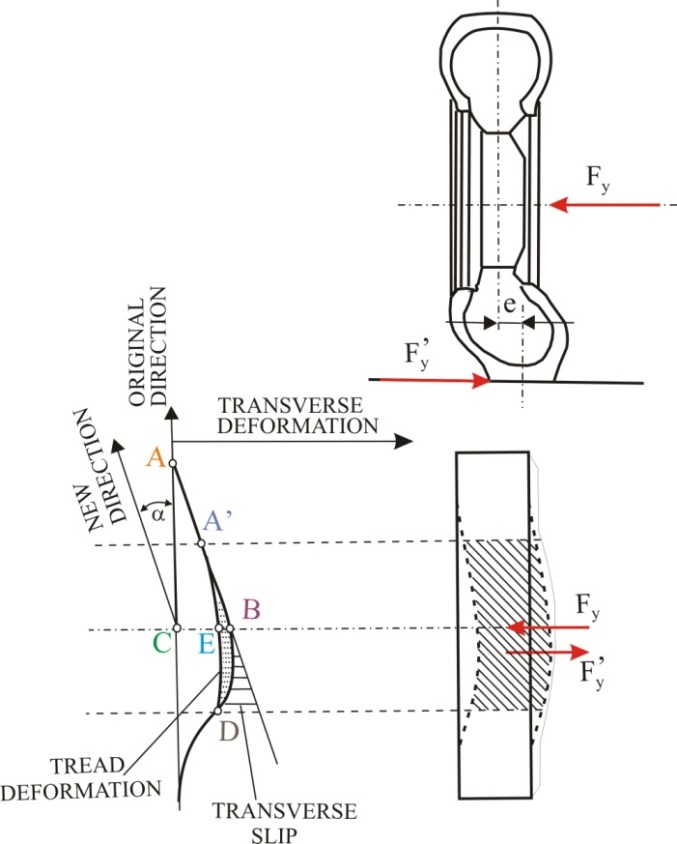
If you are concerned about stability on a side slope, increase your tire pressures to the maximum recommended. It's cheap and easy to do. Low air pressure allows the uphill tire to have maximum height because of weight transfer but the downhill tire will do just the opposite and squat more than if it were on level ground. Lower pressure will also allow more deformation of the tire...the tire contact area will be shifted to the uphill side.
Mace,
That diagram is intriguing, but I can't fully decipher it.
I know that when on the beach, you lower your pressure for traction in the sand. NASCAR drivers like to keep their tire pressure as low as possible for traction, and they ride off camber in the corners. ATV tires are low pressure to help roll over the terrain.
I understand higher pressure for riding on pavement, or when using the FEL.
If both rear tires have low pressure wouldn't both tires mold to the surface relative to the amount of added weight. Lesser for the high side tire, more on the low, but still overall good for better traction and stability?
That diagram is intriguing, but I can't fully decipher it.
I know that when on the beach, you lower your pressure for traction in the sand. NASCAR drivers like to keep their tire pressure as low as possible for traction, and they ride off camber in the corners. ATV tires are low pressure to help roll over the terrain.
I understand higher pressure for riding on pavement, or when using the FEL.
If both rear tires have low pressure wouldn't both tires mold to the surface relative to the amount of added weight. Lesser for the high side tire, more on the low, but still overall good for better traction and stability?
Mace Canute
Elite Member
That's exactly what happens and it has the effect of tipping the tractor more than it would be if maximum air pressure was used in both tires. That tipping detracts from the maximum angle your tractor can withstand before roll over. It might not be much but a little here and a little there adds up.Mace,
That diagram is intriguing, but I can't fully decipher it.
I know that when on the beach, you lower your pressure for traction in the sand. NASCAR drivers like to keep their tire pressure as low as possible for traction, and they ride off camber in the corners. ATV tires are low pressure to help roll over the terrain.
I understand higher pressure for riding on pavement, or when using the FEL.
If both rear tires have low pressure wouldn't both tires mold to the surface relative to the amount of added weight. Lesser for the high side tire, more on the low, but still overall good for better traction and stability?
In the first diagram you can see how the center line of the tire is pushed towards the centerline of the tractor when on a slope. This makes the tractor more tippy and high air pressure will help minimize how much the tire deflects when on a side slope. Don't worry about the other two diagrams, the one with the fine crosshatch just shows the shape the tire makes as it is deformed by being on a side slope and the other is just diagramming slip angles.
JKR
Silver Member
Very interesting. I ride on slops and I can see what you are saying. Thanks.

RaydaKub
Veteran Member
Seems to me that more traction and more stability are opposite goals in this situation.

CobyRupert
Super Member
Yes. They will lower your center of gravity but not by as much as the same amount of liquid weight inside the tires.
Also you can usually put more weight inside the tires then is practical to put outside in cast iron.
Kickin' the theoretical can here:
Isn't that statement based on the assumption that the center of gravity (COG) is above the axle to begin with (thus putting more weight at the axle height lowers COG)? Id say this is true for most tractors, by themselves.
...but if your driving that tractor with an implement (say on the 3 PTH) that places the COG of the unit below axle height, wouldn't adding wheel weights actually RAISE your COG?
vtsnowedin
Elite Member
Kickin' the theoretical can here:
Isn't that statement based on the assumption that the center of gravity (COG) is above the axle to begin with (thus putting more weight at the axle height lowers COG)? Id say this is true for most tractors, by themselves.
...but if your driving that tractor with an implement (say on the 3 PTH) that places the COG of the unit below axle height, wouldn't adding wheel weights actually RAISE your COG?
Yes that is the assumption and usual case. Adding a loader also raises the COC. Each piece you add on changes the exact position but you can look at each piece independently. Adding fluid in the tires lowers the COG as compared to the bare tractor. Adding the loader raises it whether or not you have fluid in the tires. Adding iron weights centered around the axle lowers it as long as it is not already lower then the axle level of the tractor. And adding weight to the 3PH can lower it if the load is held lower then the COG and raise it if the load can be raised above the present COG. The loader lifting a load above hood level is a real culprit here, the 3PH not so much as your talking feet with the loader and inches with the 3PH. It is the sum total of all the loads and their positions that resolves where the COG is but the order you add them up in makes no difference.
vtsnowedin
Elite Member
Kickin' the theoretical can here:
Isn't that statement based on the assumption that the center of gravity (COG) is above the axle to begin with (thus putting more weight at the axle height lowers COG)? Id say this is true for most tractors, by themselves.
...but if your driving that tractor with an implement (say on the 3 PTH) that places the COG of the unit below axle height, wouldn't adding wheel weights actually RAISE your COG?
Yes that is the assumption and usual case. Adding a loader also raises the COC. Each piece you add on changes the exact position but you can look at each piece independently. Adding fluid in the tires lowers the COG as compared to the bare tractor. Adding the loader raises it whether or not you have fluid in the tires. Adding iron weights centered around the axle lowers it as long as it is not already lower then the axle level of the tractor. And adding weight to the 3PH can lower it if the load is held lower then the COG and raise it if the load can be raised above the present COG. The loader lifting a load above hood level is a real culprit here, the 3PH not so much as your talking feet with the loader and inches with the 3PH. It is the sum total of all the loads and their positions that resolves where the COG is but the order you add them up in makes no difference.
budepps3760
Silver Member
Explain to me about setting your tires to the widest setting possible. Have no idea what ya'll are talking about or how to do it. Can any tractor have this done to it? Seems like it would place a strain on the axle system.
vtsnowedin
Elite Member
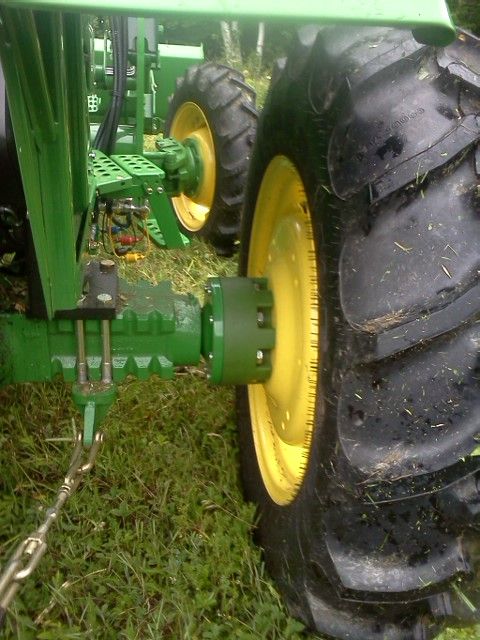
No not all tractors can be easily adjusted for width without adding in after market spacers. The rims they come with are one position only. Many mid sized and utility tractors have two piece rims and center disks that can be bolted up in up to eight different combinations to achieve the tread width that fits the row spacing of the crop being grown. There is more strain on the bearings at the wider settings but the tractors are overbuilt by design to allow for this. In the picture below I have my tractor set to the eighth(widest ) position PLUS have 4.1 inch spacers to give me the best possible side stability without adding dual rear tires.

dieselcrawler
Elite Member
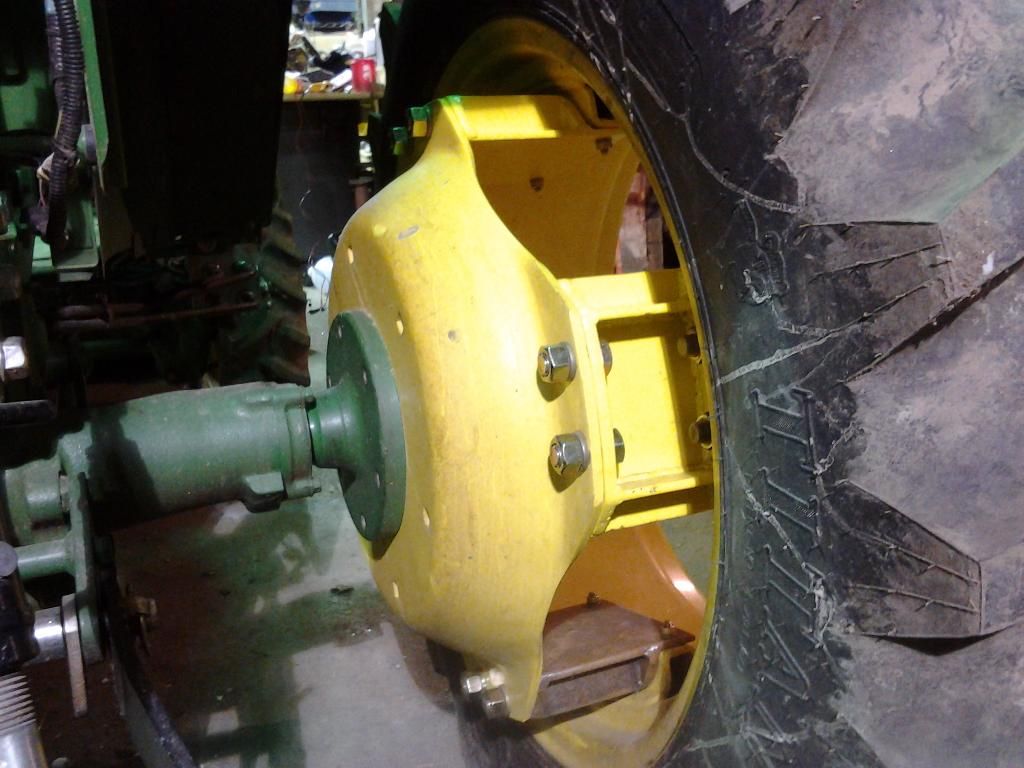
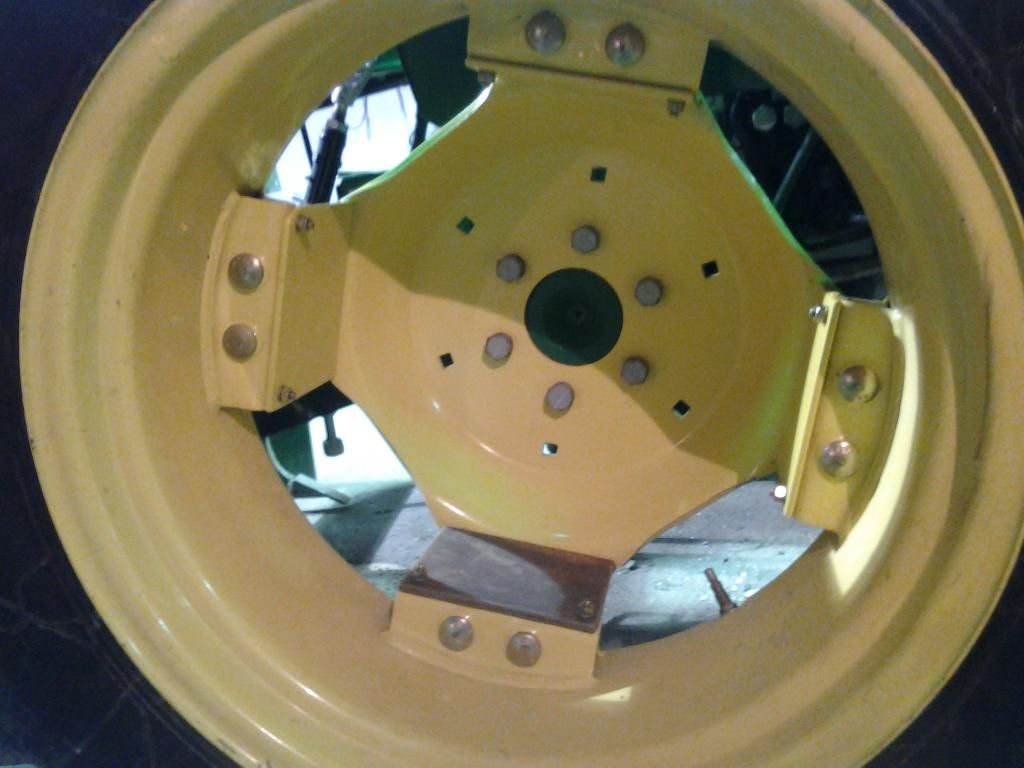
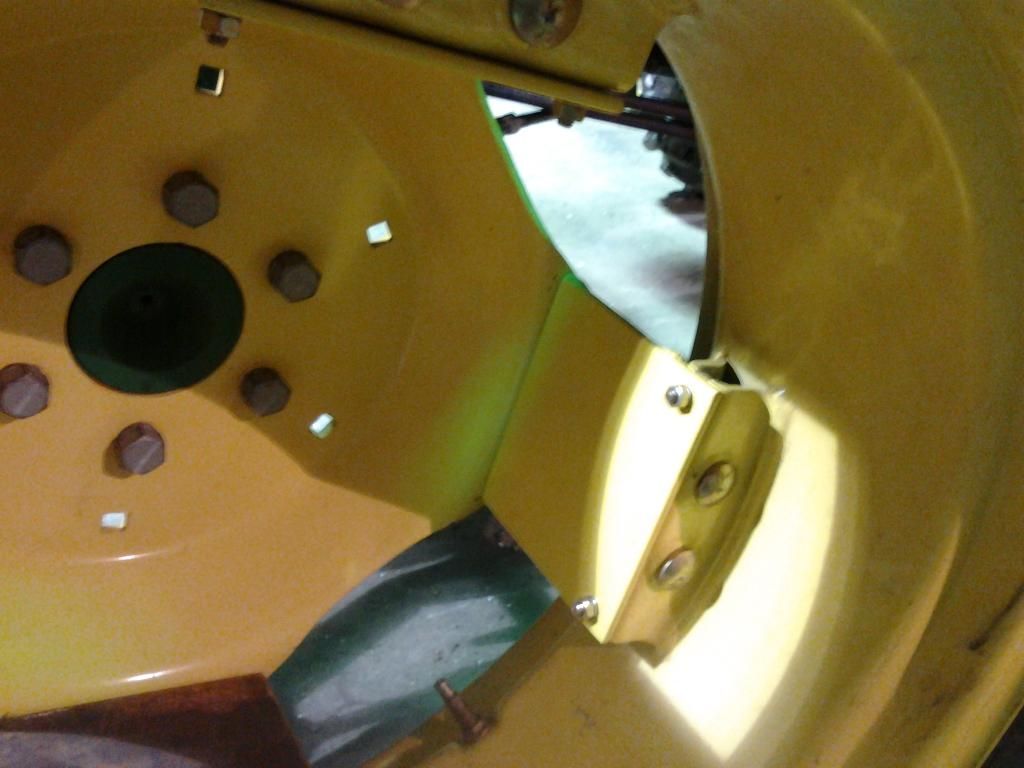
Here's my spacers, between the center dish and the outter rim. Yes, it will accelerate rear wheel bearing wear. But the added stability might mean that I live to replace them, rather than widow my wife and orphan my kids.


Here are some similar links:


- Replies
- 27
- Views
- 7K

