Hydraulic Resevoirs

/ Hydraulic Resevoirs #1  

kiotiken

Veteran Member
Joined
Aug 29, 2011
Messages
2,378
Location
Dunrobin, Ont
Tractor
2012 Kioti DK45 HST Cab
I built a firewood processor and I'm having a heat problem with the hydraulics. I've come to learn that the 10 gallon tank that I was sold when assembling the hydraulic components is WAY undersized. My plan is to replace the 10 gallon tank with a 37 gallon tank (37.1 GALLON HYDRAULIC RESERVOIR), but it was just suggested in my build thread (http://www.tractorbynet.com/forums/build-yourself/324028-firewood-processor-build-thread-38.html) that I consider keeping my 10 gallon tank and adding a second tank in parallel. So my question is, can I do that? I would keep the return line and filter to the 10 gallon tank as they are now, go from the outlet port on the 10 gallon tank to the return port of the new tank and have my suction line to the pump on the outlet of the new tank. Assuming that the tops of the tanks are at the same level and both tanks have breathers, will this work?

Hydraulic info for the processor:
The processor is using a 15 hp gas engine and a 28/7 GPM 2 stage pump. As mentioned above, it has a 10 gallon resevoir and has a 5" x 24" main cylinder, 24 cu hydraulic motor and 2" x 18" cylinder to adjust the splitter head. The saw is not hydraulic.
 
/ Hydraulic Resevoirs #2  
You need to do some more home work on the cooling requirements. Allowing your hyd.fluid to cool for twenty some seconds before making the trip again is not going to work. Now you have doubled the cooling tank to 20 gallons but your pump can take 27 gpm. Do you really think anything can cool in 60 seconds. And keep going hour after hour?
 
/ Hydraulic Resevoirs
  • Thread Starter
#3  
You need to do some more home work on the cooling requirements. Allowing your hyd.fluid to cool for twenty some seconds before making the trip again is not going to work. Now you have doubled the cooling tank to 20 gallons but your pump can take 27 gpm. Do you really think anything can cool in 60 seconds. And keep going hour after hour?

The second tank is 37 gallons so I'd be going from 10 gallons to 47 gallons.
 
/ Hydraulic Resevoirs #4  
I agree with 2458N. A 20 second turnover time is funtional but pushing it, 45-60 seconds would be better for air release, etc. A typical hyd tank has relatively low surface area vs volume, and is insulated with paint, so the cooling isnt that great. Really all you will be doing by adding the second tank is adding mass which will just delay the time it takes to overheat. Wild guess is that you are doubling the time it takes to overheat. If that doesn't get you enough run time you really have two options - reduce the heat generation or add a cooler w/fan. Add it before the filter so you don't blow it up when the oil is cold.

ISZ
 
/ Hydraulic Resevoirs #5  
I didn't read the build thread. How big is the pump?

General rule: 2-3 times pump flow for oil volume. If a 2-stage pump, 1x high flow. Ie: if you have a 22 GPM single stage pump, 44-66 gallon resivoir. If 22gpm 2-stage, 22 gal resivoir.

2 tanks with suction and return on same tank won't work.
 
/ Hydraulic Resevoirs #6  
I don't think today's reservoirs use the old 4 to 5 times pump flow as a gage for size.

Today's mobile hyd use about 1 to 1.5 times pump flow , and hyd radiator/fan cooling.

My machine has a 20 gal reservoir and a 45 HP engine driving three pumps with about a 20 GPM flow rate.

Check your tractor tank/reservoir and compare to pump flow.
 
/ Hydraulic Resevoirs
  • Thread Starter
#7  
I didn't read the build thread. How big is the pump?

General rule: 2-3 times pump flow for oil volume. If a 2-stage pump, 1x high flow. Ie: if you have a 22 GPM single stage pump, 44-66 gallon resivoir. If 22gpm 2-stage, 22 gal resivoir.

2 tanks with suction and return on same tank won't work.

28/7 GPM, two stage log splitter pump. I would have approx. 40 gallons of fluid if I retain my current 10 gallon tank and add a second tank or 30 gallons if I upgrade to a larger tank. Return would be to the smaller tank and suction would be from the larger tank.

I don't think today's reservoirs use the old 4 to 5 times pump flow as a gage for size.

Today's mobile hyd use about 1 to 1.5 times pump flow , and hyd radiator/fan cooling.

My machine has a 20 gal reservoir and a 45 HP engine driving three pumps with about a 20 GPM flow rate.

Check your tractor tank/reservoir and compare to pump flow.

I designed this with a logsplitter in mind, although I relied on bad advice at the store when buying the tank. This is the biggest 2 stage pump I could find but I've never seen a (commercial) logsplitter with a rad/fan for cooling. I don't have the electrical power to run a fan, it's a 15hp engine using a lawn tractor battery that wouldn't keep up to the draw of a fan. Can I use two tanks, as described above, so I'll have 40 gallons of oil will that be enough to let the oil settle and cool so the machine doesn't overheat?
 
/ Hydraulic Resevoirs #8  
Yes, that is more than enough.

16 HP is the min for that pump, so if the relief valve opens, you are at stalling point
 
/ Hydraulic Resevoirs #9  
Tank volume either buys you time with how long it takes to heat the oil up or surface area to cool the fluid. So if you are only going to run the machine for a few hours then let it cool off a bigger res will allow you to do this. Almost everything I design and build has to be for continuous use so coolers are a must. If you can put a cooler in the air stream of the engine it will be way more effective in cost and cooling than a bigger res. I am building a power unit right now that has a 50HP Deutz diesel. It is air cooled so I am going to have to fab a bracket and shroud for the cooler, not easy but it can be done. The last splitter I built for myself had a 16hp Kawasaki liquid cooled twin, so a cooler was easy on that. CJ
 
/ Hydraulic Resevoirs #10  
Yes you can use two tanks as long as the line between them is large enough to prevent one from over filling or being emptied.

I would also look for the source of your heat. Do you have flow controls or flow diverters or dividers in your system? If yes these are heat generators so you have to allow for extra cooling capacity.
 
/ Hydraulic Resevoirs #11  
I'm wondering if you have restrictive points that are creating more heat than they would if the oil was more free flowing... 90's and smaller capacity valves ect.., create a lot more heat that you have to get rid of...

My splitter it powered with a 30hp diesel, 20 gallon pump and a 15 gallon tank that I don't even have full, and I NEVER even come close to having heat problems!

SR
 
/ Hydraulic Resevoirs #12  
If he is using the relief valve a lot, the heat will build up .
 
/ Hydraulic Resevoirs #13  
I think you will be fine as planned. Pulling from one tank, returning to other. Just make sure you have plenty of flow between the two.

Your heat issue was simply lack of volume. 10 gallons on a 28gpm 2-stage is just way too small. That is the capacity of smaller splitters running 11gpm pumps.
 
/ Hydraulic Resevoirs #14  
The prople that made my hyd tank say any use of it in summer would require a cooling fan unit. Its 25 gal tank.

In winter the outside temps will cool it, but in summer, no way.
And dang, those coolers are like 800-900 bucks
 
/ Hydraulic Resevoirs #15  
Some food for thought.
A cooler is like a radiator, lots of tubing and fins to dissipate the heat.
What would be wrong with trying to use a small car rad (well cleaned) on the suction side of the pump?
Would that not work?
For that matter copper tubing comes in (usually) 25 ft coils, could a suitably guaged coil downstream from the engine cooling fan not do the trick?
Also a fan could possibly be rigged with V-belt and couple of pulleys to cool the coils or rad.
 
/ Hydraulic Resevoirs #16  
More to think about. I chugged the numbers and the 31 gallon reservoir gets you about 4000 BTU/hr of cooling with oil 100°F over ambient (assumes no wind or sun load). Go look up coolers and you will have a hard time finding one that small. Backs up what several of us have said - a larger reservoir just buys you time due to time it takes to heat the added mass. If it buys you enough time between coffee breaks great, otherwise it would be cheaper to increase the cooling or possibly decrease the system losses (which create heat).

Piloon has the right idea, but I do not recommend putting a cooler on the pump inlet. You want to keep the inlet restriction at a minimum to maximize pump life. It could cause a collapsed inlet hose and/or air leak resulting in cavitation.

The standard solution is to add an oil-to-air cooler, but you could use Piloon's suggestion of tubing, etc. Anything that increases the surface area, especially with forced air flow, will help. Scavenge a stand-alone transmission cooler from a truck and position it so the engine air blows across it. Most tranny coolers are rated around 150psi, but your mileage may vary. :)

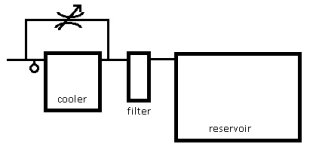
The idea below will allow you to use a cooler designed for less than 28gpm. A company I used to work for did this on one of their off-road forklifts to avoid bursting the cooler in cold weather. I highly recommend the pressure gauge so you can monitor the back pressure with cold oil and adjust the bypass opening, thus preventing a failure.
filter bypass.jpg

ISZ
 
/ Hydraulic Resevoirs #17  
ISZ,
I have seen check valves installed to act as cooler by-pass valves in place of the flow control. This eliminates the need to fine tune the flow control as the temperature changes.
 
/ Hydraulic Resevoirs #18  
Why not add something like a trans cooler from a car? That is designed for hyd fluid.
 
/ Hydraulic Resevoirs
  • Thread Starter
#19  
Thanks guys, you've all given me a lot to think about. I really like the idea of using the engine's air stream to cool a rad. I really have to give this some more thought at this point.

I have a couple questions about the rad. Could I use a rad between the tanks and have it gravity fed? I would go from the outlet of the first, smaller tank, through the rad at very low pressure and into the inlet of the second tank. If that is possible, could I then use an automotive rad since there would be virtually no pressure? I'll also look for a trans. cooler but may be more expensive.

I'll have to take a closer look, but I don't think I can get a pulley on the drive shaft of the engine, the pump and bracket are in the way. I don't know of any other sources of extra heat, I have no diverters, flow controls etc.
 
/ Hydraulic Resevoirs #20  
Having the two tanks will act like a baffle. This might help cooling as it will slow the oil. Youd have to make sure you have a low restriction path between the tanks though. Might be easier to just cut a couple large hole in the side of the tanks and weld them together as opposed to trying to run pipes between them

I think adding capacity will work out for you.

I know there is no love for PA right now, but they do have their ProPoint 26GPM cooler on right now for $349. 26 GPM Hydraulic Oil Cooler | Princess Auto Unfortunately it draws 16A. You might be able to swap your lawn mower battery for a car battery and get some decent run time, but I doubt your motors alternator will keep up causing more problems. An external alternator run off the motor could power the fan on the cooler, but again, its a HP parasite.

Sticking a fan onto the motor to blow across a rad will draw HP from the engine that you dont really have to spare.

I think right now your best bet is to just add oil capacity. I run my 22gpm 2 stage on a 18Gal tank with baffle. Ive yet to see the temps in my tank get to a level that concerns me. IT actually runs pretty cool.
 

Marketplace Items

2010 Case 580N (A60462)
2010 Case 580N...
UNUSED X-STAR 101"x20' LOADING RAMP (A64280)
UNUSED X-STAR...
PALLET OF MISC PARTS (A63291)
PALLET OF MISC...
Truck Diesel Tank (A64119)
Truck Diesel Tank...
2013 VOLVO VNL 6X4 T/A DAY CAB TRUCK TRACTOR (A59912)
2013 VOLVO VNL 6X4...
2006 Western Star 4900 Concrete Mixer U98358 (A62613)
2006 Western Star...
 
Top