Plug wielding---- when is it needed?

/ Plug wielding---- when is it needed? #1  

jakescia

New member
Joined
Oct 9, 2010
Messages
9
Tractor
Cat 65C 75C 55 45
Note-------- what I know about welding is......... deeper the better.........so, with that in mind:

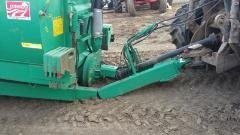
We just had a situation where the main two "beams" under a tandem-axle slurry tanker broke, just in front of the tank (where the greatest flex would occur). Have not figured why yet....applicator/tanker is not that old, is only 6000 gal, and is not "banged" over corn rows.....loaded or empty..........maybe just crap happens sometimes.

Anyway......... the fix is going to be ........ an upright plate, about 8ft long, 8inchs wide, and 3/8inches thick.........welded onto the vertical sides of the 7.5inch box metal that composes the two main beams under the applicator........both of which meet in front of the tanker, and V into the drawbar.

The plate will be slightly "taller" than the box metal.......and will be able to be welded on the shoulders of the box metal, so that a greater depth/amount of weld will be allowed.

My question.......... in that application------ plate onto the sides of box metal-------- is drilling holes in the plate and plug welding to the box metal needed?

Seems to me logical that it would provide much more support, but is that additional support necessary when the plate is going to be fastened pretty much all along the edges of the box metal? (I assume it will not be continuous weld, but rather skip-welded...every few inches)

I would assume that the flex is going to be pretty much taken out of the box metal, after two plates 3/8 inches thick are welded to the vertical sides of each of the box metal "beams".

Your comments will be appreciated------ thanks.
 
/ Plug wielding---- when is it needed? #2  
On a wider plate plug welds will add strength and not allow any deflection of the beam under load. They will work similar to if you bolted the plate to the beam.
 
/ Plug wielding---- when is it needed? #3  
Can you post pictures of what you're trying to do?
 
/ Plug wielding---- when is it needed? #4  
On a wider plate plug welds will add strength and not allow any deflection of the beam under load. They will work similar to if you bolted the plate to the beam.
Bolts = holes = drill, I hate a drill!:laughing:
 
/ Plug wielding---- when is it needed?
  • Thread Starter
#5  
'Splain how to post a picture.....and will do it.
 
/ Plug wielding---- when is it needed? #6  
Similar to bolting is not the same as bolting but you have to make holes for plug welds.
 
/ Plug wielding---- when is it needed? #7  
Hit "go advanced" when replying and then there is a manage attachments (I think) and it is sort of self explan. from there.
 
/ Plug wielding---- when is it needed?
  • Thread Starter
#8  
Houle- 03.21.14 broken tongue.jpg

Not as hard posting a picture as I thought.....just have to be able to read!

Looks to me that also.....reason for not just laying a piece under the box metal is that----- the downward pressure would only have to shear 3/8, whereas by putting plate on side of box, the downward shear would have to effectively shear 8inches of 3/8 metal......am I thinking correctly?
 
/ Plug wielding---- when is it needed? #9  
Similar to bolting is not the same as bolting but you have to make holes for plug welds.

10-4! I was picturing the repair in my shop and instantly the lazy side of me came out and (in my head) I was punching the holes in the plate with the I/W.:thumbsup:
 
/ Plug wielding---- when is it needed? #10  
Has you dealer been out to look at this failure? That break is hard to point a finger at user abuse. You can't overload it, not a moving part, didn't look like it has been "jackknifed" of otherwise damaged. Frame problems are either one of the above or a design/material issue. Add fatigue but like you said, not very old.
 
/ Plug wielding---- when is it needed? #11  
Plug welds are commonly used in body shops, during the replacement of sheet metal components, as a substitute for factory spot welds.
 
/ Plug wielding---- when is it needed? #12  
I just did a project like this not to long a go for a friend's galvanized boat trailer.
I drilled a series of 3/4-inch holes in both sides, and top of the box tube. inserted solid square stock in the box tube. Gaped the box tube just a touch, made a full pen weld all the way around the box tube, then made all the plug welds.
 
/ Plug wielding---- when is it needed? #13  
I forgot to add, in this case I would also use oval, or diamond shaped fish plates on both sides of the box tube, right at the break in the box tube. ;)
 
/ Plug wielding---- when is it needed? #14  
I don't think you would gain any strength on that narrow of a plate by putting in plug welds after it is welded down both sides. Plug welds are useful when putting a thicker plate to a thinner one to give more attachment points and equalize the stress rather than put all on the edges. When I put chain hooks on my FEL, I used a 1/4" plate 4x6" for a repad. It already had holes in it as it was made as a trailer leaf spring holder. I plug welded up the 4 ea 1/2" holes then put my hook over the top of them. This stiffened up the plate, added additional weld area to the 1/8" thick bucket material. Did I need to do that, probably not but the holes were there and I didn't want to have them collect water/dirt anyway.
 
/ Plug wielding---- when is it needed? #15  
Please excuse the really crude MS Paint drawing!:eek::eek::eek::eek:
Here is what I was trying to say how I would make this repair.
 

Attachments

  • Enforced box tube.JPG
    Enforced box tube.JPG
    55.1 KB · Views: 221
/ Plug wielding---- when is it needed? #16  
View attachment 366634

Not as hard posting a picture as I thought.....just have to be able to read!

Looks to me that also.....reason for not just laying a piece under the box metal is that----- the downward pressure would only have to shear 3/8, whereas by putting plate on side of box, the downward shear would have to effectively shear 8inches of 3/8 metal......am I thinking correctly?
I am not a welder but it looks to me from the little picture that it was a bending failure not shear. If that is the case, it will be important to reinforce the top/bottom and make sure there is at least as much material thickness. Putting a tube inside the original tube will not have as much bending strength. The bending stress is highest at the outer most edges. That is why I-beams are the most efficient in carrying bending loads. My :2cents:
 
/ Plug wielding---- when is it needed? #17  
I think Shield Arc has a good method for repair since the hitch will have to be cut off and reattached anyway. It might depend on the dimensions of the existing tube and if a smaller size would fit nicely inside it. Another method to reinforce it would be just like most tandem axle trailers. Another length of tubing going on the bottom of the A frame hitch. That method might depend on how much ground clearance you needed.
 
/ Plug wielding---- when is it needed? #18  
Another option on the same lines of thinking as Arc weld suggested. You could buy some structural tee. Skip weld it on the top and bottom. And still add a fish plate over the weld repair on the sides.
When I skip weld something like this, before painting I like to run a bead of caulking between the welds so water doesn't get under the metal and rust it out.
 

Attachments

  • Enfored box tube 2.JPG
    Enfored box tube 2.JPG
    60.1 KB · Views: 140
  • Tee.jpg
    Tee.jpg
    106.5 KB · Views: 103
/ Plug wielding---- when is it needed? #19  
Caulking the seams is a good tip.
You can also get weld through primer.

As for the T iron for reinforcement, i would go for some small channel iron. Creating additional box sections. That would put more metal farther away from the nutral axis.
 
/ Plug wielding---- when is it needed? #20  
Another option on the same lines of thinking as Arc weld suggested. You could buy some structural tee. Skip weld it on the top and bottom. And still add a fish plate over the weld repair on the sides.
When I skip weld something like this, before painting I like to run a bead of caulking between the welds so water doesn't get under the metal and rust it out.
Hey I know nothing about welding but why not just square up the break, weld it back together all the way around and then weld a flat plate to top and bottom sides? While a tee would work also, in theory one should not design a bending member without a stabilized edge or a return flange if subjected to compression stresses due to bending. In this case, the material thickness will likely prevent a crippling failure but in thin material this is an issue. Sorry for my two cents here, I come from aerospace structure background. :D
 

Marketplace Items

1992 Norris Long Basket Trailer (A55973)
1992 Norris Long...
2016 PETERBILT 365 (A60736)
2016 PETERBILT 365...
Pallet fork attachment for mini skid steer (A61567)
Pallet fork...
ATTENTION PLEASE READ (A60463)
ATTENTION PLEASE...
LaneShark L53 (A60463)
2025 Pabreak Auger Bits and Plate Skid Steer Attachment (A61567)
2025 Pabreak Auger...
 
Top