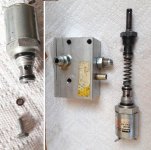
Crown 20MT Walkie forklift (lift-lower valve problem)

   / Crown 20MT Walkie forklift (lift-lower valve problem) #41  
Sodo,
Not exactly sure how the Parker solenoid valve is made but it has at least one sealing surface and possibly two. Since you say the valve is working perfect does that mean it lowers electrically? Parker DS091C D012HP valves are 3/4-16 threads and have .623 diameter nose for sealing in a .625 diameter hole. This is an odd ball cavity so finding a replacement valve may be difficult.

A concern I have with this electrical valve is what is controlling the lower speed when using the electrical. Is there a metering orifice in solenoid valve or some restriction below the valve. The DS09 is rated @ 5 GPM with @ 70 PSI pressure drop so this would allow the mast to free fall which is not good.

If you want to experiment: Remove the solenoid valve and look at the drill diameter below the valve cavity. Is the hole around 3/8 to 7 /16 in Diameter? Is the nose of the cavity reasonably smooth? If yes get a 1/2" diameter steel ball and a #8 SAE fitting. Put the ball in the hole install the fitting and operate the lift. The ball should seal on the nose of the cavity similar to how the check valve ball seals. You may need a soft spring to hold the ball in place.

This would help identify what is leaking.

Ditto what oldnslo said or plumb in a shut off valve on each the lines. Just dont "deadhead" the pump, I dont think that pump has an internal relief.
 
   / Crown 20MT Walkie forklift (lift-lower valve problem)
  • Thread Starter
#42  
Sodo,
Not exactly sure how the Parker solenoid valve is made but it has at least one sealing surface and possibly two. Since you say the valve is working perfect does that mean it lowers electrically?
Regarding the walkie's operation, every button, valve, function works perfect, so I am assuming the solenoid valve is working.
The ONLY problem** with the entire forklift is (with a load) it creeps down an inch every 5 seconds.

A concern I have with this electrical valve is what is controlling the lower speed when using the electrical. Is there a metering orifice in solenoid valve or some restriction below the valve......allow the mast to free fall......
Noted-good call thx for mentioning that. Will look @ circuit & valve for a down flow control before considering a substitute to OEM solenoid valve.
If you want to experiment: Remove the solenoid valve ..........try .... 1/2" diameter steel ball and a #8 SAE fitting ......& spring.......
Great suggestion to isolate the 2 valves, will have a look at that option. Thanks!!
 
   / Crown 20MT Walkie forklift (lift-lower valve problem) #43  
SoDo,
For reference this is my best guess on the hydraulic schematic in the manifold. I don't recall ever seeing a relief valve in any of the pictures and I also am not sure where the lower speed/flow control is located. For safety I would expect it to be at the cylinder but not positive on this location.
 

Attachments

  • Lift check dump.pdf
    3.9 KB · Views: 302
   / Crown 20MT Walkie forklift (lift-lower valve problem)
  • Thread Starter
#44  
Yes Oldnslo that schematic looks correct. The only thing I see different (and it is outside of the manifold) is from the top of the lift cylinder there is a small return line to the tank. Also where is the flow control, and wouldn't there be one control (for the case where both valves are open at the same time)?

You have drawn the 2 valves with a check in them. The manual lower valve has a seat that would function as a spring-and pressure-activated check. The seat appears to be perfect. I suspect the manual lower valve is rarely used. On the Solenoid valve, I can't see the 'seat', iand it doesn't look like this valve can be disassembled. I will take it apart again and look at these carefully. Are there any pics that I should take? Closeups of the valves?
 
   / Crown 20MT Walkie forklift (lift-lower valve problem) #45  
On the Solenoid valve, I can't see the 'seat', iand it doesn't look like this valve can be disassembled. I will take it apart again and look at these carefully. Are there any pics that I should take? Closeups of the valves?
The solenoid valve probbaly doesn't have a "seat" as it blocks/unblocks holes in the side of the valve rather than pushing on a seat. Its "seat" is the side of the hole that it goes into.

Aaron Z
 
   / Crown 20MT Walkie forklift (lift-lower valve problem)
  • Thread Starter
#46  
The solenoid valve probbaly doesn't have a "seat" as it blocks/unblocks holes in the side of the valve rather than pushing on a seat. Its "seat" is the side of the hole that it goes into.

Aaron Z

I see…. thanks Aaron. I will look at that. Like a shuttle valve that pressure does not energize? Makes sense then that it could wear out and leak since it's not pressure-energized.
 
   / Crown 20MT Walkie forklift (lift-lower valve problem) #47  
On the Solenoid valve, I can't see the 'seat', iand it doesn't look like this valve can be disassembled. I will take it apart again and look at these carefully. Are there any pics that I should take? Closeups of the valves?

SoDo,
Usually the solenoid can be dismantled IF you have access to collet to grip the nose or cage. Look closely at the connection between the cage and retainer threaded area. Does it look like these are two seperate pieces? The cage in most cases unscrews from the tube assembly. This joint may be loctited. See the attached data sheet on the Delta Power valve. This valve has TWO sealing points. One is the pilot pin to the main poppet and the other is the main poppet to the cage. Both of these are metal to metal seats.

NOTE: A couple of companies may have the tube assembly unscrewing from the retainer or mechanically staked this joint so they cannot be dismantled

If this was a spool valve like azclan described it would always leak some.

The flow control in the schematic is in a location unknown to me. I suspect it is in the cylinder or the cylinder line since this would be the best place for safety reasons.
 

Attachments

  • PB-S2A.pdf
    128.1 KB · Views: 352
   / Crown 20MT Walkie forklift (lift-lower valve problem)
  • Thread Starter
#48  
If you want to experiment: Remove the solenoid valve and look at the drill diameter below the valve cavity. Is the hole around 3/8 to 7 /16 in Diameter? Is the nose of the cavity reasonably smooth? If yes get a 1/2" diameter steel ball and a #8 SAE fitting. Put the ball in the hole install the fitting and operate the lift. The ball should seal on the nose of the cavity similar to how the check valve ball seals. You may need a soft spring to hold the ball in place.

This would help identify what is leaking.

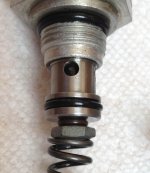
OK I eliminated the solenoid valve. I put a fairly tight-fitting bolt, with an o-ring around it, into the hole. The spring for the manual valve on the other side, pushes against my 'plug bolt' which is also energized by hydraulic pressure. See this in the pictures attached below.

The walkie still creeps down!

So I guess the Solenoid valve is not the problem. The manual valve is a 45deg seat, is pressure energized, and appears to be 'perfect'. I'm pretty sure the hold valve (ball-check) is perfect too. And the return tube from ABOVE the cylinder packing, is DRY. There has been no fluid passing thru it in a long time so I conclude the cyl. packing is 100%.

As if I wasn't stumped before now I'm really stumped. Its like the manifold has a crack or void or something.
 

Attachments

  • 20MT_plug_for_valve2.jpg
    20MT_plug_for_valve2.jpg
    219.5 KB · Views: 495
  • 20MT_plug_for_valve3.jpg
    20MT_plug_for_valve3.jpg
    124.5 KB · Views: 600
   / Crown 20MT Walkie forklift (lift-lower valve problem) #49  
Sodo

Maybe you have already done the cyl check, but

You seem confident that the cyl is not bypassing and the problem is the valve..

Have you put a needle valve in the base end cyl port and raise the cyl with a load and close off the needle valve and see if the cyl will hold. If it does hold, that will tell you that the cyl piston seal is good, and it is indeed that the lowering valve is faulty. .
 
   / Crown 20MT Walkie forklift (lift-lower valve problem)
  • Thread Starter
#50  
JJ, I have not done a cylinder check, and my reasoning may be faulty. I tried to explain it in page1 but let me try again.

Pressure comes into the bottom of the cylinder, and is released from the same port at the bottom of the cylinder. At the top of the cylinder there are some return ports to return any fluid that gets past the cylinder packing. The packing is new, replaced a few months ago.

If the cyl piston seal was leaking then the fluid would be above the piston, and when you extend the cyl to the top, this fluid would be forced thru these tubes, and return to the reservoir.

But when I remove any fitting and look, its dry inside. If I tip the hoses down, not one drop comes out. If there is any fluid getting past the piston, it's not enough to wet the hoses, and that is not possible because it will creep down from top to bottom, and in that case there would be the entire ram's volume passing thru these return hoses.

That's why I say the packing is 100%. What do you think, does this observation eliminate the packing as a possible cause of the creep?

341725d1381969044-crown-20mt-walkie-forklift-lift-20mt-cyl-top-return.jpg


I really appreciate you guys helping me on this. I have not done much with hydraulics but I'm enjoying the learning part. The losing part it isn't as much fun.
 
   / Crown 20MT Walkie forklift (lift-lower valve problem) #51  
Yes, you are correct. Thanks
 
   / Crown 20MT Walkie forklift (lift-lower valve problem) #52  
SoDo,
Not sure how heavy the spring was un the bolt head but is it possible that the pressure created by the load was high enough to compress the spring and allow oil to flow past the O-ring. The way the bolt was installed it would be like a direct acting relief valve.

example: if 1/4" diameter at 100 PSI = 5 lbs force

I guess I have to agree the Cylinder does not appear to be the problem but for peace of mind can you install a ball or needle valve in the cylinder line. This would confirm the cylinder is good a

Check valve should be an easy test. Raise the mast and disconnect the supply line from the pump. No oil flow not your problem.

Manual lower and Solenoid are going to be more difficult. On post #10 you showed the manifold and labeled the plugs. Is there any way to put a plug that you can remove below plug "E" to isolate the cylinder port from the solenoid valve? You could use the same plug to isolate the manual lower valve. This would prevent the cylinder pressure from getting to these valves and should eliminate them one at a time.

Isn't trouble shooting manifolds fun :)
 
   / Crown 20MT Walkie forklift (lift-lower valve problem)
  • Thread Starter
#53  
?.is it possible that the pressure created by the load was high enough to compress the spring and allow oil to flow past the O-ring. The way the bolt was installed it would be like a direct acting relief valve.

The spring is in the same pressure-cavity as the (very light) spring for the hold valve (a ball-check valve). The bolt head is energized like the ball of the check-valve (not the other way around - i.e. relief valve).

346792d1385005993-crown-20mt-walkie-forklift-lift-20mt_plug_for_valve2.jpg


I guess I have to agree the Cylinder does not appear to be the problem but for peace of mind can you install a ball or needle valve in the cylinder line.
The line from manifold to cyl is a hard line, and I don't have a hydraulics toybox, no hoses no fittings etc. I would have to get some hoses made up but it's hard to imagine necessary when the return fittings are bone dry.

Check valve should be an easy test. Raise the mast and disconnect the supply line from the pump. No oil flow not your problem.
This is very do-able; I can crack the fitting to the pump. I have NOT done this yet. Such an easy one, thx for mentioning it. I sure wish you guys were here looking over my shoulder.

Manual lower and Solenoid are going to be more difficult. On post #10 you showed the manifold and labeled the plugs. Is there any way to put a plug that you can remove below plug "E" to isolate the cylinder port from the solenoid valve?

I tried to remove plugs B,C,E but they are soft aluminum and the tiny hex was clearly not going to turn it. They have a fairly large thread diameter. The steel fittings had threadlocker and came out HARD. Would have to get the torch out and get serious.

But pretty sure my bolt-plug isolates the solenoid valve. It doesn't isolate the (new) o-ring at the nose of the valve though.

You could use the same plug to isolate the manual lower valve. This would prevent the cylinder pressure from getting to these valves and should eliminate them one at a time.

Isolating the manual valve maybe can be done the same way if I remove the spindle? Or there may be other ways.

341864d1382051404-crown-20mt-walkie-forklift-lift-liftlowervalve_closeup.jpg


Isn't trouble shooting manifolds fun :)
Well it was fun for a little while but the guys who use it have dealt with it creeping down for 2 years and are about fed up with me saying it's fixable. If course its fixable but I've run out of time and I keep putting more into it because I like a good fight but they are losing patience with me…..
 
Last edited:
   / Crown 20MT Walkie forklift (lift-lower valve problem) #54  
It most surly is making a hissing noise, you just can't hear it.

Lift a heavy load an while it leaks down take a wood dowel with a pointed end and bite down on it hard to leave some teath marks. Now touch the end to the solenoid valve. Hear it? No? Try the manual lower valve. Try to do this when its very quiet of course. Earplugs or earmuffs will help.
 
   / Crown 20MT Walkie forklift (lift-lower valve problem) #55  
Sodo,
The spring is in the same pressure-cavity as the (very light) spring for the hold valve (a ball-check valve). The bolt head is energized like the ball of the check-valve (not the other way around - i.e. relief valve).

Are you saying the nose of the solenoid valve and manual lower valve are connected to the cylinder port. If yes I have been looking at this backwards.

My thoughts on the circuit where.
Pressure connects to "D".
Cylinder connects to "D" through the check valve.
"B", "C", & "E" connect cylinder to top port of manual valve and solenoid valve.
Nose of manual valve and solenoid connect to tank.

If this is wrong I have been giving you some bad advice.

To remove the SAE plugs hit them with a hammer like you are driving a nail. For some reason this loosens them 99% of the time.
 
   / Crown 20MT Walkie forklift (lift-lower valve problem)
  • Thread Starter
#56  
It most surly is making a hissing noise, you just can't hear it.

Lift a heavy load an while it leaks down take a wood dowel with a pointed end and bite down on it hard to leave some teath marks. Now touch the end to the solenoid valve. Hear it? No? Try the manual lower valve. Try to do this when its very quiet of course. Earplugs or earmuffs will help.

I have done this before on car engines,,,, but with a flat (not sharp) dowel to my skullbone right behind the ear. Haven't tried the teeth method that's interesting. I'm willing to try anything at this point?. Problem is there's no quiet to be had. Its in a roaring industrial area next to the I-5 freeway? :irked:

But do you think I could be able to hear the difference between 3 valves with an inch of solid aluminum between each valve?
 
   / Crown 20MT Walkie forklift (lift-lower valve problem) #57  
Sodo said:
I have done this before on car engines,,,, but with a flat (not sharp) dowel to my skullbone right behind the ear. Haven't tried the teeth method that's interesting. I'm willing to try anything at this point?. Problem is there's no quiet to be had. Its in a roaring industrial area next to the I-5 freeway? :irked:

But do you think I could be able to hear the difference between 3 valves with an inch of solid aluminum between each valve?

You might. If you put the dowel on the coil end of the solinoid, or the operating lever of the manual valve. Don't bother on the AL block.

Not having a quiet place is going to hinder your efforts.
 

Tractor & Equipment Auctions

2011 NORAM POWER SYSTEMS 100KW GENERATOR (A58214)
2011 NORAM POWER...
2019 Land Rover Range Rover Sport AWD SUV (A55853)
2019 Land Rover...
2017 FORD F-150 XL CREW CAB TRUCK (A59823)
2017 FORD F-150 XL...
2007 JOHN DEERE 605C CRAWLER LOADER (A60429)
2007 JOHN DEERE...
UNKNOWN  500BBL FRAC TANK (A58214)
UNKNOWN 500BBL...
2018 John Deere 245G LC Excavator - Hydraulic Thumb, Tooth Bucket, 56K LB Class (A56438)
2018 John Deere...
 
Top