Home made Grapple

   / Home made Grapple #41  
1/2 may be overkill but 3 might be a bit small. I will need to measure but I think mine is 3/8 x 4. Some guys like half inch on the sides but I would put extra steel into an extra bottom tine or gussets for support .

My grapple has curved bottom tines which would be easy with CAD and CNC. I don't understand why more grapples don't use them as I see no advantage to straight except ease of building. That should not be such an issue with computers doing the cutting.

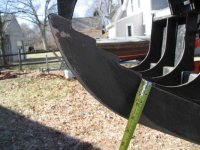
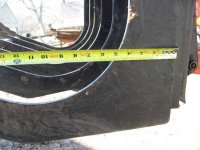
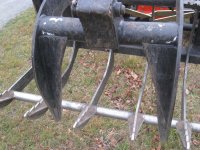
I was wrong about the 3/8 x 4. As the photos below show, 3/8 by 3 is more like it for the middle with even more than 4 inchs in the tips and especially the elbow. However, the bottom tines on my grapple are clearly CAD/CNC fabricated rather than using straight bottom tines like Markham/Gator and WRLong. The "elbow" of the outside tines and the two middle tines are more like 7 inches or so. I presume these variable dimensions were worked out in some engineering program.

After five years of heavy use grubbing stumps and small trees where I often lift the rear of the tractor or ride up trees, the bottom tines have held up without any issue. Rocks and asymmetric loads are the things that cause problems but those tend to cause trouble for the upper arm not the bottom tines.
 

Attachments

  • IMG_3017_small.jpg
    IMG_3017_small.jpg
    84 KB · Views: 372
  • IMG_3018_small.jpg
    IMG_3018_small.jpg
    83.5 KB · Views: 283
  • IMG_3019_small.jpg
    IMG_3019_small.jpg
    79.6 KB · Views: 314
  • IMG_3020_small.jpg
    IMG_3020_small.jpg
    64.9 KB · Views: 291
  • IMG_3021_small.jpg
    IMG_3021_small.jpg
    76.8 KB · Views: 264
  • IMG_3789_small.jpg
    IMG_3789_small.jpg
    112.3 KB · Views: 320
  • IMG_3790_small.jpg
    IMG_3790_small.jpg
    113.9 KB · Views: 349
   / Home made Grapple #42  
I was wrong about the 3/8 x 4. As the photos below show, 3/8 by 3 is more like it for the middle with even more than 4 inchs in the tips and especially the elbow. However, the bottom tines on my grapple are clearly CAD/CNC fabricated rather than using straight bottom tines like Markham/Gator and WRLong. The "elbow" of the outside tines and the two middle tines are more like 7 inches or so. I presume these variable dimensions were worked out in some engineering program.

After five years of heavy use grubbing stumps and small trees where I often lift the rear of the tractor or ride up trees, the bottom tines have held up without any issue. Rocks and asymmetric loads are the things that cause problems but those tend to cause trouble for the upper arm not the bottom tines.

Island....comparing your tines to the Markham design (which I have)....my guess is that your bottom tines are about 6 to 8" less in length or "bucket depth". To me the size you have is a bit better for the average CUT in that is not as "unwieldy" and would not bend as easily with side loads (thus thinner material could be used).

While I lack much seat time with mine.....I've always thought the Markham tine length was a bit much....maybe fine for skid steers....but too much for CUT's....IMO.

It would be neat to have your Milonzi and a Markham side by side to compare the strengths and weakness points.
 
   / Home made Grapple #43  
It would be neat to have your Milonzi and a Markham side by side to compare the strengths and weakness points.

If you want to come up with specific camera angles and measurements etc, I will try to provide them for the Millonzi. I know there are a lot of guys with the LD48 Markham so those should not be hard to get either.
 
   / Home made Grapple #44  
foggy1111 said:
Island....comparing your tines to the Markham design (which I have)....my guess is that your bottom tines are about 6 to 8" less in length or "bucket depth". .

I measured the Millonzi bottom tines at 32 inches from the back frame. (I don't recall if that included the 3 inch frame depth but probably not).
 
   / Home made Grapple #45  
If you want to come up with specific camera angles and measurements etc, I will try to provide them for the Millonzi. I know there are a lot of guys with the LD48 Markham so those should not be hard to get either.

I think this would be worthwhile information to post...particularly if someone was out to build a grapple for themselves or for the CUT market. :thumbsup: But.....I'm not the guy to provide the Markham data / pics.....as I keep my tractor 200 miles away from home. :( Else-wise I would participate.
 
   / Home made Grapple #46  
crazyal said:
I see most grapples have two upper claws, does anyone think three would be useful?

Do you mean tines or grapple arms? My Millonzi has one arm and two tines. If I ever build another upper arm I think I would scallop the tip so there was a short middle tine in between to help hold logs pointing front/back.
 
   / Home made Grapple #47  
Island....comparing your tines to the Markham design (which I have)....my guess is that your bottom tines are about 6 to 8" less in length or "bucket depth". To me the size you have is a bit better for the average CUT in that is not as "unwieldy" and would not bend as easily with side loads (thus thinner material could be used).

While I lack much seat time with mine.....I've always thought the Markham tine length was a bit much....maybe fine for skid steers....but too much for CUT's....IMO.

It would be neat to have your Milonzi and a Markham side by side to compare the strengths and weakness points.

I see it as what are your plans for the grapple. If you are going to be lifting logs then the shorter length is an asset as you can get the weight closer to the tractor plus the lighter weight of the grapple allows you to lift more. If you are just going to be lifting brush piles then larger would allow you to get more each time, weight shouldn't be as much of an issue.

3/8" seams to be the standard thickness for the tines. I think the Markhams have braces to help support sideways. I think that does more to help keep from bending.

Anyway thanks to all of you guys as talk like this is helping me narrow down exactly what to build.
 
   / Home made Grapple #48  
Do you mean tines or grapple arms? My Millonzi has one arm and two tines. If I ever build another upper arm I think I would scallop the tip so there was a short middle tine in between to help hold logs pointing front/back.

Upper (hydraulically controlled) tines. It looks like all the grapples I've seen so far use only one cylinder. In your case it looks to be centered between the two tines. Are they also 3/8" thick? I was wondering if having a three full tines or two heavy duty ones close to the edge and two lighter ones near the center would be better?
 
   / Home made Grapple #49  
I realize this thread is old so I hope some of the ops see this. These all look nice, by the way. I am considering building a grapple bucket myself and have been searching for info, thus my stumbling across this thread. Could someone please tell me what size pins are used where the grapple pivots? Also did you put grease fittings there on your builds?
 
   / Home made Grapple #50  
I realize this thread is old so I hope some of the ops see this. These all look nice, by the way. I am considering building a grapple bucket myself and have been searching for info, thus my stumbling across this thread. Could someone please tell me what size pins are used where the grapple pivots? Also did you put grease fittings there on your builds?

I believe the pivot joint on my grapple uses simple bolts, probably 5/8, maybe 3/4. No grease fitting. Working fine on original set after 7 years.
 
   / Home made Grapple #51  
Since this is a real old post- could I ask where you bought your quick attach boxes?
 
   / Home made Grapple #53  
Just asking here. I have a B7500 HS Kubota TBL. The rated lift of the bucket at the pivot pin is around 600 LBS. Seems like the heavier you make the grapple the less load the tractor can actually pick up. What is the optimum design of a grapple for strength and lightness?
 
   / Home made Grapple #54  
   / Home made Grapple #56  
I found this thread recently while comtemplating purchasing or building a grapple. This grapple is awesome!...and it gave me the confidence to build my own. In fact, I have a 10-year old son whom I want to teach to weld, and more importantly teach that we men don't have to buy everything in our lives.

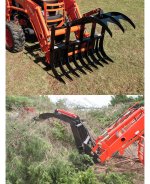
But...I have a question. I have seen some grapples with a design similar to this, where the bottom tines are 25-30" or more long. I have seen other manaufactured grapples where the bottom tines look to be 12" long, and the back of the grapple is much taller. It seems that the latter design would be stronger, but would put more reliance on the top grapple for holding the load (which is probably already pretty important)

I am hoping you guys with experience can give me some advice on this topic. I will be using the grapple to pick up logs, brush, some rocks, etc. The first primary use will be to clean up some log/dirt piles on my property left by the excavator. He used a dozer, and too much dirt was mixed in with the logs...preventing a full burn. I need to sift the remaining logs and brush out from the dirt, pile them, then burn them.

For reference, I have attached a picture of the newer model grapple I am referring to
precision mgf closeup.jpg
 
   / Home made Grapple #57  
I found this thread recently while comtemplating purchasing or building a grapple. This grapple is awesome!...and it gave me the confidence to build my own. In fact, I have a 10-year old son whom I want to teach to weld, and more importantly teach that we men don't have to buy everything in our lives. But...I have a question. I have seen some grapples with a design similar to this, where the bottom tines are 25-30" or more long. I have seen other manaufactured grapples where the bottom tines look to be 12" long, and the back of the grapple is much taller. It seems that the latter design would be stronger, but would put more reliance on the top grapple for holding the load (which is probably already pretty important) I am hoping you guys with experience can give me some advice on this topic. I will be using the grapple to pick up logs, brush, some rocks, etc. The first primary use will be to clean up some log/dirt piles on my property left by the excavator. He used a dozer, and too much dirt was mixed in with the logs...preventing a full burn. I need to sift the remaining logs and brush out from the dirt, pile them, then burn them. For reference, I have attached a picture of the newer model grapple I am referring to <img src="http://www.tractorbynet.com/forums/attachment.php?attachmentid=344080"/>

The grapple type your photo shows and you describe is known variously as a claw or rake or RBG or clamshell. It is indeed quite different from the more common longer bottom tine grapple. The claw style grapple works essentially the way your hand does when you pick something up with finger and thumb when fingernails are pointed up. You must use your thumb in a pinscher grasp. The thumb holds the item firmly against the finger and that allows you to lift the object. The long bottom tine style, variously called open bottom, L shape, and other names works the way your hand does when you scoop something up with fingernails pointed to the ground. Gravity keeps the item in your palm and the thumb just steadies the load. Indeed, you can even lift something without the thumb so long as the item is balanced.

Both grapples have advantages but in general, the open bottom or L type is less expensive and can carry a larger load of solid irregular sized objects. Same as your hand. See how many pencils you can grasp with fingernails up. You can certainly pike more than that into your open cupped palm with fingernails pointed down.

The claw style excels at grabbing brush or at picking up small debris. It also holds a single log more securely.

The open bottom style holds much more volume so you can load multiple logs at one time. You can scoop more because you can get the bottom tines under objects. Because the top grapple jaw just stabilizes the load, you can grab one item, move to another spot and grab another easily without having the first item fall out when you open the top jaw a second or third time. Indeed, you can lift and carry something like a big rock without even closing the top jaw because gravity holds the load in place.

Another major difference between the two basic styles is cost. The claw type grapples are much more expensive and heavier because they require full width upper jaws that have to be just as strong as the bottom short jaw. With the open bottom style the top jaw just stabilizes the load so it doesn't need to be as heavily built as the bottom jaws.

Weight is another difference. Claw grapples weigh more so your net lift capacity is less. Not an issue for brush but it can be for rocks and stumps and logs.

In general, unless you have a specific application or reason to have a claw type, the open bottom style makes more sense for most people.
 
Last edited:
   / Home made Grapple #58  
I found this thread recently while comtemplating purchasing or building a grapple. This grapple is awesome!...and it gave me the confidence to build my own. In fact, I have a 10-year old son whom I want to teach to weld, and more importantly teach that we men don't have to buy everything in our lives.

But...I have a question. I have seen some grapples with a design similar to this, where the bottom tines are 25-30" or more long. I have seen other manaufactured grapples where the bottom tines look to be 12" long, and the back of the grapple is much taller. It seems that the latter design would be stronger, but would put more reliance on the top grapple for holding the load (which is probably already pretty important)

I am hoping you guys with experience can give me some advice on this topic. I will be using the grapple to pick up logs, brush, some rocks, etc. The first primary use will be to clean up some log/dirt piles on my property left by the excavator. He used a dozer, and too much dirt was mixed in with the logs...preventing a full burn. I need to sift the remaining logs and brush out from the dirt, pile them, then burn them.
-------------------------------------------------------
:welcome: to TractorByNet!

I think either design would do what you listed. I have had both styles, sold the claw or clamshell style and bought the L bottom grapple. I can move more brush with it.
 
   / Home made Grapple #59  
Awesome answers to my question! I'm very new to this site, and I'm afraid I'm already hooked. We have 54 acres and cleared 8 acres last summer...spent days with a borrowed rock rake cleaning it up before seeding. Now I see a post for a land leveler...that would have been awesome!

Back to the grapple. I have seen one video that suggested putting the bottom teeth into the ground 5-6" at just the right angle in order to remove surface roots. That same video featured a grapple whose support pipe (pipe near the end of the bottom tines) was nearly the diameter of the bottom tines, which made it easier to do this as the pipe helped kep the grapple from digging too deep. This seems like a great concept to me, but I wonder how useful it would be.

Most of the grapples I have seen on this site feature a rod connecting the bottom times (drilled through all tines) and gussets going from the rod to the tip of each tine. This seems very easy and strong, but I think it would effectively prevent the rooting operation mentioned above.

I have a 27hp Kubota with FEL. I'm thinking I will build the L type grapple with bottom tines 24-30" long. Advice on length would be appreciated. I'm thinking about 48" wide with tines 6, 8, or 12" on centers. We have a clay soil here, so I am thinking wider spacing would be better so as to not get clogged...but this would not be needed during most of the tasks I will be doing. Again, advice on tine spacing is appreciated. I would like to use 3/8" x 2" for the bottom tines, but I'm thinking this might not be strong enough (seems most on here are 2.5" or 3", and even 1/2 thick). I've thought about doubling up the ends of each tine (last 8" or so) in order to give more strength there while trying to keep weight down.

I really respect the opinions of the experts on here, but it would be great if those opinions were that the rooting operation was rarely useful (seems easier to build with gussets), that I should make the bottom tines x long, that 3/8" x 2" would be plenty strong, etc. I also wonder about using 3/8 x 2 for the center tines, and use 3/8" x 3" or 1/2" x 2" for the outside tine on each side.
 
   / Home made Grapple #60  
Rooting is a term that gets thrown about a lot but it is better to be specific. If you are talking about grubbing the roots from a single or multiple trees, you really wouldn't be inserting the grapple tines six inches and blindly moving forward. You would instead be pushing on the tree to expose the roots and then selectively sticking the grapple under where you know the roots are before curling and slowly driving to rip the root.

What you seem to be describing is kind of a front end plowing or root raking the way a bulldozer would. Not a great idea with a CUT as the FEL is really designed with lifting rather than pushing in mind. Long skinny offset arms on a tractor loader are quite different from the stubby thick inline arms on a bulldozer. A CUT will do it but you risk damage to the grapple or FEL if you hit something immovable with a lot of momentum. A subsoiler or chisel plow would be better for blindly clearing old roots.

3/8" is plenty for a grapple on a 27hp tractor but I would suggest 3" rather than 2" tines. . I've never seen 2" used. Tine spacing depends in how you intend to use it. If you primarily are hauling brush and logs or stumps then 9-10" spacing is fine. If you want to carry cut firewood or collect smaller debris and rocks, then 4-5" is better. One compromise is to make the main tines 10-11" and the
put lighter shorter intermediate tines in between. The light tines just keep
Stuff from falling through so don't need the strength of the others.

The pipe reinforcement near the tine tips does provide a lot of support. It doesn't really work that well as a depth limiting device though as the down force on the tips tends to pull the pipe into the ground where it pushes rather than surfs over the dirt.
 

Tractor & Equipment Auctions

2015 JOHN DEERE 35G EXCAVATOR (A52707)
2015 JOHN DEERE...
500 BBL FRAC TANK (A58214)
500 BBL FRAC TANK...
2023 NEW HOLLAND WAGON TONGUE AND LOADING CHUTE FOR NEW HOLLAND SQUARE BALERS (A55315)
2023 NEW HOLLAND...
2012 NISSAN 110 FORKLIFT (A55745)
2012 NISSAN 110...
UNUSED FUTURE XLA59 - 59" DRUM SPIKE LAWN AERATOR (A52706)
UNUSED FUTURE...
Case-IH 370 Steiger (A57148)
Case-IH 370...
 
Top