Need some suggestions on basement drainage

/ Need some suggestions on basement drainage #1  

lzicc

Platinum Member
Joined
Jul 20, 2009
Messages
723
Location
Pittsburgh, Pa
Tractor
Kubota B2650
I built an addition on my house. It is 24' x 32'. I dug the foundation out, poured the footer and laid the block. I have the addition all framed in, all the gutters installed which drain through PVC pipe that goes to the street. I put an exterior french drain around the perimeter, backfilled and have the dirt sloped away from the house. I am getting ready to pour the basement floor when I noticed water on the ground. I don't know where the water is coming from, but it doesn't look like it's coming through the blocks since they are dry but seeping possibly under the footer. You can see the water in the one end of the basement and it wicks up the footer. It's not allot, but you can see shallow puddles. The ground there is mushy also. It seems like after it rains real hard, about 4 days later the water shows up. It dries up on it's own after a week. The footer is on solid ground which is shale. My backhoe had trouble digging the footer so I rented a demolition hammer to break up the shale for the footer so I know it is solid.

I would like to know how this water is getting in, but I don't have any idea. I am going to put in an interior french drain around the perimeter. I have a few options. Where I built the addition, there is an old well pipe that is in the middle of the basement floor. I cut it off level to the ground and was going to cap it and pour my floor over top of it. The well is about 70' deep. I thought about running my perimeter french drain to it so that the water will drain into the old well. Is that a stupid idea? What would be a better drain pipe to use, PVC or Flex pipe? When I go to pour the floor, would it be a good idea to put a good layer of gravel or limestone on the surface? Right now I have a small layer of limestone covering the surface, but may be putting a thicker layer on since I saw the water. I guess I would put the vapor barrier on top of the limestone not below it?
 
/ Need some suggestions on basement drainage #2  
1. Do not ever try to run a drain into a drinking well pipe, no matter how old it is. You'll contaminate the drinking aquifer and you don't even want to think about how much the government will fine you for it. We're talking 7 figures minimum. They will destroy you. And if they don't, your neighbors will, and with justification.

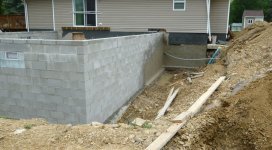
2. I hope you put your footers below the frost line. Otherwise, that water will freeze in the soil and destroy the foundation of your addition.

3. I'd recommend digging out around the foundation, applying a heavy sealant to the outside (asphalt?), laying 6 inch drain pipe all around, bury it with at least a foot of 1.5 to 2.5 inch gravel, and cover the gravel with fabric before covering with soil.
 
/ Need some suggestions on basement drainage #3  
This issue requires pics of the site during construction so we can see where you might have gone wrong, and so we can advise what to do to remedy it. NO to water down old well!
You may end up having to re-excavate outside to seal the walls and footing area from groundwater penetration. Sounds like you also have rising water table from rainfall, and you will definitely have to seal off any existing water which is showing up in the basement, PRIOR to pouring any kind of floor. Yes to vapor barrier on top of final subfloor surface, for VAPOR, not liquid ~ water.
 
/ Need some suggestions on basement drainage #4  
Pics always help.
x3 on don't use the well.

I'm not sure you have done anything wrong, you just haven't done enough yet maybe. The outer perimeter drain is not going to collect water that seeps up in the floor area inside the footer and foundation walls, there is no good path for the water to get there. It would have travel under or through the footer and/or wall to reach the drain.

You have some extra water to deal with is all. Now is the time to do it. It is possible you could pour the floor over a good vapor barrier and not be bothered, bt you would be taking a chance that is more difficult and expensive to fix after the slab is in place.

You are on the right track with the under the floor drain pipe. It needs to be installed in a bed of washed gravel about 8" deep. If radon is an issue in your area, the radon abatement piping would also be in that bed of gravel. I hope you have enough depth to not cut into your basement ceiling height too much if you add the gravel.

The water you collect in the under the floor drain pipes is best sent to a sump pump pit IMO since you want the water no higher than the base of the footer ideally.
 
/ Need some suggestions on basement drainage #5  
If you havent poured the basement floor yet, then you shouldn't have any issues if the drain lines are at the footer. Once you bring the floor up to the footer with crushed stone and lay plastic, the water can't push up through the floor without first seeking the path of least resistance, which should be the drain pipe.

FWIW, when I do foundations or footers, we always use 6" slotted filter wrapped pipe. It's not mush more than 4" and will handle loads of water and silt if you ever have a silt infiltration issue.

Also, I only use crushed stone as my fill under any concrete. Water will travel under the conrete through the stone to find the path of least resistance which will be the pipe.
 
/ Need some suggestions on basement drainage #6  
How deep is your exterior french drain?

When it rains, some of the water flows over the ground, most soaks into the ground. From there some is retained by the soil, some makes its way down to the aquifer, some emerges in ponds, streams and rivers. It moves sideways and down. Since the well is 70' deep you're not really hitting groundwater, you're hitting rainwater that's making its way somewhere. You need to give it a better path than through your basement. The best way is to have exterior perimeter drains below floor level, and then either basement walls with a waterproof basement exterior or an excavated trench filled with gravel that redirects flowing water at any level down to the drains.

Interior drains work -- I have them in my house -- but they're a poor second choice because they do little to protect your walls from hydrostatic pressure.

If possible, the best outlet is to have the drains flow at a 2% drop until they emerge at grade. A sump pump is a poor second choice, sump pumps fail all the time, gravity has been working continuously for billions of years.

Agree with the others that you don't want to be putting anything down the well, that's seriously illegal almost everywhere, a bad idea everywhere.
 
/ Need some suggestions on basement drainage #7  
I have a few options. Where I built the addition, there is an old well pipe that is in the middle of the basement floor. I cut it off level to the ground and was going to cap it and pour my floor over top of it. The well is about 70' deep.
You need to properly abandon a well according to the local legal requirements, which probably means grouting it. You should have a licensed well contractor do that for you to avoid future liability and resale problems. Many people in the area, probably including you, are vulnerable to contamination of an abandoned well even if you don't deliberately dump something in it.
 
/ Need some suggestions on basement drainage #8  
How deep is your exterior french drain?


Interior drains work -- I have them in my house -- but they're a poor second choice because they do little to protect your walls from hydrostatic pressure.

If possible, the best outlet is to have the drains flow at a 2% drop until they emerge at grade. A sump pump is a poor second choice, sump pumps fail all the time, gravity has been working continuously for billions of years.

I have both a grid of interior drains and exterior perimeter drains. They don't serve the same area though is the way I picture it. Assuming the OP's exterior footer drains are deep enough, as you asked, then obviously they are not removing the water that is seeping up inside the foundation, or it wouldn't be there. Pouring concrete over it isn't going to change that, not that a lot of basement floors aren't poured over wet ground.

It really depends on how much water is there as to whether it will become a problem. That's the tricky thing about home construction, someone says "I did it this way, or I've always done it this way and never had a problem." Yet, there are more than a few wet basements.

Sump pumps do fail, but so do gravity drains. They can get clogged, get roots in them--although that should be rare anymore with plastic pipe, get crushed, etc. It's easier to replace a pump than to repair a bad gravity drain that is at the bottom of a basement foundation. It depends also on what good options are available as to where the sump pump water is going to go.

In the event of a flood or plumbing disaster, a sump pit is a built-in basement floor drain. Sumps pits are bad for radon control. They both have pluses and minuses.

How ever you get there, the ideal slab is one that sits high and dry.
 
/ Need some suggestions on basement drainage
  • Thread Starter
#9  
Thanks for the heads up on the well.
My footer is about 5' below grade. The french drain is 4" perforate pipe. I have landscape material on the bottom with a layer of gravel on the bottom and about 1.5 feet over the pipe with landscape material over top that. The pipe runs next to the footer on the side.

I shouldn't have any water is this basement with the way I graded the landscape and how the french drain was put in. Really odd. It only happens when we get a good rain and even then it takes a few days after the rain for the water to show up in the basement. The rest of the basement is dry, it is just the one corner/side of the basement. I wasn't going to put an interior drain in, but might as well now. I can put a sump pit in for that. I just want to make sure that once I pour the floor that I don't get any dampness.
 
/ Need some suggestions on basement drainage #10  
Were does your exterior french drain water go?

If you put a sump pit in get a sealed unit with a vented cover, for radon venting, and dont use as a floor drain.

The well needs to be capped and sealed by a well guy, then reported to the state.

After the slab has cured, calk the perimeter, this is often skipped.

Dave
 
/ Need some suggestions on basement drainage
  • Thread Starter
#11  
The drain goes to and underground dry well that I built.
 
/ Need some suggestions on basement drainage #12  
Could the dry well be filling up and backing up around the foundation?

Dave
 
/ Need some suggestions on basement drainage #13  
Sounds to me like your exterior drain was done correctly.
#1- Run an interior footing drain. Perf pipe be it black or white will be fine. I don't like using roll black perf pipe outside as it will crush easier but i see no issues under a slab.
#2-Fill your basement with stone to top of footing not soil. Any stone is fine just not process. You want stone and stone only.
#3-Drain that footing to daylight, if you can would be my first choice.
#4-Install and sump basin prior to pouring your floor regardless if you did drain to daylight. Install the sump basin right next to the interior footing drain but do not connect if you are draining to daylight. This sump basin is just in case your drain to daylight fails. If it does fail its a matter of making a hole on the side of the basin that you have against the pipe. A picture at install will help for future reference. Also fill around your sump basin with stone.
#5-Once you have installed you interior drain find a location to cut in a T and bring a 4" solid sched. 40 pipe up thru the floor. You will want to put a cap on this pipe for now. This pipe will act as a place for you to install a fan if you ever have radon. When locating this T remember that this 4" pipe will have to be run up the side of the house if and when needed for radon. So pick a location that it won't be as visible.
#6 If not draining to daylight just hook up interior drain pipe into the sump basin. As far as the pump goes i would use a sewage ejector. They are alot more reliable over an off the shelf sump pump.
Hope this helps. Gook luck with your project.
Just remember one thing you can never stop water you can just control it.
 
Last edited:
/ Need some suggestions on basement drainage
  • Thread Starter
#15  
BuilderML, thanks for that explanation. Do you think either gravel or limestone should work?

Dr. Dave, that thought crossed my mind last night. My thoughts are that I shouldn't really be getting much water around the foundation from the way I have my landscape away from the addition plus it's only that one end/corner of the house. You would think that if it was the dry well issue that it would be all around the basement floor/dirt.

When I do run the interior drain, which would be a good idea anyhow, if the water is coming from under the footer, could that cause me issue's down the road? Will the earth start to deteriorate underneath the footer. My footer is on solid shale so I wouldn't think so. I also want to make sure the addition is dry. I hate damp basements.
 
/ Need some suggestions on basement drainage
  • Thread Starter
#16  
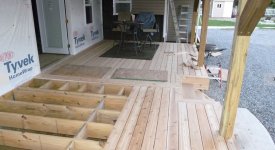
If you look at the picture with only the blocks up, you can see where I parged the wall and also put parging between the bottom blocks and the footerr so that water flows away from the footer. That is the part of the addition where the water is coming in. I did parge all of the foundation that is below grade like that and put 2 coats of foundation coating on it. I then wrap the under grade foundation with Grace TriFlex. If you look at the picture of the deck that is now there, you can see that the deck extends out from the foundation a little over 12' and the gravel drveway slopes away from the house. The spot of the foundation that you see in the first picture is under the deck below the table and chairs in that corner.

Also, I put dirt up around the foundation under the deck to slope away from the house. I will take some pictures of the inside of the basement when I get home.

house.JPG

Hosue2.JPG
 
/ Need some suggestions on basement drainage #17  
We still need pictures of the site.. better if they are of the construction.

Is the wet spot 'uphill'? What is the actual water table in your area? A 70' well means nothing. Mines 80' deep with the well head @ 60', but the water table is 6'-10'.
 
/ Need some suggestions on basement drainage #18  
We still need pictures of the site.. better if they are of the construction.

Is the wet spot 'uphill'? What is the actual water table in your area? A 70' well means nothing. Mines 80' deep with the well head @ 60', but the water table is 6'-10'.
 
/ Need some suggestions on basement drainage #19  
Is that a pipe or conduit in the first pic, maybe water is folowing it to the foundation. Were does the other end go?

There is water in the corner of the first pic, from rain or ground water? Water will flow the path of least resistance.

Dave
 
/ Need some suggestions on basement drainage #20  
Hard to tell from your first two pics, but it seems maybe the parge and triflex are not enough, or there is something about the water table in the area in question that allows water to seep there over time after heavy rains. I was wondering if you could allow the drywell to let water pass through it to daylight long enough to see if it is causing your issues? By this I mean for you to essentially bypass the drywell with a connected non-perforated pipe to see what happens during and after a big storm. Are your roof gutters doing their job and what are they connected to? Drywell? Run to daylight?
It also doesn't seem you have very much pitch away from the house/foundation, but with just one pic it's hard to tell.
FWIW, I solved a problem of groundwater entering my flip house by excavating out some of the exactly flat grade around the foundation, at existing finished grade; placing a rubberized membrane of 1/8" x 10' x 25' EPDM roll roofing material up the foundation wall about a foot, and out four feet into existing grade/lawn; then I threw down stone on top of the membrane to keep it from being destroyed by UV, etc. I have hardly any slope to the area, but I actually created some by digging down and away as I went from foundation toward lawn, and made the membrane and stone higher at the foundation wall and lower as it went away from same. The membrane came on a 10' wide by 25' roll for around $200-$225. I cut it in half down the middle and laid down 5', (4' out from the foundation wall). With good replaced gutters and downspouts draining to daylight it has worked to keep rain and snow from being able to find it's way along the foundation wall in crevices/fissures that must have cut their way through the foundation soil from years of inattention. I did not tar it to the foundation but may do so this fall to provide a best case seal going forward.

Show us lots more pics and explain what finished state the foundation/basement were at when you started seeing water in the basement.
 
 
Top