Thinking of propylene

/ Thinking of propylene #1  

deereman75

Veteran Member
Joined
Apr 29, 2011
Messages
1,912
Location
canada
Tractor
Deere 2120, Warner & Swasey 6000# offroad forklift, Case W9B loader, various non-running decorations
In using my latest B tank of acetylene, I have decided to get something else when it's empty....
I can close the tank valve, and bleed the whole system, and within a day or two, the inlet gauge reads 150psi..... The tank valve is bad. I think the main issue is the darn square shank on those B tanks....
Anyways, this is my last B tank. I am trying to decide between getting the next size up acetylene tank, or switch to propylene.
I have done a tiny bit of gas welding, but the tig will end that. My understanding is that you can braze with any gas. Any thoughts on this from those of you who are torch experts? (Or at least know more than me... (easy to do...))

I guess the next size acetylene tank is still too small for a rosebud..... That would be really useful.

Anyways, is propylene the way to go? I am looking at the 25# tank from air liquide.
 
/ Thinking of propylene #2  
I use a rosebud with a B tank, but it eats acet fast. I have switched to propane for heating, cutting, and brazing. Works good. Takes a little longer to get up to working heat as propane has less BTU content per CF. Keep the acet around as I do gas welding of steel often. Actually I am a better gas welder than arc welder.

Ron
 
/ Thinking of propylene #3  
A B tank is too small for a rosebud and you'll draw acetone out of the cylinder. This creates a very dangerous situation. I wouldn't be surprised if your rosebud is all black at the end from acetone being drawn out. In my opinion a B tank is too small for a standard torch set. B tanks are what plumbers use with air/acetylene torches. Go to a 75 cu. ft. cylinder and it will have the same valve as the larger cylinders. Air Liquide uses a different acetylene fitting but you can get an adapter. If you're not using it a whole lot, I'd just get the 75 acet. cylinder.
 
/ Thinking of propylene
  • Thread Starter
#4  
B tank is way too small for a rosebud....
I think I have found my answer. I will get the 75cf acetylene tank, and I think I will get a propane rosebud, and just borrow a tank from the bbq when I need to do heating. Tiger torch is another option..... LOL
Air liquide has the good cast iron tiger torches for $70..... Might also be good for my lead casting.
 
/ Thinking of propylene #5  
If you're not going to be using it for a lot of applications where you need the fast pinpoint heat of acetylene, going to propane makes a lot of sense. They make cutting tips and rosebuds, and of course the cost of the gas is significantly less.
 
/ Thinking of propylene #6  
Propane is very convenient, but be aware it sucks the O2 like crazy. I believe it is worse than acetylene in that regard, but I haven't had to ever deal with swapping tanks when using acetylene, as the only place I used it was in class with a massive manifold system. I will kill probably 4-5 (or more..never got that far...) O2 tanks (125cf) to one 20 lb grill tank of propane. You need different tips and hoses too.
 
/ Thinking of propylene #7  
This thread is getting confusing - Deereman originally asked about PROPYLENE, not PROPANE - no one has mentioned PROPYLENE again, not even the OP. I'm trying to figure out if everyone is answering a question that hasn't been asked, or if it's generally thought that PROPYLENE is just another name for PROPANE (it's NOT), or if I'm finally going even MORE "bat guano" than I already was :confused2:

Some alternative gas info

Alternative Fuels | Welding & Gases Today

http://www.advancedweldingsupply.com/gas guide.html

Whatever - in regards to using a rosebud, I have the smallest acetylene rosebud Victor offered at the time, and the LARGEST single acetylene cylinder that's still portable (referred to in some areas as a "size 5", which is typically 360 cubic feet - this is because under the OLD acetylene safety standards, you weren't supposed to draw more than 1/7 of the tank volume per hour, or you would (as previously mentioned) pull acetone out of the tank and into the hoses - eventually, the hoses would rebel and you'd get more flames in more places than you'd bargained for :(

My chosen combo of small rosebud and largest tank BARELY met the OLD standards, if I didn't push it too hard. The only other SAFE alternative is multiple tanks and a manifold, which obviously isn't very portable or affordable :thumbdown:

Anyway, a small rosebud and a VERY large tank STILL don't come up to the NEW safety standards

Fuel your safety knowledge - Safety Tech Cell - TheFabricator.com

Which now recommend no more than 1/10 per hour intermittent, or 1/15 per hour continuous.

I've yet to find info on whether PROPYLENE tanks have the same quirks as Acetylene (wierd concrete filler, x amount of acetone by weight BEFORE filling, so the tank won't explode at tank pressure, etc) or not - but considering the possible consequences of ignorance I would want to know MORE about PROPYLENE before recommending it or changing to it.

Especially since each type of flammable gas needs its OWN combo of orifice sizes, etc; it's not like you can just hook up your O/A rig to a PROPANE or PROPYLENE or Natural Gas tank and run with it :confused:

Sorry if I come off a bit strong on this - I've lived 48 years LONGER than I would have if the T handle of an oxygen regulator had come about 1 inch closer to my head than it did, when an "expert" hooked up a new bottle and cranked the valve open without first backing off the regulator setting.

As it was, that T handle went through two double sided plywood sheathed walls and dented a parked car about half a block away :eek:

I've had a lot of fun in that "extra" 48 years, so I figure it's worth knowing what you're messing with... Steve
 
Last edited:
/ Thinking of propylene #8  
I use the WQ acetylene tank which seems to be the largest that can be owned from TSC. Although there appears to be a WS tank for ownership in some jurisdictions that would be much better ?
 
/ Thinking of propylene #9  
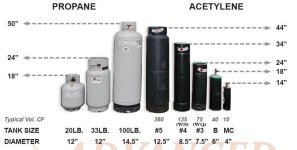
Better, but still not big enough to use even the smallest rosebud - here's a comparison chart, I have the size 5 and have listed the two letter size you mentioned - you now have a size 3, the WS is a size 4. HTH... Steve
 

Attachments

  • FlamGasCylChrt.JPG
    FlamGasCylChrt.JPG
    40.8 KB · Views: 199
/ Thinking of propylene #10  
B tank is way too small for a rosebud....
I think I have found my answer. I will get the 75cf acetylene tank, and I think I will get a propane rosebud, and just borrow a tank from the bbq when I need to do heating. Tiger torch is another option..... LOL
Air liquide has the good cast iron tiger torches for $70..... Might also be good for my lead casting.
you miht want to make sure you have the proper hose for you gas, i think it takes a special hose to use both gasses safely.
 
/ Thinking of propylene #11  
Where is the chart that shows flow for the various cutting and welding tips?
For bulk heating I use a small or large LP Tiger torch.
 
/ Thinking of propylene
  • Thread Starter
#12  
To answer a few questions here.
I am fully aware of the difference between propylene and propane. I had initially asked about propylene, but have figured that if I'm going to lose the ability to weld anyways, I might as well save a bit more. Plus I have 3 tanks for the BBQ, and no propylene tanks......

Yes, all fuel gasses have different tips. I have a concoa rig (best in the industry.....), and the torch, and regulators are rated for all fuel gasses. It even has the stainless steel regulator diaphragms.

The hose you need for other fuels is a grade T. It is actually better for acetylene as well. You can run propane in a normal hose, but it isn't a good idea for too long.
Air liquide has 25 foot grade T hose cheaper than most places have the crap hose.....

Finally, propylene is like propane in that it is stored as a liquid in the tank, and the only limit to how much you can draw is when the tank freezes.
 
/ Thinking of propylene #13  
Deereman, I was pretty sure you were knowledgable in this stuff from reading your previous posts - that was part of my confusion when you didn't correct the propane comments.

Thanks for clearing up the propylene bottle specs for me, hadn't found anything that spelled it out (yet)

I did find some vids on fires/explosions caused by poorly configured overpressure valves on propylene tanks, but nothing since about 2005 or so - hopefully that issue is ancient history.

I'm with you on the changes - I think when my acetylene bottle is finally empty I'll put the money into propane change-over stuff, since I also have 4 25 gallon and numerous smaller tanks.

Where I used to work (til this month, now retired and working twice as hard) our main weld shop went from acetylene to mapp gas to propylene and finally settled on propane - welders bitched and moaned, some actually researched the differences and got used to the longer preheat time -

Personally, those "extra 48 years" I spoke of earlier make the tradeoff in favor of extra safety, lower operating costs AND less hassle well worth it to me... Steve
 
/ Thinking of propylene #14  
They say that you need grade T hose for alternate fuels..We did use regular hose for ions prior. As for O2 consumption..Not much different between Propane and Propylene and only a little more than Acetylene only on the preheat..other than that all are similar. Alternate fuels are liquids in hollow cyllinders that work off of head pressure..This makes a Rosebud useable even with small Alt fuel cyllinders. Propylene costs similar to Acetylene but lasts 4x longer. That value makes a little more O2 consumption a lesser issue. Other plus notes with alt fuels: Much less cost overall, Not much chance of flashback, Can light both gases at the same time in windy conditions, No Acetone to ruin regs and torches, Can be used laying on it's side, Tips require much less cleaning and are easier to clean, Able to run rosebud with a small tank. Minuses: Wild when lighting in the wind unless you light both gasses at the same time, Grade T hose suggested, Uses slightly more O2 during preheat. If you don't actually Weld with your Oxy fuel setup, You can enjoy all of the plus with limited downside using Alternate fuels.
 
/ Thinking of propylene
  • Thread Starter
#15  
I have found that for me, there isn't much of any need for gas welding.
I find brazing to be a lot easier, and it can be used on things such as cast iron as well.
Between stick welding, and brazing, I almost never would have a need for gas welding. Add in tig, and mig, and I'm not sure there is ever a need for gas welding.
 
/ Thinking of propylene #16  
Yomax, thanks for the extra info - I'm just waiting for my last acetylene bottle to run dry, then I'll do what I need to be able to heat and cut (thick stuff) with propane.

Got 250 amp ac/dc transformer stick welder, miller 252 mig with 30A spool gun and dual bottle running gear, 200 amp dc tig with 160 amp stick, and Powermax 45 plaz.

All I'd need gas for now is heating/bending stuff, and cutting steel thicker than 1" so I should only need a new reg for propane, and hopefully I can find a propane compatible "bud" and cutting head for my Victor handle. Last I looked, it was an older model that may not be compatible with newer stuff. We'll see... Steve
 
/ Thinking of propylene #17  
Your Acetylene reg will work fine it just has no numbers after 15 psi. Usually you wont need much over 15 psi anyway..The fittings are the same. The older Victor handles still take the new tips and they also have a cool short rose bud that screws on to your cutting attachment. It replaces the cutting tip.
 
/ Thinking of propylene #18  
Good to know - I see another "seek and acquire" mission in my future :=) Steve
 
/ Thinking of propylene
  • Thread Starter
#19  
One nice thing about concoa regulators is that they have numbers all the way up to 50psi on the acetylene gauge. The background changes to red after 15. It's a really nice system, they really thought of everything.
They set up every aspect of their rigs for all fuel gasses.

My understanding is that in tip mixers such as smith and airco are better for alternate fuel gasses, because the mixer can be optimized for a specific fuel gas. I know that my torch with its airco tips cuts nicer than the victor my neighbor has, and as good or better than the purox at the museum.
I bet there would be even more of a difference if they were ran on propane.

Of course I could be totally wrong on all this..... LOL
 
/ Thinking of propylene #20  
For safety reasons, some things need to be stated clearly within this discussion...:) :thumbsup:

"Only use Grade R hose for use with acetylene gas. Use Grade T hose with propane gas and all fuel gasses."

"Never go over 15 PSI on the acetylene regulator as the gas can become highly explosive at high pressure"- pg 7 from Hobart Gas Apparatus Medium Duty Torch kit

This Hobart manual says nothing about changing torch bodies on this medium duty kit, just the tips...(could be different with other brands/models)

Propane Cutting Tips

Hobart# 770162 ~~ Tip Size - 2 ~~ Material Cut Thickness 1" ~~ Fuel Gas PSIG -8 ~~ Oxygen PSIG- 35 ~~(Victor Tip Part# 3GPN)
\
Hobart# 770172 ~~ Tip Size - 3 ~~ Material Cut Thickness 1.5" ~~ Fuel Gas PSIG -9 ~~ Oxygen PSIG- 45 ~~(Victor Tip Part# 3GPN)
 
 
Top