Drowning information and video

/ Drowning information and video #1  

dmccarty

Super Star Member
Joined
Sep 7, 2000
Messages
12,669
Location
Triangle Of North Carolina
Tractor
JD 4700
I saw a video in the last week or two of a kid at a small wave pool start to drown. The pool was full of kids and when the child starts to drown, none of the other kids reacted to the child struggling in the water. It took the lifeguard about seven seconds to see the child in trouble and go after the kid which is not a damning statement about the lifeguard. I was really surprised the lifeguard saw the child struggling as fast as he did because the pool was so crowded.

The following is from page 14 of a US Coast Guard publication: http://www.uscg.mil/hq/cg5/cg534/On Scene/OSFall06.pdf.

Characteristics of the Instinctive Drowning Response:
1. Except in rare circumstances, drowning people are physiologically unable to call out for help. The respiratory system was designed for breathing. Speech is the secondary, or overlaid, function. Breathing must be fulfilled, before speech occurs.
2. Drowning people's mouths alternately sink below and reappear above the surface of the water. The mouths of drowning people are not above the surface of the water long enough for them to exhale, inhale, and call out for help. When the drowning people's mouths are above the surface, they exhale and inhale quickly as their mouths start to sink below the surface of the water.
3. Drowning people cannot wave for help. Nature instinctively forces them to extend their arms laterally and press down on the water surface. Pressing down on the surface of the water,
permits drowning people to leverage their bodies so they can lift their mouths out of the water to breathe.
4. Throughout the Instinctive Drowning Response, drowning people cannot voluntarily control their arm movements. Physiologically, drowning people who are struggling on the surface of the water cannot stop drowning and perform voluntary movements such as waving for help, moving toward a rescuer, or reaching out for a piece of rescue equipment.
5. From beginning to end of the Instinctive Drowning Response people's bodies remain upright in the water, with no evidence of a supporting kick. Unless rescued by a trained lifeguard, these drowning people can only struggle on the surface of the water from 20 to 60 seconds before submersion occurs.

Below is the video but before watching, go back and read the five behaviors to see how many the child does. I have tried to not leave any clues as to which child is going to get in trouble, so you have to watch the pool knowing that something bad is about to happen but you do not know to which child. You only know a child is going to get into trouble and then be rescued.

[video=youtube;L0KTqPloUiU]http://www.youtube.com/watch?feature=player_embedded&v=L0KTqPloUiU[/video]

I counted seven Mississippi's from the time the child gets into trouble before the lifeguard jumps into the pool. Step 5 says one only has 20-60 seconds and it took the Lifeguard seven to jump into the water and a few more seconds to get the child. What was scary to me is that if the child had breathed in water, and sunk to the bottom of the pool, it would have been very hard to see the kid because of the number of people in the pool.

The child is surrounded by other people, including another child who was playing with the kid who starts to drown and NONE of them reacted to the child. The drowning child's playmate just watched and did not know what was happening. Lifeguards who are supposed to know these behaviors, have watched people drown when they thought they were playing.

Later,
Dan
 
/ Drowning information and video #2  
I saw the arms and the kid trying to get their head above the water about a second before the lifeguard blew the whistle.
IMO, if your kid cant swim, they shouldn't be in water over their head without a flotation device attached to them (ie: life jacket, flotation vest, "water wings", etc) unless there is an adult standing/swimming next to them to work with them 1 on 1.

Aaron Z
 
/ Drowning information and video #3  
That is some video. I knew there was going to be trouble so I was watcing extra hard and I still didn't see the child go into the water and have trouble until the lifeguard jumped into the water.

I think the lifeguard was amazing. Can you imagine sitting in the sun for hours watching all those kids jump around and keeping your focus to see problems.

All I can say is wow.

MoKelly
 
/ Drowning information and video
  • Thread Starter
#4  
I saw the arms and the kid trying to get their head above the water about a second before the lifeguard blew the whistle.
IMO, if your kid cant swim, they shouldn't be in water over their head without a flotation device attached to them (ie: life jacket, flotation vest, "water wings", etc) unless there is an adult standing/swimming next to them to work with them 1 on 1.

Aaron Z

Yeppers, there was some bad parenting going on.

I have watched the video many times now and it took awhile for me to figure out that the kid slipped off the tube. I don't think the child had much experience with tubes and the child sat on the tube in just the right way to have it flip over. I think a wave might have helped as well. If you watch the video, you can see the kid float into the deeper water. No way should that child have been in a wave pool.

Later,
Dan
 
/ Drowning information and video #5  
Sincere thanks for posting. Hopefully those members with Children or Grandchildren that can't swim, will set up classes with the Red Cross. I think that the program is still Free.
 
/ Drowning information and video
  • Thread Starter
#6  
That is some video. I knew there was going to be trouble so I was watcing extra hard and I still didn't see the child go into the water and have trouble until the lifeguard jumped into the water.

I think the lifeguard was amazing. Can you imagine sitting in the sun for hours watching all those kids jump around and keeping your focus to see problems.

All I can say is wow.

MoKelly

The video really impressed on me how difficult it is to see someone drowning. If the kid had just slipped under water it would have been VERY easy to miss because there were so many people in the pool.

At Disney World there are numerous lifeguards at the pool and they rotate frequently to keep from getting complacent. They switch positions often and I have seen them walking the edge of the pool looking along specific sight lines to make sure the scan every inch of the pool bottom. The pool we go too switches out the lifeguards but I have never seen them do the scans like at Disney but then again our pool is just L shaped and not complicated like at Disney.

By my count it took seven seconds for the lifeguard to see the kid in trouble and another 6-7 seconds to reach the child. Pretty fast but the research says you only have 20-60 seconds before going under.

If it was cold water, it can happen even quicker.

I showed the video to my kids so they could recognize the signs. The other disturbing part of the video is that NOBODY around the child noticed the kid drowning. NONE. Even the kids play mate was just watching. I think the kid that was watching simply did not know what was happening but may have started to figure out the other child was in trouble when the lifeguard went into the pool. The other kids in the pool, even within feet of the child, did not even notice.

Later,
Dan
 
/ Drowning information and video #7  
Yeppers, there was some bad parenting going on. Dan

Unfortunately, that actually wasn't bad parenting, just average parenting (other than the initial decision to allow the non-swimming child in water over their head.)

It may take only 60 seconds for a drowning victim to go unconscious. You've got about 5 minutes from the point they stopped breathing to getting them to breath again before their brain starts dying. (Time varies depending on water temperature.)
 
/ Drowning information and video #8  
It may take only 60 seconds for a drowning victim to go unconscious. You've got about 5 minutes from the point they stopped breathing to getting them to breath again before their brain starts dying. (Time varies depending on water temperature --->


...and age of victim.


.
 
/ Drowning information and video #9  
I think that under the conditions the lifeguard did a marvelous job.
If someone is not able to swim, under the wrong conditions that life guard would have been recovering a body. Parents need to teach their kids to swim.
 
/ Drowning information and video #10  
I'm thoroughly impressed with the lifeguard. He saw the child was in trouble, and reacted rapidly and correctly. It's difficult to blow the whistle, stop the wave pool, draw attention to yourself as stopping everyone's fun etc. I think he did a great job in tough circumstances; he's truly professional, and was doing his job and not chatting up the female lifeguards. Good job!


This is an article by Mario Vittone; I had originally read it several years ago elsewhere, but it can be found at Rescuing drowning children: How to know when someone is in trouble in the water. - Slate Magazine . There are some important reminders and information: Kids are noisy, so once they go quiet, there is probably something amiss. The vertical body positioning is distinctive to drowning, and the "ladder climb" and extended arms pushing down on the water are both indicators too. The rolled back head to place the mouth upward is an emergency sign, too.

I take issue with a little bit of what the Coast Guard described; I don't think the person needs to be a trained lifeguard to make the rescue. I've gone into the water to get a child who was drowning. While I actually AM trained as a lifeguard, it wouldn't have been any less effective for the child if a non-trained person did the same thing.

The article:


"The new captain jumped from the deck, fully dressed, and sprinted through the water. A former lifeguard, he kept his eyes on his victim as he headed straight for the couple swimming between their anchored sportfisher and the beach. “I think he thinks you’re drowning,” the husband said to his wife. They had been splashing each other and she had screamed but now they were just standing, neck-deep on the sand bar. “We’re fine; what is he doing?” she asked, a little annoyed. “We’re fine!” the husband yelled, waving him off, but his captain kept swimming hard. ”Move!” he barked as he sprinted between the stunned owners. Directly behind them, not 10 feet away, their 9-year-old daughter was drowning. Safely above the surface in the arms of the captain, she burst into tears, “Daddy!”


How did this captain know—from 50 feet away—what the father couldn’t recognize from just 10? Drowning is not the violent, splashing call for help that most people expect. The captain was trained to recognize drowning by experts and years of experience. The father, on the other hand, had learned what drowning looks like by watching television. If you spend time on or near the water (hint: that’s all of us) then you should make sure that you and your crew know what to look for whenever people enter the water. Until she cried a tearful, “Daddy,” she hadn’t made a sound. As a former Coast Guard rescue swimmer, I wasn’t surprised at all by this story. Drowning is almost always a deceptively quiet event. The waving, splashing, and yelling that dramatic conditioning (television) prepares us to look for is rarely seen in real life.

The Instinctive Drowning Response—so named by Francesco A. Pia, Ph.D., is what people do to avoid actual or perceived suffocation in the water. And it does not look like most people expect. There is very little splashing, no waving, and no yelling or calls for help of any kind. To get an idea of just how quiet and undramatic from the surface drowning can be, consider this: It is the No. 2 cause of accidental death in children, ages 15 and under (just behind vehicle accidents)—of the approximately 750 children who will drown next year, about 375 of them will do so within 25 yards of a parent or other adult. In some of those drownings, the adult will actually watch the child do it, having no idea it is happening.* Drowning does not look like drowning—Dr. Pia, in an article in the Coast Guard’s On Scene magazine, described the Instinctive Drowning Response like this:

“Except in rare circumstances, drowning people are physiologically unable to call out for help. The respiratory system was designed for breathing. Speech is the secondary or overlaid function. Breathing must be fulfilled before speech occurs.
Drowning people’s mouths alternately sink below and reappear above the surface of the water. The mouths of drowning people are not above the surface of the water long enough for them to exhale, inhale, and call out for help. When the drowning people’s mouths are above the surface, they exhale and inhale quickly as their mouths start to sink below the surface of the water.
Drowning people cannot wave for help. Nature instinctively forces them to extend their arms laterally and press down on the water’s surface. Pressing down on the surface of the water permits drowning people to leverage their bodies so they can lift their mouths out of the water to breathe.
Throughout the Instinctive Drowning Response, drowning people cannot voluntarily control their arm movements. Physiologically, drowning people who are struggling on the surface of the water cannot stop drowning and perform voluntary movements such as waving for help, moving toward a rescuer, or reaching out for a piece of rescue equipment.
From beginning to end of the Instinctive Drowning Response people’s bodies remain upright in the water, with no evidence of a supporting kick. Unless rescued by a trained lifeguard, these drowning people can only struggle on the surface of the water from 20 to 60 seconds before submersion occurs.”

This doesn’t mean that a person that is yelling for help and thrashing isn’t in real trouble—they are experiencing aquatic distress. Not always present before the Instinctive Drowning Response, aquatic distress doesn’t last long—but unlike true drowning, these victims can still assist in their own rescue. They can grab lifelines, throw rings, etc.

Look for these other signs of drowning when persons are in the water:

Head low in the water, mouth at water level
Head tilted back with mouth open
Eyes glassy and empty, unable to focus
Eyes closed
Hair over forehead or eyes
Not using legs—vertical
Hyperventilating or gasping
Trying to swim in a particular direction but not making headway
Trying to roll over on the back
Appear to be climbing an invisible ladder

So if a crew member falls overboard and everything looks OK—don’t be too sure. Sometimes the most common indication that someone is drowning is that they don’t look like they’re drowning. They may just look like they are treading water and looking up at the deck. One way to be sure? Ask them, “Are you all right?” If they can answer at all—they probably are. If they return a blank stare, you may have less than 30 seconds to get to them. And parents—children playing in the water make noise. When they get quiet, you get to them and find out why."


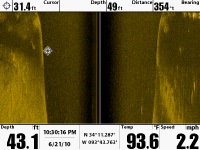
All of these efforts are to avoid a situation like this:

-1.png

If you're not sure, find the crosshair cursor, and look very slightly to the left. This is a sidescan sonar image taken during a search for a 16 year old girl...they found her body floating 30 or so feet down.
 
/ Drowning information and video
  • Thread Starter
#12  
Bumping this back up since swimming season is starting.

Be careful boating because the air temperature can be hot this time of year but water temperature, especially on lakes, can still be very cold. If the water is cold enough and one's head goes underwater, one can get a gasp reflex which causes one to breath in which is not a good idea when you head is underwater.

Later,
Dan
 
/ Drowning information and video #13  
Bumping this back up since swimming season is starting.

Be careful boating because the air temperature can be hot this time of year but water temperature, especially on lakes, can still be very cold. If the water is cold enough and one's head goes underwater, one can get a gasp reflex which causes one to breath in which is not a good idea when you head is underwater.

Later,
Dan

Good call. We've had several drowning incidents up here in the last few weeks... including one 18 YO who tried to swim a river.
 
/ Drowning information and video #14  
When my younger brother was 16, he and a younger boy probably 13 went to the lake for a swim.

The 13 year old was swimming across some deeper water and got into trouble. At first my brother thought he was goofing around, but realized it was serious.

My brother was strong and a good swimmer, but had no training to help someone that was drowning. He tried his best several times to save the boy, but the boy kept grabbing on to my brother and pulling him down. Finally my brother had to save himself and left.

The boy drowned and we still have his baseball cap hanging in our sauna, because they had sauna the night before.

My brother has talked to me about it a couple of times and feels terrible that he couldn't help the boy.
 
/ Drowning information and video
  • Thread Starter
#16  
Bumping this back up since swimming season has started. Guess I forgot to do this in 2015 and 2016. :(

Later,
Dan
 
/ Drowning information and video #17  
Unfortunately, that actually wasn't bad parenting, just average parenting (other than the initial decision to allow the non-swimming child in water over their head.)

I'd be the first to agree with you. But it's not that simple. You still need to be vigilant with your young kids around water, period.

Here's a story I can share:
I have a daughter that swims daily with her grandparents in their pool and can easily stay afloat, swim end to end, go under water and surface without an issue. We've also had her in the ocean multiple times with surf knocking her over etc.

A couple of years ago, we sent her to summer camp and they had a trip to a local water park. Prior to going on the trip, each kid had to qualify and show swimming proficiency. Ours passed without an issue.

When they went to the water park, they were all given a boogie board floatie. My daughter put hers in the pool, placed her belongings poolside and then turned around to jump onto her floatie. In the split second she turned around to place her belongings, another child had grabbed her floatie, so when she jumped in, there was nothing there. It freaked her out and she gulped water. The rest is just like the video. My other daughter and her friends were standing next to her and none of them realized what was going on. An alert lifeguard jumped in and grabbed her. We only learned about it because she came home from the waterpark with a note that told us about it.

I saw that video the other year and it was an eye opener. My daughters scenario was textbook to the video, no screaming, no arm waving etc. She's a good swimmer, but the scenario caught her off guard and she panicked.

That was a great video to help "calibrate" us parents as to what to watch for. It was a real eye opener for me.
 
/ Drowning information and video #18  
Good video, kudos to the life guard, he was on the ball. My daughter is a life guard, I will have to show this to her.

I was at a large crowded pool at Disney. A very similar thing happened and I went over and grabbed the kid and pulled her to the edge, when I looked over the the side of the pool I could see a life guard was gettting ready to jump in, so he was on the ball to.
 
/ Drowning information and video #19  
I have a personal experience with a person drowning. I was working on a house out at the lake and saw a lady across the channel from me walking along the shore. She was wearing a big t-shirt over a bathing suit. I saw her take off her T shirt, fold it up and place it on the shore on top of her flip flops. Then she jumped in and swam out into the water a little ways. She then swam back to the shore to where I guess she could stand. She paused there for a little bit, then swam back out into the deep water. I was on a ladder watching her, but then went back to what I was working on and lost track of her. The homeowner and I both heard her yell help. She only said it once. I looked over at her and she looked like she was treading water, but could barely get her face out of the water. I got off the ladder, took off my shirt and shoes and jumped in after her. The home owner called 9-11 and I could here her screaming into the phone what was happening and that she went under and hadn't come up again. I didn't actually see her go under, I was just trying to swim as fast as I could to get there. It was probably 100 yards out to her, which was about halfway in the middle of the channel. I never saw her again. She just went down quietly without any sort of a struggle or thrashing around like you see in the movies.

The ambulance was there in about ten minutes. They both jumped in with a raft. I went out with them in the raft and tried to help pinpoint where I last saw here. They kept diving down looking for her. Three fire trucks arrived shortly after the ambulance and about half a dozen guys came out to look for her too. About half an hour into it, the Game Wardens showed up with a boat. They launched it off of the bank and took over the search. They found her after about an hour of looking.

What haunts me the most is how quickly and quietly it happened. She just all of a sudden sank. My wife is a nurse and she relayed what happened to a few doctors she knows. They said that it was very common. People that can swim drown because they are too exhausted to keep swimming, or cramp up so bad that they cannot move.
 
/ Drowning information and video #20  
Thanks for posting Dan.
 

Marketplace Items

2007 CATERPILLAR D6N LGP HIGH TRACK CRAWLER DOZER (A62129)
2007 CATERPILLAR...
UNUSED JCT HYD TREE/POST PULLER (A62131)
UNUSED JCT HYD...
2000 Bobcat 863 High Flow Compact Wheel Loader Skid Steer (A61567)
2000 Bobcat 863...
Case CX75C (A62177)
Case CX75C (A62177)
2014 Lamar Pipe Trailer (A60460)
2014 Lamar Pipe...
UNUSED SDLANCH SDLGC100 ELECTRIC GOLF CART (A62130)
UNUSED SDLANCH...
 
Top