How do you cut metal for finished projects?

   / How do you cut metal for finished projects? #1  

Ted Summey

Platinum Member
Joined
Feb 22, 2012
Messages
730
Location
Germanton, NC
Tractor
Kubota MX5100F IH McCormick Farmall 140, Massey Ferguson 135
I am interested in knowing what tools and methods you use for cutting metal for your fabrication projects? I have a 14" abrasive cut off saw, grinders, a portable reciprocating saw and an OA torch. What else do I need? I can weld ok but really struggle with cutting parts.

Is a plasma cutter the best next cutting tool or a bandsaw?
 
   / How do you cut metal for finished projects? #2  
I have used a vertical metal band saw at work. cut off wheels in a 41/2" grinder and a reciprocating saw.
 
   / How do you cut metal for finished projects? #3  
My background is 35+ years of welding and fabricating including many years working as foreman of a fabrication/erection company. Now I just have a home hobby shop. The tool I use depends on the material and what I intend to do with it. I started with only a reciprocating saw. It did everything I needed but was slow and not the most accurate since there was nothing to guide it except my hands. It still has a place and gets used often. Then I added a O/A torch. Much faster and can be more accurate in steady hands (which when younger I used to have but not so much now) but of course it has limits on the material it will cut and the cut most times must be ground smooth. The next I added to my shop was a cut off chop saw. Works fast and leaves a clean and pretty accurate cut. Really makes a mess though with grinding wheel and metal dust. A plasma cutter came next, really fine cut capability and can be very accurate in steady hands (see my O/A comment above) with the ability to cut anything that will conduct electricity. My portable hand bandsaw is similar to the reciprocating saw in it's ability and limitations. I also have a table band saw, it gives really accurate cuts, relatively fast, leaves very little mess and very little clean up of the cut needed.

I'm not sure what you mean by struggling with cutting but before investing in a plasma cutter I'd say get a band saw.
 
   / How do you cut metal for finished projects? #4  
It depends on the metal. For heavy parts it's the horizontal band saw. For lighter gage sheet metal, snips or 18V double-cut. For heavier sheet metal plasma or cold cut Milwaukee circular saw. For tubing the Milwaukee cold cut saw or band saw. For smaller tubing the 4-1/2" angle grinder with a cutting blade comes in handy. When I run into stuff like 8" beams, pipe over 4" Sch 40, etc I do it in the shops at work. The horizontal band saw there will do something like 14" x 18" (unlike my Harbor Freight 4x6). The press brake will do a 90 on a 10' piece of 1/4" plate and I'm not sure of the upper limit of the hydraulic shear.

This past weekend I had some 16GA that needed cut at a cousin's house. I had the 18V sawzall and saber saw along. The sawzall wasn't a lot of fun because it wanted to grab and bounce. For giggles I tried a metal cutting blade in the jig saw and it worked like a dream.
 
   / How do you cut metal for finished projects? #5  
Well the sawzall and torch are what i'd call demolition tools, at least that what I mainly use them for. The cut off saw is great for tubing and angle iron and crap like that, but like a miter saw it doesnt work great for longer cuts. I have what you have and my next tool ended up being the plasma. They are pretty diverse, anything conductive it cuts. You wanna get crazy with it, a good machine you can upgrade it to a CNC plasma down the road. I bought a hypertherm powermax 45 and i think it was rated pretty modestly. I forget what they say it can cut nicely but it will handle more than what they say. 3/8 is no problem for it and if you have a steady hand its a finished edge other than knocking the small bit of slag off from the bottom side of the cut. My opinion anyway. Much faster than a torch.
 
   / How do you cut metal for finished projects? #6  
If you really are 50/50 on a plasma cutter and a bandsaw, I think the answer depends on what type of cuts you're doing in what type of material. Cutting bar/tube/angle stock to length? Bandsaw, hands down. Long straight cuts in sheet and/or complex curves/patterns? Plasma. The fact that you have an O/A torch already would seem to tip the scales in favor of a bandsaw, since there is substantial overlap in the cutting ability of a plasma and an O/A torch. A bandsaw is going to do much the same type of cuts as your 14" abrasive cut-off wheel, but a lot quieter, cleaner, and way more precise and consistent. Also slower, however. A bandsaw will also be able to be used vertically for notch cuts, which can be tricky to do any other way--although you may find that the O/A torch would be just as good or better for anything you'd do with a bandsaw in the vertical position.

It must be pointed out that a plasma unit will require a middle-of-the-line air compressor as well, which, if you've already got one, then no big deal, but if you don't have one, it can be a substantial investment. A 120v, 2-2.5 HP unit with a large (30 gallon+) tank has been reported to do an acceptable job, as long as you take the cuts in shortish bites. To really meet the CFM requirements that most plasmas call for, you have to step up to a 220v compressor. Also, don't forget that you need an air filter and dryer, which is another item that you may not already have.
 
   / How do you cut metal for finished projects? #7  
I do a lot with a 4 1/2" handheld grinder. I haven't been too impressed with the cutting disks, but either a thin or thick grinding disk seems to work well for me.

I just bought a used HF style "4x6" horizontal bandsaw, and have gotten quite a bit of use out of it already.

I've been dreaming about a plasma torch, but haven't quite decided why I need it. I suppose one won't know until one actually has it.

I saw one of the 14" carbide tipped metal cutting chop saws at the local welding shop and it looked impressive, albiet a little expensive.
 
   / How do you cut metal for finished projects? #8  
Like has already been pointed out, a plasma can be a major investment. In addition to the plasma cutter, you will need a good compressor and drying system. I have a 60 gallon 220 compressor with multiple drying filters. Even with my 60 gallon compressor using the plasma can create quite a demand.
 
   / How do you cut metal for finished projects? #9  
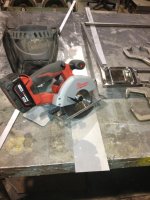
If you ever have a chance to try a Milwaukee M18 - do so. This one is from the weld shop at work and came in really handy when I built the cab:

23 small.jpg
 
   / How do you cut metal for finished projects?
  • Thread Starter
#10  
My struggle is that I see the fabrication that some of you guys do and I can't seem to get parts cut consistently. For just cutoff of tubing, pipe, bar stock and angle I get consistent parts but things like gussets and flat parts it is a real bear. My parts seem to require endless grinding to get two parts to match dont mention the time involved in getting a third part to match.

It is sounding like the bandsaw maybe the better choice but I am open. My daughter, the artist, wants the plasma cutter.

Cutting sheet metal I am okay with and do okay with sheet metal fabrication. It is the heavier gauge and plate that is my greatest challenge. I don't plan on fabricating more than typical farm implements. I'm thinking about a grapple.

I appreciate your responses.
 
   / How do you cut metal for finished projects? #11  
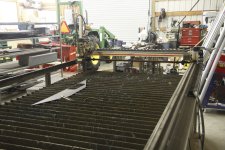
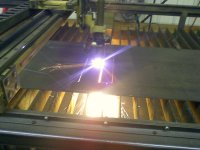
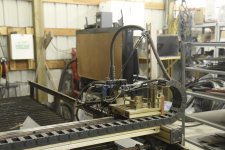
i cheat......this is the plasma unit i use. Its set up in my shop, and cant live without it_MG_4810.jpgplate 2.jpgshop 3.jpg
 
   / How do you cut metal for finished projects? #12  
I think since you have a chop saw get a plasma.

I primarily use a band saw, chop saw or torch. It depends on the job. I am hoping to get a plasma in the next few months. I am looking at a Thermal dynamics Cutmaster 42.

I think a plasma would be nice for cutting out gussets like you mentioned.
 
   / How do you cut metal for finished projects? #13  
I have been using most everything that has been mentioned so far and they all work very well but they all have there limitations.
I would recommend that you start with a port-a-band, it can be portable or I built a base for mine and it works great as a stationary saw.
I would also recommend a carbide tipped saw blade that fits into a Skilsaw, it is like the blades that are used in the slow speed cutoff saw but has a higher RPM rating for use in a Skilsaw. These blades work well up about 1/2" thick steel. They can also be used on tube, angle or channel. This would be for straight cuts only.
At some point you can add the Plasma cutter and maybe a stationary band saw as well.
 
   / How do you cut metal for finished projects? #14  
My struggle is that I see the fabrication that some of you guys do and I can't seem to get parts cut consistently. For just cutoff of tubing, pipe, bar stock and angle I get consistent parts but things like gussets and flat parts it is a real bear. My parts seem to require endless grinding to get two parts to match dont mention the time involved in getting a third part to match.

It is sounding like the bandsaw maybe the better choice but I am open. My daughter, the artist, wants the plasma cutter.

Cutting sheet metal I am okay with and do okay with sheet metal fabrication. It is the heavier gauge and plate that is my greatest challenge. I don't plan on fabricating more than typical farm implements. I'm thinking about a grapple.

I appreciate your responses.

You should be able to do what you are wanting to do with your O/A torch. Maybe you have too big a tip on your torch or it is dirty. Most people tend to use too big a tip size. I use a Victor size 000 for 1/8 inch thick, then size 00 for up to 1/4 inch, then size 0 for up to 1/2 inch, then size 1 for 3/4 inch, then size 2 for 1 to 1 1/2 inch thick.

If your main additional need is cutting plate then the plasma is the right tool if you can justify the extra expense of the cutter and air supply which again, MUST be dry air. The main place a handheld plasma cutter will hold an advantage is cutting thin (under 1/8 inch) and non ferrous material. Otherwise the properly set up O/A torch should do what you need
 
Last edited:
   / How do you cut metal for finished projects? #15  
I started out with just a cutting torch and a grinder. In time I bought a smaller grinder and a HF style band saw. (30 yrs ago and before HF) When I bought my 14" bench style chop saw I thought I was in heaven. Fast accurate cuts that didn't need grinding. Later I bought a brick masons saw and use it with the half worn out chop saw blades that are too worn to make cuts in 2"-3" pipe or tubing. With a bushing to get it down to the 3/4" arbor, my blades are basically free. It does great on small pipe, bar or angle. Later I got a gas operated chop saw, (chainsaw with a 14" chop blade) and used it to build my shop using metal galvanized decking material. I use it a lot cutting bigger pipe, angle, tubing. I hate dragging in a 20' stick to cut on the inside saw so I make a rough cut out on the rack and then a finish cut inside. That gas chop saw is a scrappers dream too. And the blades wear down pretty close to nothing before I need to change it. Cutting decking the other day I was using old take off blades from the 14" inside saw. I had new ones but saving $$ by using old ones.

I use and like the thin slicing blades on a small side grinder but they get expensive, doesn't last very long and they eat up pretty fast.

I also have a port-a-band hand held band saw but it doesn't get much use. If I can get it inside and in a mounted saw, I do it that way. For portable cutting that or my 14" gas chop saw usually get things done.

For thin sheet metal I have a shear that came out of a welding shop (table or flat trailer mounted), a big scissors shear that is basically a 4' long pair of scissors (work great for expanded metal or thin sheet) and also have a 4' break-sheer-roller from harbor freight but it basically is only good for ductwork thickness or thinner.

Some of you guys talk about not having a steady hand with a torch. I learned to clamp a heavy piece of tubing or channel to my plate to use as a guide to let my torch rest against when cutting 1/8" or thicker. I still have to grind it but it comes out straight and not as much grinding.

I also had a buddy teach me how to cut circles out with a torch that look like they were cut with plasma, yes, I have to grind them but the finish product looks professionally cut and precise. YES, with a hand torch.

I dream of the day I have a big enough shop and funds to buy a large commercial sheer and press break but I don't see it anywhere near in the future. i guess we'll have to get it done the old slow way.
 
   / How do you cut metal for finished projects? #16  
I also had a buddy teach me how to cut circles out with a torch that look like they were cut with plasma, yes, I have to grind them but the finish product looks professionally cut and precise. YES, with a hand torch.

Well, don't leave us in suspense!
 
   / How do you cut metal for finished projects? #17  
If you are making very exact parts and especially multiples of anything from flat metal, the NC plasma is ideal. If you can afford it, it opens a whole new world for your capabilities. Caution: right after getting an NC plasma, you will need a press brake.
 
   / How do you cut metal for finished projects? #18  
Like has already been pointed out, a plasma can be a major investment. In addition to the plasma cutter, you will need a good compressor and drying system. I have a 60 gallon 220 compressor with multiple drying filters. Even with my 60 gallon compressor using the plasma can create quite a demand.

What about some of the plasma cutters that have built in air compressors?

For example:
Hobart Airforce 500534 250ci Light Weight Plasma Cutter with Air Compressor - Amazon.com
Hobart AirForce 500i Plasma Cutter 500548
Hobart AirForce 700i Plasma Cutter 500546

Just the portability might be nice.

Do these dry the air?
 
   / How do you cut metal for finished projects? #19  
Unless I'm wrong, of the three you listed, only the 250ci has a built in compressor. I'm not familiar with units with built in compressors but I'd have to assume they have some sort of moisture separator built in also.

However, for the type of things you are talking about wanting to do I don't think you would be happy with the 250ci. While they say it is rated for 1/4 inch, they mean severing. In other words, the useful smooth cut capability of the unit is probably more like 1/8 inch. I'd also be worried about the durability of the compressor and how hard it will be to rebuild (or how costly to replace?)

If I were looking at the other 2 I'd probably go for the 700i for it's extra duty cycle and cut capacity. Once again however, you will need a clean and dry air supply. I really don't see the advantage of the dual voltage capability on the 500i since you have to have an air source anyway.
 
   / How do you cut metal for finished projects? #20  
When I built my electric tractor I did it from scratch using metal found in a scrap metal yard.
All the metal was cut using one good quality 'Eclipse' hacksaw blade in a cheap hacksaw frame.

I have a 4 1/2" and a 9" disc cutter but after the initial 'keeping the noise down in the evenings due to the neighbours' I was determined to hand cut everything and then to try and make the blade last to the end of the project. So I did, and had the tractor on the road and running before I changed the blade in the saw.
 

Tractor & Equipment Auctions

2008 GMC Savana 2500 Cargo Van (A59230)
2008 GMC Savana...
2005 Honda Accord LX Sedan (A59231)
2005 Honda Accord...
Case-IH 370 Steiger (A57148)
Case-IH 370...
John Deere 6110M (A53317)
John Deere 6110M...
2413 (A60432)
2413 (A60432)
2006 CATERPILLAR D604S GENERATOR (A58214)
2006 CATERPILLAR...
 
Top