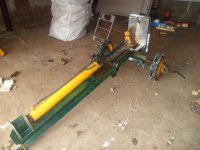
UK hydraulic log splitter build

   / UK hydraulic log splitter build #1  

mickeyw

Bronze Member
Joined
Dec 10, 2012
Messages
64
Location
Surrey, UK
Tractor
1987 Renault 68-12, 1981 JD1640, 1973 Ford 3000
Having recently installed a log fire in my living room my attention turned to means of log processing. This fire won't be my main means of heating, just something to enjoy on a miserable, wet and cold English winter Sunday afternoon spent at home with my young family. As such I won't be needing huge quantities of wood.

I have a chainsaw, and a source of good timber, and I am not averse to using a splitting maul, in fact my brother-in-law is an enthusiastic bush crafter and likes doing everything by hand, but I like machinery, and the desire to build my own hydraulic splitter appealed to my engineering side.

Initially I am going to build the bare minimum to check my choice of materials won't self destruct when put under pressure. Once that is proven I will either add some 3-point brackets, or build it onto some wheels for ease of moving around when not in use. To begin with I shall use our JD1640 to provide the hydraulic power. It's a ready-and-waiting source of hyd power.

A future project will include installing a hydraulic PTO to my V8 powered Landrover D90, my other major interest. Typically the PTO setup is not new, but well (ab)used and needs a rebuild :) . This certainly won't be the cheapest way to run a splitter, or maybe not even the most efficient, but the 'let's see if I can make it work' rule definitely applies.

Materials:
Well having read so many splitter build threads on here I am highly envious of the apparent availability of second hand and surplus supply hydraulic components in the USA. The UK does not seem to like this way of recycling, a great shame really.

My search for hydraulic components started on the UK version of that well known auction site. Good used items don't seem to turn up that often, but I found a number of guys selling new log splitter kits of cylinder, spool, hoses and QD connectors. I am not the world's most patient guy, and having sown the seed of the idea I couldn't wait to get on with the build, so I settled for these parts new.

I now have an 80mm bore cylinder with 40mm rod and 500mm stroke. It was sold as being a 10 tonne kit, hopefully this will be adequate for my needs. The wood types I expect to find might include English oak, Pine, possibly Ash and who know what else.

As for the steel, I already have some 100x50mm (4"x2") C-section steel channel that has been in the hedgerow for a number of years. I know an H or I section beam would be best, but I reckon 2 lengths of C section welded back to back will stand a good chance. It is to all intents free, as it's been there so long. I have modelled this beam in 3D CAD using Solidworks, and run some stress analysis tests on it based on a 10 tonne force, and deflection looks minimal.

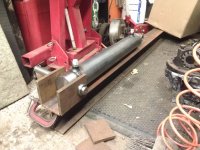
Here is an initial mock up of what I am planning.
Splitter-post1-img1.jpg

I also have some 100x12mm (4"x1/2") mild steel plate knocking about, so that will be used for various brackets once I figure out what they will be.
 
   / UK hydraulic log splitter build
  • Thread Starter
#2  
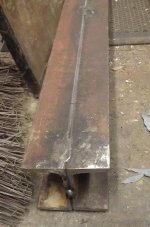
I've now welded the two C channel sections together, initially just some short stitches to hold everything in place. I shall weld up right along the join once I am happy the plan isn't going to change here.

BeamTacked2.jpg

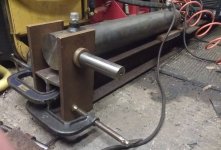
The cylinder has an eye at each end, so I made brackets for the fixed end. The eye is 30mm (1 3/16") diameter, the brackets are 12x100mm plate (1/2"x4") and will be welded either side of the beam, providing greater stiffness at the beam end than the shorter plates shown in the previous picture.

NewPlates2.jpg

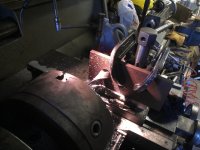
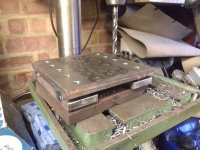
The plates are 9" long, so cutting the hole for the pin was going to be awkward. My pillar drill is only 2MT and the drill bit I have is 3MT. This pushed me towards doing the job on my lathe (Colchester Student 1800 short bed), as the tail stock is a 3MT. Alas this piece wasn't going to clear the bed or fit in my 4-jaw chuck. After a little head scratching I decided to clamp the plate against the tool post and mount the drill in the 3-jaw chuck. Some careful positioning enabled the hole to be cut in 3 goes, starting with a 12mm drill, then 25mm and finishing with the 30mm. Job done and now feeling rather pleased with how it went.
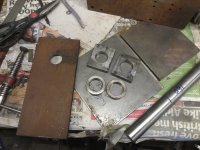
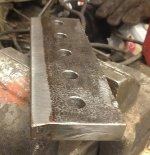
I also made some smaller brackets for the rod end mount to the wedge, and at 50x60x12 these went in the 4-jaw comfortably.

Splitter-post2-1.jpg Splitter-post2-2.jpg

You can also see the pin I turned down. Needs cutting in two yet.
 
   / UK hydraulic log splitter build #3  
mickeyw, It's good the hear from the other side of the pond! Welcome the this great site.
I can't understand why you can't find used parts, what do they do with them? It's a shame if they just throw them away.
On your beam build, as long as you know the limitations of it you will be fine, you could always maybe add a piece of thicker flat stock to the top.
Are you going to have just a knife wedge on the beam like I see most UK splitters seem to have?
Good luck with the build and keep us posted, we like pictures!
 
   / UK hydraulic log splitter build
  • Thread Starter
#4  
Davedj1, one thing we struggling with in the UK is environmental legislation. This makes it very difficult to have heaps of what you or I may consider as useful old equipment just sitting around waiting for someone to want them.
All old commercial or industrial equipment now has to be recycled by approved and documented methods, which means that scrap metal is dismantled, sorted and broken down in a huge chipping machine, which is then sold on to become a bean can or maybe part of a new car. All oils and fluids etc have to be carefully recycled too. Obviously this doesn't stop farmers having things tucked away in the corner of a field, but the style junk yards that we love are a thing of the past over here :(

Next installment of the log splitter build later today :)
 
   / UK hydraulic log splitter build #5  
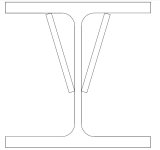
You might want to add some bracings to the edges of those C channels. My brother rented out his log splitter made from an old 100mm silage block cutter cylinder and a HE140A beam. Got it back with the H beam all twisted, because they kept on pushing when the log deflected, pushing the blade aside. We cut the twisted beam out, welded a new piece in, and added 60x6mm flatbar to create triangles, there is 3.5cm of sliding surface on each inside of the beam, and at cm from the outside, we welded the flatbar from the horizontal flange to the vertical flange. It greatly improves the torsion stiffness of the part of the beam where the guide slides on. The other option was to weld 20mm bar over the entire flange, but this was the cheapest option of getting more torsion stiffness. :)


550157_450844851637117_1295412067_n.jpg

601061_450844934970442_892283350_n.jpg

14752_450846121636990_1953861493_n.jpg

428057_450845428303726_922963333_n.jpg
 
   / UK hydraulic log splitter build
  • Thread Starter
#6  
Now for the foot of the splitter.

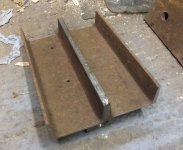
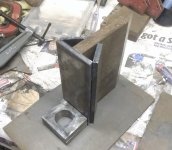
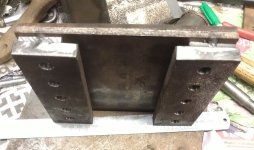
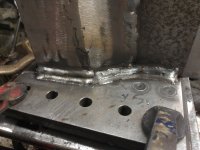
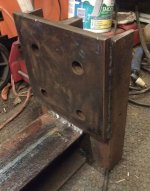
Again I made this from the 100x50mm C section, but this time 2 pieces welded side by side. I figure this should give me sufficient to push against. The weld is continuous around the join. It looked good in the stress analysis results.
I shall weld this to the end of the main beam, adding some gussets to help prevent any twist.
I also have a piece of 5/8" thick plate that will end up welded to the foot for a bit of extra support.

FootWelded.jpg
 
   / UK hydraulic log splitter build
  • Thread Starter
#7  
Hi Renze,

Many thanks for those pictures, that is a pretty significant bend. It's a shame the guy using the splitter didn't have thesense to stop before he did so much damage!
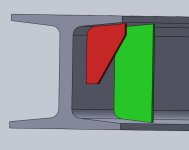
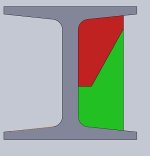
I am not quite sure if I quite understand where you have added the triangular parts you refer to.
Do you mean like the red highlighted part in this image? I was wondering about adding a number of pieces like the green highlighted part.

BeamWebs.JPG BeamWebs2.JPG
 
   / UK hydraulic log splitter build
  • Thread Starter
#8  
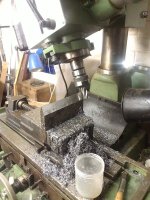
I got some work done to the wedge yesterday. I machined the cutting angle using my father's bench top milling machine. It took quite a while :)
Material choice was again down to what I already had. This time some 5/8" thick plate, I am not quite sure of the grade of steel, but I'll have to see how this performs. The included angle is 45 degrees.

WedgeMachining2.jpg

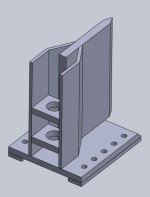
And here is how my current plan for the wedge looks.

WedgePlan1.JPG

The holes are for 10mm bolts.
 
   / UK hydraulic log splitter build #9  
Hi Renze,

Many thanks for those pictures, that is a pretty significant bend. It's a shame the guy using the splitter didn't have thesense to stop before he did so much damage!
I am not quite sure if I quite understand where you have added the triangular parts you refer to.
Do you mean like the red highlighted part in this image? I was wondering about adding a number of pieces like the green highlighted part.

No, we supported it over the full length: The bend in the splitter is in the vertical flange, the flange on which the blade slides is still straight crosswise, just twisted over its axis.
I welded 60x6mm over the full length of the beam like this:
log splitter.jpg
in one photo you can see the gray steel welded into the green painted beam. We left just enough so the blade slideplate has about 3cm to hold onto on the backside of the horizontal flange.

We figured a gusset plate like the green one in your photo, wouldnt do much if it could only be 3 to 4cm high to keep a place for the blade guide to slide.

p.s. i envy your milling machine ;)
 
   / UK hydraulic log splitter build
  • Thread Starter
#10  
I managed a little time with the plasma cutter the other night and produced some suitable sized pieces for the secondary wedge. Progress is slow with not much time between work and family, but I always feel better for getting something done, however small.

wedge parts.jpg

In case you are wondering how I have cut the thicker materials and beams, I thankfully have access to an elderly power hacksaw. It's a slow machine, but I can leave it to get on with cutting while I do something else.
 
   / UK hydraulic log splitter build
  • Thread Starter
#11  
Hi, it's been a while since my last update, but I've had a few productive evenings this week.

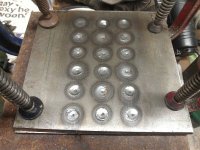
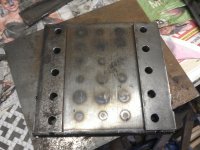
I've made progress on the sliding wedge. I didn't have a nice thick piece of plate for the base of the slider, so I decided to double up with some 1/4" plate. To make this more like a single piece of steel I drilled 3/8" holes through the top plate, and plug welded through to the lower plate, like this:

WeldedBase.jpg

I'll also weld around the edges later on.

Next for some lateral guides to keep it on the beam. I'm not sure quite how much clearance to leave, so I sat the slider on the beam and clamped more plates to the underside of the slide plate, adjusting their position until the whole thing ran up and down the beam smoothly. I then tack welded them in place and drilled the clamp bolt holes through.

slider guides.jpg

Then for the keeper plates, not sure if that is the correct term but it'll do for now, that stop the wedge assembly jumping off the beam. I had some 2x1/2" bar, so a couple of lengths of that were cut. I tacked them in place to hold everything in place while I spotted the bolt holes through.

drilling slider.jpg

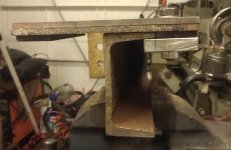
So looking on the end I now have this construction.

slider end view.jpg

The keepers will need an angle machined on the inner top corners to provide the correct clearance against the underside of the beam.

end view on beam.jpg
 
Last edited:
   / UK hydraulic log splitter build #12  
Looks good Mick. I wouldn't worry about machining the top edges, they will self clearance!
 
   / UK hydraulic log splitter build #13  
Looks good Mick. I wouldn't worry about machining the top edges, they will self clearance!
I agree, if you dont have enough clearance, dirt will be rubbed in the slide surfaces. We have no clearance right now, but it will be about a millimeter when the rust and thick old paint has rubbed off :)
 
   / UK hydraulic log splitter build #14  
A couple of suggestions for you to consider from my years of heating with wood self put up. On your foot weld on some spurs, sharp points that push into the wood 10 to 20 mm to keep blocks that are cut on an angle from popping off under pressure and wacking you in the knee. On your wedge I would drill a small hole through the sliding plate and leave another 20mm hole in the top plate covering the wings. Then you can pour in some used crankcase oil into the wedge at the start of the day and it will run out through the small hole lubing the beam with each stroke. Your wedge is a good design, if anything I would have made the back even wider to get the wood to give up before the piston tops out. Once the 5/8 plate has made it in an inch most wood blocks will be done but the tough ones will cling together until the haves are spread out to forty-five degrees or so. My commercially made splitter has an attachment around the case of the piston that strips wood off the wedge if it is still there on the return stroke. It is better then twisting them off by hand but a wider and taller wedge would have accomplished more.
Nice project by the way, looking forward to seeing the finished product.
 
   / UK hydraulic log splitter build
  • Thread Starter
#15  
Renze, thanks for that. It'll sure save me some work.

Vtsnowedin - good idea re the lubrication holes. I had thought of just greasing the beam, don't know how well it will stay there though. Maybe sticky saw chain oil would be better, but a lube hole will help get the oil under the slider.

As for the spurs idea, I've seen others have run beads or even circles of weld on the foot to prevent the log slipping. It certainly needs something.

As for the wedge, nothing is welded together yet, so still easy to change plans. The widest part is currently 72mm wide, I might try it like this and see how it fares. It'll be pretty easy to add width later on. Nothing will be painted before it's been proven :)
 
   / UK hydraulic log splitter build #16  
Renze, thanks for that. It'll sure save me some work.

Vtsnowedin - good idea re the lubrication holes. I had thought of just greasing the beam, don't know how well it will stay there though. Maybe sticky saw chain oil would be better, but a lube hole will help get the oil under the slider.

As for the spurs idea, I've seen others have run beads or even circles of weld on the foot to prevent the log slipping. It certainly needs something.

As for the wedge, nothing is welded together yet, so still easy to change plans. The widest part is currently 72mm wide, I might try it like this and see how it fares. It'll be pretty easy to add width later on. Nothing will be painted before it's been proven :)
The one I have now is a casting and has a hole in the bottom which is much too big so I stuf the hollow in the wedge with sawdust to ****** the flow. I add about a cup of waste oil at each gas fill up. If you started with a 2mm bottom hole it might work out right. The pattern of the spurs is not critical, I've seen several variations, circles squares star patterns, old bolts welded on and cut of on an angle etc. Just don't have them interfere with the point of the wedge at full extension.
 
   / UK hydraulic log splitter build
  • Thread Starter
#17  
Right! Progress is still annoyingly slow, but last weekend I got busy with the angle grinder for an hour or so, tidying up welds and ragged plasma cut edges. Most of the time I get during the week is late in the evening and I don't wish to wake up the neighbours, or my own daughter for that matter, by running the grinder. So the grinding jobs get saved up for noisy hour :)

I managed to finish welding the wedge components together. Annoyingly I got so carried away when welds started to run neatly that I welded where I shouldn't have. This prevented the rod end fitting as planned. Some chamfers ground on the rod end soon remedied this. Typically these lovely weld are somewhere they won't be seen, lol. They do exist I promise, I might take some more photos for proof.
Other welds were ground back to smooth the wedge, some areas need a few more dollops added to fill in the low spots. I also ground a big chamfer on the leading edge of the slider. I may enlarge this yet.

My mind returned to what Vtsnowedin mentioned about lubrication, I thought I would see how I could incorporate a grease nipple to get lubrication right under the sliding wedge base.

First off I worked out where I could drill a lube hole through the base, and tapped it for the greaser. Next I added some grease grooves to the underside.
Having been 'machined' with a grinding disc these are not particularly tidy, but ought to help keep some of the lubricant in place. I'll have to see how well this works out.

GreaseGrooves.jpg

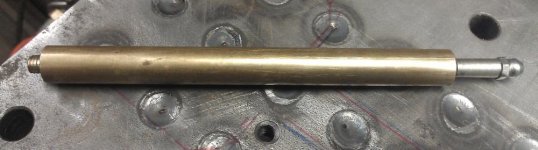
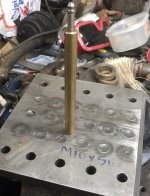
My original plan was to screw the greaser directly into the slider plate, and hope my grease gun would reach through the space created by the secondary wedge plates. I decided that this would likely be difficult by the time a load of saw dust and muck had blocked up the hole, so I turned up an extension tube from a length of 1/2" dia brass rod. The length of the tube was limited by the length of drill bits I have :rolleyes:

GreaserExtn.jpg

GreaserExtnFitted.jpg

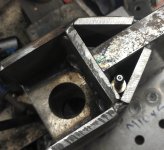
With the items assembled it looks like I will at least be able to get access with the grease gun.
Next step is to weld the wedge and base together. No (easy) going back once I've done that ;)

GreaserInSitu.jpg


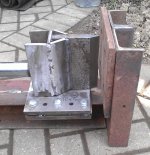
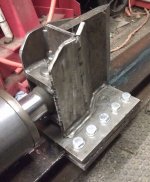
Here's a shot of the wedge and slider in place next to the foot. This was taken before the slider plate was chamfered.

Wedge&Foot.jpg

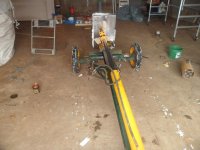
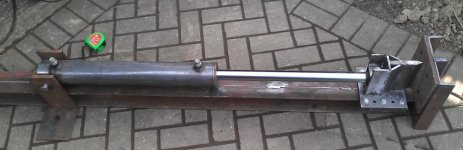
and one showing the general layout so far.

Assembly6-3-13.jpg
 
   / UK hydraulic log splitter build #19  
Looks great Mick! Keep up the good work.
I had to wait until my kids grew up and moved out before I could build mine..LOL
 
   / UK hydraulic log splitter build
  • Thread Starter
#20  
I've managed to get quite a bit done lately, just not had a chance to update this thread.

The wedge is now fully welded together and to the slider. The beams are now welded along their entire length too.

WedgeWeld.jpg CompletedWedge.jpg

I made some precision chamfers on the slider clamps using the angle grinder :) The angle is a pretty good match to the inside of the beam.

clamp.jpg

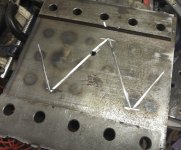
The foot now has a nice thick lump of plate welded on to reinforce it. I still need to add some pointy bits to stop the log sliding off the foot.

EndPlate.jpg

The best news of all is that I have had the wedge running back and forth under air pressure. I shall put a short video on YouTube soon.
At 90 PSI I even managed to split some pine pallet slats. The movement is very jerky under air pressure, but no load cylinder extension takes about 2 seconds. If it's that quick under hydraulic power I'll be impressed, but I'm not holding out too much hope yet.
 

Tractor & Equipment Auctions

2001 FORD F-750 SUPER DUTY (INOPERABLE) (A58214)
2001 FORD F-750...
2016 CATERPILLAR 330FL EXCAVATOR (A60429)
2016 CATERPILLAR...
Commercial Lawn Mower 652R (A56859)
Commercial Lawn...
Caterpillar D6K LGP (A53317)
Caterpillar D6K...
2019 CATERPILLAR 326FL EXCAVATOR (A60429)
2019 CATERPILLAR...
2019 Ford F-150 4x4 Crew Cab Pickup Truck (A60460)
2019 Ford F-150...
 
Top