
mangus580
Gold Member
So reading my manual - it states that just the filters get changed at the 50 hour service, not the actual oils.... I thought the oil got changed too?

So reading my manual - it states that just the filters get changed at the 50 hour service, not the actual oils.... I thought the oil got changed too?

I try to stick as close to the manual as possible that way I don't have to remember when the last time I changed something> I do write the dates on the filters also when I change them. I don't believe in wasting our hydrocarbon resources and figure that if the manufacturers think it will go to 300, it likely will go to 600 without a problem so they already have a built in safety factor to protect their warranty money so why do I need to spend the extra /extra money.You are correct, according the the manual, you change just the filters at fifty. I changed my oil as well as the filters @ fifty, and will likely change it, as well as the hydro fluid @ around 150 (manual says 300).


So reading my manual - it states that just the filters get changed at the 50 hour service, not the actual oils.... I thought the oil got changed too?
I can kinda see changing oil and even oil filters due to poor machining and bearing wear in, but FUEL FILTERS. Come on that is ridiculous. That little tractor couldn't possibly burn more than 2 gallons per hour so 100 gallon for fuel. I wouldn't change them till they showed some sign of contamination / fuel problems or at least 200 hours of service. I filter all my fuel with5 micron filters from my storage tank and so far I haven't had to change any fuel filters on any of my vehicles. Kubota RTV over 2 years and over 200 hours and filter is still clear(well red) with no water or other contamination evident in the clear plastic housing.I've noticed different models have drastically different instructions. I got the service manual for my S3010 and it had me change all fluids (except coolant) and filters at 50 hrs -- even the front axle gear lube and fuel filters.
I can kinda see changing oil and even oil filters due to poor machining and bearing wear in, but FUEL FILTERS. Come on that is ridiculous. That little tractor couldn't possibly burn more than 2 gallons per hour so 100 gallon for fuel. I wouldn't change them till they showed some sign of contamination / fuel problems or at least 200 hours of service. I filter all my fuel with5 micron filters from my storage tank and so far I haven't had to change any fuel filters on any of my vehicles. Kubota RTV over 2 years and over 200 hours and filter is still clear(well red) with no water or other contamination evident in the clear plastic housing.
As I remember there was a little bit of trash in the bottom of the bowl, but nothing I could see on the fuel filter itself. I'm pretty frugal so it was hard for me to do change it out like that. Did it anyway just to be following the maintenance schedule for warranty purposes. Had the same problem with the hydraulic oil -- that stuff was SO clean it seemed like such a waste.
Heat and pressure over time broke the chains until only the longest were left. The key is to change oil before it stops lubricating.
That is good info for motor oil, but hydraulic oil is really not a lubricating oil even though it does lubricate the pump I suppose. It is just a non compressible fluid that moves cylinders. The only lubrication it does is with the slow sliding of the hydraulic ram and just about any slick'em will work for that. It isn't like motor oil that circulates around a hot piston and bearings. I have seen old farm tractors from the 60's and 70's that didn't even have a filter (not HST because they hadn't been invented yet) and went a life time without changing oil and never had a pump problem. Seen them so milky with water that they looked like creamed coffee and still worked well and the oils of those days weren't as good as they are today either, no synthetic just good ole mineral oil.I once lived across the street from a chemist who was something of a curious gearhead with his cars. When the full synthetic motor oils came out he did his own testing and chemical analysis. What he found was that the oil after 3k miles was virtually the same as when it was new. By 6k miles, the oil had started to lose the shorter carbon chains, but looked clean. By 8k miles the oil looked dirty and had only long carbon chains left. For those that dont know, its the short and medium carbon chains that give oil its lubricating properties.. Tbe shorter the chain, the better it lubricates. Heat and pressure over time broke the chains until only the longest were left. The key is to change oil before it stops lubricating.
That is good info for motor oil, but hydraulic oil is really not a lubricating oil even though it does lubricate the pump I suppose. It is just a non compressible fluid that moves cylinders. The only lubrication it does is with the slow sliding of the hydraulic ram and just about any slick'em will work for that. It isn't like motor oil that circulates around a hot piston and bearings. I have seen old farm tractors from the 60's and 70's that didn't even have a filter (not HST because they hadn't been invented yet) and went a life time without changing oil and never had a pump problem. Seen them so milky with water that they looked like creamed coffee and still worked well and the oils of those days weren't as good as they are today either, no synthetic just good ole mineral oil.
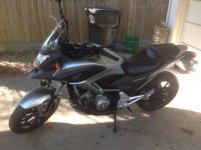
My hydro oil only had 50 hrs on it, but it nearly 2 years old. Not a lot of heat and pressure to break it down, but quite a bit of time for it to gather moisture from our humid Southeast Texas climate. (You guys with tractors at home are lucky -- some of us have tractors at remote locations.) Only have about 80 hrs on it and now I have a competing distraction:
View attachment 300785
Poor little blue S3010, but football is almost over and soon the two shall meet....
Looks like you got the name right, although I wouldn't have thought a tractor guy would be on a crotch rocket. They tend to be more GoldWing guys or those with John Deere's probably ride Harley's to keep with their status symbol position of paying more for less.
How much of the $3400(if I added in my head right) in accessories did you get. I would want a tall windshield, saddle bags and some sort of back rest , maybe some highway front pegs. I didn't see any of the accessories pictured on the website you linked but it seems a cool bike. I hope those $200 each tires last more than 6K miles. The best mileage I got was with the Goldwing I had but they only got about 10K. My Yamaha Virago only got about 5K on the rear. Tires are the most expensive things about a motorcycle as long as it is running then repair cost are outrageous.Nah, it only LOOKS like a crotch rocket. It's actually a "value" (read cheap) high-mileage commuter bike. They call it an adventure/touring bike:
Honda NC700X Road Test Review- Specifications- Photos
It's just like a tractor in that as soon as you get it you want to start adding stuff to it.
How much of the $3400(if I added in my head right) in accessories did you get. I would want a tall windshield, saddle bags and some sort of back rest , maybe some highway front pegs. I didn't see any of the accessories pictured on the website you linked but it seems a cool bike. I hope those $200 each tires last more than 6K miles. The best mileage I got was with the Goldwing I had but they only got about 10K. My Yamaha Virago only got about 5K on the rear. Tires are the most expensive things about a motorcycle as long as it is running then repair cost are outrageous.


