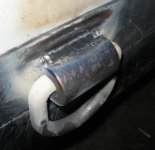
Adding tiedown hooks to my trailer

/ Adding tiedown hooks to my trailer #1  

MikeA57

Silver Member
Joined
Jun 22, 2010
Messages
238
Location
N. Mississippi
Tractor
Ford 1510
I've got a 16' flatbed trailer that I just got back on the road after reflooring and rewiring it. I'd like to add some tiedown hooks to it and am wondering whether I should go with "through the floor" or have some welded on the frames?

I will be carrying ATVs and my Ford 1510 with a bush hog or finish mower so I'm thinking that the welded ones would be best. I was thinking of 3 on each side. Is there a mfr/vendor that is favored over others? I saw some at Home Depot but don't know about strength values.
 
/ Adding tiedown hooks to my trailer #3  
If you do "through the floor" you may want to put metal backing plates under them to distribute the force. Definitely would have been easier before putting the new floor on!
 
/ Adding tiedown hooks to my trailer #4  
For hauling larger items such as a tractor I'd install the weld on type. Don't know about HD brand but they should have a rating. I bought mine from local tractor supply store. AW direct is another good source.
Through the floor type would be OK for the ATV or riding mower etc.
My welded on D-rings are the 5/8" models rated for 15,000 lb. I have 2 on each side, 2 on back and 2 on front.
 
/ Adding tiedown hooks to my trailer #5  
I too suggest weld on. I think they're easier to hook to, and they seem stronger than floor anchors. I'm assuming you have a wood deck.
 
/ Adding tiedown hooks to my trailer #6  
I was doing the same thing a while back, was thinking of going with the weld on D-Rings, actually the ring itself is not welded on, a short pc of angle iron that culp over the straight part of the ring that gets welded on, leaving the Ring able to move to position of the tie-down,

a while back when I inquired, there was mention of using a large shackle hook,
( No welding necessary )
only to drill a hole to put the pin or bolt through, ..... I chose this method:thumbsup:
although I must note: that a standard type chain hook will not hook to them,:cool: I wound up hooking another hook onto the shackle that I could use a standard chain link hook onto, But either way even using the D-hook a chain Link type hook doesn't fit, You would have to run the entire chain through and then come back making a loop to catch a link,

 
Last edited:
/ Adding tiedown hooks to my trailer #7  
another thing I seen on a trailer, that might be a less expensive method compared to the cost of the D-rings.... But I would get another opinion as to its strength, I seen look like 1/inch rebar bent into the shape of a D-ring and I assume was welded together under the angle iron that held it in place,
 
/ Adding tiedown hooks to my trailer #8  
I vote for the weld on D-rings. I think I spent between $40 and $50 on ebay for 8 of them (I forget if they are 1/2 or 5/8), and I can't imagine anything working better for less money. As shown in the pictures, on each side I put two on the frame rail in front of the axles and one behind. The fourth was put on the top rail above the wheels (hidden in these pictures by the spilled mulch). The working load of these weld on's is 5K to 6K for each ring, which would take more than just a through bolt to get with deck mounted rings.

mulch.jpg

dring.jpg
 
/ Adding tiedown hooks to my trailer #9  
Everyone is saying weld on D-rings, but those are only as good as the welder installing them. If OP doesn't weld, it could get a little costly bringing it to a shop to get done.

How about a bolt on D-ring with a 12,000 lb capacity, anyone can drill a hole and tighten a nut and bolt.

D Ring Hardware - D Rings Tie Downs - Trailer D Ring - D Ring Mount

Other ideas shown here.

D-Rings & D Ring Tie Downs: Trailer Tie Down Anchors & Weld On D Rings

I have stake pockets, so I just use those.

Good luck,

JB
 

Attachments

  • DSCN3438.jpg
    DSCN3438.jpg
    420.7 KB · Views: 5,846
/ Adding tiedown hooks to my trailer #10  
I would not use rebar. It is not designed for these type loads and not all rebar can be welded without reducing its strength in the heat affected zone (area near the weld subject to high temp).

Buy quality D-rings that are made to be welded on, and size them for the heaviest load you can but on the trailer, not the load you plan to carry today. Why limit your capacity in the future by saving a couple dollars now.

At a place I worked a while back we had some concrete barriers that had been poured with pieces of bent rebar protruding from the top so they could be lifted with a crane. During one rigging operation one of the loops broke. It snapped of like a twig. It had been loaded at an angle using a pair of slings instead of using a spreader and slings dropping straight down. That angular load was enough on the #6 bar (3/4" dia) to break it.

If you used rebar to make rigging attachment points on your trailer it would amount to the same setup...an angular load that could result in a break during transit, especially if the rigging was shock loaded as when making a quick stop or hitting a good size bump or pothole in the road.

....anyone can drill a hole and tighten a nut and bolt.

But will they torque those bolts to the recommended value or will they over-tighten them..or just as bad... not tight enough. Will they use hardened washers or none at all. And where or what will they attach them to, that 3/16" thick web of the 4" channel or some flimsy angle iron that the bolts (w/o washers) could rip right through?

I agree that you need a decent welder (person) to install the rings. A trip to a weld shop might be cheap insurance.
 
/ Adding tiedown hooks to my trailer #11  
I would not use rebar. It is not designed for these type loads and not all rebar can be welded without reducing its strength in the heat affected zone (area near the weld subject to high temp).

Buy quality D-rings that are made to be welded on, and size them for the heaviest load you can but on the trailer, not the load you plan to carry today. Why limit your capacity in the future by saving a couple dollars now.

At a place I worked a while back we had some concrete barriers that had been poured with pieces of bent rebar protruding from the top so they could be lifted with a crane. During one rigging operation one of the loops broke. It snapped of like a twig. It had been loaded at an angle using a pair of slings instead of using a spreader and slings dropping straight down. That angular load was enough on the #6 bar (3/4" dia) to break it.

If you used rebar to make rigging attachment points on your trailer it would amount to the same setup...an angular load that could result in a break during transit, especially if the rigging was shock loaded as when making a quick stop or hitting a good size bump or pothole in the road.


But will they torque those bolts to the recommended value or will they over-tighten them..or just as bad... not tight enough. Will they use hardened washers or none at all. And where or what will they attach them to, that 3/16" thick web of the 4" channel or some flimsy angle iron that the bolts (w/o washers) could rip right through?

I agree that you need a decent welder (person) to install the rings. A trip to a weld shop might be cheap insurance.

Well scrub the rebar idea:cool: see I knew someone would Know the do'es & don'ts;) perhaps the company who manufactured the concrete barriers should have used D-rings:D
 
/ Adding tiedown hooks to my trailer #12  
On one of my trailers I welded D rings in the area where the fenders are, then welded stake pockets and flatbar from the front of the fenders to front of trailer, same from rear of fenders to back of trailer...basically a tie down rail like you see on G/N and big truck flatbeds. if you go that route be sure to use 3/8"x3" flatbar, will not flex easy when using 2" ratchet straps and tightening down hard.
On my other trailer I came with the system I really like, I use 1/2" wire rope approx 22' long for my 20' trailer. I pressed a button every 12" on the cable, then I started at the front of the trailer on inside of frame, welded button.Then I used a piece of pipe laid under the cable and welded second button..giving enough slack in the cable to hook my tie down strap or chain to. I have a tie-down point every foot, the tie down point is flexible/durable enough to set a load ion if you have too, but rarely does that happen as the cable sticks out only a few inches from each side. For vehicle or heavy equipment I use the stake pockets I welded to the outside of the frame, but for ATV's and small stuff the cable works great. Have had that setup for several years now.
Here is a pic
 

Attachments

  • IMAG0655.jpg
    IMAG0655.jpg
    67.1 KB · Views: 561
/ Adding tiedown hooks to my trailer
  • Thread Starter
#13  
Thanks guys! Lotta good ideas. Yeah, my son is a welder so I can get that done cheaply. :cool: And, I'd forgotten but I've seen the US Cargo Control website before and told myself I'd remember it but I didn't. I probably will go with the welded ones but that cable idea is very slick too!
 
/ Adding tiedown hooks to my trailer #14  
On our 21' trailer we have stake pockets. Sometime I use them. The side of the trailer is of C-channel type stock and I can hook to the underside of this. I use this method to tie on heavy loads that I tie down with ratchet straps.

However, for the tractor, we also have welded D-rings. Since we use chain and binders to tie down the tractor, we prefer the D-rings. Just make sure they are welded correctly.
 
/ Adding tiedown hooks to my trailer #15  
Thanks guys! Lotta good ideas. Yeah, my son is a welder so I can get that done cheaply. :cool: And, I'd forgotten but I've seen the US Cargo Control website before and told myself I'd remember it but I didn't. I probably will go with the welded ones but that cable idea is very slick too!

I actually never heard of US Cargo Control, just found that site looking for an example to show. you can get those weld on in many places as has been mentioned, aw direct, tractor supply, even Home depot I think. If you have a welder in the family then for sure that would be the way to go.

On our 21' trailer we have stake pockets. Sometime I use them. The side of the trailer is of C-channel type stock and I can hook to the underside of this. I use this method to tie on heavy loads that I tie down with ratchet straps.

However, for the tractor, we also have welded D-rings. Since we use chain and binders to tie down the tractor, we prefer the D-rings. Just make sure they are welded correctly.

That is very important for a couple of reasons, first of all there is very little contact area for the amount of weight these things are rated for, secondly the bottom weld is totally out of position. Not a job for a guy who just knows how to weld IMO. Being such a critical application, it should really be done by a professional welder. I've been welding for 30 years as an amateur, I don't think I'd trust myself on that bottom weld, the top no problem.

Now look at the stake pocket, there's probably 2 times the contact area, your not gonna rip one of them out. the only problem is how do you rate a stake pocket? everyone uses them, but who knows what they are rated for???

JB
 
/ Adding tiedown hooks to my trailer #16  
My 16' trailer has one weld-on D ring in front center & one on each back corner. Plus, I added a row of smaller bolt-on's down the center with a 5/4 decking board (for clearance) to tie down garden tractors. The outside has stake pockets with a 1/4" x 2" "rub-rail" so I can tie anywhere along the side in front of the fenders. The tread plate fenders also have a small d-ring in the center. ~~ grnspot
 

Attachments

  • Picture 093.jpg
    Picture 093.jpg
    59.5 KB · Views: 561
/ Adding tiedown hooks to my trailer #17  
My 10k 18' trailer has four 11k lb D rings on each side of the floor. I used 1/2" grade 8 bolts/nuts down through the main frame rail and a cross member.

With the 7500 lb tractor I chain to factory welded lugs on the side of the trailer. Love those D rings for hauling odd size stuff as there is always one near by.
 
/ Adding tiedown hooks to my trailer #18  
I have seen equipment chained down to decks through stake pockets. The chains can be drawn up so tight they pull/distort the side channels. I am concerned about that so never used them. Weld on/bolt on D's all the way.
 
/ Adding tiedown hooks to my trailer #19  
Just a quick thought on the difficulty of welding on the D-rings. I don't think this requires a extremely experienced welder. As long as you don't try to just tack weld them on, the cross section of the bracket weld is going to be many times the cross section of the ring itself. As far as welding the bottom side, it is harder than the top, but this is where the wire welder is an advantage over a stick welder. My son, who is in high school, welded ours and did a pretty nice job.
 
/ Adding tiedown hooks to my trailer #20  
Just a quick thought on the difficulty of welding on the D-rings. I don't think this requires a extremely experienced welder. As long as you don't try to just tack weld them on, the cross section of the bracket weld is going to be many times the cross section of the ring itself. As far as welding the bottom side, it is harder than the top, but this is where the wire welder is an advantage over a stick welder. My son, who is in high school, welded ours and did a pretty nice job.

That's a legitimate way to try to figure the overall WLL.

If true, then in a destructive test, the D-ring would fail before the welded bracket pulled out you're saying.

But the quality of the weld is more important than the size/area of the weld.

Though they have been used for ever so they must be pretty reliable and not often fail.

JB
 
 
Top