Has anyone built a pole building using "bookshelf construction method"?

/ Has anyone built a pole building using "bookshelf construction method"? #1  

jimgerken

Veteran Member
Joined
Nov 26, 2001
Messages
1,635
Location
Minnesota
Tractor
John Deere 3720
I am going to build a new shop building and wish to be able to finish the inside, insulation, sheeting, etc. I am in Minnesota, so it has to be fairly energy efficient. I saw some breif info on the "bookshelf method" in a pamphlet from the Menards store. Looks like a super way to provide the desired structure on the inside of the wall surface to fasten sheeting to, and provide spaces for fiberglass bats laid in there horzontally. Very material efficient method, I beleive. If anyone here has used this method, please share your experiences with it, pictures too if possible. Even if you have seen one built, like by a neighbor or friend, please speak up and share.
In case you do not recognize the method by the name I gave it (bookshelf), it is a technique which puts the wall girts between the posts, laid flat, typically 2x6's, 24 inches on center vertically spaced (instead of the usual girt method which puts them on the outside of the posts). The pamphlet says they can be toe-nailed (?) or little nailers installed above and below them, for fastening to the posts. The pamphlet says wind loading is increased with the bookshelf method. The real attractive part of this method for me is that the 2x6 girt is available to the outside tin for fastening, then provides a 22.5 inch tall space for fiberglass bat (off the shelf size for between trusses on 24 inch center) and then is flush to the inside of the wall for interior wall sheeting fastening.
Thanks.
 
/ Has anyone built a pole building using "bookshelf construction method"? #2  
I think this is the same method that is sometimes called ladder framing? I've seen one large building framed out this way, although it used 2x10s on four foot centers, I believe. It's a much larger building (100x150x18 I think?) that will never be completely insulated. The purlins do double as nice shelves inside. No direct experience with the construction method in process, though.

-rus-
 
/ Has anyone built a pole building using "bookshelf construction method"? #3  
I am going to build a new shop building and wish to be able to finish the inside, insulation, sheeting, etc. I am in Minnesota, so it has to be fairly energy efficient. I saw some breif info on the "bookshelf method" in a pamphlet from the Menards store. Looks like a super way to provide the desired structure on the inside of the wall surface to fasten sheeting to, and provide spaces for fiberglass bats laid in there horzontally. Very material efficient method, I beleive. If anyone here has used this method, please share your experiences with it, pictures too if possible. Even if you have seen one built, like by a neighbor or friend, please speak up and share.
In case you do not recognize the method by the name I gave it (bookshelf), it is a technique which puts the wall girts between the posts, laid flat, typically 2x6's, 24 inches on center vertically spaced (instead of the usual girt method which puts them on the outside of the posts). The pamphlet says they can be toe-nailed (?) or little nailers installed above and below them, for fastening to the posts. The pamphlet says wind loading is increased with the bookshelf method. The real attractive part of this method for me is that the 2x6 girt is available to the outside tin for fastening, then provides a 22.5 inch tall space for fiberglass bat (off the shelf size for between trusses on 24 inch center) and then is flush to the inside of the wall for interior wall sheeting fastening.
Thanks.

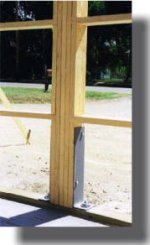
I have built several this way. We use blocks between the girts so the posts looks like a 6 by 10 when done. Very beefy.

It is the only way to do a building that you plan on insulating IMO.

It's just as you said about the insulation and a wall that is 3 inches thinner. THat is a aditional 50 square feet on a 40 x 60.
 
/ Has anyone built a pole building using "bookshelf construction method"?
  • Thread Starter
#4  
Cool, thanks for the first-hand info Duffster! Is there anything on-line or in print that would show any details? I am having trouble drawing a clear and simple plan for the floating concrete slab, and its relation to the pole wall (basically footed, not floating like the floor). Actually that issue is confusing regardless of the type of wall construction, if the wall is insulated (so it has thickness, exists above the slab which can float,...).
 
/ Has anyone built a pole building using "bookshelf construction method"? #5  
Cool, thanks for the first-hand info Duffster! Is there anything on-line or in print that would show any details? I am having trouble drawing a clear and simple plan for the floating concrete slab, and its relation to the pole wall (basically footed, not floating like the floor). Actually that issue is confusing regardless of the type of wall construction, if the wall is insulated (so it has thickness, exists above the slab which can float,...).

If you plan on pouring a floor right away I wouldn't put the pole in the ground. Just on top of the slab.

It has never made sense to me to put post in the ground and pour inside the grade boards.

The post will heave in the frost anyway if there is a board resting on the ground and nailed to the post.
 
/ Has anyone built a pole building using "bookshelf construction method"? #6  
This is basically how we do it.
 

Attachments

  • constr10.jpg
    constr10.jpg
    11.4 KB · Views: 1,266
/ Has anyone built a pole building using "bookshelf construction method"?
  • Thread Starter
#7  
Duff, so the entire structure floats then? Can you do this on a large scale though? I always heard it was a poor idea to float a slab bigger than about a 24x24 garage. I will be building about 40x60x12. I am putting plenty of effort into the site under the floor, so possibly there will be very little stress due to frost movement if I am successful. So far: site chosen was not flat, so I excavated it to near flat, taking west side down 16 below original grade, removing most of the material that was dirt or clay. Built up east side about a foot using gravel and dirt mixture (old driveway bed), packing and spreading in sub-one inch layers. The site has since had several hard rains and a day with a sprinkler running on it. It still has slope, out the east end, about 1 inch per ten feet. There will be perimeter drain tile laid down now, then I will be putting back in crushed rock type fill, about 16 inches on the uphill end, and up to 24 inches deep on the lower end (so it actually has a level top surface). At that point I could proceed as is customary, setting poles. Or could deviate to your plan of pouring concrete and set poles on the slab later. I wonder, do you have any more detail photos or drawing of the slab thickness at the edge and pole locations, etc? And, is that a comercial product bracket that mates the laminated pole to the slab? Thanks for anything you offer. I am near Rochester MN if you want to make a visit. hehehe
 
/ Has anyone built a pole building using "bookshelf construction method"? #8  
Duff, so the entire structure floats then? Can you do this on a large scale though? I always heard it was a poor idea to float a slab bigger than about a 24x24 garage. I will be building about 40x60x12. I am putting plenty of effort into the site under the floor, so possibly there will be very little stress due to frost movement if I am successful. So far: site chosen was not flat, so I excavated it to near flat, taking west side down 16 below original grade, removing most of the material that was dirt or clay. Built up east side about a foot using gravel and dirt mixture (old driveway bed), packing and spreading in sub-one inch layers. The site has since had several hard rains and a day with a sprinkler running on it. It still has slope, out the east end, about 1 inch per ten feet. There will be perimeter drain tile laid down now, then I will be putting back in crushed rock type fill, about 16 inches on the uphill end, and up to 24 inches deep on the lower end (so it actually has a level top surface). At that point I could proceed as is customary, setting poles. Or could deviate to your plan of pouring concrete and set poles on the slab later. I wonder, do you have any more detail photos or drawing of the slab thickness at the edge and pole locations, etc? And, is that a comercial product bracket that mates the laminated pole to the slab? Thanks for anything you offer. I am near Rochester MN if you want to make a visit. hehehe

Yes the entire thing floats. I had always heard the same thing about the 24 x 24. We have gone as big as 40 x 64 x 14 and wouldn't think twice about going bigger. Sorry I don't have any drawings but the slab was 6" thick with 1/2" rebar 2" oc. with a extra 5-6' pieces 1' oc perpendicular to the perimeter. The first 4 bars parallel to the perimeter was also 1' oc. The slab edge was 16" thick in ~16" with 2 extra runs of bar in that. Posts are 8' oc.

The steel bracket is just made at a welders fab shop.

I could be there in a few hours. :)
 
/ Has anyone built a pole building using "bookshelf construction method"? #9  
Never seen it this way... although not many pole barns around here.

Any more detail pictures?
 
/ Has anyone built a pole building using "bookshelf construction method"? #10  
Jim,
Are you going to heat this bldg?
 
/ Has anyone built a pole building using "bookshelf construction method"? #11  
As far as concrete slabs go, I just poured one last year in central Texas that was 60 x 80. In Florida, I know a house slab was 90' long and 30' wide with additional bump-outs. There are some that are bigger. And of course there are the commercial warehouse buildings with a concrete floor - not sure if it's a monolithic pour. An airplane taxiway was about 40' by 600' in a monolithic pour. I say this to let you know that whatever slab size you choose to do can be done as a floating monolithic pour (at least in the south) - I do not know what kind of ground prep you'll need for freeze concerns.

The 60x80 was for a metal barn - essentially I beams for poles and they were bolted to the concrete slab.

As for insulation, you may want to check on the feasibiliy of spray on foam instead of the batt type insulation. You might find it to be cost effective.
 
/ Has anyone built a pole building using "bookshelf construction method"? #12  
The post will heave in the frost anyway if there is a board resting on the ground and nailed to the post.

Great observation, never thought about this. It's just like an ice lens on a foundation picking the whole thing up. I'm building a large barn later this year, had planned to use a skirt board, but now I'm thinking twice. It will have gravel floor, so no option for attaching to slab.
 
/ Has anyone built a pole building using "bookshelf construction method"? #13  
Two separate issues here, wall framing and slab/foundation arrangement.
 
/ Has anyone built a pole building using "bookshelf construction method"?
  • Thread Starter
#14  
Duff, thanks again, consuming the info now, may have more questions later. Are you a professional builder? Seriously, would you like to offer some consultation on this? I possibly could drive to your locale and view some projects to understand your methods. It would be worth something to me to get this information, so you wouldn't be wasting your time. At least dinner and drinks or something.

Rustyiron: YES. Will be heated. Leaning toward using radiant hydronic in-floor heat again. I used RFH in a shop I built in 1996 and have enjoyed its great success. It heats to a low degree very inexpensively, and is comfortable for working even as low as 50 degrees. Previous building was fired with LP. This new one will have some wood heat source with LP backup.

>>>>Let's call the slab-on-grade with columns bolted with steel fittings to the surface (no poles set below ground) method, the DUFF method for easier communication. <<<

So, using the Duff method, it now becomes a small challenge to insulate the outside edge of the slab, if using the RFH. If the slab is to be heated, it must be insulated below and beside so the heat is encouraged to only flow into the living space above the slab. Not an insurmountable challenge, but must be planned. Insulation below is to be 2 inch extruded polystyrene. Outside edge would need to be similar. If using the other method of construction, where a slab is poured inside the grade planks, a layer of insulation is applied there on the inside of the grade plank, and around each post, to provide a thermal break and to provide a release layer so the concrete will not bond to the plank or posts.
 
/ Has anyone built a pole building using "bookshelf construction method"? #15  
>>>>Let's call the slab-on-grade with columns bolted with steel fittings to the surface (no poles set below ground) method, the DUFF method for easier communication. <<<

So, using the Duff method, it now becomes a small challenge to insulate the outside edge of the slab, if using the RFH. If the slab is to be heated, it must be insulated below and beside so the heat is encouraged to only flow into the living space above the slab. Not an insurmountable challenge, but must be planned. Insulation below is to be 2 inch extruded polystyrene. Outside edge would need to be similar. If using the other method of construction, where a slab is poured inside the grade planks, a layer of insulation is applied there on the inside of the grade plank, and around each post, to provide a thermal break and to provide a release layer so the concrete will not bond to the plank or posts.

You might want to adopt industry names for these various foundations to make it easier to look for info. What you probably need to use is called a Frost Proof Shallow Foundation, it incorporates insulation around the edge, often includes insulation extending out from the edge, and only works with heated structures because it relies on retained heat to prevent heaving. A floating slab was Frank Lloyd Wright's favorite foundation and requires sufficient aggregate under the slab to prevent ever having any moisture accumulate, so it can survive in cold climates. It also incorporates thicker concrete and significant reinforcement around the edge to effectively create a concrete beam that carries the slab. Finally there is a slab on grade, which isn't supposed to be used in locations that have frost heave. In practice I think what Duffster is referring to is some combination of a frost proof shallow foundation and a floating slab rather than slab on grade. He describes steel and thickening around the edge, it's not clear how much sub aggregate was used but that's a function of the type of soil.
 
/ Has anyone built a pole building using "bookshelf construction method"?
  • Thread Starter
#16  
Yea Beez, that's good stuff, now we're cooking, thanks for the definitions! I have a couple books with Wright designs in them, I will do some reading. I agree, Duff seems to be using a hybrid plan, which may work for me, considering my original intent to add 16-24 inches of sub aggregate under the floor for drainage, and under floor insulation for the RFH.
I realize this is way beyond the original question about wall construction, but it is all so related and important, it is tough to seperate. I only wish I could edit the original thread title a bit.
 
/ Has anyone built a pole building using "bookshelf construction method"? #17  
I assume you need a building permit, that might impact your options. I'm guessing you will need a lot more engineering approval to attach the structure on top of the concrete than you will to put up a pole barn and pour a concrete floor. Frostline must be pretty deep in the land up north.
 
/ Has anyone built a pole building using "bookshelf construction method"? #18  
Jim, I will help you out however I can. Only problem is that the closest on slab ladder framed building I have done is 3.5 hours from here. :eek:

Beez, a slab on grade and floating slab are one in the same, at least to me. We were not so much concerned about frost proofing because there really isn't such a thing on a typical post in ground building anyway. If I was to heat a building like this full time I would use styrofoam out horizontally from the base of the thickened edge.
 
/ Has anyone built a pole building using "bookshelf construction method"? #19  
Duffster, this is an interesting twist on pole barn construction I was not familiar with. Thanks for your insight!

Have most of this style of construction been insulated between the boards, or just used for shelves? Either way, this looks like a great way to build.

I'm thinking about my barn/machine shed which was already built when we bought the property. It's conventional timber construction with 2x6 on 16" center on concrete slab, roof trusses on 24" center, with Masonite exterior siding. It's well built, but not insulated, and probably never will be. I just keep thinking of all the shelf space that I don't have that your style would have had. We may be building another machine shed at our farm in a couple years, so why wouldn't I want to use this style of construction? Thanks.

GGB
 
/ Has anyone built a pole building using "bookshelf construction method"? #20  
Jim, I would guess that we have similar climates and I just built a bldg. 40x80x16 that is heated with in floor radiant.
It has been my experiance that if you are going to insulate and FINISH the interior of a "pole" bldg. it is just as easy to frame it 16"oc. conventionally, that is if you have a slab to build on, and that brings me to my second point. It is more costly but the results are worth it especially when heating in the colder climes that we have....... build a frost wall and insulate it.
I put a 4' frost wall with 1" of foam on the inside before backfill and then 2" under the slab. If I had it to do over, I would have used 2" on the frost walls as well. I then built a 2x6 wall 16"oc. with 2x6 purlins on the outside face of the vertical studs. This gave me space to put 1 1/2" of iso foam outside between the purlins and then put another layer of 1 1/2" foam vertically in the "stud bay". With 3" of foam with a "R" value of about 4.5 to 5 per inch, I have a R15 or so wall and still have 3 1/2" left in the stud bay for wiring, plumbing, etc and a layer of R13 FG batts for a really nice insulation value. Last winter (just because I could) I worked in it all winter in it in a tee shirt! It really melts the snow/ice off your truck in a hurry!
But with all that said, by the time you take a pole bldg with say 8' pole spacing, and frame it in for a finished interior wall (usually 16"oc.) you may as well just build it that way. You won't need the beam between the post to support the trusses, the lumber that would be used for the posts (I like to laminate 3 or 4 2x6 together for pole bldgs) can make close to 3' of wall, and this brings you to be able to use much more conventional materials, usually designed for 16" framing, as well as using a "regular" 2'oc. roof truss. (Many pole bldgs. use a "heavy" roof truss @ 4' centers or even one truss at each post, requiring a much heavier roof girt or purlin than would be needed with a 2'oc. truss spacing. This also makes insulating the roof easier, or at least more insulating options than a 4' or more spacing.
This winter I'm going to "rough it" and try to cut back on my wood use and keep the temp. down around 50 to keep my wood use down.
One last thing, Google "Perma column" they make some nice posts (concrete) with a steel saddle to accept the post if you go that way, they also make a post saddle that you can "wet dip" into either your slab or concrete wall. and they also offer a saddle that you can drill/anchor post pour.
INSULATION - THE GIFT THAT KEEPS GIVING! Good luck.
 
 
Top