At Home In The Woods

   / At Home In The Woods
  • Thread Starter
#2,181  
Here's the stone we will place on the fireplace hearth. The stone is 2' x 7 1/2'. My got it at a stone yard 1 1/2 hours away from here. She picked out the type of stone she wanted, then had them cut it to size. The edges of the stone have been chiseled for appearance. The stone weighs 300+ pounds.

attachment.php


Yesterday the stone mason was supposed to start working on the fireplace but he did not show up. He was also supposed to help us unload the stone. My wife tried to call him but his phone wasn't working. I need to drive the truck to work on Monday so tomorrow we will have to try to unload the stone using the tractor.
Apparently, the stone weighs more like 400 lbs. Getting it our of the truck looks like it will be a challenge.
 
Last edited:
   / At Home In The Woods #2,182  
Obed....What if you threaded a chain through the pallets and hooked it on the end of the pallet against the truck cab and then hooked the other end to your tractor ..then pull the stone off along with the pallets onto something you would have to set up even with your tailgate...no lifting that way just pulling it off onto whatever you set up to pull it on to..
 
   / At Home In The Woods #2,183  
   / At Home In The Woods #2,184  
Any ideas how the stone mason planned to unload it?

Moving that without cracking it is going to be tricky.

Since you have already demonstrated that it is road-worthy as is, I would be inclined to leave it in the truck and just drive the truck to work until I could get the mason to take the risk of getting it out.
 
   / At Home In The Woods #2,185  
I was able to slide my 400 lb grapple out the back of my truck by myself with a pair of doubled 2x8 ramps and I'm no big guy - 5'9/180ish - and I don't workout at the gym either. :) In this case the risk is cracking it as Curly Dave said, but you do have it on a pallet. I'd make sure it is well secured to the pallet with straps and padding to avoid scratching it. You'll be pulling on the pallet. Find a spot you can drive up to that takes away as much of the truck bed height as possible so are not pulling down a major slope - maybe the front porch? Or use the slope of the land? Or even build up some staging to put it on. Then you can slide it down a pair of ramps that are as shallow as possible. You want a little down hill slope to the ramps to help you out but not so much that it takes off. If you can find a place you can set it where you can get the tractor on the other side of the "high ground", you can even pull it off that way, which is a lot easier than doing it by hand, but it still can be done.

In fact here is a pic of me doing the same thing with my 400+ lb splitter. Same technique, and all by hand. You would want less slope than I have here, but my driveway has enough slope to knock off a foot or so of drop with my 8' long ramps. You need to make sure the ramps stay put when you do this. In this pic, they are butted against the edge of the garage slab to keep them stationary (and captured by the ramp plates on the tailgate).

attachment.php


Another example - I helped a friend carry a 500 lb cast iron whirlpool tub up a full flight of stairs during a remodel. There were 6 of us lifting, and that nearly killed us as we didn't have enough room around the tub on the stairs to get everyone in place at once. But on the flat floor leading up to it, it was manageable.

It can be done...b
 

Attachments

  • Supersplit (Medium).JPG
    Supersplit (Medium).JPG
    61.2 KB · Views: 929
Last edited:
   / At Home In The Woods #2,186  
Floodlight Question
We need to buy floodlights for the house. I would like the floodlights to be controllable by the future home automation system controlled by an HAI Omni Pro II controller.[/URL].

Does anyone have any suggestions on what floodlights to get?
What features should I look for?
Should I get X-10 compatible floodlights or use some other automation standard?
Obed

As for the question "standard ?" :laughing: :laughing: :laughing: :confused2:

The HAI does X10 native with the user connecting a PSC05 interface module plugged into the wall which goes to/from the HAI unit. This module does two way X10 communications. There are various flood light devices that operate as stand along motion detection flood light and can also send a signal back to the controller when motion is detected, and can be turned on and of by the controller. The fixture also has the X10 electronics since it's designed for a retrofit environment. Check out the various devices carefully. Some are a motion detector that send to the controller and lights that can be turned of from the controller ONLY, others can function as a stand along motion detection light and also send signals when there is motion and can be controller by the controller. That's probably what you want so you have motion controlled lights now and can add the controller later. Read the various suggestions/warnings on where you can install these lights to be sure they will work for you.

Note that the PSC05 connects to one phase (or 120 V side) of your line, so if you go this route be aware that sometimes there are problems when the device you're trying to control is on the other side of the line. There are cross over devices to solve this problem. X10 is a one way system with no feedback that a command was received, but due to volume and simplicity it is dirt cheap. The main point here is that sometimes X10 systems are flakey and can need a little debugging.

There is another system call UPB that is more expensive but more advanced. It sends a command to a device and makes sure that it gets an acknowledgment. It has a device similar in function to the PSC05 but it connects to a serial port and you'll have to check and see if the HAI system has support for that device. Better, but more money. The UPB can co-exist with the X10 stuff.

As I think I posted earlier, I ran relays for all my outside flood lights so I just need to get 12V to the relay coil to turn on the lights. This requires you run a 14-3 into the switch box that had the wire to the light, and bring the other end into a 3 gang box which has an 18 gauge wire that goes to your automation system location. But you came into this during the fog of construction and will need to go down the retrofit path. If possible, I'd make sure than anything you get that controls lights uses a relay and not a triac to turn the light on. I had a Leviton three way (i.e. two devices) motion detection switch for the basement stairs and it uses a triac. The compact fluorescence (CFL) burned out after about a year, had to switch them over the incandescent. The triac switching in the switch and the power factor correction circuitry in the CFL don't like each other. Kinda like having a Kubota loader on a Deere tractor :laughing:.

So if I were you, I'd find an X10 fixture with motion detector. I'd be sure where it was going was OK as per the warnings. I'd make sure it can function stand along but also can send X10 on motion detect and use received X10 commands to turn the light on and off so you can use an automation system to control it down the road. Since I don't use these I can't give a direct recommendation, but if you find some you like post and I'll take a look at them.

Pete
 
   / At Home In The Woods
  • Thread Starter
#2,187  
... So if I were you, I'd find an X10 fixture with motion detector. I'd be sure where it was going was OK as per the warnings. ...

Pete
Thanks Pete for the info. That helps a lot. Why did you use relays instead of buying X-10 equipped floodlights?

It seems like I could use relays too, even though the sheetrock is up. I believe I can get to the flood light wiring in the trusses via the attic. Couldn't I just add a junction box and put the relay in parallel with the light switch? That way either the automation controller or the light switch could turn on the light.

I've heard that X-10 can be a little flaky. Maybe I'll check to see if UPB is available for the HAI OmniPro II. Requiring a serial port surprises me, seems a little behind the times.

Obed
 
Last edited:
   / At Home In The Woods
  • Thread Starter
#2,188  
Apparrently, the stone weighs more like 400 lbs. Getting it our of the truck looks like it will be a challenge.
Here's how we did it. It turned out to be pretty simple.

attachment.php
attachment.php


I sat the stone down on a pallet on the garage floor. I then slid it back and forth from each end by hand and wiggled it against the wall in the garage. We plan to borrow some floor dollies to move the stone into the living room. We do have an 8" step from the garage to the house to negotiate.
 

Attachments

  • IMG_0364.JPG
    IMG_0364.JPG
    167.7 KB · Views: 968
  • IMG_0366.JPG
    IMG_0366.JPG
    167.8 KB · Views: 1,152
  • IMG_0367.JPG
    IMG_0367.JPG
    82.7 KB · Views: 224
   / At Home In The Woods #2,189  
Thanks Pete for the info. That helps a lot. Why did you use relays instead of buying X-10 equipped floodlights?
Obed
In new construction where installation's not a problem, the relay is very cheap and reliable. The only challenge is finding various closets where you can hide the boxes for the relays. Only down side is you have to have the automation stuff going to use them in an automated way. The switches will always work whether you have automation or not.

It seems like I could use relays too, even though the sheetrock is up. I believe I can get to the flood light wiring in the trusses via the attic. Couldn't I just add a junction box and put the relay in parallel with the light switch? That way either the automation controller or the light switch could turn on the light.
Obed
If the light is a single switch control, you can certainly parallel the relay contacts with the switch. For a three way or more, then you need access to the wire that goes to the light and the power for that circuit. Note also that sometimes things are wired with power at the light, and the run to the switch is just the switch leg. Sometimes things are wired with power at the switches and the run to the light is just the light so you'd have to find the power circuit somewhere else. You _really_ want that to be the same circuit as the light so if you or someone else goes to work on the light, when they pop the circuit breaker off you are guaranteed everything is off. So figure out how your place is wired so you know what you have to do. In my house, power is always at the switches and not the light(s).

What I did was bring a 14-3 from the switch box that has the wire that goes to the light. The black wire was the power for that circuit. The red wire went to the light. The white wire (with a piece of red tape around it so no one confuses it with neutral) was the "output" from the switch(es) that would have gone to the light in normal circumstances. This means that the switch(es) can run the light on their own with no automation, but the automation system can turn on the light whenever it wants independent of the switch(es). Failure of the automation system means that everything still works manually.

The 14-3 is run to a box where you can have access, and a low voltage wire (I used an 18-2) goes into the box too. The light (red) goes to the common of the relay. The black goes to the normally open, the white to the normally closed. I had a little PCB that takes up 2 spaces (I'm re-doing it to fit in a single space), so just use a box one size bigger so you can wire it up.

Obed, for a relay retrofit, just be sure that when you put your relay in up in the truss area that the power for it is the same circuit as the switch. This gets back to how your place is wired. I know of someone who used the other phase and sometimes when the light was already on and the relay was used, it arced and shorted out the 240 phase popping the breaker. He broke all the rules. Be sure the relay is in a nice box since it will be hot up there in the attic. If the coil goes, you'll want to be able to contain it.

I've heard that X-10 can be a little flaky. Maybe I'll check to see if UPB is available for the HAI OmniPro II. Requiring a serial port surprises me, seems a little behind the times.
Obed
Well, no one can agree on anything about home automation. The physical layer (serial, USB, X10, UPB, Zigbee, other 2.3GHz stuff) and the packet format. The collective efforts of all the companies got nothing on the Tower of Babble. Ethernet would be nice, but the cost is very high. X10 just has a volume, overseas production, and 1st to market going for it but that's about it. So lots of automation controllers have a few extra serial ports for this sort of thing. You find serial ports on weather stations, solar panel inverters, floor heating systems, and other devices just because they are cheap and well known. Lots of single chip controllers have serial ports on them, so the cost is just the RS-232 level conversion. Now you're down to just a wire and connector difference. Topic for another day, but, all my efforts are to interface to this hodge podge of stuff and come out with an Ethernet jack, published open protocols, and open source code for the lower level layers. Ethernet is now available on single chip computers, and if home automation every really becomes mainline it will become more popular.

So if you can relay, great. If not, see if the HAI supports UPB. If not, see if your light positions will work with X10 stuff. Note that if you're confident you can retrofit a relay, you can just put a normal fixture for now (least time and effort), get your CO, and then retrofit when the fog has cleared. And if you go the relay route, I can help you on the relay stuff.

Pete
 
   / At Home In The Woods #2,190  
Here's another way to protect your underground conduit/piping, etc. Cut 2" blueboard to fit into the trench and then cover it with the backfill. After lining the ditch with sand as you have done the blueboard protects and insulates the pipes/conduit from frost too. And rocks are then not an issue and removing the blueboard is easy to do and makes access to the pipes for future work real easy. Just lift out the board and voila, instant access to the pipe.

Also take some red or yellow 2" wide "caution buried undrground cable" tape and wrap it around the pipe and then lay it near grade but underground so when you start to dig you hit the tape first and then excavate by hand or very cautiously from that point to where the pipe is laid. Just like a pro would do!:D

I still don't see why you should pay the cabinet 'designer' any fees. Do you have a written contract outlining exactly what you should pay and for what services? If NOT then he should pound salt. Clearly he is the most expensive bidder and sees his value as being above all the rest- but his pricing is not usual and customary for the work he is/has done. AND he was not given the job. So I'd say at best he deserves to be paid a consulting fee and nothing more.

Good luck.
 
   / At Home In The Woods
  • Thread Starter
#2,191  
Yesterday we connected the last 15 feet of phone conduit where the conduit enters the house. The hole drilled through the concrete wall was angled slightly the wrong direction so we had to bend the pipe in order to connect the pipes together. Because of the bending, I needed my wife's help to connect this section. It took one person to bend the pipe and pull it through the wall while the other person glued the pipes together. We had string in the existing pipe but needed to get the string through the last 15 feet. My wife tied a plastic grocery back to the string and stuffed in in the end of the existing pipe before we glued the last sections of pipe. After gluing the pipes, we used a wet vac to suck the plastic bag and string through the conduit.
 

Attachments

  • IMG_0370.JPG
    IMG_0370.JPG
    166.4 KB · Views: 227
  • IMG_0369.JPG
    IMG_0369.JPG
    185.9 KB · Views: 246
  • IMG_0368.JPG
    IMG_0368.JPG
    201.3 KB · Views: 224
  • IMG_0372.JPG
    IMG_0372.JPG
    156.1 KB · Views: 211
   / At Home In The Woods #2,192  
Good idea to use conduit for the phone lines. When I built, I told the phone company how I wanted the phone line ran, because of the future garage that was going to go on that side of the house. The phone company ignored my request and ran it straight thru the garage area. The phone line is now buried under my garage floor.
 
   / At Home In The Woods
  • Thread Starter
#2,193  
I've heard that X-10 can be a little flaky. Maybe I'll check to see if UPB is available for the HAI OmniPro II. Requiring a serial port surprises me, seems a little behind the times.

Obed
I checked out Universal Powerling Bus (UPB) controllers for controlling floodlights. I had trouble finding UPB enabled floodlights so I considered getting a UPB controller wall switch that can be controlled by UPB controllers. The wall switch would be wired to the floodlight enabling a person to turn the floodlights on or off using the wall switch and also would enable the floodlights to be controlled by the home automation controller. However, when I saw the $79 price of the HAI UPB wall switch, I almost fell out of my chair.

So I guess I may have to take my chances with X-10 controlled floodlights. Unfortunately, I haven't been able to find an X-10 motion detector floodlight that can be turned on/off using a regular light switch; I'm starting to wonder if such a device actually exists.

So I might have to get an X-10 enabled floodlight

and a X-10 wall mounted controller
for manually operating the floodlight.

Or a 4 device controller

might be handy.

Really confused,
Obed
 
Last edited:
   / At Home In The Woods #2,194  
Yup, all this stuff is high priced, not simple, and the product features were selected by monkeys. That X10 flood light is a "on all the time" motion controlled flood light where the motion controller can also send out X10 "light on" commands to other lights. What it's Not is two independent devices (an X10 controllable light and an X10 output motion sensor) that can be linked with a switch on the unit that makes the sensor run the light.

You could install this and the switch would just be a big "motion detection light off" switch. You'd have a motion controlled light to get by with for now. When you automate, your automation system could see when the motion detector triggers.

The UPB stuff is expensive, you saw the price for a switch and a two way switch is even higher. The serial module is in the $80 range or so, and you still need an automation controller. But you can also see why it's a great retro fit- stuff still works, but you can also turn it on or off remotely and see what the current state is. And when you look at the total system cost (such as the cost of the HAI system or an Elk Gold system) the price isn't too bad. Also, when retrofitting you can do a bit every few months to spread out the work and costs.

I think I'd just put a normal flood light and wait for the fog to clear and pick an approach to retrofit later. Each partial solution keeps expanding out into a "and then what" next step and before you know it you're trying to second guess the final solution. It's hard to see your final destination when it's foggy out.

Pete
 
   / At Home In The Woods #2,195  
Yup, all this stuff is high priced, not simple, and the product features were selected by monkeys. That X10 flood light is a "on all the time" motion controlled flood light where the motion controller can also send out X10 "light on" commands to other lights. What it's Not is two independent devices (an X10 controllable light and an X10 output motion sensor) that can be linked with a switch on the unit that makes the sensor run the light.

You could install this and the switch would just be a big "motion detection light off" switch. You'd have a motion controlled light to get by with for now. When you automate, your automation system could see when the motion detector triggers.

The UPB stuff is expensive, you saw the price for a switch and a two way switch is even higher. The serial module is in the $80 range or so, and you still need an automation controller. But you can also see why it's a great retro fit- stuff still works, but you can also turn it on or off remotely and see what the current state is. And when you look at the total system cost (such as the cost of the HAI system or an Elk Gold system) the price isn't too bad. Also, when retrofitting you can do a bit every few months to spread out the work and costs.

I think I'd just put a normal flood light and wait for the fog to clear and pick an approach to retrofit later. Each partial solution keeps expanding out into a "and then what" next step and before you know it you're trying to second guess the final solution. It's hard to see your final destination when it's foggy out.

Pete

I ran 12-3 wire to the motion light on our garage. Black is hot power to the motion sensor, red is switched power direct to the light and by-passing the motion sensor, and as expected white is the neutral. I also added a PE Cell between the motion sensor and light so that it only activates at night. Works well.
 
   / At Home In The Woods
  • Thread Starter
#2,196  
I think I'd just put a normal flood light and wait for the fog to clear and pick an approach to retrofit later.
Pete,
That's what I will do. I don't want to rush into something now. We'll just put standard non-automation floodlights without motion sensors up for 4 of the five floodlights. We'll put a floodlight with a motion sensor at the garage for convenience.

Later when I have time to do some research I'll spec out exactly what I want.
Obed
 
   / At Home In The Woods
  • Thread Starter
#2,197  
I ran 12-3 wire to the motion light on our garage. Black is hot power to the motion sensor, red is switched power direct to the light and by-passing the motion sensor, and as expected white is the neutral. I also added a PE Cell between the motion sensor and light so that it only activates at night. Works well.
Cyril,
That's a great idea. I wish I had had the electrician run 12-3 wires to all our floodlights. Eventually, I may end up installing motion detectors that are independent of the floodlights and use the home automation controller to turn the floodlights on/off.
Obed
 
   / At Home In The Woods
  • Thread Starter
#2,198  
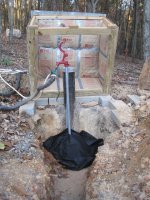
I back filled around the well Monday evening. I learned another tractor trick.

attachment.php


I couldn't reach the whole dirt pile across the trench with the FEL. So I put the FEL on the ground and lifted the front tires off the ground and drove the front of the tractor across the trench. I then back dragged the dirt back into the trench keeping the front tires lifted above the trench with the FEL.
 

Attachments

  • IMG_0376.JPG
    IMG_0376.JPG
    165.2 KB · Views: 231
  • IMG_0375.JPG
    IMG_0375.JPG
    176 KB · Views: 887
  • IMG_0374.JPG
    IMG_0374.JPG
    167.8 KB · Views: 248
  • IMG_0373.JPG
    IMG_0373.JPG
    172.8 KB · Views: 235
  • IMG_0378.JPG
    IMG_0378.JPG
    119 KB · Views: 223
  • IMG_0379.JPG
    IMG_0379.JPG
    136.4 KB · Views: 191
   / At Home In The Woods
  • Thread Starter
#2,199  
The stone mason, trim carpenter, tile guy, and I moved the hearth stone from the garage to the fireplace using a couple floor dollies we borrowed from my brother-n-law. The wooden platform under the hearth stone was not exactly level with the fireplace. So the trim carpenter drilled about 15 screws in the top of the hearth platform and leveled them similar to how concrete slab workers level their work using grade stakes. The stone mason then put some mud on top of the hearth platform.

attachment.php


We then set the hearth stone on top of the mud and screws. The wet mud flattened out until the stone rested on the screws. The trim carpenter came up this this solution and it worked out great.
 

Attachments

  • IMG_0383.JPG
    IMG_0383.JPG
    79.8 KB · Views: 320
  • IMG_0382.JPG
    IMG_0382.JPG
    84.7 KB · Views: 225
  • IMG_0381.JPG
    IMG_0381.JPG
    84.1 KB · Views: 1,087
  • IMG_0380.JPG
    IMG_0380.JPG
    81.4 KB · Views: 236
   / At Home In The Woods
  • Thread Starter
#2,200  
Yesterday evening I backfilled around the phone conduit area. I first put some hydraulic cement around the hole through the wall. Then I used some gravel and landscaping fabric to encourage water to seep into the gravel instead of into the basement around the conduit. I'm really glad to finally get this area graded so that water will run away from the house. With rain in the forcast for today, I really wanted to finish the backfilling last night so I ended up working using the tractor lights. The tractor has 3 work lights mounted on the ROPS and lights up the work area reasonably well.
 

Attachments

  • IMG_0385.JPG
    IMG_0385.JPG
    138.4 KB · Views: 207
  • IMG_0386.JPG
    IMG_0386.JPG
    139 KB · Views: 186
  • IMG_0389.JPG
    IMG_0389.JPG
    121.5 KB · Views: 199

Tractor & Equipment Auctions

2001 Dorsey 48ft Flatbed T/A Trailer (A56857)
2001 Dorsey 48ft...
UNUSED FUTURE HYD AUGER (A52706)
UNUSED FUTURE HYD...
2025 GPS Trailer (A56858)
2025 GPS Trailer...
Redirective Crash Cushion Guardrail (A59230)
Redirective Crash...
ELECTRIC GOLF CART (A58214)
ELECTRIC GOLF CART...
2023 John Deere XUV 825M S4 (A60462)
2023 John Deere...
 
Top