Restoring Native grasses

/ Restoring Native grasses #1  

twarr1

Bronze Member
Joined
Feb 15, 2009
Messages
86
Location
Central Texas
I'd like to get some thoughts on restoring native grasses. About 4 years ago I had the county extension agent and Texas Natural Resources Conservation agent come out and survey the land, but their focus is really more on maintaining land for grazing. They were very helpful in explaining the effects of years of grazing and taking inventory of the remaining natives.
Now after 4 years and reading countess publications and giving it a lot of thought, I have come to the conclusion that it is difficult if not impossible to maintain a truly native grassland without fire. I notice that a lot of the 'natural" habitat around here (North Central Texas) is actually heavily infested with invasive brush that previously was suppressed by regular fires. The invasive plants around here are just not as obvious as in other parts of the country.
Comments?
 
/ Restoring Native grasses #2  
Nothing to add just that I hope this thread takes off. I think it will be interesting to follow if it does.
 
/ Restoring Native grasses #3  
We are trying to restore a few acres back to native grasses, and contacted our local soil conservation office for assistance. They have been very helpful, and even provided some help with expenses for reseeding since the ground is in a runoff area into and out of a pond on the property.

They recommend burning every spring, and from what I have researched, it will be difficult to restore otherwise. Many of the native grasses require heat to promote new growth, and the fire will help control other invasive plants.

In addition, it will probably take at least 3 to 4 years to really start to see what we think of as a native stand of grasses. On another ground we put into one of the FSA programs (WHIP), I learned that patience is a virtue! That ground looked absolutely horrible for several years, but now have really started to look like we had hoped. In addition to helping control erosion, the pheasants and quail have started to return.

Check with your local resources again to see if any newer programs might be applicable to your situation.

GGB
 
/ Restoring Native grasses #4  
Do a Google search on "Kentucky CREP program". It is available for my county and many farmers have signed up and are receiving a big check every year for protecting the Green River Valley watershed. All Native grasses. There are many rules and regs to participate in this program. We did not sign up. Someone has to farm and produce goods for the consumer. Ken Sweet
 
Last edited:
/ Restoring Native grasses #5  
Now after 4 years and reading countess publications and giving it a lot of thought, I have come to the conclusion that it is difficult if not impossible to maintain a truly native grassland without fire. I notice that a lot of the 'natural" habitat around here (North Central Texas) is actually heavily infested with invasive brush that previously was suppressed by regular fires.

Good thread. I'm interested in establishing some native warm-season grasses for quail habitat in NC.

I'm curious as to whether you have any problems getting permits for controlled (prescribed) burns out your way. It's getting harder in NC due to air-quality regulations.

Steve
 
/ Restoring Native grasses #6  
Twarr1 is there a reason you can't burn. It sounds as if your research says it needs to happen to achieve the goal. Controlled burns are used for forest management in my area often.

MarkV
 
/ Restoring Native grasses #7  
I'm in Kansas and entered the Consevation Reserve Program (CRP). It is expensive to plant native grass seed. The CRP does do cost sharing. I did not enroll in the cost sharing as it is deducted from the annual payments. Sort of pay me now or pay me later deal. I planted around 76 acres to grass about 4 years ago and it is now starting to really take hold. Seems like my cost was around $3500.00 for seed not counting the prep work and grass planter rental. $6.00 an acre for seeder rental. There is a requirement to burn about every 2 years. The burning really helps control invasive woody plants such as honey locust and osage orange. The control will get better as the grasses impove and fuel load increases. I am paid roughly $50 an acre annually to be in the program.

The CRP is mainly for returning erodable tilled ground back to native grass/pasture.

There are also government programs to restore/improve pasture land. I would guess Texas and other states have programs appropriate to the areas.
 
/ Restoring Native grasses #8  
We can still burn in Kansas with the appropriate burn permits. I live in an area of KS. that is known as the Tall Grass Prairie (Flint Hills) and the spring burning smoke can be seen from sattelites.
 
/ Restoring Native grasses #9  
Now after 4 years and reading countess publications and giving it a lot of thought, I have come to the conclusion that it is difficult if not impossible to maintain a truly native grassland without fire. I notice that a lot of the 'natural" habitat around here (North Central Texas) is actually heavily infested with invasive brush that previously was suppressed by regular fires. The invasive plants around here are just not as obvious as in other parts of the country.
Comments?

I live very near to the LBJ Nat'l Grasslands. Last spring, they burned thousands of acres to kill invasive brush and restore grasses. An interesting side-effect of that was the destruction of many geocaches. The grasslands is open to the public and an ideal place for geocaches. Another TBN member, Ron Hall, and I found a couple of geocaches with the contents burned to a crisp.:( However, within a couple of weeks of the burn, the ground was green with new grass.
 
/ Restoring Native grasses #10  
What are geocaches. I mark and mow around any trees that I intend to keep such as pecan, walnut, and oak. Our pecans are not like the Texas variety. About 1/2 to 2/3 as big as Texas's.
 
/ Restoring Native grasses #11  
What are geocaches. I mark and mow around any trees that I intend to keep such as pecan, walnut, and oak. Our pecans are not like the Texas variety. About 1/2 to 2/3 as big as Texas's.

As I understand it, geocaches are part of a new activity where people put hidden items somewhere and post coordinates on the internet for GPS users to try and find. A Google search will bring up many results. Seems like a good healthy sport that gets people off the couch.

MarkV
 
/ Restoring Native grasses #12  
What are geocaches?

Geocaches are a hide and seek game played worldwide with GPSs. Someone places a cache of small trinkets and a logbook inside a metal can (often an ammo box or coffee can) and hides it in an out of the way place. The location of the box is provided with a GPS lat/long and sometimes riddles to help with location. People find the cache and take a trinket and leave something or they just log their name into the book and then record that they found the particular cache. I'm not into it that much, but it is great practice for using the GPS to locate something through exact coordinates. Like all games, some people spend way too much time doing it and others just do it occasionally as a fun passtime.:thumbsup:
 
/ Restoring Native grasses
  • Thread Starter
#13  
MarkV, Burning is problematic. Our county uses a Risk Assessment to implement burn bans. When the burn ban is off, conditions are not favorable to burn. When conditions are favorable to burn, the ban is on. There are a couple of exceptions, one is to obtain a certification as a Prescribed Burn Manager. Unfortunetely, this requires liability insurance and no company is currently willing to underwrite these policies. The last time I checked, quite a few people had taken the required training, but no one had actually recieved certification because of the lack of insurance.
A private landowner can burn on their own property without the certification if there is no current ban, (pretty much impossible as noted above) but they have unlimited liability.
 
/ Restoring Native grasses #14  
Geocaches!!! That must be what all those wild hogs are rooting for on my place. They've got my pasture all torn up.
I believe that MIG(management intensive grazing) might help to re-establish those native grasses. Cattle raisers in my area are so ingrained with the idea of leaving their cows in one pasture for a whole grazing season that they don't give any type of grass much chance of surviving. Common bermuda comes back because it is so tenacious. Careless weed(redroot pigweed to those of you up north) and bullnettle take over because nothing can eat them. By rotating pastures you can maintain any type of grass or mixture you want to encourage.
Butch
 
/ Restoring Native grasses #15  
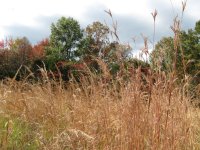
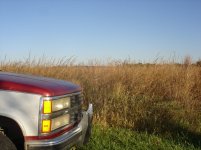
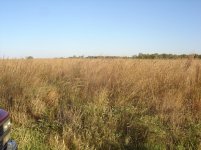
Here is some pictures of Kansas native grass planted in old tillable fields through the CRP program. I included my truck for a reference for size. What is in the picture is Big Bluestem. There is also Small Bluestem and Turkey Grass. In Kansas there is a requirement to burn CRP periodically. A burn permit is required for burning and a requirement to call the sheriff dispatcher on the day of the burn and when complete. The burning really helps control invasive trees and weeds. This is the 4th year and I have seen improvement every year.


CRP 001.jpg

CRP 002.jpg
 
/ Restoring Native grasses #16  
We put in 3-4 acres of prairie grass seven or so years ago and haven't been able to burn it. I've mowed it several times because of scrub trees and bushes, but that has resulted in thatch and no game birds. I don't think it has hurt the grass.

The field is surrounded by woods and I won't burn without the aid of the local fire department. We have just moved here full time after it being a weekend place for 25 years, so I hope to get a burn in this spring. I couldn't get here when the fire department was available and the weather was right.

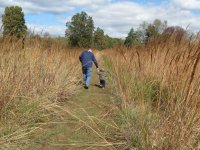
The grass is still beautiful and gets more so every year. We haven't had rain since July and the grass has still grown. My son is 6'4" so you can see the grasses are really tall.

We love the grass and it has been well worth the cost. I'd get back in touch with the state folks and see if any programs have changed or if they could help with the burn.

Good luck,
 

Attachments

  • grass.jpg
    grass.jpg
    336.8 KB · Views: 182
  • grass2.jpg
    grass2.jpg
    355.5 KB · Views: 211
/ Restoring Native grasses #17  
In addition to the government agencies that provide information/resourses regarding native plant restoration, some states have non-profit native plant societies that can provide useful local information.

Here's a listing by state. I know that the SC society is very active, but don't know about the other states.

Native Plant Societies

Steve
 
/ Restoring Native grasses #18  
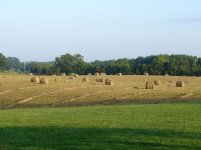
We got rid of fields of fescue (using glyphosate) and converted to Native Warm Season Grasses 4 years ago. Since then we have had 2 and 1/2 drought years but the native grasses have predominated. This year we got 2 cuttings of hay.

We have not had rain since August 23rd, and the field that was cut for hay since then is the only one in the area that shows a little green; this in the middle of (a warm) October.

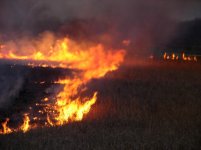
Burning is essential for weed control, and to strengthen your native grasses. It is fun and exciting. Not rocket science, but you have to have the training, or someone who has, and proper fire-control equipment.

Go for it.
 

Attachments

  • DSC02970.jpg
    DSC02970.jpg
    471.4 KB · Views: 109
  • Flappers.jpg
    Flappers.jpg
    711.5 KB · Views: 123
  • DSC02683.jpg
    DSC02683.jpg
    248.1 KB · Views: 135
/ Restoring Native grasses #19  
Wow I love this thread and the post's.
I would not spend a bunch of money on seed. Your soil bank more than likely has the seed there unless you have been heavy on the 2-4D for many years.
Starting out I would disk the area. Just a soil disturbance will help get things going and remove brush and small trees this may help you control a burn easier. ANd open up your soil seed bank.
Fire is a tool. I would recommend to anyone wanting to apply a prescribed burn to an area be trained. In fire: behavior, effects, weather etc.
MS State University offers Certified Burn mang classes, 5 days that all.
Contact your local; county agent, USDA NRCS, DNR, to find out what is avable in you State.
A written burn plan for a specific area is a must have period. This is to protect you and the public.
Your plan at a minimum should have;
location of burn(detailed),
desired fire weather conditions, Like high temp of 65 to 80 degrees,
relative humidity 35% to 50%.
Desired wind direction,
Phone numbers.
What you put in your burn plan has to be followed to a T.
You can go to National Weather service and find your official fire weather forecast for your area. This fire weather forecast from the NWS will determine if you can get a permit to burn. When your fire weather forecast falls between your desired fire weather in your plan go burn it!! And stay with it, its your baby.
MS uses the transport wind as a determining factor to issue permits. If the TPWind is less than 3.5 meters a second don't even pick up the phone it won't happen, and going ahead without a permit is stupid.
Is some person with a breathing problem down the road gets smoked in from your burn and has to go the ER, you are SOL.haha. Or you smoke in a HWY or road and there is a wreck. Your smoke is your biggest liability!!!!!!
But if you go by your plan and have a permit it will be hard to find you were negelent.
I have been doing prescribed burns on public and private land for 15 years and I still get nervous when I strike the match.
BUT I know the awesome results from a good RX fire and thats why I burn.
There are many native grass plants the require fire, (and wildlife esp birds) wire grass (found in gulf coast states) will only bloom and produce seed if burned.
I could go on and on ladys and gents.
Bottom line is get educated on fire and how to manage it.
What your grass needs; fall burn, spring time burn, mowing, disking etc.
AND have fun with it!!!!!:thumbsup:
DAVID,
 
Last edited:
/ Restoring Native grasses #20  
Is some person with a breathing problem down the road gets smoked in from your burn and has to go the ER, you are SOL.haha. Or you smoke in a HWY or road and there is a wreck. Your smoke is your biggest liability!!!!!!
But if you go by your plan and have a permit it will be hard to find you were negelent.

David,

Good post.

What sort of liability insurance do you have for burning? If I understand my county ranger correctly, the NC Department of Forest Resources and I will share liability if I contract with them to do a controlled burn on a thinned pine plantation tract. That is, if I can get a burning permit. It's becoming increasingly difficult to obtain permits due to air-quality regulations.

I will be checking about buying a rider on my farm policy, but I am curious as to whether any insurance companies specialize in this sort of thing.

Thanks in advance for any info.

Steve
 
 
Top