How to Dry a Field

   / How to Dry a Field #1  

whstein

New member
Joined
Sep 5, 2008
Messages
5
Location
Vancouver Island
Tractor
Kubota B26 TLB
We have a field of about 2 to 21/2 acres that holds small ponds of water through the winter. It dries in the summer - say June through September. I would like to drain it to be drier longer. One suggestion has been to ditch/trench it where the natural drainage channels have formed and to put drain rock and perforated 4" pipe in the ditches and then cover the pipe and drain rock with soil. The field is reasonably level pasture but there is enough slope to drain the field. The soil is black earth and clay - no rocks. My questions:
1. Is the drain rock/perforated pipe proposal a realistic solution?
2. If so, how deep should the ditch/trench be?
3. Anything else I should do or avoid doing if we go this route?
Thanks guys.
Wally Stein
 
   / How to Dry a Field #2  
Consider using some shallow trenches with very relaxed side slopes that you can drive over.:D
 
   / How to Dry a Field #3  
If water is collecting in the field then it must be in the low spots. That now determined if you were to scrap soil from the field you could fill in the low spots. We all get water puddles in our gravel driveways and when I regrade I fill in the low spots. If you rent a laser tripod rotary level you can find the slope of the field and mark the high and low spots. And by recording the information for future use you could determine trench lines as suggested before.
Craig Clayton
 
   / How to Dry a Field #4  
I would invest or find a transit level then you could span large areas and be right on the money.
 
   / How to Dry a Field #5  
Without a pic this may be way off, but you may be able to rent a grader/land plane that you pull behind a good sized tractor. These will shave off high spots and fill low ones. Since the land plane frame is carried on wheels and quite long, they will form very gentle slopes, you just drive around :).

In the permanently wet ground where I came from in Ohio, they run parallel field drainage lines at 50' spacing about 4' deep. They drain into roadside ditches there. These days it is done with a dozer pulling a subsoiler type of slit trencher thing behind it and the drain pipe is fed into the open slit before it falls closed. Lazer guided depth, all automated.
Dave.
 
   / How to Dry a Field #6  
How high is the water table? Around here they dug massive drainage ditch systems and put drain tile in some fields. You need a place for the water to go. The drainage ditches also eventually fill in with cattails etc. so they are cleaned out periodically with a excavator (ditches are around 12 feet deep or so and drain into creeks).
 
   / How to Dry a Field #7  
The cheapest may be to just have the field tiled.
Farmers in the midwest have to do this to get good drainage for crops in many locations and soil conditions.
The tile are put in as dave1949 mentioned.
When I grew up, the ditches for the clay tile were dug by hand with a tiling spade. the short runs would feed into larger tile and eventually into a crick or stream. Now they have machines to do the job much quicker.

Sounds like the soil is such that it retains water, so just sloping the field to smooth the "pot holes" will likely not be enough to do what you want. Both land planing and tiling will cost some money.
 
   / How to Dry a Field #8  
Wally,

We have a field of about 2 to 21/2 acres that holds small ponds of water through the winter. It dries in the summer - say June through September.
Right ....

I would like to drain it to be drier longer.
...... this sounds familiar :D

One suggestion has been to ditch/trench it where the natural drainage channels have formed and to put drain rock and perforated 4" pipe in the ditches and then cover the pipe and drain rock with soil.
Yup - very familiar:

172168d1279904057-determining-if-french-drain-will-750753-img_0586.jpg


The field is reasonably level pasture but there is enough slope to drain the field. The soil is black earth and clay - no rocks. My questions:
1. Is the drain rock/perforated pipe proposal a realistic solution?
Absolutely, yes.

2. If so, how deep should the ditch/trench be?
Somewhat dependent on the nature of the soil, the lay of the land, and where the eventual outlet will be.

If you have 12" of topsoil thats holding water, and then solid clay below, I'd probably dig out the trench at 18" or 24" (provided I had enough elevation drop to where I was draining to, to make that practical)

172170d1279904057-determining-if-french-drain-will-750752-img_0578.jpg


In the image above, the steel culvert was joined to plastic line and extended out another 60' or 80' down slope, where it breached the surface and emptied out in my lower front yard.

3. Anything else I should do or avoid doing if we go this route?
Yes - the pipe and drain rock need to be encased in geo-textile filter fabric, to prevent clogging of the drain pipe by the infiltration of fine soil/silt.

The drain rock should be washed gravel or some type of rock with no fines.

Thanks guys.
Hope this helps.
 
   / How to Dry a Field #9  
Most field tile in my area that is installed is direct bury. No rock or liner or anything. Just black perforated plastic buried in the ground. The trick is to get enough slope on it that it is self cleaning.
 
   / How to Dry a Field #10  
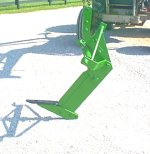
I would try to use a HD deep penetrating subsoiler first(24-26 inches deep about every 3 ft apart) and if that don't work, go to plan B. Ken Sweet
 

Attachments

  • johndeeresubsoilercat-2hitchniceside450.JPG
    johndeeresubsoilercat-2hitchniceside450.JPG
    71.2 KB · Views: 195
  • tuflinesingleshankusedsubsoilerfront395.JPG
    tuflinesingleshankusedsubsoilerfront395.JPG
    72.9 KB · Views: 191
   / How to Dry a Field #11  
If the water table is high, subsoiling it will not do anything cause the water is close to the surface, if there is a clay lense that holds the water on top and you can get to it by the subsoiler, it may work. Around here on the coast (High water table) they dug ditches between the fields anywhere fron 18" to 6-8 feet deep, the water will flow out of the soil into the lower open ditches and stand there and eventually run inot roadside ditches into a pond or river or swamp.
 
   / How to Dry a Field #12  
If the water table is that high, A subsoiler would do no good at all. I have 17 acres like that myself. Ken Sweet
 
   / How to Dry a Field
  • Thread Starter
#14  
Thanks for all the suggestions. The photos posted by rswyans are pretty similar to my situation. My last question is: what size drain rock should I be using in my trench? my options seem to be 1. pea gravel or 2. 3/4" rock or 3. 1 1/2" rock. I am thinking the 3/4" rock would be best. Any other reccomendations? Thanks again.
Wally Stein
 
   / How to Dry a Field #15  
Hopefully I can help solve your dilema as im a professional tile contractor. I'll be the 4th generation to do this so my advice is based on decades of experience. What it really depends on is how much you want to spend. If you want to do it right and not worry about it ever again, it'll cost you more. In my opinion, I would hire a contractor to come in and tile the whole thing. Most people think that running tile to the low hole will fix the problem, this is only partially true as the water that is collecting there, is running off the hills surrounding it. So one must ALSO tile the hill to cut off the water from ever reaching the hole. Water will still collect in the hole on heavy rains, so i would suggest 2 things, either install a french drain (trench backfilled with stone, going from the tile all the way to the top) or a T fitting put in the tile with a piece of tile coming up to the top. In your case if its your yard or just a field, i would rather go the french drain route, its cleaner looking and theres no open tile for trash to go in an plug up the system. A 4" tile has the capacity to drain roughly 4 acres, which is way more than what your plannin on draining.

Tile depth varies, and old time practice was to put tile in deep an wide, somewhere around 4' deep on about 50' spacing, farmers could drain more acres with less tile. But as time went by, we found out that on top of pulling the water table down too low (bad for crop root development) it also had a long response time (time it took for rain water to soak in an get to the tile). So tile is now put in at an average depth of 2.5-3.0ft depth, and around 40' spacing. Tile should also have a minimum grade of .2, thats 2 tenths of a foot, a rise of 2.4'' every 100', this will ensure self-cleanout.

for a rough pricing estimate, 4" tile costs around 30cents a foot, at most you have 2.5 acres to tile. on 40' spacing it takes 1089 feet of tile per acre, so your looking at around 2800' feet of tile, plus a lil extra maybe to run to an outlet, so 3,000' will probably be more than enough. what will really determine the price is a contractors installation price, around here in NW ohio the going rate is 20 cents a foot, anywhere else it ranges from 50 cents to over a dollar a foot. guessing the rate is 50 cents, you'll have an installation cost of around $1500, plus $900 for the tile, a couple ton of stone for the french drain, lets say 7 tons at $250 a ton, so another $1750 plus a few fittings, your looking at ROUGHLY $4300. may sound expensive to ya, may not, if its put in right even your grandkids wont have to worry about it. hope this helps and if you have any questions, please ask, i dont mind helpin others out.
 
   / How to Dry a Field #16  
Hopefully I can help solve your dilema as im a professional tile contractor. I'll be the 4th generation to do this so my advice is based on decades of experience. What it really depends on is how much you want to spend. If you want to do it right and not worry about it ever again, it'll cost you more. In my opinion, I would hire a contractor to come in and tile the whole thing. Most people think that running tile to the low hole will fix the problem, this is only partially true as the water that is collecting there, is running off the hills surrounding it. So one must ALSO tile the hill to cut off the water from ever reaching the hole. Water will still collect in the hole on heavy rains, so i would suggest 2 things, either install a french drain (trench backfilled with stone, going from the tile all the way to the top) or a T fitting put in the tile with a piece of tile coming up to the top. In your case if its your yard or just a field, i would rather go the french drain route, its cleaner looking and theres no open tile for trash to go in an plug up the system. A 4" tile has the capacity to drain roughly 4 acres, which is way more than what your plannin on draining.

Tile depth varies, and old time practice was to put tile in deep an wide, somewhere around 4' deep on about 50' spacing, farmers could drain more acres with less tile. But as time went by, we found out that on top of pulling the water table down too low (bad for crop root development) it also had a long response time (time it took for rain water to soak in an get to the tile). So tile is now put in at an average depth of 2.5-3.0ft depth, and around 40' spacing. Tile should also have a minimum grade of .2, thats 2 tenths of a foot, a rise of 2.4'' every 100', this will ensure self-cleanout.

for a rough pricing estimate, 4" tile costs around 30cents a foot, at most you have 2.5 acres to tile. on 40' spacing it takes 1089 feet of tile per acre, so your looking at around 2800' feet of tile, plus a lil extra maybe to run to an outlet, so 3,000' will probably be more than enough. what will really determine the price is a contractors installation price, around here in NW ohio the going rate is 20 cents a foot, anywhere else it ranges from 50 cents to over a dollar a foot. guessing the rate is 50 cents, you'll have an installation cost of around $1500, plus $900 for the tile, a couple ton of stone for the french drain, lets say 7 tons at $250 a ton, so another $1750 plus a few fittings, your looking at ROUGHLY $4300. may sound expensive to ya, may not, if its put in right even your grandkids wont have to worry about it. hope this helps and if you have any questions, please ask, i dont mind helpin others out.

How do you handle glacial silt to keep it from clogging the tile, rock, and any cloth used?
 
   / How to Dry a Field #17  
Dont use a sock or a trench liner, they really aren't needed. On average, we install between 1-1.5 million feet of tile a year, in ohio, north carolina, and iowa. and we never install tile with sock becuase it will plug up. your not ever going to stop dirt from getting into the tile, but as long as the tile has 2 tenths of grade on it, the dirt will wash out with the water. If the wrong stone is used for backfill in the low holes, it can also plug up. I know what your talking about when you mention glacial silt, we run into alot in iowa. I would say your best bet is either peat gravel, or maybe even sand. -joe
 

Tractor & Equipment Auctions

2017 Ford F-550 (A55973)
2017 Ford F-550...
2021 Kubota SVL75-2 Track Loader (A56438)
2021 Kubota...
2014 HYUNDAI 53FT DRY VAN TRAILER (A59905)
2014 HYUNDAI 53FT...
Schulte SBW800 Rock Windrower (A56438)
Schulte SBW800...
2018 KOMATSU WA320-8 WHEEL LOADER (A60429)
2018 KOMATSU...
2025 JMR 36in Bucket Mini Skid Steer Attachment (A59228)
2025 JMR 36in...
 
Top