YM276D Brakes

/ YM276D Brakes
  • Thread Starter
#41  
California,

Do you mean a snap ring on the INSIDE where all the rust was? I have been cleaning it and can take a look.

IMG_4090.JPG
 
Last edited:
/ YM276D Brakes #42  
From the looks of the photo, you want to replace all moving parts with the possible exception of the cam. Possible exception because when you get it apart to inspect, you may decide to replace it as well. I do not know if the ‘fixed’ pin is replaceable, although looking at other pictures and parts diagram, it appears it has a nut outside of the brake cover holding it in place. Cut the springs holding the shoes to center then remove the shoes.
Looks like a wire brush (or several are in your future. I also suspect that a snap ring in that rust will probably crumble.

The good news is it is out of the tractor and now you can work toward getting into pieces and rebuilding it to proper working order.
 
/ YM276D Brakes #43  
How does one make a "proper vent" for the brake cover? Anything is better than dealing with this again....

Rick, I am impressed that you used a dead blow and some tricky work to get that thing apart without damage. So I sure don't mind putting some writing time into what to do now. A lot of this is going to be things a guy with your mechanical talent obviously already knows. But it might help someone.

Well, your rust is as bad as any I've seen. The first thing is to have the drum lathed to see if you can get all the pits out. I doubt that one will simply sand out. Typically you can increase the ID of the drum up to maybe a total of somewhat less than the thickness of new pads. But check the cam actuation first - Lathing is an art and removing that much metal to get the pits out, still has to leave you the ability to use half a pad thickness on each shoe. If you go any deeper than that lathing, you will need to find thicker shoes or a different actuating cam - or both. Today that's a problem....Although in the days when mechanics hand-riveted shoes onto pads it was easy to reach on the shelf and grab the next thicker pad material.

I recommend lathing the inside of the drum first, because sometimes the rust forms pits and you need to know what you are going to have for drums. It doesn't take much pitting to quickly eat up a set of new brake shoes. Even worse, the pad material that get imbedded into the pits in the drum causes the brakes to be very "grabby" and tears up the shoe quickly.

Yes, it is sometimes possible to groove the new pads so that they miss the worst of the pitting in the drum! If you can, then do it. ( Oldmechanictrick #whatever)

If you have a problem with the drum pitting or finding good shoes, find out who is doing vintage car and motorcycle brake system work in your area. The shop may be British oriented, or older US. He/she will want your old pads and drum. It is possible to fit riveted pads onto the existing shoes by grinding off the remnants of the old bonded pads and then drilling the aluminum shoes for rivets. Much easier than making new shoes. There are tricks for pitted drums as well. ANYTHING IS FIXABLE. Usually the actuating cam is OK, but sometimes the bore it fits into in the drum cover is wallowed out., Check that, more on that below

The good news is that if fixed properly it will not happen again. New pads every 20 years should be the extent of the problem.

Let me back up a second here... sure we can rebuild it. We can rebuild anything. But I would be strongly tempted to firs see what OEM parts Hoye Tractor has for that YM276D brake system. And go from there. I'd be tempted to replace whatever I could buy with new OEM parts. Those old USA Yanmars are simply that good.

BTW, the YM276D was not a gray market tractor. It was made specifically for the US market and sold here back when Yanmar had dealers in the USA (the first time) - and Kubota not yet competitive. So your YM276D probably never saw a rice paddy. It may be from a flood area though, lots of that these days... Back in the days of the YM276D....way back before Yanmar did that dishonorable, disasterous deal with John Deere....back then YM276D and the YM336D were the flagship tractors of the line. Very nice and very,very expensive. Pricy even by today's standards. There was all kinds of literature is available for both with excellent printing and beautiful illustrations.

OK....finally to venting.... or not. Yanmar couldn't make up their mind on whether to vent that brake cover or seal them up tight. I've seen them both ways on different models. At first on the smaller older models YM135/155/186s and the green painted models like the old 195 Yanmar decided to try to seal up that brake housing so that water wouldn't get in. In those, you will find no vent in the cover, a fairly thick and compressible cover gasket (use silicon seal properly), and the actuating cam had not one but two O rings that fit into a polished bore in the cover. The actuating cam was shimmed for minimal end play, and then held in place with a circlip. If you put that system together and everything is just right, then no moisture can get in. I've taken these apart and there was no water at all.. That's perfection if you can do it. Yanmar rarely got it that perfect. Part of the problem was that Yanmar tended to use a stamped steel cover, no silicon sealer, and not enough cover bolts. So it flexed.

Then on the larger models from about the YM187 on up and on later US models Yanmar went to a heavier cast cover. Yours looks like one of those. It was more rigid, and had more perimeter bolts. But then they had a brain fart, and decided that it needed a little straight thru vent hole - which they put up at the top of the cover....thereby insuring that water thrown by the tire coud get into the brake housing where it would stay forever. Immortal corrosion.

And just to make sure water could get in, they re-designed the actuating cam support so it only had one O ring and the cam actuator screwed into a funky threaded mounting system that just didn't make any sense to anyone.

That's no good. About the best you can do for that system is to improve it. Since it has a vent as well as poor sealing on the actuating cam shaft, you need to also add a drain. And both vent and drain should be of adequate size and shielded somehow so that water has a difficult time getting in but can exit easily. Bascially this means drilling a larger vent, adding a drain hole, (1/4 to 3/8" diameter is my choice) and then using some small gas or plumbing fittings along with some tubing or hose. Now moisture can't be forced in by the tire slinging water or snow, and anything that does get in crossing a creek can drain and dry out.

I'm sure you can do better than I did. I modified without much finesse, and rarely twice the same way. The only rule at the time was that everything had to be cheap, durable, available at the local hardware store, and take little time to do. I used to drill the cover both high and low, thread the holes, and put in a right angle brass gas fitting of the 3/8" NPT to barb type. To that, I would either hang a couple of inches of rubber fuel line. That worked.

Sometimes if I felt artistic on a friend's tractor. Instead of a barb fitting I would instead use a right angle 3/8" NPT-to-copper flare fitting with a flare nut. Then instead of a few inches of rubber fuel line that could rot, both drain and vent would have a pice of soft copper flared and bent to fit.

Note that whether you use hose or tubing, the end of the fitting that goes into the hole you drill in the brake cover is usually a tapered thread. Get the right tap.

No, I don't think I have any photos. But here are some photos below of parts from an online hardware to give you an idea. Use your imagination.

And while you are at it, do the transmission vent under the seat as well - so vapor can exit the transmission housing but water can't go in. You don't need to add a drain to that system, just a better shielded vent.

Good luck,
rScotty
 

Attachments

  • Flare & bend.png
    Flare & bend.png
    31.1 KB · Views: 146
  • right angle.png
    right angle.png
    13.8 KB · Views: 151
  • 5346K19p1-c01h-digitall@1x_637085675233880537.png
    5346K19p1-c01h-digitall@1x_637085675233880537.png
    10.9 KB · Views: 141
/ YM276D Brakes #44  
California,

Do you mean a snap ring on the INSIDE where all the rust was? I have been cleaning it and can take a look.

California, I know the snap ring you mean. It was actually a pretty good system and could be shimmed to be even better. But not all of the models used that method to locate the actuator cam.
rScotty
 
/ YM276D Brakes
  • Thread Starter
#45  
Here is INSIDE the cover. This is the back side of the cam. Best I can tell the top one would push out the opposite way.
Right CamJPG.JPG
 
Last edited:
/ YM276D Brakes #46  
California,

Do you mean a snap ring on the INSIDE where all the rust was? I have been cleaning it and can take a look.

View attachment 660400
There was a snap ring there on the YM186D, in such poor shape that I had to go to a specialty parts house for a replacement.

But I was mistaken re your tractor. Obvious from your photo, no circlip (the more correct term) there.

Listen to rScotty. He's a pro with much experience. (Winston too). I'm just throwing out opinions, obviously not always correct ones.


Now I'm curious. What does hold that shaft in there?

Incidentally - post #45's photo seems to have disappeared.
 
/ YM276D Brakes
  • Thread Starter
#48  
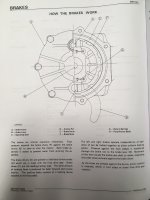
A couple of things. First, the cover doesn't appear to have any inlet to allow water inside, so if I make an inlet it would be the original, not simply enlarging one on the cover. Perhaps I should be looking elsewhere for the inlet. Second, the manual certainly doesn't offer much wisdom on how to disassemble the cover. It merely provides a rendition of the cover and simple explanation of how brakes work.

276 Brakes.JPG
 
/ YM276D Brakes #49  
A couple of things. First, the cover doesn't appear to have any inlet to allow water inside, so if I make an inlet it would be the original, not simply enlarging one on the cover. Perhaps I should be looking elsewhere for the inlet. Second, the manual certainly doesn't offer much wisdom on how to disassemble the cover. It merely provides a rendition of the cover and simple explanation of how brakes work.

View attachment 660574

Covers and vent holes in the covers - or not - did vary. When they did put in a vent hole it was a single simple drill hole about 3/4 of the way up the face of the cover and sometimes slightly angled upwards. Diam. about 3/32".

My guess is that Yanmar knew they had a water-in-the-brakes problem, and were trying simple ways to fix it. The same applies to how the brake cam actuator shaft is sealed where it passes through the cover. Take a close look at that as well.

My suggestion is to consider what happened to your brakes, and then ask yourself if that is how they intended the brake housing to work?
Did they intend for water to be trapped and cause corrosion? Probably not....so then how can it be improved? We may not get it right the first or secont time around...but then neither did Yanmar. The good news is it would be hard to make it worse. I see this kind of thing as being part of the enjoyment of having a vintage tractor.

BTW, make sure that the decal that is in the center of the steering wheel is intact. The decal is part of Yanmar's scheme to block water from flowing down around the nut that holds the steering wheel on and then eventually onto the top of the steering box where it eventually gets past the upper seal, displaces the oil in the steering box, and rusts the steering box bearings. So take a look at your steering wheel. If you can see the nut instead of a center mounted decal then check at the bottom of the mounting tube where there should be a small weep hole right above where the shaft connects to the steering box. Make sure that weep hole is open. Better yet, tarp the tractor. Or both.
good luck,
rScotty
 
/ YM276D Brakes
  • Thread Starter
#50  
BTW, make sure that the decal that is in the center of the steering wheel is intact. The decal is part of Yanmar's scheme to block water from flowing down around the nut that holds the steering wheel on and then eventually onto the top of the steering box where it eventually gets past the upper seal, displaces the oil in the steering box, and rusts the steering box bearings. So take a look at your steering wheel. If you can see the nut instead of a center mounted decal then check at the bottom of the mounting tube where there should be a small weep hole right above where the shaft connects to the steering box. Make sure that weep hole is open. Better yet, tarp the tractor. Or both.
good luck,
rScotty
Thank you. The tractor stays in a barn or garage when not being used. That corrosion had to occur or begin prior to me purchasing the tractor a couple of years ago.....
 
/ YM276D Brakes #51  
Thank you. The tractor stays in a barn or garage when not being used. That corrosion had to occur or begin prior to me purchasing the tractor a couple of years ago.....

The big lesson here for all of us is to learn all we can about our tractors and to check out all of the maintenance items as soon as possible once the tractor becomes ours.
Was that corrosion there 2 years ago when you bought it. Probably! Was it that bad? We will never know, but best guess is no—even humidity in the air can cause things to continue to rust.

How does your drum look? I expected much worse pitting on your cover than I saw in your pictures of it cleaned up. I also expected more rust in your drum than appeared in your pictures from the looks of your shoes and cover.
 
/ YM276D Brakes
  • Thread Starter
#52  
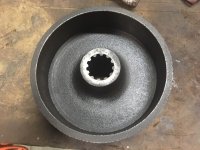
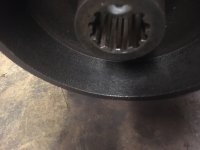
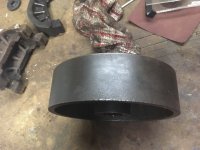
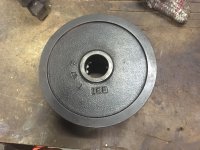
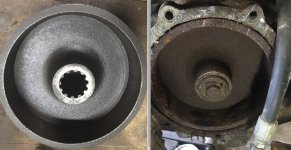
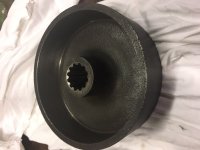
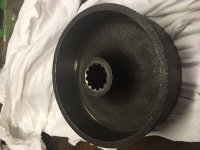
As suggested, the drum goes to the local mechanic to get machined tomorrow. Here is the rusty drum cleaned up a bit from when it was on the tractor.

IMG_4092.JPG IMG_4094.JPG IMG_4095.JPG IMG_4096.JPG

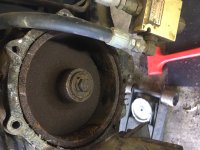
Versus this on the YM276D.

IMG_4085.JPG Clean:Rusty.jpg
 
Last edited:
/ YM276D Brakes
  • Thread Starter
#53  
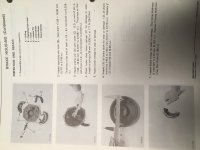
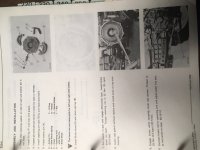
The mechanic didn't have a tool small enough to machine the drum. Hopefully a machine shop can surface the drum. The original YM276D Manual seems much more detailed with diagrams and information.

IMG_4103.JPG IMG_4101.JPG IMG_4102.JPG
 
/ YM276D Brakes #54  
Have you measured your drum’s inner diameter? 2 thoughts here.
1) Is the drum out of round—constant pressure from the locked up breaks equals heat build up. Then with the one liner loose inside the drum, it could have had pressure to force it out of round.
2) 2mm of wear allowance with continual pressure for ??? how long.....longer than you have owned it! Along with the depth of your pitting, you may just need to be looking for a replacement drum. Hoye shows it as a used part only so call them and any others you know of that might have used parts. Aaron at Hoye may be able to let you know of other tractors that may use the same brake drum.
 
/ YM276D Brakes #55  
The mechanic didn't have a tool small enough to machine the drum. Hopefully a machine shop can surface the drum. The original YM276D Manual seems much more detailed with diagrams and information.

View attachment 660975 View attachment 660976 View attachment 660977

Yes, I agree that a machine shop is the way to go for this. It sure would be easier on the machinist if he had a splined shaft to mount the drum on to maintain concentricity. Hoye may have a stub shaft that he uses as a tool for this. Probably worth a call.
I don't believe these are lined drums. it's been a lot of years, but I recall them as being one piece.
 
/ YM276D Brakes #56  
I don't believe these are lined drums. it's been a lot of years, but I recall them as being one piece.

I totally agree the drums are not lined but are as you say one piece. My reference to the lining was that one of his rusted up brake shoes appeared that the bonded brake lining had detached from on of the shoes. It was then possibly free to jam against the drum and other parts to constantly create heat and then when allowed to cool cause distortion in the drum.
Also that 1.9-2.0mm is very tight tolerance on being turned on a lathe. An inexpensive 6” slide caliber could have him using the time to find a machine shop to handle splined center looking fir a drum if it is beyond 142mm or out of round.
 
/ YM276D Brakes
  • Thread Starter
#57  
Coy, the machinist checked for out of round prior to working on the drum and stated it fell within tolerance. He also read the specifications from the manual provided above and said after machining the drum falls within specifications. The machinist finished the drum today and said he removed about 17/1000". Almost all of the pitting is gone, but some minor pitting exists. Running a finger across the area doesn't allow one to "feel" the pitting at all though. There is a slight discoloration in the area where the "pitting" still exists.

IMG_4108.JPG IMG_4109.JPG

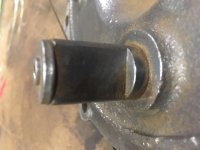
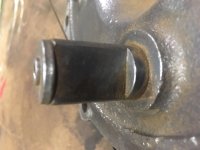
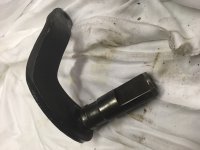
The operating arm/cam pin pressed out of the cover with no problems for cleaning. Whoever said the operating arm/cam pin had only one o-ring was spot on the money. And a very deformed and old o-ring it was. The operating arm/cam pin would barely move prior to removing it and cleaning, but it now easily moves when dry fitted. Of course, the o-ring needs to be replaced, but that should not offer a huge amount of resistance.

IMG_4111.JPG

The stationary one is certainly holding tight when put on the press. I am not sure it's worth risking cracking the cover to remove and reinstall that anchor pin since the exploded view shows no o-ring inside it. It seems appropriate to simply replace the washers and reinstall the nut.
 
/ YM276D Brakes #58  
Coy, the machinist checked for out of round prior to working on the drum and stated it fell within tolerance. He also read the specifications from the manual provided above and said after machining the drum falls within specifications. The machinist finished the drum today and said he removed about 17/1000". Almost all of the pitting is gone, but some minor pitting exists. Running a finger across the area doesn't allow one to "feel" the pitting at all though. There is a slight discoloration in the area where the "pitting" still exists.

The operating arm/cam pin pressed out of the cover with no problems for cleaning. Whoever said the operating arm/cam pin had only one o-ring was spot on the money. And a very deformed and old o-ring it was. The operating arm/cam pin would barely move prior to removing it and cleaning, but it now easily moves when dry fitted. Of course, the o-ring needs to be replaced, but that should not offer a huge amount of resistance.

The stationary one is certainly holding tight when put on the press. I am not sure it's worth risking cracking the cover to remove and reinstall that anchor pin since the exploded view shows no o-ring inside it. It seems appropriate to simply replace the washers and reinstall the nut.

I think that it was the brake operating arms on the earlier and smaller tractorsthat had two O rings mounted in grooves cut in the actuating arm. They sealed by being inside the bore of the mounting "barrel" on the cover. For some reason the YM276/336 went to a single O ring .... and I believe that O ring sealed differently. I think it was held pressed against the cover by the face of the actuating arm rather than being inside the cylindrical bore... but I'm not sure of that.... & also not sure just how your actuating arm is held into the case cover. It doesn't appear to have the shim & circlip setup of the smaller tractors, and from your picture it doesn't have the crazy threaded-into-the-cover mounting system that some did.

I would NOT try to remove the stationary shoe pivot. There isn't any advantage to doing so. It may be a shrink fit.

Nice brake job you are doing there.
rScotty
 
/ YM276D Brakes #59  
I agree with rScotty on not messing with the stationary pin at least not as long as it is the correct orientation for your shoes. Considering the condition that the cover appeared to be in when you got it off, you could create more problems.
It has been many many years since I have done any brake machining work, but I still have concerns about the drum. Back in the day, a standard pass on a lathe was 0.010”. Perhaps this has changed over those years I do not know!
The concerns that I have still have are
1) he did not take out all of the pitting
2) 0.017” converts to 0.4318mm
3) you did not mention measurements merely that you were told it was within specs

As you are talking about braking from high speeds as in an automobile, it will probably be fine. In truth if the drum was not out of round, it would have likely been fine without being dressed.
I do not know about your usage of brakes, but I do do that from your description, you have not had a brake on that side since prior to your ownership of the tractor.
I would tend to estimate my brake usage to be 95%+ as either while parked or while holding the tractor on a incline. The less than 5% remaining would including the stopping and starting on an incline and other slowing/ stopping and hard turning using one brake for steering.
Best of luck in getting those brakes all back together.
 
/ YM276D Brakes
  • Thread Starter
#60  
I agree with rScotty on not messing with the stationary pin at least not as long as it is the correct orientation for your shoes. Considering the condition that the cover appeared to be in when you got it off, you could create more problems.
It has been many many years since I have done any brake machining work, but I still have concerns about the drum. Back in the day, a standard pass on a lathe was 0.010? The machinest completed two passes because the first pass didn't remove the pitting to the touch. Apparently he wasn't quite cutting .10" each pass (or at least on average) Perhaps this has changed over those years I do not know!
The concerns that I have still have are
1) he did not take out all of the pitting
He said he removed it to the touch but not discoloration. Technically the pitting is gone.
2) 0.017 converts to 0.4318mm
The machinst measured the drum after turning at 140.5mm, the range is between 140 and 142mm for the drum.
3) you did not mention measurements merely that you were told it was within specs. The second photograph in post 53 in this thread shows the specs between 140 and 142mm (and a few other specs) according to the Yanmar manual

As you are talking about braking from high speeds as in an automobile, it will probably be fine. In truth if the drum was not out of round, it would have likely been fine without being dressed (several people suggested it was fine with a sanding, but I wanted it to be smoother).

I do not know about your usage of brakes, but I do know that from your description, you have not had a brake on that side since prior to your ownership of the tractor.
I would tend to estimate my brake usage to be 95%+ as either while parked or while holding the tractor on a incline. The less than 5% remaining would including the stopping and starting on an incline and other slowing/ stopping and hard turning using one brake for steering.
Best of luck in getting those brakes all back together.
Thanks for your help with the brakes.
 

Marketplace Items

(INOP) 2012 FORD F450 XL SUPER DUTY SERVICE TRUCK (A59823)
(INOP) 2012 FORD...
2014 Ford F-550 Altec AT40M 40ft Material Handling Bucket Truck (A61568)
2014 Ford F-550...
2023 FORD F-650 SUPER DUTY CAB & CHASSIS TRUCK (A59823)
2023 FORD F-650...
2025 Unused SDLGC80 60v Electric Golf Cart (A60352)
2025 Unused...
2021 CATERPILLAR 259D3 SKID STEER (A62129)
2021 CATERPILLAR...
New Holland EC215 (A60462)
New Holland EC215...
 
Top