Water lines for filling horse buckets

/ Water lines for filling horse buckets #1  

RobA

Platinum Member
Joined
Feb 27, 2005
Messages
567
Location
Chester County, SE PA
Tractor
Kubota L5030 HST
We're getting tired of dragging the hose around in the horse barn were going to add water lines from a cold water hydrant to each of 6 buckets. PEX would probably be good (and burst resistant in the winter) but it seems like there is more stuff to buy and more expensive. I figured running plastic piping would be cheap and easy. Should I use PVC or CPVC? Thoughts?
 
/ Water lines for filling horse buckets #2  
I would think you would have to heat tape them regardless of the type of plastic.
 
/ Water lines for filling horse buckets #3  
I'd use black poly pipe...it will not burst when frozen and the fittings are cheap and adaptable...

IMO there is nothing worse than PVC/CPVC in freezing conditions...they will bust every time...
 
/ Water lines for filling horse buckets #4  
water in lines in cold climates freezes sooner or later ... even if you get it routed , the water will freeze in the buckets anyway ....

so you are looking at heating wraps and bucket heaters .. extra cost and eventually a fire hazard as the equipment wears and frays ....

perhaps you can run a hose up to the rafters and back down again for filling the buckets ( inverted U ) .... put a dual hose bib at the hydrant end ....

close the free hose bib and turn the hose on , fill the buckets . ... the close the hydrant , open the spare bib and the nozzle on the far end of the hose .... the hose should drain from both ends and not freeze up ...
 
/ Water lines for filling horse buckets #5  
There are automatic water dispensing options that are available for stalls albeit pricey and you have to dig up the floor to bury the lines. I have used individual electric buckets (upward of 20-25 at times) and the insulated bucket holders too. I always had individual GFI's for each bucket so if one went bad, I would not loose a whole series of buckets. I have had buckets go bad and not heat but never an electrocution issue though I have heard plenty of stories from people that know someone that knew someone who....

The insulated bucket holders will freeze a little on top overnight as the temps get to around 20 but sure beat a plain bucket.

I forget the name now but I used to get this plastic pipe that was blue on the outside and an opaque white inside. I used brass fittings with double stainless screw clamps because I feel that the plastic fittings are prone to leakage. I also ran the lines inside four inch corrogated pipe for a little extra protection from the surrounding bakfill and to allow for some expansion and contraction. Glad where I live now that I don't need to bury water lines four feet deep.
 
/ Water lines for filling horse buckets #6  
black poly pipe, with plastic barb fittings and pipe clamps.

best bet is to dig up the floor, and install "frost free" hydrants at each location.

frost free hydrants, the valve itself is located a few feet deep under the ground, and when you turn off the hydrant any water in the pipe above the valve drains out down below ground. and in that keeping any water that would be above ground from freezing and cracking/busting pipes.

frost free hydrants only work if they can drain water out of them, if you attach a garden hose or like to them. and do not disconnect the hose... well something going to freeze crack / burst. and it could be hose or hydrant. (granted a 2 to 3 feet of hose, that stretchs over the fence and into a stall or lot or what not, is not going to harm anything, or less end of garden hose is submerged under water. everything just needs to drain of water, when ya shut off the hydrant.

============
cheap and easy, no such thing with plastic or any type of hard pipe or hoses.. the pipe may seem cheap, but once you hit those fittings and more so valves. BOOM! there went your budget a few times over.

============
to note it, PEX is just not a single type of material, there are wide variety of PEX piping out there. cheaper stuff and used a lot is the black poly pipe with barb fittings and pipe clamps.
 
/ Water lines for filling horse buckets
  • Thread Starter
#7  
....so you are looking at heating wraps and bucket heaters ...
We already use heated buckets in the winter and they work very well. Even last winter when we had several nights with temps near 0.

..perhaps you can run a hose up to the rafters and back down again for filling the buckets ( inverted U ) .... put a dual hose bib at the hydrant end ....
close the free hose bib and turn the hose on , fill the buckets . ... the close the hydrant , open the spare bib and the nozzle on the far end of the hose .... the hose should drain from both ends and not freeze up ...
That is exactly what I was thinking of doing except using PVC or Poly instead of a hose - although using a good garden hose might be easier. In the winter we drag the hose out, fills the buckets and then drain the hose. Using the "inverted U" setup would eliminate a lot of the work.
 
/ Water lines for filling horse buckets #8  
Avoid black poly pipe. It's cheap for a reason. CPVC is just for hot water. If you go with PVC, switch to copper where it comes above the ground and you wont' have any issues if it freezes. Be sure the PVC is below the frost line and it wont freeze. I like to put pipe insulation around the pipe where it comes above the ground, then slide a 1 1/2 inch plastic grey conduit over it and cap it. I put a 90 at the top of the pipe and run my faucet out the side of the grey conduit. It's a nice clean look that never gives me any problems. Temps here get into the teens and can remain freezing for up to a week.

PEX is really simple to use. The only tool you need is a crimper. I never use any of the slide on fittings, I don't trust them. While they work most of the time, they do fail and it's just too easy to use a crimper and never having to worry about a failure. PEX is rated for freezing temps and it's cost effective. There are some plastic fittings that you can use to make your connections, but I don't trust them either and use either the brass connections that they sell at the store, or make my own out of copper.

Plumbing is one of those things that after I'm done with it, I never want to see it again. For me, I will spend more time and more money to make it the best I possibly can. Cheaper and faster always results in having to do it again. And there is no such thing as a good time to fix a leak!!!!

Eddie
 
/ Water lines for filling horse buckets #9  
We already use heated buckets in the winter and they work very well. Even last winter when we had several nights with temps near 0..

up here , -40 F is common ... 0 is where you consider putting on the heavier winter coat instead of the lighter plaid lumber jacket.:rolleyes:
 
/ Water lines for filling horse buckets #10  
FWIW...for over 40 years I have maintained two different surface water/spring systems that supply 4 residences...the springs are located several hundred yards up steep mountainous terrain (where no trencher will go) so many of the black poly pipe lines lay on the surface...
The only issues I have ever had were with a few of the cheaper plastic couplings (I only use the steel ones now) cracked during a very hard freeze...just a slight trickle running through the lines prevent them from freezing...occasionally a squirrel will chew through a surface line... (no big deal IMO)...

Also several of the lines are overflow and auxiliary lines that are normally closed so they freeze up solid...after they thaw there are no issues (other than the cheaper plastic couplings I mentioned)

On the four residences that are served by the system...the poly pipe connects to the house plumbing that is either PVC or hard copper...I can't tell you how many times I have had to replace cracked/split copper and PVC at these locations...the black poly pipe has never split or cracked...
 
/ Water lines for filling horse buckets #11  
What type of copper cracked? I should have mentioned that I only use Type L, the heavier wall copper compared to the thinner wall Type M. I never touch the flexible stuff, that's pure junk and what I get to fix a lot of the time.


Eddie
 
/ Water lines for filling horse buckets #12  
What type of copper cracked? I should have mentioned that I only use Type L, the heavier wall copper compared to the thinner wall Type M. I never touch the flexible stuff, that's pure junk and what I get to fix a lot of the time.
Eddie
It was most likely the thinner walled copper...but I have seen poorly sweated fittings come apart (without splitting) under frozen conditions...
...as for PVC...I have occasionally (in a pinch) had to use some (Schedule 40) PVC fittings to make up connections to tanks, spigot risers etc...they never make it through even mild winters...they are the first things to bust/crack...

Curious as to the type of issues you run across with black poly pipe?...evidently some must be better than others as The only problems I have ever had are what I described...It (black poly) is the most widely used pipe in these parts for extended runs of water lines...

One thing about the better quality plastic fittings is there will sometimes be places where excess plastic (from the molding process) needs to be trimmed off so the pipe seats well on the barbs...
 
/ Water lines for filling horse buckets #13  
You getting water from a yard hydrant. Unless you allow it to drain after each use, It will freeze.

I suggest a Quick connect at the hydrant. from the QC run your water to the rafters, install a vacuum breaker at the highest point, and then lines to each bucket with a valve. After filling the buckets, disconnect at the hydrant, open the bucket valves. The whole system will then drain dry, drawing air through the vacuum breaker. It will never freeze since the water has been drained out
 
/ Water lines for filling horse buckets #14  
We already use heated buckets in the winter and they work very well. Even last winter when we had several nights with temps near 0.


That is exactly what I was thinking of doing except using PVC or Poly instead of a hose - although using a good garden hose might be easier. In the winter we drag the hose out, fills the buckets and then drain the hose. Using the "inverted U" setup would eliminate a lot of the work.

over rafter watering.png

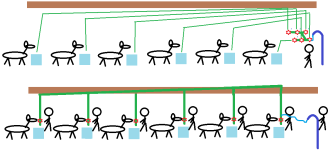
first diagram = central manifold (bunch of tees and valves with a frost free hydrant), each location has its own pipe ran to it.
--it is assumed, there is a bucket near to the hydrant, and that would be the last one to be filled up in winter. so you can drain the lines after shutting off hydrant.

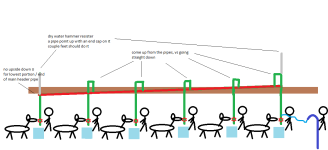
second diagram. single main pipe ran up in the rafters, and a drop leg to each bucket. with a valve near each bucket.
--the hose between hydrant and first bucket, may be iffy, if it is not hear the hydrant, and need for one more valve to be put into mix. so you can open valve and let water drain out of things once hydrant is shut off.

==================
1/2" inside diameter is more than plenty, you might get away with 3/8" inside diameter hose and/or pipe. but might advise the last couple feet of what ever goes into the bucket, be 3/4" this is more of an attempt to slow down the water, as it comes out. so it is not like a power washer, and spraying water all over the place.

a single handle 1/4 turn valve to fully open, more likely see them labeled as "gas valves" might be easier to deal with, vs the multi turn handle gate valves. the 1/4 turn and open valves may be a couple bucks more. but so much easier to use, more so if you have gloves on.

if ya looking at long runs, pvc pipe or a hard pipe might be better suggested if hanging from rafters and like. the stuff is less likely to "bend" or "sag" creating a low spot, were water would collect and freeze.
==================
big issue you are going to encounter "surging" lots of air in the pipe runs, and this is going to cause some water hammering. "you can fill and hear the pipes bounce around some" while ya filling up the buckets at each location. along with when ya open/close a valve.

a smaller inside diameter pipe, will help with the surging/water hammer effect, but will take a little longer to actually fill a bucket with water.
--pvc pipe with all the fittings will more likely be more prone to breaking / cracking due to the surging / water hammer.
--even black poly pipe you will get surging and water hammering like effect, but the hose may hold up, but the fittings will take the beating, just like pvc pipe.
over rafter watering.png
diy water hammer resister = just a piece of pipe sticking straight up with a end cap on it. this pipe is suppose to have air in it, and it will automatically get air in it. i honestly don't know how long, but if you have a 1 to 2 feet of length you can deal with it. make it 2 feet, it should be more than plenty.

coming up from the main pipe, lets air escape upwards, allowing water to fully go through pipe vs having little air pockets here and there.

to large of inside diameter of a pipe / hose in above diagram can be a bad thing. 3/8" most likely suggested, 1/2" maybe ok, 3/4" ya most likely asking for trouble, 1" ya never clear the air out, by the time ya fill up the buckets at each location.

===============
with anything above, or other, make sure you add extra bracing for the pipes, the plastic pipe hangers vs metal would be suggested, "less sharp corners" and considering amount of water surging / water hammering going on. the plastic might let things give and take some vs cutting into a pipe and puncturing it, or causing apipe to burst.
--were ever there is a fitting, is were the most abuse will happen. so get a pipe hanger around them.
--make sure the pipe hangers are snug on the pipe, (pipe not seating there loose), but also not so tight ya end up cracking pipe due to over tightening the hanger.

===============
above is rough thoughts. give/take from what you will. 100's ways to go about it.
 
/ Water lines for filling horse buckets #15  
Curious as to the type of issues you run across with black poly pipe?...evidently some must be better than others as The only problems I have ever had are what I described...It (black poly) is the most widely used pipe in these parts for extended runs of water lines...

My personal experiences are in dealing with leaks in mobile homes and areas of Tyler where it was installed for the water mains into the house. Both before and after the meter. The city of Tyler has a crew working 24/7 to fix water line leaks because for a period of time, they used it in thousands and thousands of homes. Freezing isn't a problem that I've had with it because it's either in the ground deep enough not to freeze, or it's in a mobile home that is heated. But the problems are breaking from movement in the ground or just being loose in a mobile home. It does not flex very well and it is not strong enough to handle it for very long. It cracks along the sides and the crack can vary from small to massive.

I've also seen this in Schedule 40 over fairly long runs in the hundreds of feet. If it's a really long run, then a gasketed pipe is the only way to go because of all the movement in the soil. This will allow the pipe to slide in and out of itself and not tear apart. I believe PEX will stretch enough to handle the movement of the soil, but my experience with PEX is for short runs of less then a hundred feet in the ground and inside houses.

As for copper fittings, it's either done right or it leaks fairly quickly. You really have to get it clean before sweating it and I also like to use Mapp gas to heat it in the yellow bottles. It's faster then propane and I think that makes a big difference, especially with sweating brass to copper.

Eddie
 
/ Water lines for filling horse buckets #16  
My personal experiences are in dealing with leaks in mobile homes and areas of Tyler where it was installed for the water mains into the house. Both before and after the meter. The city of Tyler has a crew working 24/7 to fix water line leaks because for a period of time, they used it in thousands and thousands of homes. Freezing isn't a problem that I've had with it because it's either in the ground deep enough not to freeze, or it's in a mobile home that is heated. But the problems are breaking from movement in the ground or just being loose in a mobile home. It does not flex very well and it is not strong enough to handle it for very long. It cracks along the sides and the crack can vary from small to massive.

I've also seen this in Schedule 40 over fairly long runs in the hundreds of feet. If it's a really long run, then a gasketed pipe is the only way to go because of all the movement in the soil. This will allow the pipe to slide in and out of itself and not tear apart. I believe PEX will stretch enough to handle the movement of the soil, but my experience with PEX is for short runs of less then a hundred feet in the ground and inside houses.

As for copper fittings, it's either done right or it leaks fairly quickly. You really have to get it clean before sweating it and I also like to use Mapp gas to heat it in the yellow bottles. It's faster then propane and I think that makes a big difference, especially with sweating brass to copper.
Eddie

After reading the above I truly do not think we are talking about the same type of "poly" pipe...what you are describing sounds like possibly "polybutylene"...google the word to read about all the issues and lawsuits over it's use in mobile homes, condos etc.etc...

The black poly pipe we use is very tough I use it from 2" down to 3/4"....you can repeatedly drive over this stuff and it will flatten out but I've never seen any type of crack, split etc...
 
/ Water lines for filling horse buckets #17  
Having lived both in East Texas (near Canton) and now West Texas (west of Abilene) and caring for 4 horses and a mini donk, I have yet to run lines in over 10 years of ownership. I maintain 2 600 gallon troughs, both are equipped with trough heaters when the weather is forecasted to be below zero. I hose fill em to the brim and set my heaters in then pull the hose into the garage. I have yet to run out of water for my small herd, have yet to run lines under asphalt (the wellhouse is on the far side of the drive). I maintain an extra 500 gallon tank in a protected area that won't freeze IF I need to get water to the horses but never have to date. TExas weather is a lot differnt than up north stuff where one can go 3 weeks below zero/freezing.

IF I were to design a system, it would be below the frost level of that area and I'd never use PVC but rather an insulated pipe coming from a warm water source (partial heat system to prevent water freezing enroute). The spigot or exposed area would be wrapped and a heat source available to prevent fast freeze. In texas, we don't face the weeks/months on end of sub freezing temps.
 
/ Water lines for filling horse buckets #18  
For well water we use blue polyB. As I recall polyB can withstand 4-5 freeze thaw cycles no problem.
Rating I seem to recall is like 150PSI or thereabouts. Some black poly also carries that rating.
Also to remember running water will not freeze so if overflow is not a problem leave the faucet opened a crack.
Heated tracing wire can also be a solution for those dicey areas. There are some tracing wires that are self regulating in that only the section that needs heat will get it, a bit more costly but excellent long term solution and no thermostats required. I know of some installations that are surface mounted and supply water even down to -35 deg. Naturally any or the more insulation provided the lower the hydroelectric costs.
 
/ Water lines for filling horse buckets #19  
I'm not sure what "black poly pipe" is being described in this thread. There's some relatively thin wall black plastic pipe they use on sprinker systems, but there's some of that black poly pipe that comes in a big coil that's pretty stiff stuff. Are we talking about the same pipe or different pipe?
 
/ Water lines for filling horse buckets
  • Thread Starter
#20  
Thanks for the suggestions. I wound up buying 1/2" pex and 1/4 turn valves for each bucket. Total cost was about $120 of which $39 was for the crimping tool. Total cost was cheaper than I thought it would be. It will be easy to drain the pex setup in the winter and much easier than dragging the hose around and draining it when done.
 

Marketplace Items

7058CFL (A59228)
7058CFL (A59228)
2017 FREIGHTLINER CASCADIA TANDEM AXLE SLEEPER TRUCK (A59905)
2017 FREIGHTLINER...
2014 Ford Flex SUV (A59231)
2014 Ford Flex SUV...
2004 GMC Sierra 3500 Pickup Truck (A55973)
2004 GMC Sierra...
54in Loader Fork Attachment (A59228)
54in Loader Fork...
BUYERS PREMIUM & PAYMENT TERMS (A59904)
BUYERS PREMIUM &...
 
Top