Train - hazardous cargo "accident"

/ Train - hazardous cargo "accident" #221  
I want to believe train brakes are designed Fail Safe. But, if that is correct, how did we end up discussing Lac Megantic ?

I "suspect" the findings will be that not enough hand brakes were applied. I've read that 5 locomotives and 10 cars had their hand brakes set. They are independent of the air system.

Bruce
 
/ Train - hazardous cargo "accident"
  • Thread Starter
#222  
It's been a while, so I may not have this right.....

There was a minor fire on the parked active locomotive, so the FD and/or a rail employee shut the locomotive down. Apparently standard procedure when responding to a locomotive fire.

With the engine down, air pressure would drop. If all the "regular" air brakes on the train are designed to automatically apply with low pressure, I can't see the train rolling away like it did. Same goes for the other earlier runaway train in Quebec.

Yes, too few manual brakes are cited as the cause for the roll-away, but the recent personal conversation I had leaves me puzzled about train air-brake design.

Rgds, D.
 
/ Train - hazardous cargo "accident" #223  
I think enough hand brakes were applied but the other issues such as the Engine fire and subsequent shutdown of the Robotic Locomotives by accident no doubt had a lot to do with the runaway.
If the one man crew Engineman/Conductor had put 15 handbrakes on the rail cars and only 1 on an engine and the train sat secure he would have been under investigation by the company for delaying the train as the person coming on duty to relieve him would have to go and undo what he did a real catch 22 but thats a railroad reality as "these wheels must turn"
The disaster in Quebec was the Perfect Storm that same method of securement had gone on for months and months and nothing happened but when it did....
 
/ Train - hazardous cargo "accident"
  • Thread Starter
#224  
If the air "bleeds" from a rail car the brakes will release unless a hand brake is applied which is the mechanical brake
I think a truck applies its mechanical brake when the air is released automatically

Yes, I think that was the gist of my buddy's point.

Guessing.... but maybe the rail rationale is they don't want to have just one car spring a leak and be dragged along with all it's wheels locked up. With the high rolling staff levels of days of olde, the idea of an entire train rolling away was probably not considered as likely.

Rgds, D.
 
/ Train - hazardous cargo "accident" #225  
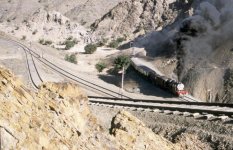
Runaway train track in Pakistan.

runaway_track_RZ.jpg
Logic is Variable: Khyber Pass Railway
 
/ Train - hazardous cargo "accident"
  • Thread Starter
#226  
I think enough hand brakes were applied but the other issues such as the Engine fire and subsequent shutdown of the Robotic Locomotives by accident no doubt had a lot to do with the runaway.
If the one man crew Engineman/Conductor had put 15 handbrakes on the rail cars and only 1 on an engine and the train sat secure he would have been under investigation by the company for delaying the train as the person coming on duty to relieve him would have to go and undo what he did a real catch 22 but thats a railroad reality as "these wheels must turn"
The disaster in Quebec was the Perfect Storm that same method of securement had gone on for months and months and nothing happened but when it did....

Sounds like Profit Before Safety, to me. Rail is hardly the only industry guilty of same.

Playing the odds, cutting corners...... has some interesting reinforcement patterns for people. I draw a parallel with driving drunk - just because somebody gets away with it, doesn't mean that the behaviour should be repeated.

Just heard on CBC, another significant derailment in NB......

Wapske derailed train on fire, carrying propane, crude oil - New Brunswick - CBC News

In another area of society the question gets posed "Who shall police the Police ?". In the area of this thread, I have the impression that Rail is only lightly policed, at best. These last paragraphs are from the end of the linked article.

A CBC investigation into rail safety revealed that CN Rail did not report to authorities more than 1,800 derailments and accidents, including 44 on key rail arteries.

One of those derailments occurred in Plaster Rock which was one of two incidents that prompted the Transportation Safety Board to seek a summons ordering CN to turn over all accident records.


Rgds, D.
 
/ Train - hazardous cargo "accident" #227  
If the air "bleeds" from a rail car the brakes will release unless a hand brake is applied which is the mechanical brake
I think a truck applies its mechanical brake when the air is released automatically
Correct. A truck has spring applied brakes that release with air pressure. When you run out of air, you stop.
A train has air applied/released brakes. When you run out of air, you don't stop.

Aaron Z
 
/ Train - hazardous cargo "accident"
  • Thread Starter
#228  
Correct. A truck has spring applied brakes that release with air pressure. When you run out of air, you stop.
A train has air applied/released brakes. When you run out of air, you don't stop.

Aaron Z

At the risk of understating the obvious, I don't consider the train design to be Fail Safe.

When I consider what is imposed on trucking, and that I can't put the lightest car made on the road w/o a secondary redundant driver actuated E brake system, I think I'm being fair when saying that Rail gets away with things no other transport sector can.

With an engineer in the cab, yes, I get that a train can dissipate energy w/o working brakes - but you can make the same argument with a car. Still, you wouldn't get past a Safety Check on a car here, w/o a working Ebrake.

With people mostly buying automatics here, it doesn't get used that way much, but one of the design goals for Ebrakes on cars/light trucks is to secure it quickly when Parked. I find it troubling that the lightest vehicles in common use are mandated to have this requirement in place, but not the heaviest high speed machinery in use - Rail.

Yeah.... I get that it's all about Cost Containment/Reduction...... I'm not particularily a fan of lawyers in general, but I hope that some major lawsuits are won against the rail co's, for negligence. The government seems to be doing about as much disciplining of the rail co's as the parents were of the "affluenza" idiot that was recently in the news.

Rgds, D.
 
/ Train - hazardous cargo "accident" #229  
Train brakes are just an advancement over what trains originally had, brakemen. Each car had a man on top of them that would manually apply the brakes when the engineer yelled to them. This, of course had many problems. Between men falling off the train and not hearing the commands trains were vary dangerous. The air bake system was never designed to set or release a parking brake. Labor was cheap so it was assumed that men would just set them as needed.

Trains only have one common airline. That airline serves two duties, first it fills a tank on each car. That tank provides the braking power. The second is to overcome the pressure in the tanks to release the brakes. The final piece of the puzzle is a valve that senses pressure in the common air line. If there's no pressure then the valve opens the line between the pressure tank to the brakes. When there is air the valve closes so the air can't leak out of the pressure tank and bleeds off the brakes. The system works well because the same pressure needed to release the brakes also fills the tank through a check valve. The system doesn't work well because if their are any leaks in the car then the pressure in the tank bleeds off. If the check valve fails to let air into the pressure tank then you have no braking ability at all.

A truck air brakes have a spring in each actuator on the rear wheels. When there is no air the spring applies the brakes. When a driver wants to move they push a parking brake release button and air is applied to the other side of a diaphragm that counters the spring pressure. It takes about 40 psi to over come the spring. After that a second air line connects to another diaphragm that applies the brakes. This system takes two airlines, one to release the brakes, the other to apply the brakes. Secondly the spring's force is much less than the amount of force the air line applies.

A truck weighs a fraction of what a loaded train car could weigh. Any new system would have to be designed to that the spring could apply enough force to hold the train from moving yet be countered by the air from the locomotive. If the brakes on a trailer fail the driver knows pretty quickly and is trained to pull off the road. If one rail car fails it would be impossible for the engineer to know. A stuck brake could cause serious problems. It would overheat and could cause a fire. It could send enough heat to the wheels bearing and cause it to fail. Worse case it could cause a derailment. As it is sticking brakes are an issue with trains so any new system couldn't make it worse. Any new system would have to work with the infrastructure of the current system or a massive upgrade would be needed.

I know there have been attempts to transform to an electric pneumatic system that would use an electrical signal to apply the brakes but I think they were focused on train braking while in motion, not upgrading to an automatic parking brake system.
 
/ Train - hazardous cargo "accident" #230  
And sticking brakes are a real problem in the winter months when the engines cant pump enough air into the train line
 
/ Train - hazardous cargo "accident" #231  
When I consider what is imposed on trucking, and that I can't put the lightest car made on the road w/o a secondary redundant driver actuated E brake system, I think I'm being fair when saying that Rail gets away with things no other transport sector can.
...
With people mostly buying automatics here, it doesn't get used that way much, but one of the design goals for Ebrakes on cars/light trucks is to secure it quickly when Parked. I find it troubling that the lightest vehicles in common use are mandated to have this requirement in place, but not the heaviest high speed machinery in use - Rail.

Rail cars and locomotives do have a manual brake like cars and trucks.
 
/ Train - hazardous cargo "accident"
  • Thread Starter
#232  
Train brakes are just an advancement over what trains originally had, brakemen. Each car had a man on top of them that would manually apply the brakes when the engineer yelled to them. This, of course had many problems. Between men falling off the train and not hearing the commands trains were vary dangerous. The air bake system was never designed to set or release a parking brake. Labor was cheap so it was assumed that men would just set them as needed.

Trains only have one common airline. That airline serves two duties, first it fills a tank on each car. That tank provides the braking power. The second is to overcome the pressure in the tanks to release the brakes. The final piece of the puzzle is a valve that senses pressure in the common air line. If there's no pressure then the valve opens the line between the pressure tank to the brakes. When there is air the valve closes so the air can't leak out of the pressure tank and bleeds off the brakes. The system works well because the same pressure needed to release the brakes also fills the tank through a check valve. The system doesn't work well because if their are any leaks in the car then the pressure in the tank bleeds off. If the check valve fails to let air into the pressure tank then you have no braking ability at all.

A truck air brakes have a spring in each actuator on the rear wheels. When there is no air the spring applies the brakes. When a driver wants to move they push a parking brake release button and air is applied to the other side of a diaphragm that counters the spring pressure. It takes about 40 psi to over come the spring. After that a second air line connects to another diaphragm that applies the brakes. This system takes two airlines, one to release the brakes, the other to apply the brakes. Secondly the spring's force is much less than the amount of force the air line applies.

A truck weighs a fraction of what a loaded train car could weigh. Any new system would have to be designed to that the spring could apply enough force to hold the train from moving yet be countered by the air from the locomotive. If the brakes on a trailer fail the driver knows pretty quickly and is trained to pull off the road. If one rail car fails it would be impossible for the engineer to know. A stuck brake could cause serious problems. It would overheat and could cause a fire. It could send enough heat to the wheels bearing and cause it to fail. Worse case it could cause a derailment. As it is sticking brakes are an issue with trains so any new system couldn't make it worse. Any new system would have to work with the infrastructure of the current system or a massive upgrade would be needed.

I know there have been attempts to transform to an electric pneumatic system that would use an electrical signal to apply the brakes but I think they were focused on train braking while in motion, not upgrading to an automatic parking brake system.

Thank you for those details, and the history too ! As precise as engineering should be, there are always tradeoffs that have to be made, and you have confirmed some things I suspected, and enlightened me about some other issues.

With large and old systems like trains, there can be quite of a bit inertia in place, in regards to technical changes. Sometimes that opposition is for good reasons.... sometimes not.

Blue sky for-instance... revamp the air system on a car, to accept some smarts, and put a watchdog system on the main compressor. Default the on-car smarts so that if it doesn't get the watchdog signal from the main compressor, after a certain delay it slowly applies, then sets the brakes on. Perhaps sets a latch that needs to be manually reset before the brake will release.

Watchdog signal at the compressor is basically "Compressor healthy, output pressure within spec" and any other relevant supervisory smarts. I don't know trains, perhaps there is a valid situation where you want to proceed without a functioning compressor, but this scenario might prevent roll-aways.

Today, the control technology to implement the basic scheme I described is trivial, and cars could be RF linked, to avoid re-wiring.

One of the reasons air is used on transport systems is it cheap to implement over long distances. The electronics to build in some useful Fail Safe smarts into these legacy air systems are readily available, and basically cost almost nothing (relative to the cost of a rail system, and its rolling stock).

Thanks, and Rgds, D.
 
/ Train - hazardous cargo "accident"
  • Thread Starter
#233  
Rail cars and locomotives do have a manual brake like cars and trucks.

The impression I got was that manual brakes were available on the train cars and locomotives, but too few were set (or at least in terms of functional ones). The business reality I'm hearing on here is that the few (ONE in the case of the title accident) personnel on the train are pressured to keep a tight schedule, and the manual setting and release of brakes is frowned upon as a time-waster. Is what it is.

Another impression I have is that there are no agreed-upon federal standards for the # of parking brakes to be set - it's up to the train crew, perhaps effectively what I called in another world "tribal knowledge". I don't actually mean that in a negative sense - over time I've found that some scarily important stuff is not written down anywhere, but rather passed along as oral history !

My first hope is that trained staff are in place that fully know what they are doing. Unfortunately, many corporations don't like the cost implications of that hope.... but I digress, a bit.

I actually often prefer simple,hands-on operator controlled actions for many things, but this application nearly screams out for a computerized baseline control. Once you have some "smarts" in place at the car brake level, based on grade slope and train weight, a computer could recommend setting XY # of parking brakes.

Press a few buttons in the cab, and XY brakes are set to Park, on the train. Return to the train, and so long as the main air compressor is running, the Parking brake latches can be reset in the cab, with a few keystrokes. If the air compressor has failed and can't recover, then the Parking brakes need to be Released manually.

Adequate brakes get set, and the employee time to Set/Release them is minimal. I'd have trouble believing that a graduate MechEng would have trouble coming up with the datatable of GradeSlope vs. Train Weight vs. Minimum Brakes to Set.

While you are at it..... putting a bit more telemetry on the car brakes would be pretty easy - Brake temperature, movement of key actuators, air leakage rates per car...... tells you about sticking and overheating brakes automatically.

Any system like this today would report anywhere on the globe, so the data could be reviewed by people other than just the over-worked/tired crew on the train. Extra eyes can be really useful.

As always, any of these "smart" systems should be designed for manual override, under the control of an appropriately authorized person - confirmation sign-off by a Yardmaster, Eng specialist.....

I don't put blind faith into "smart" tech solutions, but IMO, train technology in regards to what we are discussing in this thread needs a significant amount of attention and updating.

Rgds, D.
 
/ Train - hazardous cargo "accident" #234  
Where that runaway happened there was no Yardmaster etc to sign off to maybe a dispatcher but who knows where he is located
And that Shortline equipment was borderline maintained at best and they would never purchase the equipment(Loco's) with that technology they run on a shoestring.
The new Locomotives have push button handbrakes on them now that wind on but they still have the manual override
And as you said a one man crew can be overworked it's nonsense that it's allowed
 
/ Train - hazardous cargo "accident" #235  
the same train who derail in plaster rock nb go by about 1000 feet down hill from my house in st basile nb canada
 
/ Train - hazardous cargo "accident"
  • Thread Starter
#236  
Where that runaway happened there was no Yardmaster etc to sign off to maybe a dispatcher but who knows where he is located
And that Shortline equipment was borderline maintained at best and they would never purchase the equipment(Loco's) with that technology they run on a shoestring.
The new Locomotives have push button handbrakes on them now that wind on but they still have the manual override
And as you said a one man crew can be overworked it's nonsense that it's allowed

What I still don't get - why do we have to tolerate having these 3'rd World shortline tracks in place ?

The major rail companies and the refineries get to profit HUGELY from handling and processing the oil, while mjym and many other people have to assume the risk of being in proximity to these poorly maintained lines.

How can we continue to consider Canada as a first world country ? This is banana republic thinking, at best.

Rgds, D.
 
/ Train - hazardous cargo "accident"
  • Thread Starter
#237  
The one bright spot in this rather depressing article was the following:

Similar crashes in recent years spurred the U.S. government to legally require all companies by 2015 to implement so-called positive train control, an automatic anti-crash system that can halt a train that is speeding or at risk of a crash.

Jeanes said Canada has decided to take a wait-and-see approach, watching the U.S. for signs that the costly systems prove worthwhile, though most industrialized countries have introduced the automatic train control systems.


Rail safety: Train operators breaking more rules in recent years - Canada - CBC News

While the canadian stance is pretty sad, it is good to see some initiative from Washington. While Business as Usual has been good for CorporateGovernment, it is getting too many people injured/killed.

Rgds, D.
 
/ Train - hazardous cargo "accident" #238  
The big problems began when the RR's were allowed to privatize and make money for shareholders
Everything that could be cut was and still is under the guise of safety 1st
Short Lines were created because the shareholders would not agree to maintaining lines that the Big Boys sad didnt handle enough freight to keep them happy.
They told shippers to bad and their only choice was to allow the Shortlines and they dont have enough staff to keep up when they inherit new business (crude oil) and things disintegrate.
The same guy who inspects the Engines could also be required to inspect the tracks and repair them also
 
/ Train - hazardous cargo "accident"
  • Thread Starter
#239  
The big problems began when the RR's were allowed to privatize and make money for shareholders
Everything that could be cut was and still is under the guise of safety 1st
Short Lines were created because the shareholders would not agree to maintaining lines that the Big Boys sad didnt handle enough freight to keep them happy.
They told shippers to bad and their only choice was to allow the Shortlines and they dont have enough staff to keep up when they inherit new business (crude oil) and things disintegrate.
The same guy who inspects the Engines could also be required to inspect the tracks and repair them also

If you can make your problem somebody else's problem, it's not a problem. Triple bonus marks if you insulate yourself from a problem while still continuing to benefit from the major revenue stream that those risks entail.

Calling our (Canadian) govt watchdogs toothless belittles canine dental problems.

If they had any teeth, these 3rd World Short Lines would be shut down, and they'd also take a meaningful run at hammering on Big Rail, instead of just writing reports with obvious conclusions, a year and half after an accident. Writing reports w/o any significant enforcement and penalities is not much better than doing nothing - it just becomes window dressing for pretend oversight.

If the Short Lines were shut down. I think you'd find Big Oil and Big Rail would pretty quickly take some of their profits and get these tracks up to spec soon enough.

Barring that happening, realistically, the only real way to correct this behaviour is with major lawsuits. It gets real simple - Pain, or No Pain. Until the cost of legal settlements exceed the cost of Business as Usual, things aren't going to change much.

Rgds, D.
 
/ Train - hazardous cargo "accident" #240  
It looks like NTSB is starting to realize how many lives are at risk every day with these trains. they are considering updating
standards for the cars hauling this high test oil:

Rail cars used to ship oil called 'unacceptable'

a small excerpt:

"The NTSB has been urging replacing or retrofitting the tank cars since 1991, but the most recent federal effort to write tougher regulations for new cars didn't get underway until 2011. An initial public comment period closed in December, and regulators are currently at work writing proposed new standards, Cynthia Quarterman, head of the Transportation Department's Pipeline and Hazardous Materials Safety Administration, told the panel. She said she expects her agency to propose new tank car standards before the end of this year, but refused to be pinned down under questioning by lawmakers on when those rules might become final.

"Right now, there is so much uncertainty that people aren't going to make investments in safer cars and they're going to keep running these crummy cars and killing people," Rep. Peter DeFazio, D-Ore., complained. "
 

Marketplace Items

2020 Deere 750K LGP (A53317)
2020 Deere 750K...
500 BBL FRAC TANK (A58214)
500 BBL FRAC TANK...
2008 Ford Fusion SE Sedan (A59231)
2008 Ford Fusion...
2015 DODGE RAM 3500 4X4 CREW CAB PICKUP TRUCK (A59904)
2015 DODGE RAM...
2023 RTVXG-850 SideKick (A61306)
2023 RTVXG-850...
2018 INTERNATIONAL LT625 TANDEM AXLE SLEEPER (A59904)
2018 INTERNATIONAL...
 
Top