Tire PSI question...

/ Tire PSI question... #1  

Podunkadunk

Veteran Member
Joined
Jan 2, 2007
Messages
1,185
Hi all,
I have a L3130, HST, 4x4. I was reading my operator's manual and now I'm confused. Please chime in with your interpretation/advice.

The manual has a warning which reads "Always maintain the correct tire pressure. Do not inflate tires above the recommended pressure shown in the operator's manual."

So, the manual states the inflation pressure for my unit is:

R-4's;
Front tires: 10-16.5 NHS, 6PlyRating...20psi
Rear tires: 420/70-24, 6PlyRating...20psi

You would think it would be pretty simple, but then there's this note:
"Maintain the maximum pressure in front tires, if using a front loader or when equipped with a full load of front weights." For my particular unit, that weight happens to be 386 lbs.

That statement is what is confusing me. Which "maximum" are they talking about? The manual says 20psi, but doesn't list a max or min, just 20psi.

The tire itself has a warning on the side of it stating not to exceed 45psi max cold.

I understand the meanings of these notes and warnings, but can't figure out which pressure they are talking about.

I DO NOT have an FEL, but I just added approx. 320lbs of weight to the front end (total of the grill/brush guard weight and 2 (55lbers) and 2 (80lbers)).

I know this seems like a lot of info for a "simple" tire psi question, but I wanted everyone who reads it to have the same info I have and be well informed before giving me your thoughts.

What pressure should I maintain in the front tires?

-Podunk
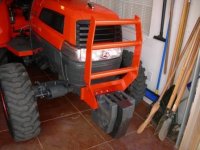
DSCN0478.JPG
 
/ Tire PSI question... #2  
In the automotive and trucking world the "max" preasure is what is listed by the manufacturer of the vehicle. The max preasure on the sidewall of the tire is very often higher than the vehicle manufacturers max preasure rating. One reason is the application, the other is that the rim may not be able to hold the higher preasure. I know many heavy truck rims are rated at between 120-130 PSI while the tires on them may have a max preasure of 150-200 PSI.

It could be the case that your tractors rims are not rated for 45 PSI. I know truck rims are usually marked with the max preasure they can hold. You might check to see if your rims are stamped with the max preasure rating. The next step would be to call the dealer and inquire.
 
/ Tire PSI question... #3  
Podunkadunk,

Good question. I hpoe more people chim in.

I have a 3130 with Ag tires and FEL. I think the manual calls for 18 psi. I am running around 22 psi in the fronts but it doesn't take very much to flaten the tires when carrying a load in the bucket or on the forks.
 
/ Tire PSI question... #4  
I have a L3130 with a FEL that is about two weeks old. I asked the same question when I read the operator's manual. I think you stand a chance of rolling the tire off the rim with power steering and four wheel drive and carrying a decent load with the FEL. I inflated my front tires (R4) to 40PSI. The back tires (R4) have 20PSI.
 
/ Tire PSI question...
  • Thread Starter
#5  
hunterridgefarm said:
Podunkadunk,

Good question. I hpoe more people chim in.

I have a 3130 with Ag tires and FEL. I think the manual calls for 18 psi. I am running around 22 psi in the fronts but it doesn't take very much to flaten the tires when carrying a load in the bucket or on the forks.

Well, 110 people have read the post as of this posting...with only 3 responses. I guess it's got everyone stumped! It makes no sense whatsoever...and if someone can make heads or tails of it, please CHIME IN with your thoughts. I'm totally confused.

I read all the time in TBN "read the operator's manual", "follow the manufacturer's recommendation", etc, etc etc. Well, I did, NOW WHAT?

I just want to know where all the "experts" and are now. Where are all those guys who are always touting their hundreds of hours of operation and thousands of posts in TBN?

I think I'm going to post it in the "General" section...gets more attention. I need an answer.

Podunk
 
/ Tire PSI question... #6  
Ok, well, the way I took it when I read my similar manual notation:
20psi is the mfg max recommendation. You can go lower for comfort (suspension in bumpy conditions) or for more traction or whatever but, if you have a FEL on or weights, don't go below 20psi. Just the way I saw it. :)
 
/ Tire PSI question... #7  
Podunkadunk said:
Well, 110 people have read the post as of this posting...with only 3 responses... I just want to know where all the "experts" and are now. Where are all those guys who are always touting their hundreds of hours of operation and thousands of posts in TBN?

I think I'm going to post it in the "General" section...gets more attention. I need an answer.

Podunk

WHAT - YOU DIDN'T GET THE ANSWER YOU WANTED IN SIX HOURS?!?!?!:eek:
 
/ Tire PSI question... #8  
HomeBrew2 said:
20psi is the mfg max recommendation. You can go lower for comfort (suspension in bumpy conditions) or for more traction or whatever but, if you have a FEL on or weights, don't go below 20psi.
That's exactly the point. You can go softer for comfort but if you have a FEL or front weights you have to inflate the front tires at 20psi (if 20 is stated in your manual).

Here's an exemple with my tractor. The manual states to inflate the front tires at 22psi (turf) or 35psi (R4)... maximum. It can be less than that (comfort) but for loader work and front weights it should be at 22psi (turf) or 35psi (R4). It's very important because the front tires tend to distort a lot especially with heavy loader work.
IMHO this is the major advantage of R4 tires over turf or AG, with more pressure the tires are stiffer and can bear more weight without distortion.

You said 320 lbs. IMHO this weight is nothing compared to a full loader charge. If the manual states 20psi for the front tires, I'd do exactly that and never think about that again.

I hope it helped you a bit.
 
/ Tire PSI question...
  • Thread Starter
#9  
Stef said:
That's exactly the point. You can go softer for comfort but if you have a FEL or front weights you have to inflate the front tires at 20psi (if 20 is stated in your manual).

Here's an exemple with my tractor. The manual states to inflate the front tires at 22psi (turf) or 35psi (R4)... maximum. It can be less than that (comfort) but for loader work and front weights it should be at 22psi (turf) or 35psi (R4). It's very important because the front tires tend to distort a lot especially with heavy loader work.
IMHO this is the major advantage of R4 tires over turf or AG, with more pressure the tires are stiffer and can bear more weight without distortion.

You said 320 lbs. IMHO this weight is nothing compared to a full loader charge. If the manual states 20psi for the front tires, I'd do exactly that and never think about that again.


I hope it helped you a bit.

Thanks HomeBrew2 and Stef. I have them set at 20 psi. I interpreted it as you did, but with an owner/operator manual, you'd think they'd be specific.
'Preciate it. Have a good evening.
Podunk
 
/ Tire PSI question... #10  
I think you got your answer but here is a bit more to think about when generally considering tractor tire pressure.
  • Lower pressure will offer more traction
  • Lower pressure will minimize damage to the lawn
  • Higher pressure will compact soil, fields, lawn, etc (which is why farmers use low pressure)
  • Higher pressure increases safe loader capacity
  • No matter what pressure, the sidewall will increase the actual ground pressure by 5 to 15 PSI depending on the sidewall stiffness (R4 tires are stiffer than Turf tires, etc)
 
/ Tire PSI question... #11  
I put my two cents worth in the own-op forum where this is also posted.
 
/ Tire PSI question... #12  
On my toy tractor I'm not sure what the maximum or minimum is for tire inflation. I just experimented and found 30 psi on the front and 15 psi on the back worked well.

I also noted higher inflation pressures led to less flats.:D

On the truck the tires run at 80 psi.:D
 
/ Tire PSI question... #13  
>>What pressure should I maintain in the front tires?<<

That depends on the amount of weight each tire is expected to carry, subject to the maximum air pressure recommended by the tire manufacturer, as stamped on the sidewall of the tire.

For example, your 420/70-24 will carry a maximum load of 3960 pounds at 20 psi. That same tire will only carry 3640 pounds at 18 psi. If a rear tire is expected to carry more than 3960 pounds, you will need to replace your tires with tires of a higher load carrying capacity, for example, 8 ply tires.

The 10x16.5 will carry a maximum of 3500 pounds at 45 psi. That same tire will only carry 2760 pounds at 30 psi.

What all this boils down to is that to correctly answer your question you would need to weigh each half of the tractor. Generally, I recommend the least amount of air pressure that can handle the load. If you want to weigh the front/rear of your tractor, I would be happy to tell you what air pressure you should run in your tire. Short of that, it is anyone's guess what the proper pressure should be.
 
/ Tire PSI question... #14  
On a flat surface, the tire treads should be flat against the ground. Maximum traction. On a tubeless front I/C tire used on a loader, go up to prevent popoff during turning with a load . On ag. type we inflate 14 in rear and 28 in front.
 
/ Tire PSI question... #15  
As I mentioned in the other thread, where you asked the same question:
--------------------------------------------------------------------------------

As long as the tire is still "pneumatic"--that is, sidewalls flex and rim isn't on the ground, then the number of sq. in. of tire patch on the ground times the psi is the weight on that tire.

Or, conversely, (don't do this) air down the tire until the rims touch, then add some air and check the psi. That's the minimum needed to support the load. If it's less than 20psi, air up to 20 psi in order to make sure the tire won't come off the rim (i.e., break the bead) when turning. If, on the other hand, in order to get the rim off the ground you would need more psi than the max inflation pressure listed on the sidewall, then get bigger tires, or a tire load rating that can support a higher max inflation pressure, or a smaller load. This is all for static load and if you were zipping along uneven ground, you would have to account for dynamic loads (jounce and rebound) which, in fact, flex the sidewalls and the friction of the cords raises the temp and/or the pressure (sometimes dramatically which is one reason a tire "blows out").

So, I suspect what Kubota is tellin' you is that they size the tires and spec the load rating of those tires so that with 20 psi they can carry the max rated load for their loader fully laden, account for dynamic forces, keep the bead intact, and provide some cushion (in the sense of shock absorption) for that boulevard ride.

This is the same logic that your auto manufacturer uses to tell you to put, say, 28 psi in the rear ...unless you are fully loaded (with passengers and golf clubs) and/or drive at sustained high speed, in which case increase it, say, to 32 psi, but stay below the max inflation of, say, 36 psi...
 
/ Tire PSI question... #16  
I had 20PSI in my front tires and all was OK for a while as I experimented with the FEL and moved light stuff. Then, one day, I grabbed hold of 2800 lbs with the FEL and happened to notice that the front tires were REALLY flattened. I immediately raised the pressure to the max on the tire itself... I don't recall right now... maybe 45 to 60 lbs... and have since been extremely glad that I did that.... seems to work fine in all circumstances and I'm ready for a heavy FEL load any time.

In your case, no FEL and just a few front weights, I think you would be fine to leave it at 20PSI.
 
/ Tire PSI question...
  • Thread Starter
#17  
texasjohn said:
I had 20PSI in my front tires and all was OK for a while as I experimented with the FEL and moved light stuff. Then, one day, I grabbed hold of 2800 lbs with the FEL and happened to notice that the front tires were REALLY flattened. I immediately raised the pressure to the max on the tire itself... I don't recall right now... maybe 45 to 60 lbs... and have since been extremely glad that I did that.... seems to work fine in all circumstances and I'm ready for a heavy FEL load any time.

In your case, no FEL and just a few front weights, I think you would be fine to leave it at 20PSI.

My thoughts exactly. I really didn't have a problem with the actual PSI issue...my problem was that Kubota is so vague in the manual. I think the technical writer was half asleep the day he was transcribing that page. You would think something as important as an operator manual would be precise and not ambiguous. :rolleyes:
 
/ Tire PSI question... #18  
JoeL4330 said:
<snipped>As long as the tire is still "pneumatic"--that is, sidewalls flex and rim isn't on the ground, then the number of sq. in. of tire patch on the ground times the psi is the weight on that tire. <snipped>

I can't imagine that is true. I have certainly never heard anything like that, in 29 years in the tire business. Logically it doesn't make sense to me. However, you got my curiousity up enough that I have put in a call to a Goodyear engineer. I will let you know what he has to say.
 
/ Tire PSI question... #19  
Billy_S: Well, let's see what your friend says ...you have noticed, as did one poster, that if you add a lot more weight the tire "flattens" ...that is, puts a bigger patch on the ground. And, as the poster found out, once the rims are about to touch the ground, the patch size can't get any bigger and it's time to increase the tire pressure (not exceeding the max spec on the sidewall).

You probably know, too, that if you "air down" some, you get more flotation ...because you have fewer psi inside the tire pushin' it out (or, pushin' on your gauge, when you check the tire pressure) ...and, in fact, it's that many psi pushin' on the ground at the contact patch.

You probably know, too, that to carry heavy loads, truck tires are a little bigger, sure, but mostly they run much higher tire pressures, say, 90-100 psi ...they are built stronger, usually more plies, and their load rating, say E, really just means that they can stand that higher psi. As some of us old timers remember, a crude, portable "weigh scale" was to measure the tire patches and multiply by the psi in each tire ...their total is the toal weight of the rig, more or less; the total for each axle is the weight that axle is carrying.

I'll be interested in what your friend says ...I could be wrong, of course
 
/ Tire PSI question... #20  
I remembered that there waws something in the installation manual for my 402 loader. There is a tire pressure chart in the manual and I assume that it is the recommended pressures to use after attaching the loader.
 

Attachments

  • sc00506b20.jpg
    sc00506b20.jpg
    417.3 KB · Views: 8,085

Marketplace Items

2018 Sundowner FD-306 REV A 24ft. T/A Enclosed Gooseneck Trailer (A60352)
2018 Sundowner...
VOLVO EC460CL EXCAVATOR (A58214)
VOLVO EC460CL...
Forward 10,000lb Two-Post Electric Auto Lift (A55851)
Forward 10,000lb...
ALLMAND LIGHT TOWER (A60736)
ALLMAND LIGHT...
UNUSED INDUSTRIAS AMERICA C10 10' FEEDER TROUGH (A60430)
UNUSED INDUSTRIAS...
Mini rock grapples (A61567)
Mini rock grapples...
 
Top