The challenge of Kudzu

   / The challenge of Kudzu
  • Thread Starter
#41  
Roughly one year update---

The kudzu has not recovered in places where I was able to remove the tubers. However, the challenge was in finding all of them to remove them. There were areas where I thought I had gotten them all removed only to find them growing this season, but overall, the situation has improved. It's a pain, but a pickaxe can be used to remove tubers.

I used Milestone herbicide as recommended by Dr. Weaver in some areas, and it appears more effective at killing the kudzu than glysphospate.
 
   / The challenge of Kudzu #42  
I hear you can eat it...lol I've never seen any here, don't even know what it looks like actually.
 
   / The challenge of Kudzu
  • Thread Starter
#43  
Goats will eat it if there's nothing else to eat first so I doubt it's anything a person would want to eat.

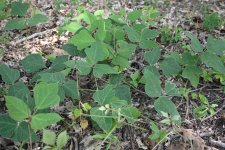
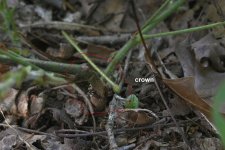
This is what a young patch looks like and this is the crown that is just on the surface.

k patch.jpg crown.jpg
 
   / The challenge of Kudzu #45  
I contacted the author of that study. He recommended aminopyralid (Milestone, Chaparral, and OpenSight).

Kudzu seems more entrenched and harder to get rid of when it gets to the tree line. My little experiment in post 35 above is still a bit of a shock to see the extent of the vine system in an open field once the other vegetation was removed.

While I have the vines exposed, I'm thinking about the best method to dig out the tubers that appear to be in the top 6-10 inches of soil. I'm wondering if it would be more effective to kill these tubers than to continue spraying. So why not a little experiment to see?

I could cut and remove the vine and then dig with a PHD. My concern is the PHD getting bound up in the root system and/or shredding the tuber and it re-establishing itself. I could try a root ripper on the 3pt hitch, but I'd have to buy or fabricate one. Have even considered using a lawn edger, but I'm not sure it would dig deep enough.

I keep looking at my pile of scrap steel thinking something will come to me....
If you spray the leaves with a systemic herbicide, it should in theory translocate to the root tubers and kill them. A mechanical method would still leave some tuberous material in the soil to regrow. I have never dealt with Kudzu, but I have yet to find a plant that tordon won’t kill when sprayed on actively growing foliage.
 
Last edited:
   / The challenge of Kudzu #46  
Glypho will work best in early Fall when leaves give their last energy to the tuber to prepare it for Winter. Any other time of the year the tuber is mostly feeding the greenery and glypho isn't transferred as effectively underground as with most weeds ... which are typically sprayed early in season or on regrowth after recent rains.

Note: This aspect also applies to Japanese knotweed and phragmites (common reed) that propagate by rhizomes and/or runners. Spot-spraying (vs 'blanket') may take a season or two but results seem to compound, costs are reduced, and non-target plants aren't impaired as much. Just time your application right for the treatment's mechanism. It matters.

btw, always use a surfactant when mixing herbicides that don't include any. (most)
 
   / The challenge of Kudzu
  • Thread Starter
#47  
Although I would like to be able to use Tordon, my understand is that Tordon is a restricted herbicide in Tennessee for which I would have to take a course and get a license to use. Milestone may not be as effective as Tordon, but requires no applicator's license.

The time, work, difficulty and expense required to eradicate kudu is one of the reasons why landowners give up and let it spread.

Kuzdu grows like crazy during July and August here when the temps and humidity is the worst and I am least inclined to fight it.
 
   / The challenge of Kudzu #48  
Although I would like to be able to use Tordon, my understand is that Tordon is a restricted herbicide in Tennessee for which I would have to take a course and get a license to use. Milestone may not be as effective as Tordon, but requires no applicator's license.

The time, work, difficulty and expense required to eradicate kudu is one of the reasons why landowners give up and let it spread.

Kuzdu grows like crazy during July and August here when the temps and humidity is the worst and I am least inclined to fight it.
Tordon is restricted in all states. Several years ago I had a big vegetation project on my land. I went to the university cooperative extension service and asked for the self study materials for the farm/ranch personal use pesticide/herbicide license. They gave me the materials which I read over in one evening, then came in and took the test. About 15 minutes later, I was done and passed. I was issued a 4 year license for $25. The license restricted me to only buying and applying chemicals on my own property and no commercial applications. This is all I needed to buy the chemicals. The product worked great. Anyone who owns a bit of land and needs restricted use chemicals can contact their state’s cooperative extension agent and it’s a really simple process.
 
   / The challenge of Kudzu #49  
I think that is way too kind. Spreading farm-eating plants around the country without looking into the longer term effect is somewhere between criminal negligence and malfeasance in office. If you ever fought the scourge of autumn olives on a farm (and whizzed away the manpower and expense involved fighting them) you would have a different appreciation for the issue. There should be an expense restitution program (Ha Ha) rather than more of the same behavior. It happened too many times. You will not find a USDA admission that they even made these mistakes.

If you want to hear a scathing one-sided discussion, sit down on a porch with an old farmer and a helpless USDA employee who happened to attend the same family reunion !!
I don't think Kudzu could be considered a farm eating plant, it is easily controlled in a field where you can easily access all of it.

Also, I think autumn olive may be more of a nusaince in other places but here in SW Virginia it is not aggressive - the berries are delicious, and a good source of food for wildlife. Therefore I leave them alone. Tree of Heaven and horse nettle, on the other hand, can go to hell!
 
   / The challenge of Kudzu #51  
When anyone mentions kudzu, I remember this effort to convert it to ethanol. Powered By Kudzu
But that would make too much sense.
 
   / The challenge of Kudzu
  • Thread Starter
#52  
That is the first time I have ever read of anyone turning kudzu into moonshine. Of course, they would be in the mountains of East Tennessee.
 
   / The challenge of Kudzu #53  
Most folks in east Kentucky and east Tennessee will drink anything... and have. :D
 
   / The challenge of Kudzu #54  
Michigan has tightened up on the use of ag grade herbicides and pesticides, you have to have an applicators license (which I have). I tend to use Glyphosate or 24D (B) on my hay fields and Roundup Ultra Max for general invasive weed control and both require an applicators license here now. The stuff you can buy in box stores is really marginal at best. Nice thing about 24D (B) which is buffered 24D is it's a selective killer and won't harm (to a great extent) alfalfa, whether Vernal or Hybrid (roundup tolerant). I prefer Vernal myself because the hybrid alfalfa is hard to control and because it's a tuber root and spreads via underground roots, it always want to grow outside a hayfield, whereas Verrnal can be controlled via application of a systemic herbicide.

Do I think requiring an applicators license is a good thing? I don't. One it costs money which the state gets and wastes and two, if people bothered to read the instructions and MSDS labelling that is on every container (by Federal Law),that is enough.

Problem is today, no one bothers to read anything and that includes tractor owners manuals. In fact a huge amount of posts on here where owners ask dumb questions can be answered by just reading the owners manual and following it. Like my wife says, 'it's a concept thing'
 
   / The challenge of Kudzu #55  
That is the first time I have ever read of anyone turning kudzu into moonshine. Of course, they would be in the mountains of East Tennessee.
They convert anything that can be distilled into alcohol.
 
   / The challenge of Kudzu #57  
Neither my wife nor I consume alcohol so we have no need but.. You very well can convert any green plant into alcohol but is it worthwhile to do? Probably not. One of the old timers down the road makes what he calls 'corn crib hooch' It's clear and smells good and I've never sampled it but I bet it's a killer (literally). He's always flying pretty high. Out here there are only 3 things to do, Farm, fight and get loaded with the last one the most popular.
 
   / The challenge of Kudzu
  • Thread Starter
#58  
I don't know what the harvesting procedure would be to convert it into something useful, but I'd rather eradicate the kudzu. People have been trying to make something useful out of it for decades, and it hasn't happened yet that I can determine.

Another problem is it once it gets established on an inaccessible steep bank or in the woods, it's that much harder to eradicate.
 
   / The challenge of Kudzu
  • Thread Starter
#59  
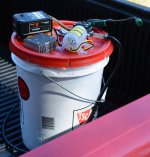
With the increasing cost of herbicides and needing to spray kudzu in some places where it is safer to reach it on foot, I put this electric sprayer together last year. I waited to post anything until I felt like it was actually useful.

The pump is just a $20 pump from Amazon powered by a 20v power tool battery that is stepped down to 12v by a converter, also from Amazon. The spray wand and hoses were taken from pump tank sprayers I already had.

The issue I was having with pump tank sprayers was they didn't quite put out the volume I wanted and required frequent pumping by hand. The electric sprayer does a better job in both respects. The sprayer is also good for spot spraying from the tractor seat and can be carried on foot to spots that I can't reach with the tractor. When full, it's a bit heavy to carry. So filling to 1/2 capacity might be a good plan when most of the spraying will be done on foot.

sprayer.jpg
 
   / The challenge of Kudzu #60  
I have about a 1/2 acre of Kudzu on a very steep open slope at my property. Where it squeezes out of this slope onto usable land I spray it with generic glyphosphate. It seems to knock it back for a couple of years. One of these days I will tackle the entire area. I would love to fence the entire thing in and run goats on it, I honestly think that might be the only way to do it.
 

Tractor & Equipment Auctions

2022 Brush Wolf 7800-HF Skid Steer Brush Cutter (A56438)
2022 Brush Wolf...
Kuhns AE10 Small Square Bale Accumulator - 10-Bale Efficient Handling System (A56438)
Kuhns AE10 Small...
500 BBL FRAC TANK (A58214)
500 BBL FRAC TANK...
UNUSED FUTURE 12" HYD AUGER (A52706)
UNUSED FUTURE 12"...
ALLMAND NIGHT-LIGHT PRO 4 BULB LIGHT PLANT (A52706)
ALLMAND...
MODEL 14C SCRAPER (A58214)
MODEL 14C SCRAPER...
 
Top