Steel strength

   / Steel strength #1  

Ym1401King

Bronze Member
Joined
Mar 10, 2002
Messages
68
Location
Preston, Idaho
Tractor
Yanmar 1401
I am thinking of building a rear blade for my tractor. I am thinking about using a piece of 2x4x1/4" thick square tube that is 28" long, and then put in a piece of 1 1/4" pipe as a collar (cutting a hole in tube, and welding in the collar). Then I will have a piece of solid 1" rod as the king pin on the pin inside of the collar that was mentioned before. I will then have 2 pieces of plate bent to follow the curvature of the blade, as one for the top collar (on the blade for the 1" pipe to go through), and then one on the bottom for the bottom attachment to the blade. I also, will have a plate of 1/4" thick welded to the top of the king pin, floating on top of the square tube, and will have the directional rotation holes punched in the plate, to match the one hole in the tube. There will be a pin inserted there for the right and left angles of both push and drag. I then will fabricate the front of it, to match my cat. 1 3-pt hitch, the front of the square tube. What I am curious about, is my friend tells me that the square tube will bend while pulling or pushing snow. I can't see this happening, unless I hit a snow bank at about 70 mph., which my little Yanmar won't do. I am making the blade 4' wide. I will be using a piece of schedule 40 pipe, cut at an angle for the blade facing, with a bolted cutting edge on the bottom of it.

Does anyone have any other ideas, or do I not make sense? I am also debating on putting a grease zerk on the collar, so that I can put grease in there for the pin to rotate in. There will also be a collar welded onto the pin so that the blade won't rub on the bottom of the square tubing.

Hope this makes sense.

Aric
YM1401/w3tcompact/icons/king.gif
 
   / Steel strength #2  
Sounds like a project, but not one I would tackle. I have one of my own building four 5' workbenches for my garage. Plenty of figuring and re-figuring, and the usual % of miscuts, but coming along.

Just wondering why only 4'? Seems when angled the 'footprint' would not be wide enough to reach beyond the rear wheels. Probably not something you didn't know already, and have figured it into your design. Will be anxious to see some pictures.
 
   / Steel strength
  • Thread Starter
#3  
I only went with 4' because I am not sure that I have the traction that you need to move the 5' blade with snow behind it or in front of it. My tractor is only a 2wd. But it does have diff lock, which I have wanted for some time. I have rice tires on it right now, which have about a 4" deep lug on them. Great for traction in the deep snow, I hope.

I built a blade like this for a friend for a garden tractor, similar, but on a smaller scale, and it turned out better than anything that you could buy from a store, I thought.

I will definitely get some pictures of it when done.

Thanks,

Aric
YM1401 /w3tcompact/icons/king.gif
 
   / Steel strength #4  
Just a suggestion. Make it wider. It wouldn't be very hard to shorten it up if it proves to be too wide..............chim
 
   / Steel strength #5  
Well, I seriously doubt the square tubing will bend from pushing snow, or even dirt, unless you go nuts and play junkyard wars.
Without doing a bit of test fitting, I think you may be a bit off on the pin and bushing using a 1" pin in 1 1/4 pipe though. Off the top of my head, I think 1" pins fit inside 1" pipe just about right. I'd be tempted to find a piece of mechanicle tubing for the bushing if possible, much thicker wall, and not subject to fracture as pipe can along the seam weld.
There were pics of my grader back on the old Yahoo site, and that blade was mounted to tilt & swivel on 3" pipe, downrigged 18" from the neck of the grader. I haven't had a bending problem with it yet.
As far as grease fittings go, on a setup like this, a grease fitting may not be a good idea since dirt accumulates in the grease, and wears the pin rapidly.
 
   / Steel strength #6  
<font color=blue>Does anyone have any other ideas, or do I not make sense? I am also debating on putting a grease zerk on the collar, so that I can put grease in there for the pin to rotate in. There will also be a collar welded onto the pin so that the blade won't rub on the bottom of the square tubing.</font color=blue>

I'll go against franz on this one. I'm a firm believer in zerts and grease. And especially true in this situation where you're going to have lots of moisture and standing in place. (You put the darn thing away wet for six months, not good on bearing surfaces).

Most folks are afraid of trying to install zerts cause of the drilling and tapping hassle. It's so much easier than that. TSC and just about anyone else has knock ins. You drill your hole, I like the quarter inch size. And then you knock in the zert. It looks like it's threaded but it isn't. The grooves are three hundred and sixty degrees and tapered to go in and not come out. I use a small socket and a light hammer to install them. They're the handiest thing since hot syrup for dipping a cone.
 
   / Steel strength #7  
wrouthnharv - thanx for the tap in zerk info - hadn't known about them.

re bending steel - 2 x 4 by 1/4 inch thick square tube on a 4 foot blade?? With two wheel drive?? You won't be bending THAT!!
 
   / Steel strength #8  
Harv, the Cub Cadet riding mower I used to have came with the tap in zerks and one came out and got lost. I didn't have one on hand, so I just ground part of the threads off a threaded one, and like you said, installed it with a small socket and hammer; worked fine and never came out.
 
   / Steel strength
  • Thread Starter
#9  
Where do I get mechanical tubing?

Aric
YM1401 King /w3tcompact/icons/king.gif
 
   / Steel strength #10  
Try looking at a few machine shops. If you have to buy mechanical tubing from a steel supplier or someone who doesn't use it often, you may have to buy a full stick. I'll warn you in advance, mechanical tubing is not cheap. We use some in various sizes, and even buying a lot of it, sometimes it is $12 to $13 a foot. If you're just buying 6" that's not bad, but if you're buying a truck load, it's expensive.
 
   / Steel strength #11  
JimMc:

Could you please define mechanical tubing for me.
 
   / Steel strength #12  
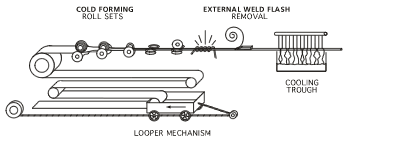
Pipe and tubing are formed by taking strips of steel from a coil and progressively rounding up the edges until a tube is formed. Then a welding process welds the edges of the strip together. Depending on several factors, speed of the mill welding equipment, skill of operators, etc, this seam protrudes to varying degrees inside the tube. Incidentally, square tubing starts out the same way, then after the welding process, the sides of the round are progressively rolled in to form a square or rectangle. Keep in mind that the tube mill process runs a continuous strip of coil that is cut to length after it is welded and all this happens at around 300' per minute.

Mechanical tubing, at first glance appears to be a thick walled pipe. On closer inspection, you will notice it has no seam. This is because mechanical tubing is formed very differently. When looking at mechanical tubing specs you will find a much closer tolerance in inside and outside diameters, and no weld seam. In fact, you would be hard pressed to state whether a shorter piece of mechanical tubing was tubing or a part turned and drilled in a lathe. This makes it an ideal receiver for bushings and bearings, if you can find a suitable size. Because of the additional processing, and the fact that more pipe and tubing is sold, mechanical tubing is much more expensive to buy and more difficult to locate off the shelf.
 
   / Steel strength #13  
JimMc:

Thank you for that descriptive definition. I have seen the very material you are talking about, used in marine refrigeration systems. Just know what they called it. And yes I remember it carried a hefty price tag.
 
   / Steel strength #14  
Here's a quick pic of the tube forming process up to welding.
 

Attachments

  • 53-169688-ERWstep2b.gif
    53-169688-ERWstep2b.gif
    7.9 KB · Views: 320
   / Steel strength #15  
Wroughn_harv - Hey, thank you for the information about the knock-in zerks. I have not had good experiences with drilling and tapping tubing; the darn zerks either fall out or I strip the threads trying to seat them REALLY snug. Next time I get close to a TSC I'm going to pick some up.
 
   / Steel strength #16  
Threaded grease zerks can be a pain. We use the 1/4"-28 tapered thread style with a 1/4"-28 pipe tap. Straight thread never seems to tighten up until they strip. Just my opinion, but it may work for you too.
 
   / Steel strength #17  
SIR,
comment on mechanical tubing,
this is also refered to as DOM. (drawn over mandrel) this is why it is
so expensive, but as you said, very well made.
accordionman
william l. brown
 
   / Steel strength #18  
You are correct, and actually we should probably refer to it in that terminology.
 
   / Steel strength #19  
DOM Yep thats the stuff they used for the refrigeration coils pn our crab boat.
 
   / Steel strength #20  
My personal experience with press-in zerks is that they pull out just as easily as they go in. Over the years I have had several pull out on a number of devices. If you have enough material to work with (wall thickness), drilling and tapping generally is more secure. If the wall thickness isn't there, you're screwed either way-you might want to weld on a block or nut for decent engagement. With the thickness of DOM tube you are looking at this probably won't be an issue.

I'm looking at my Ryerson steel catalog now, DOM tube is available in a bunch of different wall thicknesses and diameters, you should be able to find material to make up what you need. Heavy-wall pipe might be cheaper, and you could have a local machine shop bore any ID you wanted pretty cheaply, and drill and tap for the zerk.
 

Tractor & Equipment Auctions

Forward 10,000lb Two-Post Electric Auto Lift (A55851)
Forward 10,000lb...
2019 JOHN DEERE 850L LGP CRAWLER DOZER (A60429)
2019 JOHN DEERE...
2023 FORD F750 CAB & CHASSIS (A57880)
2023 FORD F750 CAB...
2019 CATERPILLAR 320 GC EXCAVATOR (A60429)
2019 CATERPILLAR...
2015 Peterbilt 389 T/A Wet Kit Day Cab Truck Tractor (A55973)
2015 Peterbilt 389...
16ft x 8ft Flat Bed (A57454)
16ft x 8ft Flat...
 
Top