OP

LD1
Epic Contributor
Just the grounding. No surge protectors or arresters or fancy stuffVery nice Install!
What do you have for lighting protection?
Just the grounding. No surge protectors or arresters or fancy stuffVery nice Install!
What do you have for lighting protection?

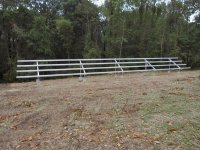
Wow that is awesome think I am going to steal this extension idea.Auger extension and racking delivery
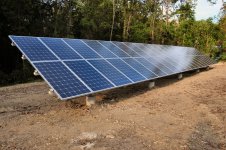
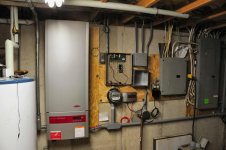
View attachment 1090501View attachment 1090502View attachment 1090503
Yes aluminum URD wire. Bout all that is used here for service installs. And yes the wire ends were coated with the no-ox stuff
Yes aluminum URD wire. Bout all that is used here for service installs. And yes the wire ends were coated with the no-ox stuff
Thanks.I figure you must have some experience using "home run" for end to end wiring.
No idea with direct bury PV wire. Not sure voltage or potential v-drop with dc.Wow that is awesome think I am going to steal this extension idea.
Other than where it exits the ground did you go with direct bury? All our existing URD is that way and want to do the same with the PV install- but getting advice to run all of the PV to Inverter which is 370 feet plus through conduit, and Not seeing the necessity.
Same here. I have been taking heat on going with 6-6-6 URD using 3 runs for 9 conductors. Run will be in excess of 370 feet, and that much Copper THHN #8 or Even #10 gets pricey also all that required conduit.
Your Install Really looks Great. I Like the crushed rock under the install as well.
I take it the system is a micro inverters at panels design?
That is so funny...No idea with direct bury PV wire. Not sure voltage or potential v-drop with dc.
I used micro inverters. So technically my PV wires are just the length attached to the panels and plug right into the inverters.
From there the trunk lines are 10/3 TC-ER cable.
But I have no issues at all with aluminum.
I'd wager a bet that significantly more service and infrastructure wire In this country is aluminum.
The ONLY people that push copper is the electricians that don't have to buy it.
But copper is no better at all IMO. When sized appropriately...it don't matter. And they both face the same corrosion issues.
But for me....direct bury the urd because it's so cheap. Maybe $1.50/ft for 100a (2-2-4).
For the price of conduit I can dig it and replace it 5 times. Which is unlikely to ever happen in anyone's lifetime

I'll have to do some research. But honestly the topic hasn't come up much at all in any of the reading I have done about solar. And none of the companies I priced inverters from and/or asked questions about mentioned anything about it.@LD1 Nice job! Thanks for posting this.
I would at least consider surge protection at your solar and the house. That is a chunk of change in sensitive electronics, not to mention hard work.
I like the Siemens ones because they are available in large capacities for areas with thunderstorms.
All the best,
Peter

No ground rods at array....but is a single1/2" ground rod gonna do any more than the 5 c-channel posts driven in the ground 9' down?A Ground rod on the array and a large surge protector where it connects in the house should be enough.
We've had hits here and they have taken out the surge protector, but not my devices.
Friend had everything in his house fried by lightning.
I did lose some LED lights during a brown out though even with the whole house surge.
It's good to keep Ground at ground, why should have ground rods at house and array.
I have ground rods at my pool and my house for the same reason.

Everyones taxes are different. My house is paid for but I still have deductions. And still pay taxes.What would that tax credit do for a guy with no deductions? House paid for.
SREC's is something new. I had to google that. Interesting concept.....have never heard of such a thing or even understand how it works....or even if it works with a rural coop for electric provider....which is member owned and not a public utility.I installed a ground array in 2011, with 40 230watt panels. I bought a Schletter rack system. All aluminum extrusion which was delivered engineered by Schletter for my installation. When I bought the rack in 2011 it ran me $4700. Schletter wanted 5 8' footings in the rear and 3' in the front. They said this was for wind uplift. I consulted with a civil engineer from the university I went to and he did some quick calcs and said "way overkill" I went with 3-4' x 12" for all 10 footings. I dug the footings with my Kubota, but before I could get them inspected we had heavy rain and most of the holes filled half way up with dirt washed in by the rain. Another day of digging was needed before inspection. Inside is a single Fronius 10KW inverter.
It has been 13 years in service and not one minute of trouble with the system. I have saved & 21,275 in electric cost (with net metering) as of this month. Additionally I have been paid $3500 for carbon credits (SREC). Along with ground source HVAC that I had installed in 2005 my average monthly cost is $ 130 to the utility.
paul
These seem to be popular offered in both AC and DC to clamp a Voltage spikeSREC's is something new. I had to google that. Interesting concept.....have never heard of such a thing or even understand how it works....or even if it works with a rural coop for electric provider....which is member owned and not a public utility.
The brief looking that i did seems to show that most places want to be able to hook into your monitering software to see how many credits you are generating....then sell them on your behalf and take a percentage....

 signaturesolar.com
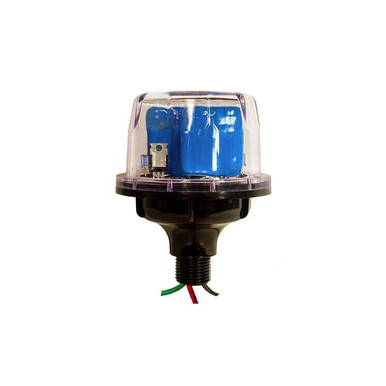 signaturesolar.com
I guess what i'm getting at is my standrd reduction 24k will outweigh any credit I would get. yes?Everyones taxes are different. My house is paid for but I still have deductions. And still pay taxes.
But I suppose if you are retired and have 0 tax liability then you would never get any of it back. But 99.99999% of the people that can even afford solar....are paying federal taxes

 . But we could have used the full $29k deduction AND reduced the tax owed dollar for dollar with any credits.