Backhoe Setting up TLB on wonky ground.

   / Setting up TLB on wonky ground. #1  

PatasColo

Silver Member
Joined
Nov 23, 2010
Messages
236
Location
Front Range of Colorado, USA
Tractor
Kioti CK20S HST and Gravely walk-behind (2 wheel tractor - 700 lbs.).
My Kioti CK20S with backhoe is fairly new to me. As I go to set up for backhoe usage, the front wheels are s'posed to get raised just off the ground by putting down the FEL bucket (lip tipped slightly down to dig in if there is movement).

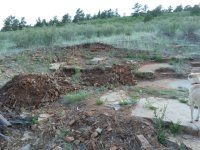
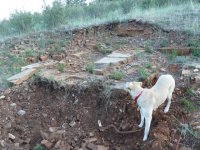
Some ground around my place is solid sandstone rock layers, and lots of variation in angles/slopes. I find it is not uncommon that one side of the FEL may touch ground/rock an inch or two before the other side. I've been repositioning to avoid this, but I'm concerned for a time when it can't be done (i.e. a tight spot that needs digging has wonky rock layers all around). It torques the FEL arms and might bend something in bad ways, even if only slightly (for example, so that if I ever removed the FEL, it might be impossible to get back on).

Any comments or experience with this? Suggestions, aside from avoiding it as much as possible?
-Mitch
 
   / Setting up TLB on wonky ground. #2  
couple of choices:

1) carry a couple 6 or so 2*6's with you and put them on the low side as needed. Get 1 1/2" of shimming per board
2) use your BH or FEL to cut it flat
3) take care and do not set your bucket on the gnd if your BH work is gentle and you think you are within a safe op environment.

I have / do all 3 all the time on a Kubota B2620 to avoid bending the FEL arms or bucket.
 
   / Setting up TLB on wonky ground. #3  
My Kioti CK20S with backhoe is fairly new to me. As I go to set up for backhoe usage, the front wheels are s'posed to get raised just off the ground by putting down the FEL bucket (lip tipped slightly down to dig in if there is movement).

Some ground around my place is solid sandstone rock layers, and lots of variation in angles/slopes. I find it is not uncommon that one side of the FEL may touch ground/rock an inch or two before the other side. I've been repositioning to avoid this, but I'm concerned for a time when it can't be done (i.e. a tight spot that needs digging has wonky rock layers all around). It torques the FEL arms and might bend something in bad ways, even if only slightly (for example, so that if I ever removed the FEL, it might be impossible to get back on).

Any comments or experience with this? Suggestions, aside from avoiding it as much as possible?
-Mitch

Why do you do that, too much stress on the frame.
 
   / Setting up TLB on wonky ground. #4  
Mitch,
I was working out of Durango a year or so back and nothing was level or even. As you probably know lots of large round stream bed rocks everywhere which prevent you from setting the bucket down on even ground.

What I would recommend it to set your bucket down flat and lower it to the point you fell it just start to raise the tractor. I would not recommend you use the method you described as this can be too hard on the machine.
 
   / Setting up TLB on wonky ground.
  • Thread Starter
#5  
Why do you do that, too much stress on the frame.

I want to get some clarity from both Murphy and Jenkins...

Murphy, if I gave the mis-impression that I continued to set the bucket down when it was contacting one side first, I didn't mean to. I have been avoiding this by re-positioning the tractor, but I anticipate times when this may not be possible. Am looking for alternatives approaches.

Jenkins, I was trying to figure out if you were referring only to the bucket contacting one side first, or other details... seemed like possibly the latter. I read numerous posts and folks I've spoken with indicate the front wheels should be slightly off ground, to avoid any twist or other force to the front axle. Yes, you could leave them only slightly contacted to the ground, but then any small change in the tractor's stance may create more contact, resulting in the front axle receiving some of the force. Consensus is that that is always bad. Could you clarify your thoughts for me? (TIA.)

For the bucket, I've wondered a bit if it should have the lip slightly down, or flat. One long-time tractor and backhoe mechanic and operator told me it should be slightly down, as any backward pushing force would cause it to dig in slightly and maintain your stability. On the other hand, I could see where someone would say "it then creates an anchor against which you can twist and bust the tractor." Both are true, so it's hard to know which is the most recommendable method. :confused:

In the manual for my backhoe (KB2465) , it states in several places that you should never operate the backhoe with the rear wheels off the ground. It does not give any other direction with regard to the front wheels or the bucket.

Any further or follow-up comments, experience?
-Mitch
 
   / Setting up TLB on wonky ground. #6  
Just get yourself level by raising one side. Don't overthink it. They are built for this. The manual caution is just for the lawyers. I setup with an uneven bucket all the time on my 1026r. No problems at 221 hrs
 
   / Setting up TLB on wonky ground. #7  
I level the tractor up with my landing gear (outriggers). If I need to anchor the tractor any more than what 4whd,low range will do, I lower the bucket.
When I need to move the tractor I reach around, raise the bucket, pull the range lever into N and push or pull with the hoe. If the ground is too uneven to move this way, then I move to the tractor seat and drive forwards or back.
The forces exerted on an uneven FEL bucket won't be any more than using the FEL for digging in uneven rocky ground. (the only kind we have around here)
 
   / Setting up TLB on wonky ground. #8  
If there. Built that fragile there not worth having
 
   / Setting up TLB on wonky ground. #9  
If there. Built that fragile there not worth having

I tend to agree with this statement. If setting the FEL bucket on the ground unlevel is going to torque the frame, then it would really bent it when using the full force of the tractor to push into an unlevel dirt pile. I think everyone is over thinking this in regard to the FEL frame. It should be plenty strong to not bend.
Due to some very rough handling with the FEL on my Yanmar, I had broke a couple of welds on the frame which allowed for some bending so that the bucket was about 2" lower on one side. When trying to bend it back to level on the bucket, I put timbers under one side, picked the front wheels off the ground and pushed down with my LS on the other. It picked the rear tire up off the ground on the opposite side and still didnt torque the frame like I wanted it too. Without turning the tractor over, I was only able to get it back to within 3/4" of level when trying my best to bend the frame back the way it was. They are stronger than you would think.

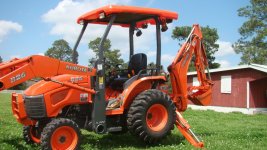
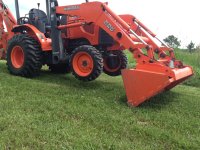
Regarding how to set the bucket. I have seen operation do several ways from setting flat to extending the curl full so the bucket sets upside down as pictured in Kubota website for the B26. I think the object is to get the tractor level front to back and side to side so when you dig, you can dig a level bottom ditch with plumb sides. If the ground is not sloping much, placing the bucket flat will allow up to 5 or more inches, depending on your tractors design. If you need more lift then you have to invert the bucket to get more
 

Attachments

  • BH stabilizers lowered back tires off of ground.JPG
    BH stabilizers lowered back tires off of ground.JPG
    229.1 KB · Views: 216
  • FEL bucket lifting wheels.JPG
    FEL bucket lifting wheels.JPG
    978.6 KB · Views: 334
   / Setting up TLB on wonky ground. #10  
Mitch,
Recognize that the front axles can oscillate 15 degrees or better so as long as you take some of the load off the axles you should be okay. A good backhoe doesn't need the ground to be perfect to use it. At the same time I wouldn't wan't to put the bucket down with one edge contactiong a high boulder leaving the other side up in the air.

For most work I set my front bucket lip flat on the ground, sometimes the machine might be moved a few inches, that is better than straining the machine and frame. The more seat time you get the less trouble you have with this, most of it is caused by wrong bucket angle and raising the machine with the boom and dipper stick.
 
   / Setting up TLB on wonky ground. #11  
In my limited experience often I fill the front bucket with gravel or small rock as I work a home project. Then with the loaded bucket on the earth, (on dirt, sod, gravel driveway) and the front wheels fully contacting the ground, I use the backhoe with the outriggers down. I have Bigfoot pads to help the down riggers hold the tractor firmly in place. Even with these measures, the backhoe on my CK20HST is so strong it often pulls the tractor a few inches or more as I use the backhoe to dig in the ground. I think the extra weight helps stop the tractor from being pulled by the backhoe. We have clay here and the earth is very hard so the powerful backhoe gets a workout. Right or wrong, IMHO I see it as counter intuitive to raise the front wheels off the ground at all to use the backhoe at least for this tractor. Seems like this would also add more stress to the outriggers. The CK20 is a very strong and well built tractor and I doubt the front axel is going to suffer by leaving the front wheels in contact with the ground (or ledge as seems to be the situation for you) while using the backhoe. If I was on ledge I might chock the wheels in addition to setting the brake to stop the tractor from getting dragged by the backhoe. In any event it sure is fun to use this backhoe for the projects I used to do by hand with a pick and shovel!! Tractor on!
 
   / Setting up TLB on wonky ground. #12  
I set the bucket flat or the back of the bucket (round HD bucket) on the ground barely lifting the front end. Sometimes if I am doing hard digging like a stump, I will tilt the bucket forward 10-15* or so but dont extend it.

Using outriggers then level the back of machine and dig. Most of the machines today are rugged enough to handle uneven ground without tourqing the frame.

My old L175 DT with 3PTH backhoe was a different story - the 3PT setup moved a lot and it wasnt a lot of fun digging with that 1980s vintage. The FEL though was a tough one - could lift a lot more than the tractor even with the BH on that machine was tippy with a full bucket.
 
   / Setting up TLB on wonky ground.
  • Thread Starter
#13  
Just wanted to give a "thanks" to all for the input. It shows that there is a range of what people do/recommend. This makes sense.

One of the best things I've learned (from this and other threads, and from working on the backhoe) is that technique makes a lot of difference in how much and what kind of stress you put on the tractor. I seem to get a lot better each time I use the backhoe a couple hours. I saw a video of one guy lifting and dropping his FEL/tractor (with a bang!) with every backhoe pull at a stump - that just looked like a BAD idea! Due to bad technique.

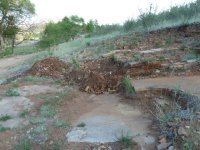
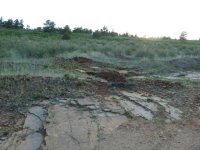
I've attached pics to show some of the ground I am on; solid sandstone layers that have a slight curve to them.. a mini-quarry (aka our backyard :) ), with differing slopes between where the back wheels sit, and where the FEL sits (and no "give" to the ground). I'm taking the top layer of dirt/loose rock off some of this ground. I also want to pry up a some thick sandstone slabs for use around the property (I figure if I can do this with a pick and bar, it should be fine to do with tractor/backhoe, and a lot easier on my body! :laughing: ).

Happy Ho'ing! :thumbsup:
-Mitch
 

Attachments

  • P1010079.JPG
    P1010079.JPG
    166.9 KB · Views: 191
  • P1010081.JPG
    P1010081.JPG
    175.3 KB · Views: 211
  • P1010082.JPG
    P1010082.JPG
    165.6 KB · Views: 189
  • P1010083.JPG
    P1010083.JPG
    162.2 KB · Views: 182
   / Setting up TLB on wonky ground. #15  
I've got that book. Its really good but go to youtube and watch letsdig18's videos instead to see the techniques in action and save some money.
 
   / Setting up TLB on wonky ground. #16  
" I seem to get a lot better each time I use the backhoe a couple hours."

That is the best advice any of us can give you. I've been operating backhoes for a lot of years and have always opened my FEL bucket all the way so I would have both top and bottom edges on the ground. It has just felt right and I've had great success with that approach.

If you set up on a dig, drop your outriggers and front bucket and get the "That's Weird" feeling, reposition and try again. I think you know what I mean.

I can relate to your landscape http://www.tractorbynet.com/forums/kioti-owning-operating/243592-shes-finally-here.html and my main thought is to not get sideways with the mountain :laughing:
 
   / Setting up TLB on wonky ground. #17  
it all depends on the situation. if i need to back down a hill. to say deal with a culvert. i will fully curl the FEL bucket so it is upside down. so when i do use backhoe, the tractor does not slide down the hill. due to front bucket digging in some.

other times. i may tilt bucket slight downward. so i do not push the tractor forward with the backhoe.

some times, i will put front blade almost vertical. so instead of digging in. the blade kind skips on the ground. (perhaps hard dry dirt, that bucket itself can not dig in)

some times, curl bucket fully up. so round bottom of bucket hits ground. so i do not tear up any yard. via the front bucket.

for most part i prefer to take a little pressure off the front tires, but still keep the front tires partially touching ground. due to tilt of the front axle. i see no point and at times trying to raise both front wheels off ground would be dangerous. changes center of gravity of tractor enough. that i just do not like.

when putting out the outriggers, i try to shoot for level. but, pending on conditions and what i need to do. i will live with un-even, trench bottom, and just take a little pressure off the rear tires with the out riggers. to help keep the rear end from sliding back and forth.

==================
my body can not handle constant jarring. and will slow things down most of the times. but the rare few times that come up. i will go full throttle, and yank and pound. i have enough problems staying up on regular maintenance, i do not need to add to the list of tearing stuff up.

folks have bent there FEL frame. but i would rather bend frame, than risk saftey. i have used FEL multi times. running on one side only, back dragging to front dragging and multi different angles of the bucket. to deal with grading out dirt and gravel driveway / road here on the farm.

and same thing when using backhoe, the FEL bucket some times is not touch on one side.

something to think about, having FEL bucket touch ground. helps extend weight out in front of the tractor. to help counter balance the backhoe on back of the tractor. so the entire tractor does not do a wheely and flip over backwards. have lifted front of tractor up into the air before. though it was much easier, when i did not know any better and made sure both front tires were off the ground and really raised up into the air. while using the backhoe.

====================
i think OSHO might have a requirement that requires rear tires for 2wd tractors, and for 4wd tractors all 4 tires, to get wheels up off ground. so tractor can not physically drive off, and there be no one at the wheel to stop the tractor.

heck i am guilty, of run away tractor. granted i was trying to get off the tractor when it started moving but *shrugs* all i took was woops hit of the wrong lever and away she goes. perhaps that is reason why some folks slight angle front bucket downwards. so tractor digs into dirt vs possibly driving away.

===============
besides physical seat time. were experience goes a long ways. another part is realizing what might or could go wrong. and making sure you are aware of possible uth ohs...
 
   / Setting up TLB on wonky ground. #18  
Ive operated my hoe in all sorts of odd ground and locations.

As a rule of thumb i try to set my bucket flat on the ground, put a little down force on it so that it has good contact with the ground but not so much as to raise the front end any.

Rear stablizers are set to stabilize the rear. I may correct some off angle with it but generally not all of it as im wanting to avoid undo strain on the frame.

as a rule of thumb for me.
Id rather be digging directly behind me, with the tractor parked on uneven terrain than to have the tractor parked on even terrain and be digging at some extreme side angle. So i generally repostion/postion the tractor more so that im digging directly behind me as much as possible and dont worry about the terrain under me nearly as much.
 

Tractor & Equipment Auctions

2020 CATERPILLAR D5K2 LGP CRAWLER DOZER (A60429)
2020 CATERPILLAR...
2000 PETERBILT 379 MID-ROOF SLEEPER (A58214)
2000 PETERBILT 379...
DEUTZ MARATHON 60KW GENERATOR (A55745)
DEUTZ MARATHON...
2018 Kubota RTV500 4x4 Diesel Utility Cart (A59228)
2018 Kubota RTV500...
Case 1020 25ft Draper Head (A56438)
Case 1020 25ft...
Kubota Snow plow with subframe
Kubota Snow plow...
 
Top