RDrancher's Photo Thread

/ RDrancher's Photo Thread
  • Thread Starter
#661  
Dealer support does seem to be better for the Ag side. That said...the JX75 was his second Case and he wasn't real happy with the dealer experience he had with the first tractor. Kubota was offering 0% financing at the time and that sealed the deal.

If you were closer I'd steer you toward my NH dealer. Their service and parts departments are both top notch.
 
/ RDrancher's Photo Thread
  • Thread Starter
#663  
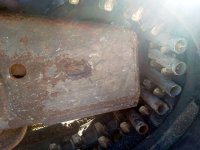
Aaaaargh!! I noticed my right track was a tad loose this morning so I tightened it up and found out the real problem. The front idler bearing is toast. It wouldn't be that big of a deal if I weren't so far behind already. Oh well...I'm thankful for all of the work, that's for sure!

Time to break out the Blue Wonder and knock out some gravel driveways.
 
/ RDrancher's Photo Thread #664  
Aaaaargh!! I noticed my right track was a tad loose this morning so I tightened it up and found out the real problem. The front idler bearing is toast. It wouldn't be that big of a deal if I weren't so far behind already. Oh well...I'm thankful for all of the work, that's for sure!

Time to break out the Blue Wonder and knock out some gravel driveways.
It seems your case is problem after problem! At least you have your Blue Wonder! Thanks for sharing all the pictures that you have recently.
 
/ RDrancher's Photo Thread #665  
It seems your case is problem after problem! At least you have your Blue Wonder! Thanks for sharing all the pictures that you have recently.

Yeah for real! I think it's time to dump that Case! After reading about all the problems I'd never buy one! I've run bobcats and they seem relatively trouble free. A lot of guys around here love the Takuchi skid steers.
 
/ RDrancher's Photo Thread
  • Thread Starter
#666  
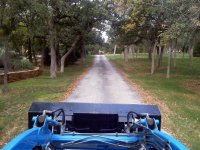
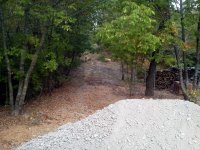
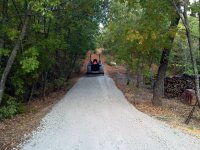
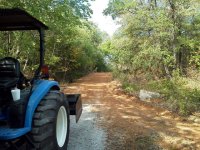
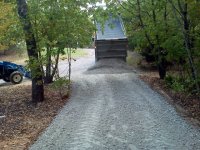
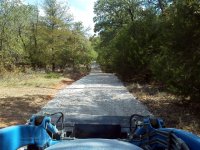
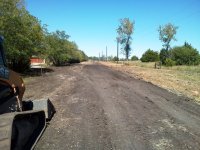
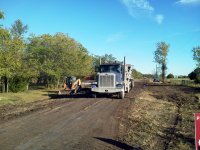
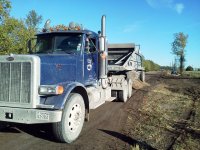
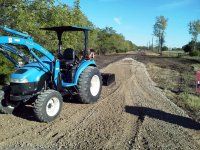
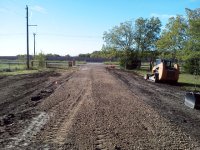
Knocked out this driveway today while I wait for the new idler for my Case to arrive. The new driveway is located on a hill at the end of a quarter-mile easement driveway.
WC01.jpg WC02.jpg WC03.jpg WC04.jpg WC05.jpg

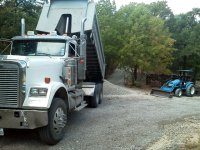
Since the easement had a topping of RAP, there was only room to dump one load at a time at the entrance to the new drive.
WC06.jpg WC07.jpg WC08.jpg WC09.jpg
 
/ RDrancher's Photo Thread
  • Thread Starter
#667  
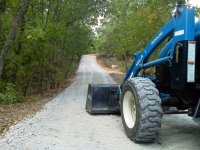
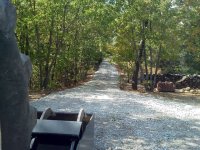
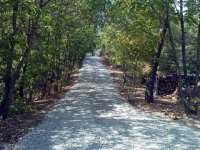
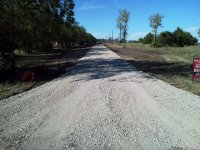
And the finished driveway.
WC10.jpg WC11.jpg WC12.jpg
 
/ RDrancher's Photo Thread #668  
John, are you spreading the gravel with the bucket and then dragging with the bb, or ???? I'm getting ready to go through this and know that you know the best methods. Thanks in advance for any help.
 
/ RDrancher's Photo Thread
  • Thread Starter
#669  
John, are you spreading the gravel with the bucket and then dragging with the bb, or ???? I'm getting ready to go through this and know that you know the best methods. Thanks in advance for any help.

No problem at all...I'm always ready to answer questions t help out. That's what makes this forum a great place! I tend to ramble, so try to keep up. :D

If the trucks have access, I prefer to pull from spaced-out piles since it's faster. If I know I'll have time to spread between trucks, I also prefer to start at the entrance and work my way back. This way, the trucks back in over the spread material and get it compacted nicely. Unfortunately, access doesn't always allow this method.

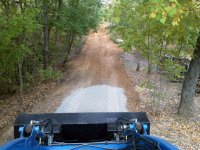
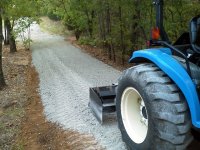
In the photos above, you'll notice that I'm working my way up the hill and each load has to be dumped in the same location. For me, this happens more often than not. My first load arrived just as I did, so I had to do a quick grade and crown on the first 60-70 feet of the drive while determining where I wanted to water to go. In the third photo I'm pulling from the pile down the center to establish a heavy (overly thick) crown. I only go heavy on the crown at the beginning of the drive. More on this later. If you do it this way, you won't have to make any adjustments to the box blade tilt. I also like to make the entrance as perfect as possible with the first load. Each additional load dumped in this spot will pack it down.

Notice that in the fourth and fifth photos I'm not overly concerned with getting my edges perfect. Close, but not perfect. There's a reason for this. Firstly, I wanted to pull the second load from the pile to speed things up and because of the tight access...put off having to turn around and grab bucket loads. Secondly, when you're pulling a second load over the first you're trying not to build up the thickness on gravel where you've already established grade. If you're too close to your final edge, some material will spill out the sides of the box blade and leave the edges too high. This either results in sloppy edges or the width of the drive will start to grow.

It is possible to pull a third load over the first and second, but there's too much room for error, too much thickness to deal with, or at the least additional dress-up work so I don't bother. Time to turn around and use the bucket. The method depends on the width of the road and width of the bucket. My bucket is 6' and this drive is 10' so depositing the material with an overlap results in a nice (slightly oversize) crown. If the drive is wider, I'll deposit material in the center first just like I did with the box blade pulling from the pile to establish a crown.

There are two ways to deposit the material with the bucket. The first is to dump and use the cutting edge vertically to lay out the material slightly thicker than the finished grade. This is the method that usually has to be used when building a gravel drive with a skid steer because the loader arm stops usually don't allow the heel of the bucket to go low enough with a standard depth bucket. This is one of the many reasons a tractor is superior to a SS or CTL for gravel. I'll get more in-depth on the subject in another post. Here's an operator using this method John Deere 210 LE Skiploader placing and grading limestone - YouTube. Since he chose this method it's obvious that he's used to spreading material with track loaders or dozers. We're tractor guys, so let's do it the easy way!

Besides having a bucket at one end and box blade at the other, there is another feature that makes a tractor handy for for gravel spreading, which leads me to the second method of depositing material. The loader can drop below the bottom of the tires while the bucket remains flat. This method uses the heel of the bucket to back-drag and grade the deposited gravel. Most equipment operators will say that back-dragging is somehow "cheating" and using this method isn't really grading. I say BS! Back-dragging with the bucket edge will pull the larger stones to the top of the grade. Back-dragging with the bucket heel is faster and actually mixes the stone and fines. Maybe those critical operators are paid hourly and don't care, but I'm all about doing a better job in a shorter amount of time. To lay material in with this method drive forward (or backward) depositing material by shaking the bucket. It doesn't matter if the material is too high here and too low there, as long as there's enough material. Now drop the FEL down with the bucket very slightly curled and back-drag the new material into the already graded material. It will fill the holes as you back up. The material rolls off the heel of the bucket and mixes nicely kinda like it does when using the box blade. Since more "curl" equals more material pulled, slight changes in the angle of the bucket are key. As you drag onto the previously deposited material roll the bucket flat then slightly onto the cutting edge to smooth.

At this point I use the oversized crown material to make the grade as perfect as possible and fill in edges. I'll use the excess material from the heavy crown I left from the first load and 2-4 bucket loads of material from the last load at the entrance for the final drag. The final drag is done slowly from the entrance to the end of the drive to make the edges straight. The heavy crown I left will also be used. Since I've been compacting the drive by driving back and forth to pickup bucket loads, it's pretty hard by now and harder to screw up. If the drive is especially long, I'll take bucket loads down the drive and deposit them at intervals to fix up the edges.
 
/ RDrancher's Photo Thread #670  
That gives me a pretty good idea of how to proceed. Thanks again for your time and advice. I'm going out in a few minutes to start. I'll be using my bb to work on smoothing out the driveway first. It's clay with deep ruts, about 1000 ft. Once I get that done, I'll order the rock.
 
/ RDrancher's Photo Thread
  • Thread Starter
#671  
Post some pics here when you're done. My Case idler just arrived, so I know what I'm doing for the rest of the day.
 
/ RDrancher's Photo Thread #672  
As luck would have it, it started raining as soon as I got out there. Supposed to rain all night and most of the day tomorrow. It will now take several days to be dry enough to move dirt.
 
/ RDrancher's Photo Thread
  • Thread Starter
#673  
My method of easy track removal and front idler replacement. We all know that working with machinery is dangerous, therefor I suggest that everyone besides me take their machine to the dealer and have it repaired.

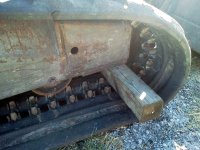
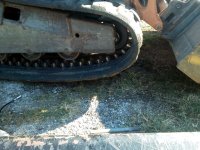
For those unfamiliar with track adjustment on a ctl, it's simply grease pressure that pushes a piston forward on the front idler and yoke assembly. Loosening the fitting a bit allows the port to be exposed (In this case loosened with a 3/4" wrench.) Pushing back against the track / front idler pushes the grease out of the port. I turn the bucket cutting edge down and place a 4x4 between the bottom of the bucket and the center of the track at the front of the idler. Uncurling the bucket pushes the idler back in it's slot.
IDLER01.jpg

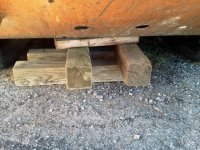
To get pressure off of the tracks for removal, I place some cribbing under the rear of the machine. I carry the cribbing on my trailer, but I've heard pf guys using a rock or stump for this if the machine loses a track in the field. With the cribbing in place, uncurling the bucket edge against the ground lifts the machine (tracks) off of the ground.
IDLER02.jpg

THE PIPE TRICK
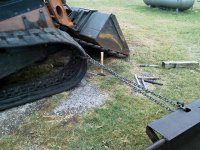
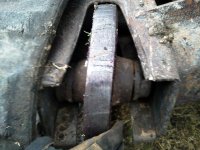
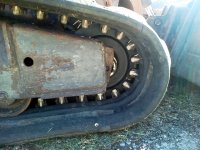
I failed to take a photo of track removal, so this pic is in here twice. I learned this trick from Willie over on HEF and it works slicker than snot on a doorknob. Place a few pieces of pipe between the track lugs on the bottom near the idler. Get in the machine and reverse travel to get the pipes up on the idler so that the track lugs clear the idler. It works just fine with pipes between every other track lug, but I have extra pipe so I use them. At this point I use my tractor and a chain to slide the track clear of the idler track. I've heard that this can also be done with a couple of cheater bars in a pinch. In the last pic you can see that the bearing is long gone.
IDLER12.jpg IDLER03.jpg IDLER04.jpg

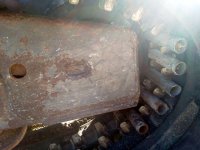
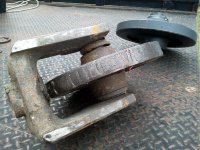
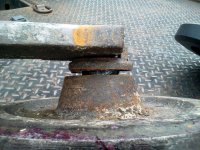
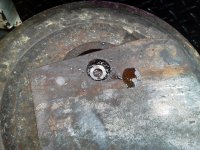
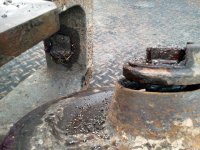
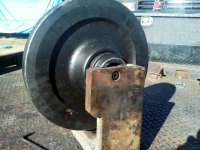
With the track out of the way, the idler/yoke assembly slides right out. (If I were changing out the track adjust assembly, it slides out next.) I don't know how much the idler/yoke actually weighs, but it's upwards of 150lbs. It's heavy. On the bench (my flatbed) you can see how bad the bearing actually is.
IDLER05.jpg IDLER06.jpg

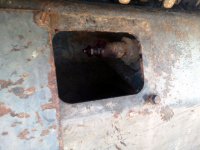
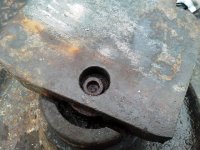
The idler sits in a slot in the yoke and is located by socket head cap screws on each side. The flats were rusted out and gone on the inside screw, so I had to drill it out far enough to slide the idler out of the yoke. Since I knew (from previous experience) that my hydraulics may bleed down enough for the bucket cylinders to block opening the door, I placed a 4x4 in there to spread out pressure on the track lugs and lowered the machine.
IDLER07.jpg IDLER09.jpg IDLER08.jpg
 
/ RDrancher's Photo Thread
  • Thread Starter
#674  
With the idler removed you can see where it was grinding into the yoke. It only took a couple of minutes of operating for the groove to happen. It was pretty noisy, but I was more worried about breaking the track than anything.
IDLER10.jpg

Here's the new idler installed along with new socket head cap screws. I used medium threadlocker on the threads just for insurance.
IDLER11.jpg

Installation is pretty simple. Slide the assembly back into the undercarriage and place the pipes at the bottom and behind the new idler, and roll the pipes up on the idler again using reverse. With the pipes up on the roller, I use the tractor's bucket to gently nudge the track so that the lugs line up on either side of the idler. Final centering adjustment is easy by hand. Now running the tracks forward spits out the pipes and viola!...the track is back on.
IDLER12.jpg IDLER13.jpg

Adjusting the track is as simple as pumping it up with grease.
IDLER14.jpg

I purchased an aftermarket idler from Prowler. Their shipped price is $329...the dealer's drive an hour each way price is $660. Since both warranties are the same and the repair is fairly simple, it was a no-brainer for me.
 
/ RDrancher's Photo Thread
  • Thread Starter
#675  
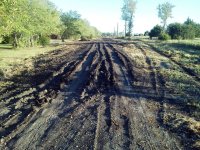
Back at the never ending mud pit. I'm not very fond of this builder's subs...
Cannon38.jpg

Fixed
Cannon39.jpg

I started the road base at the entrance so the loaded trucks could pack it down. In between loads I graded and crowned the straight stretch.
Cannon40.jpg Cannon41.jpg Cannon42.jpg Cannon43.jpg Cannon44.jpg
 
/ RDrancher's Photo Thread #677  
Where in Texas do you have black dirt ? Perfect edges on the drive as usual !
 
/ RDrancher's Photo Thread
  • Thread Starter
#678  
Thanks guys.

You'll find black dirt here everywhere in the Barnett Shale. It's not that nice fertile black dirt like the Midwest though...this stuff is nasty expansive clay.
 
/ RDrancher's Photo Thread #679  
I like the pipe trick. My dozer is ready for a new sprocket, but it's sectional so I wont have to take off the track. Thank God!!! I broke a track once and never want to go through that again.

Eddie
 
/ RDrancher's Photo Thread
  • Thread Starter
#680  
I like the pipe trick. My dozer is ready for a new sprocket, but it's sectional so I wont have to take off the track. Thank God!!! I broke a track once and never want to go through that again.

Eddie

Yeah, even the little stuff on a dozer is pretty dang heavy.
 

Marketplace Items

2014 Chevrolet Silverado1500 Pickup Truck, VIN # 1GCNCPEH0EZ393232 (A61165)
2014 Chevrolet...
(INOP) 2007 VOLVO A35D OFF ROAD DUMP TRUCK (A60429)
(INOP) 2007 VOLVO...
PT 1000 Gallon Supply Tank (A57149)
PT 1000 Gallon...
2012 MACK CHU (PINNACLE) (A60736)
2012 MACK CHU...
SALTYS MANFUFACTURING 500BBL FRAC TANK (A58214)
SALTYS...
OVERLAND VACUUM TANK (A60736)
OVERLAND VACUUM...
 
Top