Backhoe Pressure check on JW03 backhoe

   / Pressure check on JW03 backhoe #1  

Johnny P

Bronze Member
Joined
Feb 22, 2009
Messages
55
Location
Brittany, France
Tractor
"Shire badged" Jinma 284LE
Hello,
Is it possible to check the pressure on the hydraulic system of a JW03 backhoe by disconnecting a hose that goes to one of the cylinders and screwing a pressure gauge on to that hose? I have the connections to do this if it is possible and is there a particular procedure to follow?

Ta
Johnny P
 
   / Pressure check on JW03 backhoe #2  
Yes, that would work, provided you have the metric adapter to screw into the Metric "O" ring face seal hose end. I have not been able to find any adapters compatible with this type fitting on this side of the ponds. An easier way to find adapters for is if you put the gauge onto a port at teh control valve body. On my HW-03 backhoe the outlet ports to the cylinder hoses use a straight metric adapter to a metric "O" ring face seal fitting. The hose end is ORFS and screws onto this adapter. I can get straight metric to NPT or AN type fittings at my local hydraulic shop.

As for procedure, pick a working port on the valve, or a cylnder end of a hose if you have the adapters. Figure out exactly which backhoe cylinder it feeds and make sure that backhoe structure is physically supported. IE: if you remove the boom up/down line and the boom is not supported, it may head for the ground pretty quickly and crush or maim anything in it's way:( It will also spray fluid from the fitting you just disconnected, so a good rule when working around hydraulics is to wear safety glasses. Once supported, work the control levers to make sure no pressure is present in that circuit. Once the pressure is off, remove the hose end(don't loose the "O" ring or fiber sealing washer) from the cylinder or from the valve body adapter. If working at teh valve body, then remove the adapter itself. The adapter should have a "O" ring and perhaps a washer at it's base, again, don't loose these:) Screw in your metric adapter that is compatible with your gauge, and the gauge into the adapter.

The hose end you removed, should go into a bucket in case you operate the lever for the circuit you are working with in the wrong direction. If this happens, the cylinder will move, and fluid will come out of that hose end(don't ask me how I know this:)). IF you are working at teh cylinder end, cover the port with a rag and put a bucket underneath the cylinder port. Start up the tractor, engage the backhoe pump drive and move the appropriate lever to send fluid to the port or hose end that the gauge is screwed into. Since the fluid has no where to flow, the pressure will quickly build to the point that the relief valve opens. The pressure read on the gauge will be the pressure that the relief is set to open at and maintain.

Another option which I did for my BH is to modify an adapter that will screw down into the plug that holds down the spring for the check valve ball. When seated at your backhoe, there should be a round slotted screw head plug to the left side of the valve. This plug is directly over the relief valve assembly which is on the bottom left end of the valve block. You can modift an adapter to the same dimensions as this plug and put it in place of hte plug, and screw the gauge down into the adapter. This worked well for me to check system/relief pressure. IF you like, I have some diagrams of the adapter I modified, but it requires a little machine work with a lathe to make one out of a standard metric adapter.

Good Luck
 
Last edited:
   / Pressure check on JW03 backhoe
  • Thread Starter
#3  
Ron,

Thanks for the reply, I have seen your photos/diagrams of the PRV setup. It is the machined part that is a problem for me at the moment. I was wondering if I could put a longer spring in the check valve which would fit inside the adapter but I didn't know whether this would effect the working of the check valve and cause me a problem there, hence looking for a "easier" way.
Whilst on the subject of the backhoe hydraulics, when you fill the reservoir to find you correct level of fluid should the boom, dipper and stabalizer legs be fully extended or not or doesn't it matter. I again wondered that if I filled the reservoir with the boom, dipper or stabilizer legs up and then extended them would the level of fluid fall to a dangerous level with possible damage to the pump. or vice versa. So many questions.

Thanks Johnny P
 
   / Pressure check on JW03 backhoe #4  
The length of the spring for the check valve shouldn't matter much. In fact, the check ball would probably work without a spring as gravity naturally wants to pull it down into it's seat anyway. The only issue you might run into is screwing an unmodified fitting down into the plug hole over the check ball with enough thread engagement to withstand the pressure of the system.

As for resovoir filling, the difference between cylinders extended and cylinders retracted, is of course the volume of fluid displacd by the rods. The rods are about 1 5/8" in diameter with about a 12" stroke. This works out to about 24 CU/IN or 0.1 gallons per rod. So the difference between all 5 cylinders fully extended, or all 5 fully retracted is about 1/2 gallon of fluid. Since the normal stowed/travel position has 3 cylinders retracted and 2 extended, the maximum the resovoir volume will change from the stowed position is 3/10 of a gallon... My resovoir is 9.25" X 9.25" X 23", for a total volume of about 8.5 gallons. Because of the filler neck, it will only take about 6-7 gallons. 3/10 gallon is not going to make that much difference in the fluid level of that ammount of fluid, so I would say just check and or fill it in the same configuration all the time...

I am curious, are you using the pump that mounts to the rear of the tractor above the PTO, or are you using some other pump configuration? Does your pump make any noise at all when in operation?

Ron
 
   / Pressure check on JW03 backhoe
  • Thread Starter
#5  
Ron,

I am using the pump that came with the backhoe which connects to the tractor above the PTO. No, the pump does not make a noise at all. Brief history. My problems started with the hydraulics completely failing. Nothing at all in any cylinder, stabalizer legs and all. I had no experience of hydraulics but decided to have a look. Drained fluid checked filter which had none of the mesh on it at all. Thought I might find some in the system and that could be part of my problem. No, nothing. I wondered if it was there in the first place. Stripped valve block cleaned and rebuilt. Stripped PRV and rebuilt. This is where I think my problems are. Refilled with new oil ISO 32 and new filter. Still nothing. I had read on another forum that someone had replaced the spring on the check valve and this had sorted their similar problem. This I did and hey presto movement in the stabilizer leg. As the backhoe was only attached to the tractor by the pump and it was getting late in the day I did not proceed with any more tests. The next day I attached the backhoe and checked that the oil was circulating by seeing that it was flowing across the reservoir. Then I tried the boom and dipper, with success.
After running around the garden in an uncontrollable euphoria I returned to the tractor and performed a few movements of the cylinders. My joy was short lived as the boom and dipper went slow again and failed. It was at this point I decided to disengage the drive to the pump. I found on inspection that the shaft seal had blown on the pump. I replaced this and tried again. The same thing happened. Was the PRV set too high or could it be the spring on the check valve being too strong? I believe it could be the PRV. ISO 32 oil is expensive in France . They tend to use ISO 46 and all I was doing was filling the gearbox with this oil.
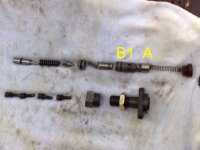
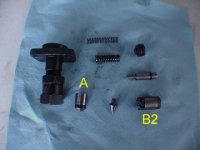
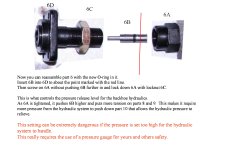
I decided to purchase a pressure gauge, but where should I insert it into the hydraulic system as easily as possible. Hence the original question. My check valve does not have a "ball" in it, unless the component (A) in mine is called a "ball". See attached photos In my PRV I have a component, either B1 or B2 that I cannot get out. B1 has an o ring on it so I imagine it should come out. So as not to cause any damage by forcing this part I decided to leave it be. I considered the fact if this part is removable has it moved and got stuck and is effecting the adjustment of the pressure in the valve. The reason for my thinking of this is that I have again rebuilt the PRV and when I insert the bottom pin (6b) it feels like I can only just insert it and I mean just, with the o ring just inside the valve and not as far as the red line in the photo. The o ring on my pin does appear to be slightly nearer the end of the pin than the one in the picture. I suppose that could explain that. It's past midnight here now so I will sign off. Thanks for your help so far.

Johnny P
 

Attachments

  • pressure valve 6.JPG
    pressure valve 6.JPG
    930.3 KB · Views: 546
  • pressure valve 5.JPG
    pressure valve 5.JPG
    36.9 KB · Views: 383
  • pressure valve 3.jpg
    pressure valve 3.jpg
    401.8 KB · Views: 855
   / Pressure check on JW03 backhoe #6  
The term "Ball" is generic, and refers to the moving part of a ball type check valve. part "A" in your attached pics is the check valve ball and mine looks lust like the one in the pictures. I do not think the upper check valve portion of the control valve inlet would have anything to do with your described problems. The fluid enters the control valve body from the left side(when seated at the hoe controls). As it enters the valve body, it flows into the vertical cavity that houses the PRV and check valve. The fluid enters on the middle leg of this "T" shaped cavity, with the PRV on the bottom and the check valve on the top. The fluid has two paths it can possibly take. It's normal path is up past the check valve, pushing it easilly up and out of the way. The fluid flows past the valve ball and enters a gallery that runs all the way across the control valve body and enters into an exit gallery. As you operate any spool control valve, fluid is diverted from this cross gallery and sent to a cylinder. The return from the other side of the cylinder comes back and makes it's way to the exit gallery. As long as the commanded cylinder movement occurs, there is always fluid flowing out of the exit gallery. The other path the fluid can take is used when the comanded cylinder movement does not occur. As the pressure builds in the inlet "T" cavity from the stalled flow, this pressure forces open the PRV, and the flow is redirected thru the PRV to the exit. THE FLUID IS ALWAYS IN MOTION, either thru the valve unrestricted, performing work in a moving cylinder with flow comming back from the backside of the cylinder, or thru the PRV when it's limit has been reached. Fluid not flowing does bad things, like blow out seals in a hydro pump, or blow hoses, or bend/break structurs ect...

If you are seeing flow across the reservoir with the pump runing, then the pump is obviously moving fluid. If at this same time, you cannot perform any work with the hoe, then the fluid is bypassing the gallery that feeds the spool valves, and no pressure can be built to move the cylinders. This bypassing is most likley occuring in the PRV, that has most likley something stuck in it and holding something open, that should be pushed closed by a spring. As you surmised, the part with the "O" ring on it that you cannot remove, is probably the root of your problem. It could be that a piece of crud has worked it's way thru the system and wedged itself into this close tollerance part. The dealer I bought my hoe from said that crud in the valve was the only problem they had had with these units.

The only purpose of the check valve that I can see is to prevent fluid from exiting back from an open control valve on a heavilly loaded cylinder toward the pump, or the PRV. In my experience, most valves do not have a check at this location. Instead they have whats called a "load check" on the inlet to each spool of the control valve that prevents fluid from flowing back into the cross gallery and being fed to another open spool valve. This valve dosn't have individual load checks, which IMO is probably it's biggest weakness as far as smooth operation is concerned.

In your position, I would disassemble the PRV and check valve again and using some smooth faced rod stock or punch, see if I couldn't gently get that immovable part to move either up or down, and perhaps out of the valve body. Once out, a testube or bore brush and some kerosene or diesel could be used to scrub out the PRV cavity.
 
   / Pressure check on JW03 backhoe #7  
Johnny,
I would sure like you to check the pressure with that gauge before you tear the PRV valve apart again.
RonJ
 
   / Pressure check on JW03 backhoe
  • Thread Starter
#8  
Thanks chaps. I will keep you posted.
 
   / Pressure check on JW03 backhoe
  • Thread Starter
#9  
Hello,

Well had time to look at the backhoe today. I connected the pressure gauge to one of the hoses that goes to a stabilizer leg. Engaged drive to pump, operated opposite stabilizer leg and got a response. Tried the other leg and the pressure gauge read 500 psi, then I released the pressure. Tried other leg, it worked tried the one with the pressure gauge on, 500psi. i checked the fluid in the reservoir and it was going down. That sinking feeling came over me again. Yes the shaft seal had blown again!!!!

I will try again after a visit to the U.K. where I can stock up on cheaper oil, as it is expensive trial and error at the moment. When I mean cheaper I don't mean on quality.

Johnny P
 
   / Pressure check on JW03 backhoe #10  
I connected the pressure gauge to one of the hoses that goes to a stabilizer leg. Engaged drive to pump, operated opposite stabilizer leg and got a response. Tried the other leg and the pressure gauge read 500 psi, then I released the pressure. Tried other leg, it worked tried the one with the pressure gauge on, 500psi. i checked the fluid in the reservoir and it was going down.
Johnny,
Can you give us any sort of time-line for these activities. For example-
engaged drive pump and let it run for a couple of minutes; checked the hydraulic oil flow through the tank fill hole; etc.

What I'm wondering is if there is any way to tell whether you were getting the 500psi readings before the hydraulic pump seal blew.
RonJ
 
   / Pressure check on JW03 backhoe
  • Thread Starter
#11  
Ron j

Engaged pump, dismounted from tractor and stood at the side of the rear wheel. cheched flow across reservoir. Checked operation for stabilizer leg and it responded, operated lever for leg with pressure gauge and got reading of 500psi. Checked oil level and it was disappearing. In all no more than two minutes elapsed I would think.
My thoughts at the moment are, when I return from the U.K with my supply of oil I will do the following tests after rebuilding pump with new shaft seal.

1. Remove spring from check valve and see if I get any movement in a cylinder. I don't think I will as I did not before with the old/original spring in place. It was only when I replaced spring that I got any movement. The spring is not an identical replacement, so I am wondering if it is too strong for the check valve and this affects the pressure when a spool valve is moved or something like that. Unfortunately I have lost the original!

2. Insert a spring. I am hoping to get a selection to try as I do not know the specification for that spring. Check flow and try a cylinder.

3. Remove PRV and try as Ron Mar suggets. What I don't understand, the piece I cannot remove at present, if I get it out, how do you know where abouts in the valve it fits? How far up/down the valve do you insert it? Is there as "seat" for it to come up against. That would determine if it comes out through the top or the bottom of the valve. If it is a moving part and is stuck, what does it move/stop against as there are moving parts above and below it. I just can't visualise this being a moving part and how it fits/works in the valve.

I have just invested in another pressure gauge, this time for my blood pressure!!!

Thanks JOhnny P
 
   / Pressure check on JW03 backhoe #12  
When you are blowing a pump seals, that would mean that you are trying to push fluid in a deadhead situation, nowhere for the fluid to go. You either blow the seal or burst the pump. . Maybe a relief valve is not working. You should not see high pressures on cylinders not doing heavy work. Until you find the cause, you can put a relief across the pump to at least protect it.
 
   / Pressure check on JW03 backhoe #13  
You could completely remove the check ball, and it should work just fine. It's only purpose is to keep a heavilly loaded cylinder from forcing fluid back thru the pump. You would have to put a VERY heavy spring on top of that check ball before it had any real effect on the flow thru the system.

Regardless of if the safety relief is working or not, if you are not working any of the spools, there should be NO real restriction on the flow thru the system. You may have a blockage in one of the lines to or from the control valve. IF you take the outlet line off of the pump that goes to the control valve, you should be able to blow compressed air thru the hose to the valve block, thru the valve block to the outlet hose and on into the resovoir. This flow should be relatively unrestricted. If not, you could have a hose with a collapsed liner that is restricting the flow and killing your pump.

Another indication of a restriction on the system would come when you engage the BH pump. As you let out the clutch, a restricted system would cause a decrease in the engine RPM. A free flowing system will have almost no effect on the engine RPM. I think if you had a collapsed hose liner or some other restriction bad enough to kill a pump, you would note a definite decrease in RPM when you engaged the BH pump.

When you get the pump rebuilt, I would reccomend running some fluid thru it without the valve block in circuit. The easiest way to do this is to disconnect the hose between pump and control valve where it enters the control valve. Take this hose end and put it into the reservoir filler nozzle and engage the pump. Just make sure the hose dosn't pop out of the filler hole(very messy:)). Run it like this for a while till you are confident that it is not blowing fluid out a seal. This will eliminate the possibility that something else is killing the pump seal, such as a bent pump shaft.
 
   / Pressure check on JW03 backhoe #14  
Johnny P, did you figure out your backhoe problem.Mine does the same thing and I have cleaned and adjusted the prv, filter,replaced pump,checked engagement lever,fluids. cylinders etc, still very poor hydraulic movement.I am out of ideas.
 
   / Pressure check on JW03 backhoe #15  
Johnny P, did you figure out your backhoe problem.Mine does the same thing and I have cleaned and adjusted the prv, filter,replaced pump,checked engagement lever,fluids. cylinders etc, still very poor hydraulic movement.I am out of ideas.
Have you checked the hydraulic pressure with a gauge? What was the reading?
RonJ
 
   / Pressure check on JW03 backhoe #16  
I am working on getting a gage set up and will post when I get the info.
 
   / Pressure check on JW03 backhoe
  • Thread Starter
#17  
Glenndhaven,

Hello, Yes, I have just managed to get my backhoe working. I dismantled the valve box and cleaned it, including the PRV, several times. Stripped the pump down and rebuilt it. Put in new suction filter and new oil. All this to no avail. The only other part I replaced was the spring in the check valve assembly, which is above the PRV. I did this after reading about someone else who had been having the same problem as us and thi is what he did to fix his problem. I have been told that it could work without the spring, but it's there for a reason. I had bought an inline PRV to bypass mine if that was the problem which I thought it must be, but before going to the trouble of getting connections etc., I replaced the aforemention spring, I set my PRV as low as possible and with the help of a pressure gauge I kept adjusting it until I reached the desired psi. Thankfully it worked.
One problem encountered when doing all this is when I rebuilt the pump. I got the inner workings the wrong way round, easy to do if you don't make special note of how they came out, and after rebuilding and testing on the tractor I blew the shaft seal on the pump.

Good luck with it.

Johnny P.
 

Marketplace Items

2016 INTERNATIONAL PROSTAR TANDEM AXLE DAY CAB (A59904)
2016 INTERNATIONAL...
(39) FLOOR TRUSSES (A60432)
(39) FLOOR TRUSSES...
2015 Vermeer D9X13III Directional Boring Machine (A59228)
2015 Vermeer...
2003 Coachmen Catalina Sport 220RK Class C Motorhome (A59231)
2003 Coachmen...
2020 PETERBILT 567 (A58214)
2020 PETERBILT 567...
10,000 PSI AIR HYDRAULIC PUMP (A58214)
10,000 PSI AIR...
 
Top