Pole Garage Question... a 'lil backward const.

/ Pole Garage Question... a 'lil backward const. #1  

Scotty370

Platinum Member
Joined
Dec 18, 2008
Messages
896
Location
Buffalo, New York
Tractor
318 John Deere, 4200 John Deere, 1947 John Deere "M"
I'm looking to build a, say, 24' x 30'. garage, pole-barn fashion. What do you folks think of this 'brainstorm'! I'd like to auger the perimeter holes, put 10" sono-tube in them, hang an all-thread rod (3/4"?) with 2x2 plates on them, into the sono-tube, and pour the floor and sono-tubes first! I'd probably isolate the floor-pour and tubes, with expansion material or tar-paper. That would give me a big flat surface to do three things. First, park and cover equipment if I don't get the superstructure built, year one. Second, it would give me a flat surface to layout trusses (Rough-cut amish hemlock) and plate them. Third, a great base for working and lifting the truss's, or other material with a FEL.
I know this is 'backwards, as the floor is usually poured last, but the above advantages, got me thinkin', a dangerous thing :eek:! I'd buy 4-1/2"x
.250, square tube, and dice it up in 4" lenghts, cut off the top, and bolt them on the 3/4" bolts that I'd leave up a bit above the floor elevation. My post would set in those, with a cross-bolts. I know two of the arguments are: (1) Wood posts in the ground, anchor the thing from blowing away! (2) They provide verticle stability. My counter would be: I'm not in Hurricane/Tornado country. Snow load would be my challange, and that shouldn't be an issue. With OSB board, or plywood, I'd have the vertical stability, to prevent from 'racking'. What am I missing? (Besides convincing the Building Inspector!!!!~Scotty
 
/ Pole Garage Question... a 'lil backward const. #2  
If your planning on sheeting the walls with osb/plywood sounds almost like you'd be better off stick building it the way your talking.
 
/ Pole Garage Question... a 'lil backward const. #3  
I'm also thinking that this post should be under projects but could be wrong. I think Build it you self is more for implement type builds. No big deal I'm sure someone will move it
 
/ Pole Garage Question... a 'lil backward const.
  • Thread Starter
#4  
Guess you might be right! My thought was I'd have the 4x4's suport the roof load at 5-8' centers, but I guess you've brought me full-circle! Sorry about the Catagory violation!
 
/ Pole Garage Question... a 'lil backward const. #5  
I have built both ways (post in the ground and on top of floor) with equal success and I am in tornado country. I would suggest 1/2"x10" anchor bolts every 4', with one of these at each 4x4 post. Let them extend 3" above finish floor, bolt down 2x4 plate and at each post bolt down( on top of plate) an L bracket made from 4"x6"x 1/4" steel angle, cut 3" wide. The 6" portion of the bracket you bolt to the post. This has worked well for me and many other builders in my area.
 
Last edited:
/ Pole Garage Question... a 'lil backward const. #6  
24' trusses are rather cheap here and are rated for our snow loads. Why mess around building them?

As for pouring the floor first, just stick build it if your going to do that much work right from the start.
 
/ Pole Garage Question... a 'lil backward const. #7  
I'm looking to build a, say, 24' x 30'. garage, pole-barn fashion. What do you folks think of this 'brainstorm'! I'd like to auger the perimeter holes, put 10" sono-tube in them, hang an all-thread rod (3/4"?) with 2x2 plates on them, into the sono-tube, and pour the floor and sono-tubes first! I'd probably isolate the floor-pour and tubes, with expansion material or tar-paper. That would give me a big flat surface to do three things. First, park and cover equipment if I don't get the superstructure built, year one. Second, it would give me a flat surface to layout trusses (Rough-cut amish hemlock) and plate them. Third, a great base for working and lifting the truss's, or other material with a FEL.
I know this is 'backwards, as the floor is usually poured last, but the above advantages, got me thinkin', a dangerous thing :eek:! I'd buy 4-1/2"x
.250, square tube, and dice it up in 4" lenghts, cut off the top, and bolt them on the 3/4" bolts that I'd leave up a bit above the floor elevation. My post would set in those, with a cross-bolts. I know two of the arguments are: (1) Wood posts in the ground, anchor the thing from blowing away! (2) They provide verticle stability. My counter would be: I'm not in Hurricane/Tornado country. Snow load would be my challange, and that shouldn't be an issue. With OSB board, or plywood, I'd have the vertical stability, to prevent from 'racking'. What am I missing? (Besides convincing the Building Inspector!!!!~Scotty

Don't see why your ideas won't work.

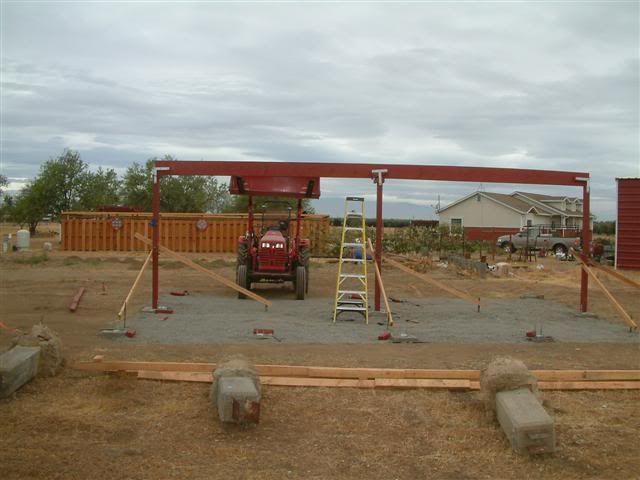
I built my 20'x28' pole frame tractor shed last year in a pretty conventional style using 4x6 pressure treated posts with Simpson post bases embedded in concrete footings.

DSCF0196Small.jpg


My Mahindra 5525 and its FEL with clamp-on bucket forks came in handy for installing the 4x12 x 14'L beams on the tops of the posts.

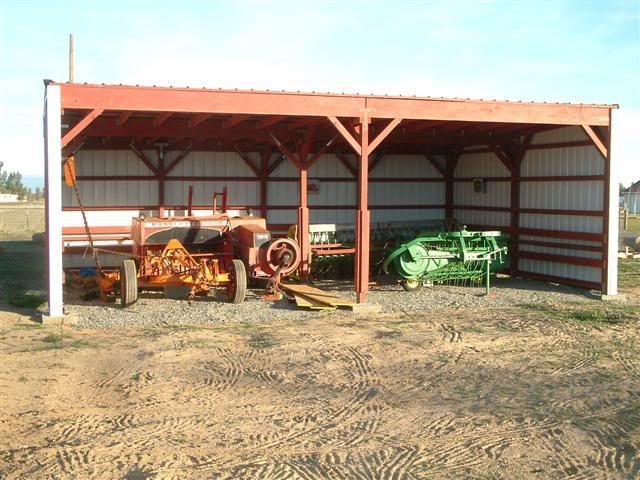
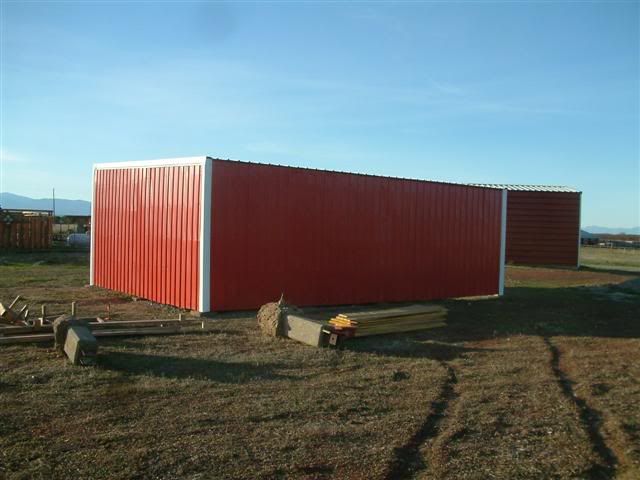
The final result:

DSCF0014Small.jpg


DSCF0094Small.jpg
 
/ Pole Garage Question... a 'lil backward const. #9  
What is your soil tipe .What is the bilding being yoused for.Where are the doors. Will it be heted if large itoms what size of a footprint. How deep dos the frost go.Bilder and Farmer ovet 40 yrs.
 
/ Pole Garage Question... a 'lil backward const. #10  
Here in SC if we build a pole barn using "cut" lumber for corner posts, poles that have been cut with a sawmill, such as 4x4 or 6x6, we have to pay taxes on it. If we build it out of round poles for corner posts, it is considered a farm structure and we do not have to pay taxes on it or get a building permit. Something to think about. It may be different in your area but worth checking in to.

I built mine out of old power poles with steel bar joists as rafters. But we all seem to build out of whats available to us at a good price.
 
/ Pole Garage Question... a 'lil backward const.
  • Thread Starter
#11  
Couple of more details. The site (40x40'?) I'm building on is solid! It's about 2' higher than the surrounding ground. It's been in the family for generations, since the 1860's. I'm told that it had a barn on it years ago. No evidence of a barn foundation, but lots of 'fist' sized to larger rocks, uncommon to the surrounding soils. God only knows what I'll encounter when I try to auger! The frost I would think would go to 3'. The rough-cut is a full 4"x4"! Typically about 42 cents a board foot. I've considered the power-pole route for the corners, Artist, but anymore, (at least in NYS) I think they're considered 'hazardous waste' due to the creosote content, and you can't get them! I'm not sure of the tax consequence that your refer to. ~S
 
/ Pole Garage Question... a 'lil backward const. #12  
I'd think stick built with 2x walls would work out better for you if this is the direction you are going. Pole building is cheap if you burry the poles; side with girts & tin, and keep the costs down.

By the time you use concrete & metal connectors to set the poles in, and side with plywood or strandboard, you are cheaper to go with stickbuilt. You use the same amount of vertical wood either way; the cheaper part is in the foundation & siding of a pole barn. You are using the expensive parts of concrete & siding anyhow, so might as well spread your poles out into real stud walls.

'Here' you can buy a premade roof truss cheaper than you can build one & the inspectors are happy, but might be different where you are.

Not saying your plan won't work, but I'd want the shelter from the weather first - why have a concrete floor & there you are tarping your machinery for a year? And then I think you will spend more for your version than just stick building it by the time you are done. The stick built is easier to hang shelving, or insulate, etc if you want to end up in that direction.
Random thoughts, your place, your money, you might have different conditions than I'm used to.

--->Paul
 
/ Pole Garage Question... a 'lil backward const. #13  
There's nothing wrong with pouring your piers/floor first, if what you're looking for is a firm, level place on which to park your vehicles and complete the rest of your construction.

I built such a building about twenty years ago. The "poles" (4x4's) sat on top of the concrete piers (8' on center, max).
It was not an easy thing to put up. The first reason was that no matter how hard one tries, you'll never get the tops of your piers to be all at the same height, which makes determining the length of each pole time consuming.
Second, and of particular relavance to your idea, is that such a building frame doesn't adapt well to the "build the wall on the deck and erect" method of construction. The "poles" themselves are the main reason for this, since they interrupt the shear plane of the walls.

You mention "cutting the tops" off of square tube in which you'll set your poles.
There are commercially available products that serve the same purpose. True, they cost you some , but they'll save you time in the long run and you can put your tube to better use.

Here's what I would do:
1) Pour your piers and floor, leaving the piers about 2" proud of the floor.
Use the commercially available sill bolts in the piers. 3/4 allthread is
expensive overkill.

2) Determine the height of your highest pier. That will be the base plane of
rest of your building.

3) Lay down a pressure treated sill (2 layers of overlapped 2x6's is the
usual), shimming atop the piers as needed to achieve a flat and level
perimeter on which to build. You can loosely fasten the nuts on the sill
bolts.

4) Your walls will be constructed as follows: The bottom chord should be
2 2x6's with 1/2 plywood sandwiched between. Overlap the joints and be
sure to leave a gap in the plywood where the wall will sit over the piers.
This gap will form a mortise. The top chord should be built the same
way, but use 2 2x8's instead.
The vertical pieces (poles) should be 2 2x4's with 1/2" plywood
sandwich. 2 2x6's would be better, but you decide. The poles, you
remember, will have the sandwiched plywood protruding out each end
a sufficient amount to form a tenon that fits the mortises you have in
the top and bottom chords. You'll also need some intermediate studs to
which you'll attach your sheathing, but those can be toe-nailed to the
chords.
Use a generous amount of construction adhesive.
You can attach the sheathing before you erect the walls, but the walls
are going to be quite heavy that way. If you decide to sheath the walls
later, you'll need to add temporary diagonal bracing.
What I've described is basically "continous header" framing and it's
very strong.

5) Be sure that you make the walls tall enough to allow for deep headers
over your doors.

6) As others have mentioned, 24' trusses are not expensive. Save yourself
a bunch of time and buy them.

Have fun:D
 
/ Pole Garage Question... a 'lil backward const. #14  
Just a note, I purchase 24' trusses at least 2-3 times a year for cabin projects and they generaly run about 75 bucks apiece as said inspectors lov um. as far as frost line here in W. Mass (runs about same temps as Buffalo)
They call for Piers to be 4' below ground on a 6-8" thk pad. You can just get a item called "big foot" from home depot fairly chaep. It pays to do it right the first time as I have fixed more then one pole barn that has lifted from frost (I've seen 1 corner lift more then 10")
 

Marketplace Items

2025 Grapple Rake Mini Excavator Attachment (A64553)
2025 Grapple Rake...
SHOPBUILT S/A TRAILER (A64278)
SHOPBUILT S/A...
2013 JCB 506-36 TELESCOPIC FORLKLIFT (A65053)
2013 JCB 506-36...
2016 CATERPILLAR TL1055D TELESCOPIC FORKLIFT (A64279)
2016 CATERPILLAR...
MINI ROCK GRAPPLE (A61572)
MINI ROCK GRAPPLE...
2004 Chevrolet Trail Blazer 4x4 SUV (A64557)
2004 Chevrolet...
 
Top